We’re live.
https://t.co/YRZNhMvQCB
The pay-to-rank board for X.
No followers.
No engagement bait.
No algorithm deciding who gets seen.
You outbid everyone else. You take the #1 spotlight.
Rank #1 is sitting at $5 right now.
That’s not a metaphor.
Search optimization or another integration? For a drawing-archive SaaS, watch paying studios retrieve a drawing before allocating the sprint. Then cap the work and test whether faster search helps them find the correct file.
1. Make the allocation decision explicit
This evergreen playbook is for a small team serving architecture studios that have imported drawings and already retrieve them for live projects.
The proposed problem is unverified: search delays may interrupt that established workflow, while integration requests compete for the same engineering time.
YC's essential startup advice recommends choosing key success metrics and allocating work around their impact. Paul Graham recommends engaging directly with early users for feedback.
My recommendation: use those principles to make one bounded engineering allocation. Observe retrieval work, choose one slow search path and decide what evidence would earn further investment.
Neither source establishes this drawing-search problem or validates the experiment below. The audience scenario, protocol, time budget, sample size and thresholds are hypothetical illustrations, not reported results or proven benchmarks.
2. Verify the delay before opening the profiler
Ask existing studio users to demonstrate an actual drawing-retrieval attempt. Establish which drawing they need and how you will verify that they found the correct one.
Record the sequence: entering the query, receiving results, inspecting candidates and opening the drawing. Keep search-response latency separate from total task time.
If the delay is elsewhere—such as choosing between similarly named drawings—preserve that finding. It would challenge the proposed latency work. Don't optimize a slow response merely because it is easy to measure.
Proceed only if observation supports the slow search path as a meaningful obstacle. Write the allocation in plain language: “Investigate this retrieval delay; defer this integration task.” Name the integration request and the customer commitment, if any, that constrains deferral.
3. A bounded engineering comparison
For this hypothetical protocol, allocate twelve founder hours over one week to profiling and optimizing one slow search path. Include preparation and evidence review in the allocation. Stop at the cap regardless of apparent progress.
Preserve search results, permissions and interface behavior. The proposed intervention is latency reduction; changing ranking or navigation would introduce another product question.
Have six existing studio users each perform two comparable retrieval tasks: one using the existing implementation and one using the optimized implementation. Counterbalance order so some encounter the existing version first and others the optimized version first.
Use comparable tasks rather than asking everyone to find the same drawing twice. Record task differences and prior familiarity so you can inspect them during review.
For every attempt, log:
• Whether the correct drawing was retrieved.
• Elapsed task time and search-response latency separately.
• Errors, assistance and unfinished attempts.
• Missing observations.
Keep unsuccessful attempts visible beside the timing results. Also log founder hours and the integration work deferred. The allocation decision needs both the customer evidence and its opportunity cost.
4. Hypothetical example
Every detail, number and outcome in this section is a hypothetical illustration.
Imagine the deferred task is a requested document-storage integration. Observation first confirms that studio users wait for results during otherwise familiar drawing searches.
Suppose the bounded optimization produces six complete paired observations. Four users retrieve the correct drawing faster with the optimized implementation. Correct-retrieval completion is no lower overall, and checks reveal no permission or result-correctness regression.
That would meet the illustrative rule below and earn a larger confirmation sprint. It would leave the integration request waiting for a separate allocation review.
Now suppose search responses are faster, but users still spend the same time distinguishing drawing revisions. That is useful diagnostic evidence. Faster responses alone would not satisfy the proposed advancement rule.
If an attempt is missing, keep the comparison inconclusive rather than quietly shrinking the required sample.
5. What this earns—and what it costs
This small paired comparison can inform the next allocation. Task difficulty, familiarity and order effects can still influence its results. Counterbalancing does not remove every difference.
Faster correct retrieval does not establish improved renewal or retention. Treat it as evidence about the immediate customer workflow, with retention remaining a later question.
The deferred integration has an opportunity cost too. Keep its request, expected use and outstanding commitments visible. This exercise does not establish that performance work is always more valuable than integrations.
The twelve-hour boundary matters even if the optimization remains unfinished. At the cap, review what you learned and what remains unknown before committing more time.
6. Write the next-investment rule first
For this hypothetical experiment, allocate a larger confirmation sprint only if all six paired observations are complete, at least four users retrieve the correct drawing faster with the optimized implementation, correct-retrieval completion is no lower, and no permission or result-correctness regression occurs.
With complete evidence that fails the rule, revise or stop the optimization. Missing observations make the comparison inconclusive. Respect the twelve-hour cap in either case.
Next action: write the retrieval task, deferred integration, time cap and decision rule before starting engineering work.
Make the next sprint earn its hours.
#StartupGrowth #B2BSaaS #ProductPerformance
LIFEEEE IS GOODDDDD😌
just passed 200 users on ShipDesk!
and today has been pretty productive:
→ optimized commiToday and improved the onboarding experience
→ managed to reduce my database bill by 64%
→ ShipDesk keeps growing!
two SaaS projects, one solo founder, and a lot of coffee
honestly, seeing things slowly come together makes all those hours of building worth it.
what did you ship today?
let's connect and keep building in public 🤝
Day 13/100 🚀
What a day, haha :))
Spent most of today fixing a bug on my first SaaS, ShipOrSleep.
Turns out, people were signing up, adding their projects, and making them public...
But half of those projects weren't even showing up in the directory. 💀
Nobody reported it. I found it myself while checking analytics.
What started as a small bug turned into hours of debugging, broken layouts, missing avatars, and a few conversations with my AI coding buddy. 😂
But we finally fixed it!
All public launches are now showing up properly.
And here's another surprise...
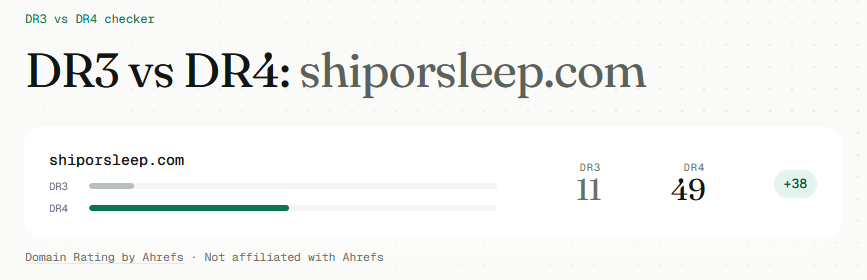
ShipOrSleep has a DR4 of 49 according to Ahrefs! 👀
That means you can:
✅ Launch up to 3 projects for FREE
✅ Get dofollow backlinks from ShipOrSleep
✅ Track your work and build in public
No payment. No backlink required.
Just another day of building a SaaS while working a full-time job, haha.
Building something? Drop your project below or launch it for free:
https://t.co/clCJgc3y71
Let's connect! 🤝
#buildinpublic
thursday night. agents still running, i am still watching them.
backend dev, toronto, 8+ yrs. one agent writes my code, another reviews it. i post the costs, the failures, and the receipts.
crossed 800 today. at 821 now, 900 is the next stop.
looking to connect with:
- ai builders
- indie hackers
- saas founders
- developers shipping in public
what are you building? drop it below, let's grow together