Why This Is A Breakthrough
Developed by engineers and alumni from IIT Madras, this mission represents a monumental shift for India's private space commercialization, supported by IN-SPACe and ISRO.
Its day-and-night, all-weather imaging capabilities directly benefit major sectors:
• Disaster Response: Instant tracking of floods and cyclones despite dense cloud covers.
• Defense & Security: Round-the-clock, weather-independent border surveillance.
• Agriculture: Highly accurate monitoring of crops and infrastructure, even during intense monsoon seasons.
GalaxEye aims to expand this technology into a constellation of 10 satellites by 2030 to establish robust, sovereign Earth observation infrastructure.
#MissionDrishti | OptoSAR | PIB
🛰️ Can satellites see through Clouds now?
India's largest private satellite solves this problem that NASA has chased for years.
Bengaluru startup GalaxEye launched "Mission Drishti"—the world’s first-ever OptoSAR satellite.👇🧵
Key Specifications & Features
• Mass: Approximately 190 kg.
• Spatial Resolution: Ranges between 1.2 to 3.6 meters.
• Revisit Frequency: Capable of returning to scan the same global location every 4 days.
• Onboard Edge AI: Powered by an NVIDIA Jetson Orin module, the satellite processes raw sensor data directly in space to send refined, actionable intelligence straight back to Earth.
#100RamsarSites | Milestone 🏆
📍Jai Prakash Narayan Bird Sanctuary (Surha Tal), Ballia, UP is the latest addition.
India now has a 100 Ramsar Sites, reaffirming its commitment to wetland conservation.
#WorldEnvironmentDay | UPSC
UPSC | #CurrentAffairs
🇮🇳 India set a global healthcare record by partnering with 🇬🇾 Guyana, performing the world's longest robotic cardiac telesurgery across a 20,000 km fibre network.
Using the SSI Mantra robotic system, surgeons in Indore successfully operated on a patient in South America.
This breakthrough can transform healthcare delivery in remote regions, disaster zones, and even future space missions.
📢 Are you preparing for UPSC CSE 2027/28?
Then this Webinar is designed for YOU!
We understand that starting from zero can feel overwhelming. The syllabus is vast, information is scattered, and it's hard to know where to begin.
Join Abhijeet Yadav Sir on this webinar for structured guidance from Day 1.
He will show you how to start strong and stay focused.
Learn how to:
• Understand the syllabus,
• Choose the right resources,
• Build strong fundamentals, and
• Plan your preparation while managing college or work.
This session will remove confusion, reduce anxiety, and help you build a solid foundation with clarity and confidence.
Scan the QR code or click on the link in comment to register now. 👇🏻🔗
Initiatives Abroad
🇧🇷 Brazil (Global Leader):
▪️Over 80-85% of new light vehicles are flex-fuel.
▪️Started with Pró-Álcool program in the 1970s (sugarcane ethanol).
▪️Widespread E100 pumps, consumer choice based on price, and strong government support made it mainstream.
▪️Flex hybrids also emerging.
🇺🇸 USA:
▪️FFVs widely available (millions on road), especially in Midwest with corn ethanol.
▪️E85 pumps at many stations.
▪️Federal incentives, Renewable Fuel Standard (RFS), and manufacturer credits for producing FFVs.
▪️Popular in trucks/SUVs.
🇪🇺 Europe and Others:
▪️Growing interest with biofuel mandates and incentives.
▪️Sweden, Germany have some adoption.
▪️EU renewable energy directives support blends.
▪️Canada and some Asian/Latin American countries have programs.
FFVs serve as a practical bridge technology alongside electrification, especially in markets with strong biofuel supply chains. In India, combined with the recent Hero launch and policy momentum, they are poised for faster adoption in two-wheelers and entry-level cars.
🧵 What are Flex Fuel Vehicles (FFVs)?
FFVs can help reduce oil imports, support agriculture, and lower certain emissions.
They are common in markets like Brazil and the US.
So, is this a solution for India?
Let's find out 👇
Initiatives in India 🇮🇳
India is aggressively pushing FFVs as part of its Ethanol Blending Programme (targeting 20%+ ethanol in petrol) to cut oil imports, boost farmer incomes, and reduce emissions. Key points:
1⃣ Policy push:
▪️National Biofuel Policy, incentives/subsidies for FFV production and ethanol distilleries.
▪️CAFE (Corporate Average Fuel Economy) norms give benefits to ethanol-compatible vehicles.
▪️Draft policies for E85.
2⃣ Recent launches:
▪️Hero MotoCorp launched India's first flex-fuel motorcycles (Splendor+ Flex Fuel and HF Deluxe Flex Fuel) in June 2026, capable of high ethanol blends — significant emission reductions (e.g., 77% less CO).
3⃣ Automaker plans:
▪️Maruti Suzuki, Tata Motors, Toyota, Hyundai, and Mahindra are developing or showcasing flex-fuel cars/SUVs (e.g., Brezza, Punch, Creta prototypes).
▪️Targets for mass-market affordable FFVs by 2026-27.
4⃣ Broader goals:
▪️One million flex-fuel two/three-wheelers targeted earlier.
▪️E20 compatibility widespread; moving to higher blends.
▪️Benefits include foreign exchange savings, rural economy boost, and lower pollution.
Hey! Do you find Economy topics a bit daunting?
Well, look no further then.
The third edition of the most effective, relevant, and concise book on the Indian Economy for UPSC CSE is here!
Pre-order now: 🔗👇🏻
Answer and Explanation:
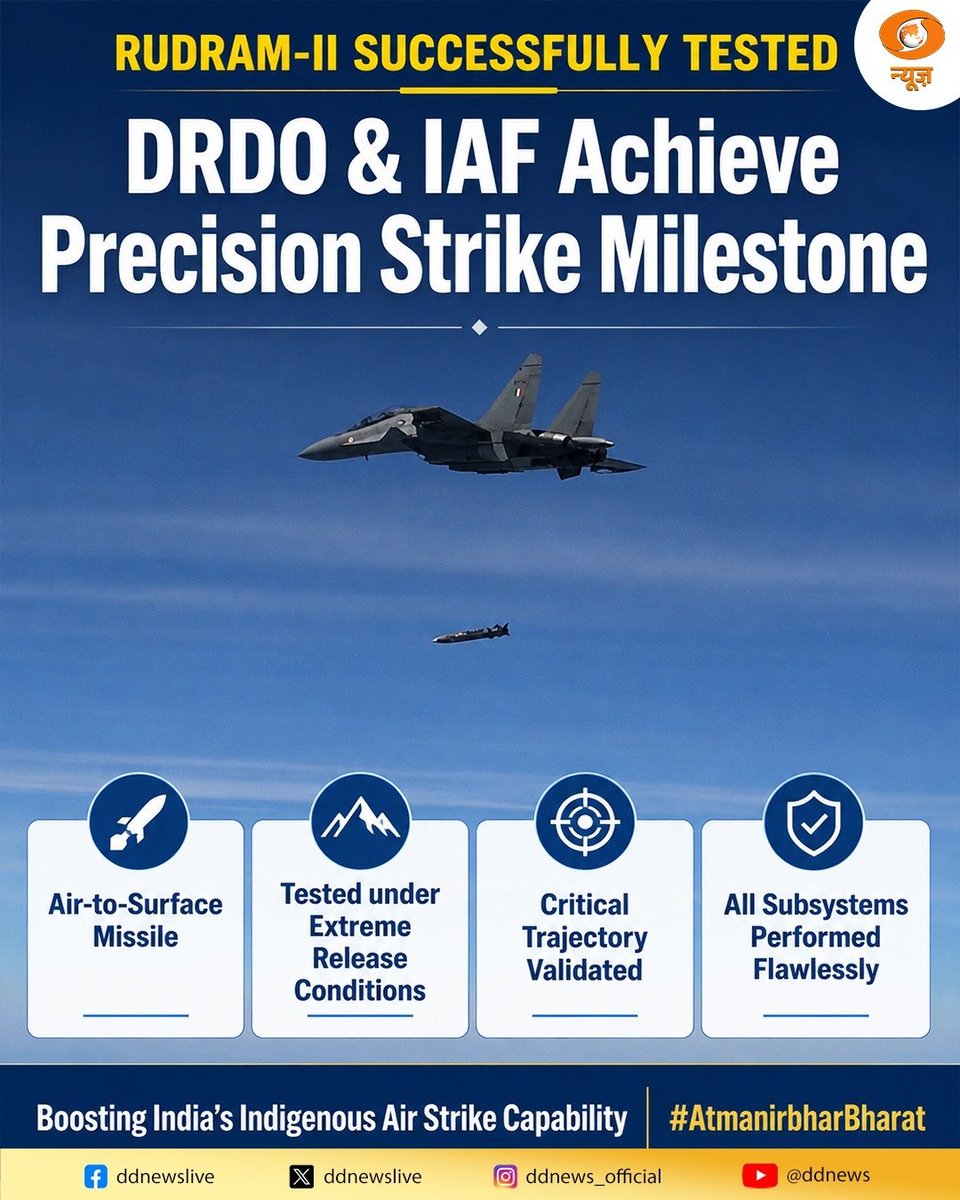
🚀 The RudraM-II is a solid-propelled, Air-to-Surface Anti-Radiation Missile (ARM) developed indigenously by the DRDO.
🔑 Correct answer is: B (2 only)
🚀 Designed to destroy ground radars by Suppression of Enemy Air Defences (SEAD) operations.
NOTE: It has Smart Tracking: Meaning, even if enemies shut down their radars, its hybrid guidance (Passive Homing + IIR Seeker + GPS/NAVIC) ensures it still hits the target!
🚀 It can:
• Reach speeds of Mach 5.5
• Carry a 200 kg warhead
• Engage targets at a range of ~300 km from aircraft such as the Su-30MKI
🚀 Why it Matters:
• Smart Tracking: It uses a hybrid seeker system (Passive Homing + Infrared + SatNav). This allows it to lock onto and destroy enemy ground radars, communication towers, and missile sites even if the enemy shuts them down to hide.
• Aatmanirbharta: Developed indigenously by the Research Centre Imarat (RCI), Hyderabad, ensuring self-reliance in cutting-edge electronic warfare technology.
UPSC | #TestYourBasics
Q. Consider the RudraM-II missile recently tested by DRDO & IAF:
1. It is a long-range Air-to-Air interceptor.
2. It targets enemy radars even if they are turned off.
Which is/are correct?
(a) 1 only
(b) 2 only
(c) Both 1 & 2
(d) Neither 1 nor 2
Acting on the Collegium’s recommendations made in its meetings held on May 22 and May 27, the Union government yesterday approved the elevation of the four High Court Chief Justices and senior advocate Mohana to the Supreme Court .
The oath ceremony comes weeks after President Droupadi Murmu promulgated the Supreme Court (Number of Judges) Amendment Ordinance, 2026, increasing the sanctioned strength of judges in the apex court from 34 to 38, including the Chief Justice of India.
🔑 Correct answer is: (d) 38 Judges
The newly sworn-in judges are:
👨🏻⚖️ Justice Sheel Nagu (former Chief Justice of the Punjab and Haryana High Court)
👨🏻⚖️ Justice Shree Chandrashekhar (former Chief Justice of the Bombay High Court)
👨🏻⚖️ Justice Sanjeev Sachdeva (former Chief Justice of the Madhya Pradesh High Court)
👨🏻⚖️ Justice Arun Palli (former Chief Justice of the High Court of Jammu and Kashmir and Ladakh)
👩🏻⚖️ V. Mohana (Senior Advocate)
UPSC | #TestYourBasics
📰 CJI administers oath to 5 new SC judges, approved by Govt.
Q. Following the Supreme Court (Number of Judges) Amendment Ordinance, 2026, what is the new sanctioned strength of the Supreme Court?
(a) 31 Judges
(b) 34 Judges
(c) 37 Judges
(d) 38 Judges