TELUS confirmed that it's TELUS Agriculture & Consumer Goods business is officially up for sale during it's Q3 earnings results:
"Monetization of non-core businesses is progressing, with near-term priority focused on accelerating the monetization of TELUS Health and TELUS Agriculture & Consumer Goods. Proceeds to be directed toward debt reduction."
I have written several times about the likelihood for a few years now due to the challenges within the business that have been apparent.
The release didn't share anything surrounding buyer(s), price or timelines.
Overall, none of this is a surprise to anyone who has been paying attention, but it's interesting to consider what comes next, particularly for some assets that deliver value to agribusinesses today, like Agrian, but weren't able to be integrated into the holistic supply chain and integrated vision that TELUS had.
I wrote about what the official confirmation actually means, some of the history around TELUS Ag & Consumer Goods occurrences and results, why the exit is not going to be a singular one purchaser sale, why it might be challenging to find buyers, and who might be interested in various assets.
Plus, check out the aggregation of assets TELUS has rolled up over the last ~7 years.
@UpstreamAg
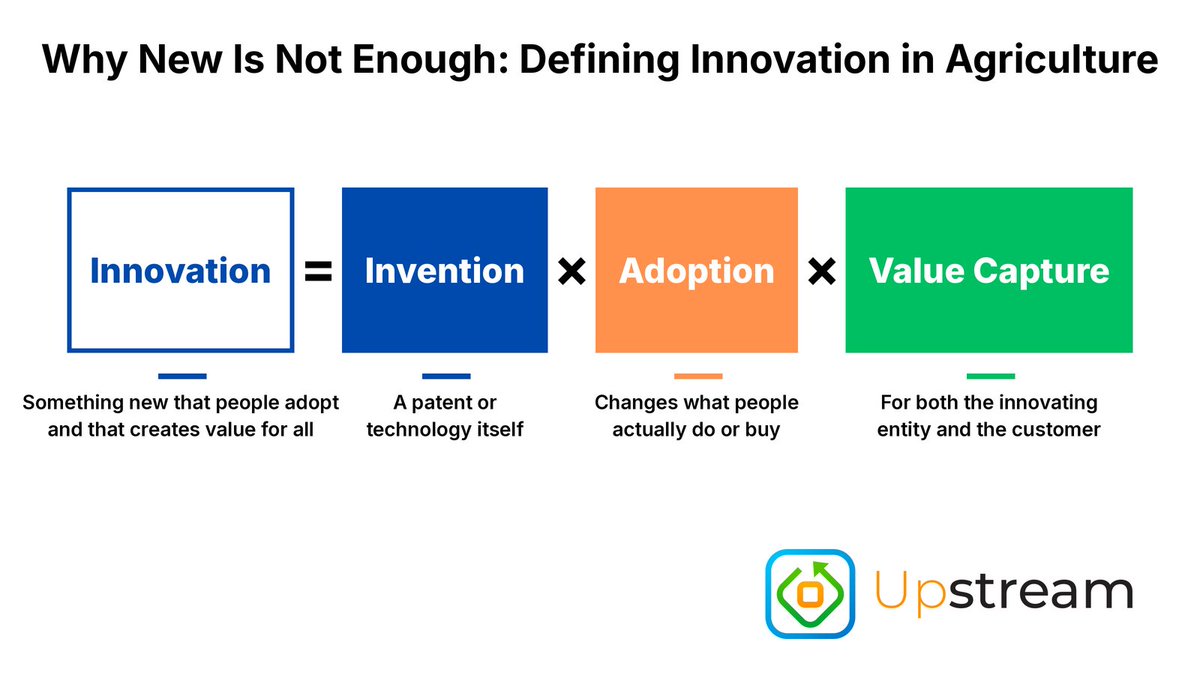
Agriculture has no shortage of technology, but technology is not the "thing" that moves an industry forward, innovation is, and the two words get used interchangeably far more often than they should (something I have been guilty of myself).
There are plenty of sensors, models and precision systems that "work," but they never change farmer or agribusiness behavior.
They are inventions, and an invention only becomes an innovation when it is put into practice, adopted and returned to, and creates value for both the customer and the company selling it.
The way I think about it is through a basic formula:
Innovation = Invention x Adoption x Value Capture
If any one of those components is zero, the whole product is zero and therefore it isn't innovative because it can't actually create an economic change. A great new sensor that is too expensive or doesn't work with other systems, and therefore nobody adopts it, is not an innovation.
This view an extrapolation of renowned economist Joseph Schumpeter's work. His point shared that "innovation" is an economic act rather than a technical one, where the new thing has to be put into practice and displace something that came before it in order to be innovative. Very often, that comes from integrating several technologies, along with novel behavioral, incentive and supply chain insights into one cohesive application that actually delivers value to the user, and delivers a mechanism for the company to capture a sustainable amount of that value.
The distinction is important because "technology" isn't useful until it can be proven to be consistent used and consistently create value for both customer and maker of the product.
"Technology" is not enough on its own, and it is why when people say to watch a specific "technology" I am skeptical - technology doesn't get adopted on it's own, it is people and companies that have novel insights, unique understanding of the problems and customers, and the ability to integrate various technologies to work in a way that creates net new value for the farmer, and the company themselves.
In the full article, I get into examples from the likes of @BASF, @MeristemAg and Vylor.
The article goes well with the more detailed article called The Theory of Innovation Adoption in Agriculture that looks explicitly at what that understanding of the customer, the market, the problem and more entails.
@UpstreamAg
…”an internal Syngenta presentation warned that not managing pricing and generics would set off "a vicious cycle of downward price pressure," and described that outcome as a "windfall for the grower" as farm gate prices declined leading to a loss for Syngenta and distributors.”
There was a ton of @Syngenta news this week.
First, the lawsuit. A U.S. federal judge denied Syngenta's motion for summary judgment in the FTC case over its Key AI loyalty rebate program, now sending it to jury.
The core issue is whether Syngenta's rebates to distributors kept the prices of azoxystrobin, mesotrione and metolachlor high after their patents expired, by requiring distributors to source over 90% of those active ingredients from Syngenta to get paid.
I read through the court document and while a lot of the detail isn't surprising, it comes across as unflattering, and I can't help but think it's a component of what had Corteva settle.
For example, an internal Syngenta presentation warned that not managing pricing and generics would set off "a vicious cycle of downward price pressure," and described that outcome as a "windfall for the grower" as farm gate prices declined leading to a loss for Syngenta and distributors.
Corteva settled its part of the case before its split, and Syngenta now heads to trial. This weekend's edition highlights some of my favorite quotes, insights and learnings from the documents.
Then there is the IPO news with Reuters reporting that it's moving closer, targeting a listing at a valuation of at least $66 billion (and upwards of ~$88 billion) by early 2027 and pitching 15 to 20x expected EBITDA - very aggressive numbers, especially when you compare them with Corteva's financials (full detail in this weekend's edition).
For Syngenta to tell a story that gets uptake at that level, I think a few things need to be true, and then still some luck:
- A credible growth story on the "new age" crop protection side (eg: RNA, EXORT) and its broader biologicals push.
- A vision for more growth in the Chinese segment of the business.
- Operational improvement to get margins above peers.
Even then, it seems unlikely. This week's results showed Syngenta's margins lagging the likes of Vylor and Corteva, which raises the question of whether it also needs to do something with ADAMA.
For more detail, check out Upstream Ag Insights this weekend, where I also dive into: https://t.co/w40Xmbztpg
@ShaneAgronomy@TheDailyScoop Full article can be found here:
https://t.co/IhQXfpdrdl
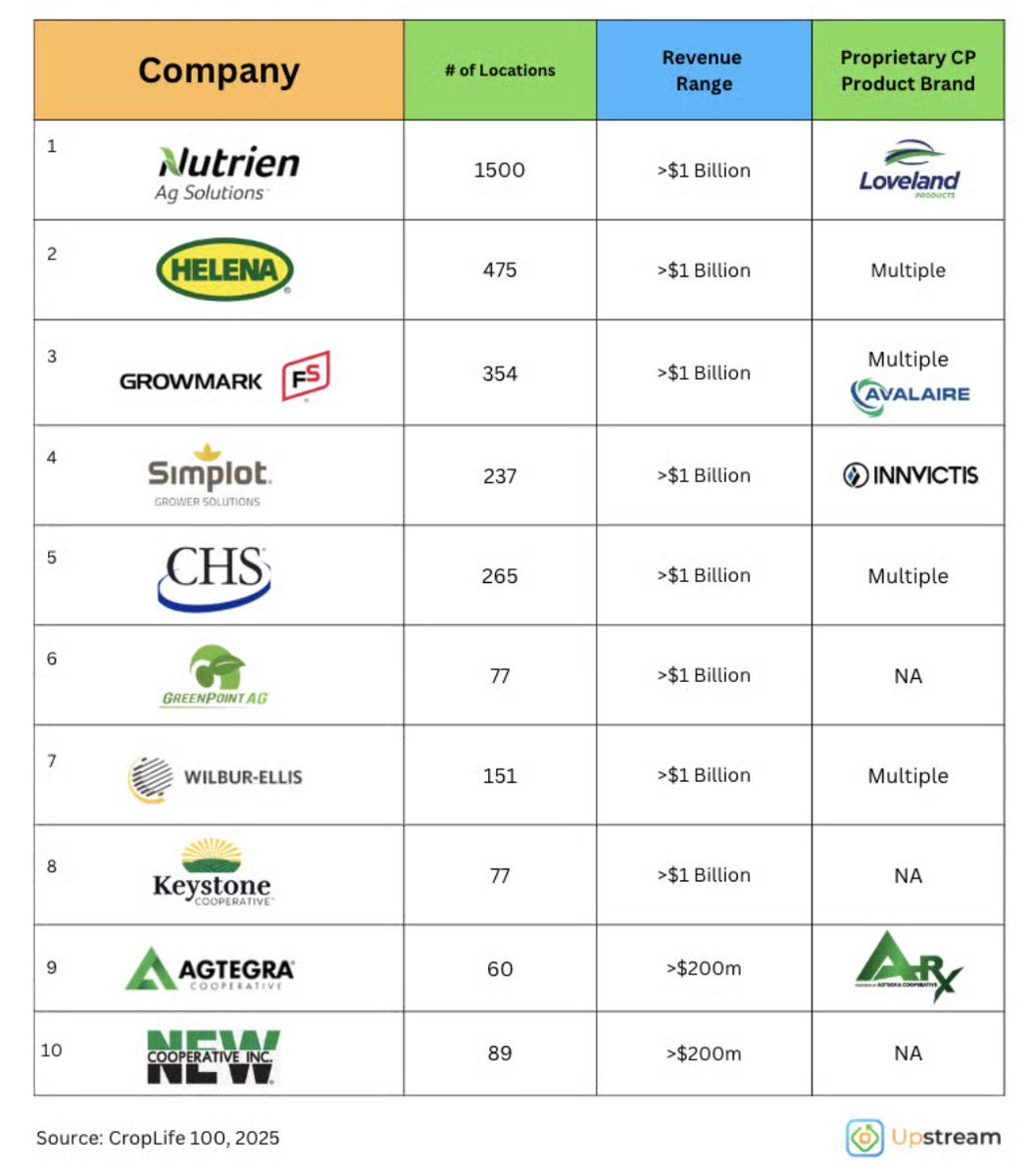
Check out the largest U.S. Ag Retailers with proprietary lines already:
Last week, @TheDailyScoop wrote about proprietary products in ag retail, a topic that's been near and dear to me for a long time and one I have emphasized in @UpstreamAg for years because it brings up many strategic avenues for ag retailers to navigate.
There is key rationale highlighted behind building a proprietary strategy, like competing with generics, offsetting margin erosion, and differentiating the portfolio, all of which are key. I'd add three more.
1. Optionality - Innovation is coming from more places than ever: startups, biologicals companies, and discovery companies in China, Japan and India looking for a route to market.
A group without its own brand has no vehicle to bring that innovation in and stays reliant on its suppliers' pipelines.
2. Control - Reliance on supplier programs can govern your growth and cash flow. And as we saw with Bayer and Simplot or WinField last month, you can be cut off from product access. Control is king.
3. Loyalty - Your own brand lets you shape the customer experience, like bringing in a product built for your region's specific needs. When growers get results from a product they can't buy from the retailer down the road, that turns differentiation into something that compounds.
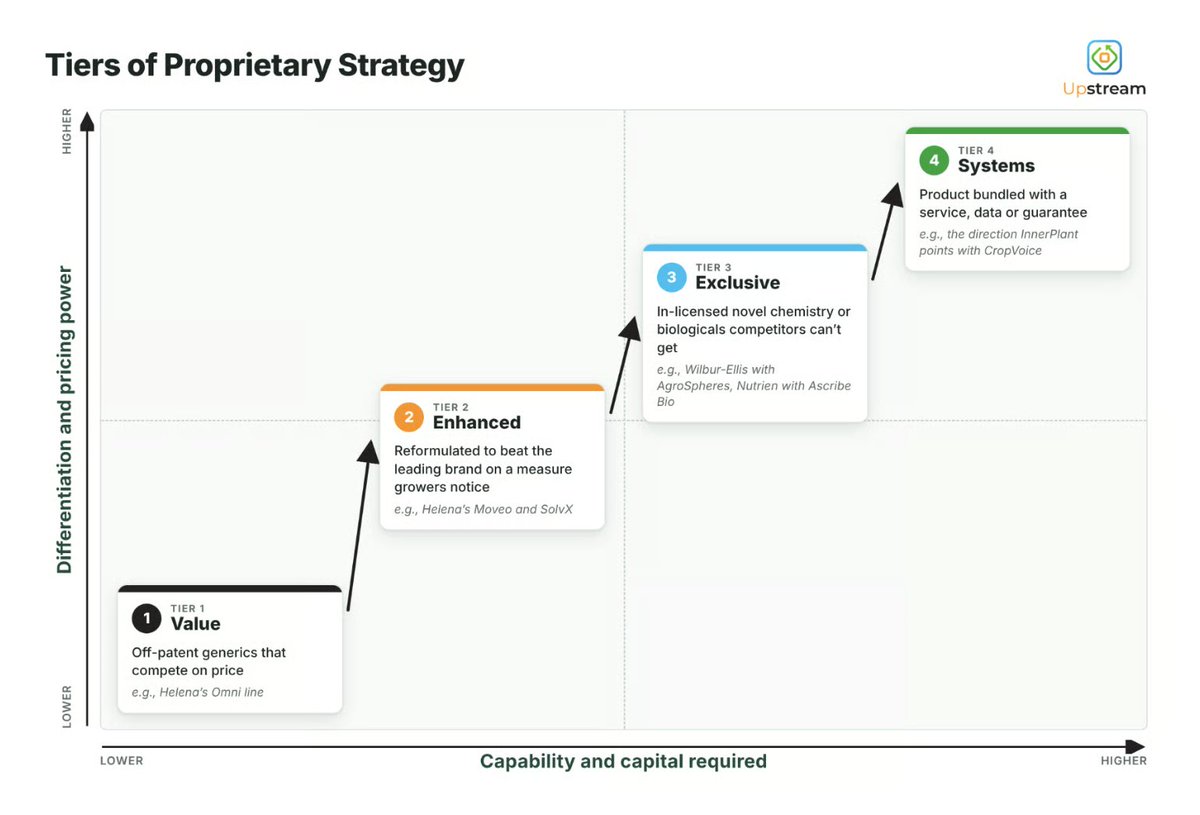
However, all of this is difficult. I view building it as a ladder.
I think about it in four tiers, each taking more capability and capital and earning more differentiation and pricing power:
1. Value - Off-patent generics that compete on price. You get a better margin percent but low absolute dollars, and the highest supplier conflict risk of any tier.
2. Enhanced - Reformulated to beat the leading brand on some specific measure or feature, like Helena Agri-Enterprises, LLC's Moveo and SolvX (eg: handleability, odor, less foaming etc)
3. Exclusive - In-licensed chemistry or biologicals competitors can't access, like Wilbur-Ellis with AgroSpheres or Nutrien Ag Solutions with Ascribe BioBio. This can be built out beyond crop protection, too.
4. Systems - A product bundled with a service, data or some guarantee. It's the hardest to execute and the hardest to shop on price.
It's a mistake to treat proprietary strategy as Tier 1 only. Value brands drive the beginning, but differentiation, control and loyalty increasingly come from the tiers above.
For the full deep dive I breakdown the above, and then get into assessing capabilities, like What to Measure, Sourcing, How Proprietary Programs Fail, Managing Supplier Conflict, KPIs and more.
I love reading through patent filings. They give interesting insight into how companies think about competitive advantage, the future of ag, and solving problems for their customers.
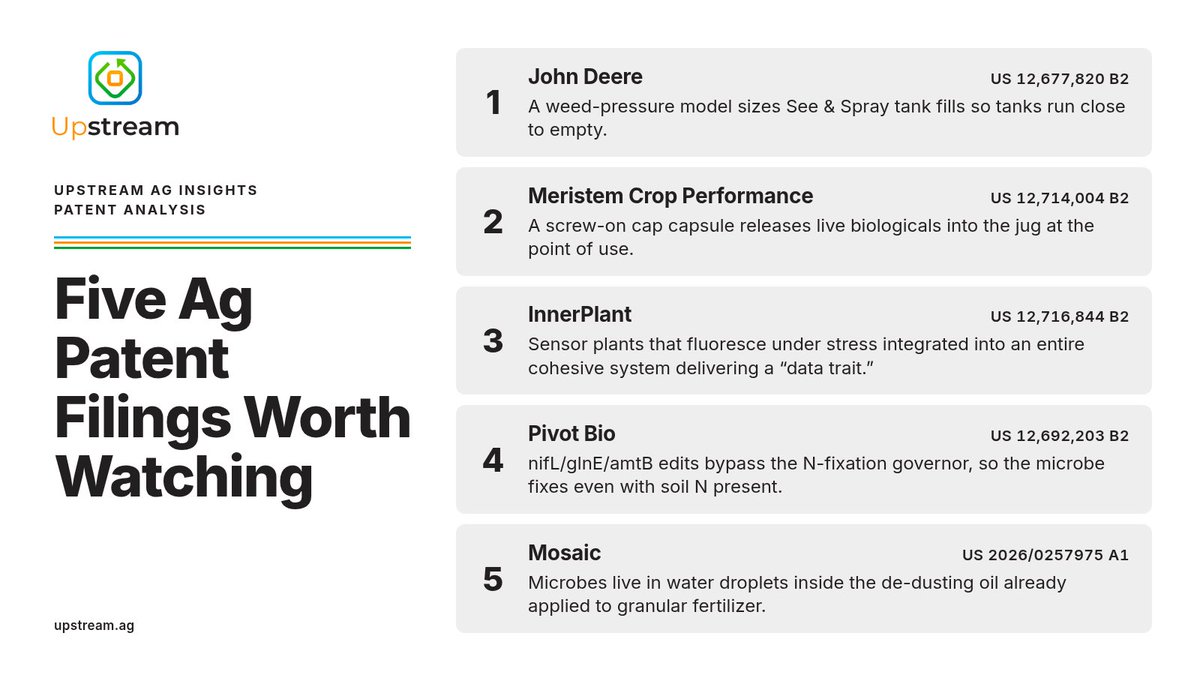
This week I published a new overview of 5 ag patent filings that stood out from the last month or so.
1. @JohnDeere: a weed-pressure model sizes See & Spray tank fills so tanks run close to empty. It solves a real problem with variable-rate spraying.
2. @MeristemAg: a screw-on cap capsule releases live biologicals into the jug at the point of use.
3. @Inner_Plant: sensor plants that fluoresce under stress integrated into an entire cohesive system delivering a "data trait.”
4. @pivotbio: microbe edits that bypass the microbe's N-fixation governor, so it fixes even with soil N present.
5. @Mosaic: input integration (eg: microbe, biostimulant) delivery via the dry granule fertilizer.
For deeper applicability and analysis, check out the full @UpstreamAg article.
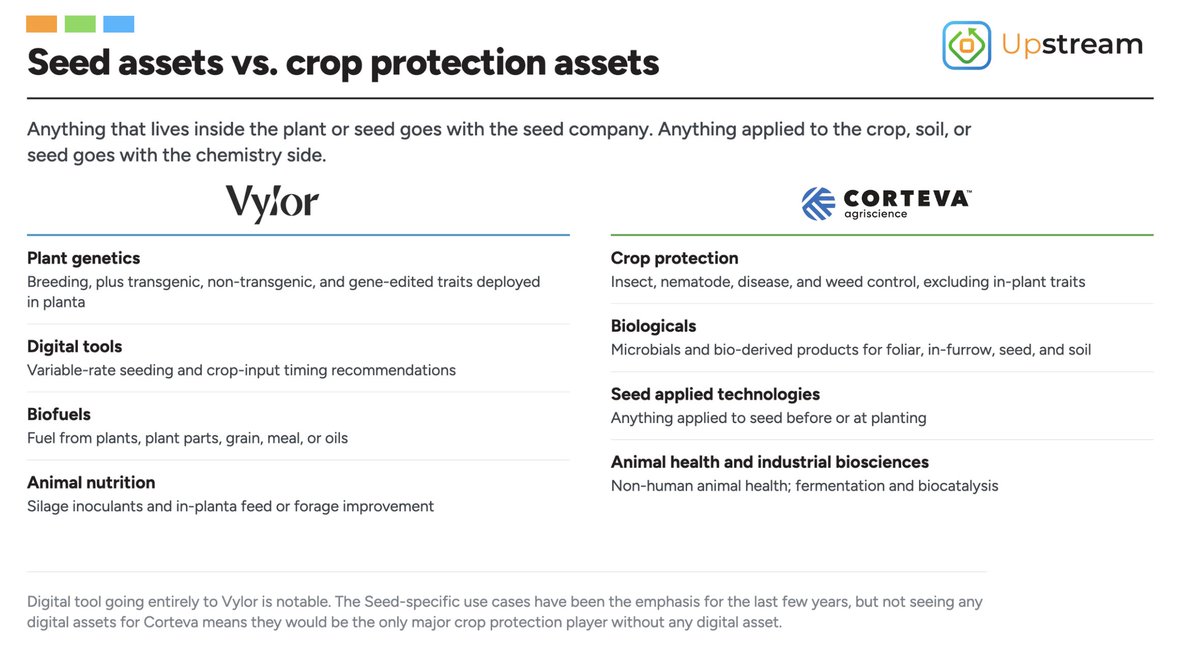
Corteva is set to split in 6 weeks time.
Many of the details of what is going where is quite obvious and previously stated: germplasm and traits to the newly established Vylor, and crop protection and biologicals going to Corteva.
There is some nuance though, such as around Enlist data, or digital solutions, and what happens to the seed treatment on Pioneer branded seed?
Last week, Vylor filed the first amendment to its Form 10. Within that filing are the two agreements (with some redactions), that illustrate what the split actually means in terms of asset and IP split, but also a look at the seed applied technology agreements and Enlist aspects get broken out.
One notable aspect surrounding digital is that Corteva will become the only big 5 crop protection player without a digital asset - @BASF has @xarviodf, @Bayer has Climate, @Syngenta has Cropwise and FMC Corporation has Arc.
For a brief overview, check out the slides below. For a deeper breakdown, subscribe to @UpstreamAg and get more details direct to your inbox this Sunday.
Does anything surprise you?
Last week I joined @MeristemAg for their Breakthrough to Excellence event.
There were many takeaways that stood out to me, but one really resonated:
"We don't ship water"
If we look at the consumer world, it has a Coca-Cola-like component to it.
Coca-Cola generates most of their profits from selling syrup concentrate than selling finished bottles of Coke.
Coca-Cola primarily sells their secret syrup to outside bottling companies that do the work of manufacturing and distributing the final bottles to vending machines, convenience stores etc. This portion of its business is known as its "concentrate operations." A huge portion of Coca-Cola’s revenue (and profit) is generated by this unique selling of its syrup.
The key here is that this allows Coca-Cola to have higher margins in their business and an ability to reach all corners of the market thanks to less demand on their balance sheet and last mile leg work.
The way to think about this applied to our agriculture setting is that Meristem is the Coca-Cola company, selling proprietary adjuvant and fertilizer ingredients to retailers who act equivalent to the bottling companies, making the product into it’s final usable form and then selling to farmers.
The outcomes become:
- Higher operating margins for Meristem and increased ability/agility to scale up growth across the USA.
- Lower cost of goods for the dealer equalling potentially higher margins
- And lower product costs to the farmer.
You get a win for farmers, a win for dealers and a win for Meristem. They have created a win-win-win scenario at all points of the value chain, and just one of the components that go into them taking costs out of the acre for farmers.
Accessing innovation doesn't always have to cost more for farmers.
Input distribution in the United States is shifting.
Last week it was announced that beginning with the 2027 season, Simplot Grower Solutions will no longer distribute or sell Bayer-branded crop protection or seed. And, starting in 2028, WinField United would not be selling Dekalb, Asgrow, and Deltapine seed brands, though it retains Bayer crop protection. Simplot's Innvictis brand retains licensing access to Bayer genetics, and WinField's Croplan and Armor brands keep Bayer traits.
A shift was bound to happen and I doubt it's the last announcement we will see.
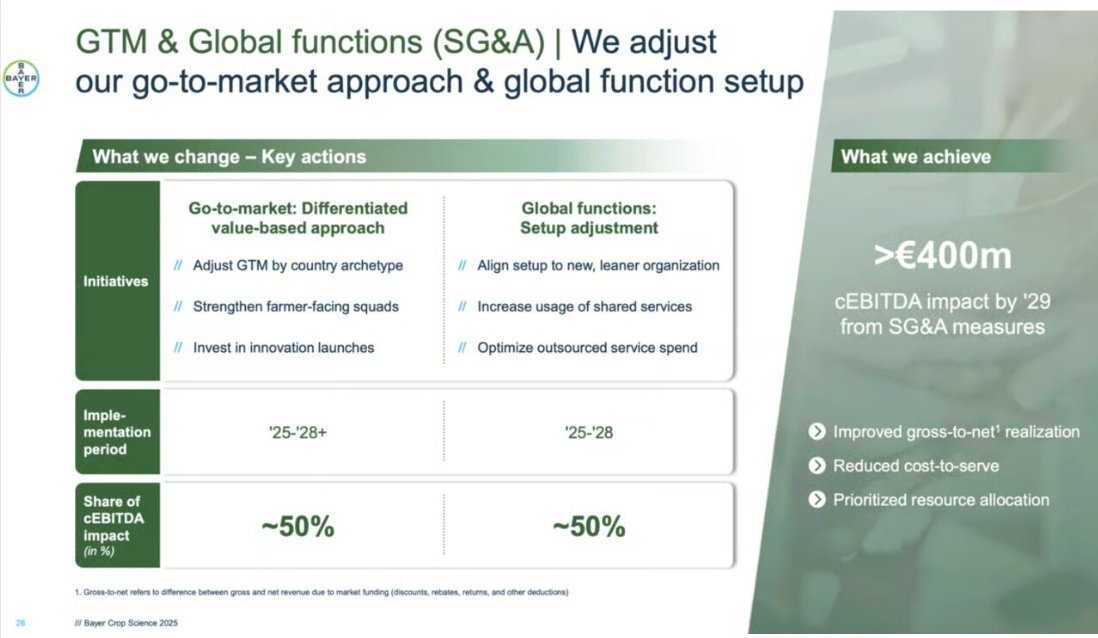
Bayer signaled a change in its May 2025 strategy update, emphasizing new GTM motions with the US called out specifically as a region where shifts would happen. Bayer has forecast a mid-twenties EBITDA margin in Crop Science by 2029, from roughly 20% today, and while new and novel products are one avenue to improve margin, the other requirement is managing costs and working capital on the other end.
I wrote a year ago that distributors and retailers should be ready for changes in product access, rebate dollars, and more high-touch demand generation from Bayer.
If I'm a retailer, distributor, or manufacturer, there are several different questions that need to be asked and strategic focus needs to be top of mind.
I broke it all down in more detail in this week's Upstream Ag Professional, alongside:
- The Law of Conservation of Attractive Profits in crop protection
- Q2 2026 results across Bayer, Nutrien, The Mosaic Company, UPL, TELUS Agriculture & Consumer Goods, and CNH
- Influence Erosion in Ag Retail
- Ambrook Raise
- Salience Bias and how it needs to be considered in the context of sensor technology
- InnerPlant Data Traits and Increasing Returns
+ much more
How do you think the future of crop input distribution will shift in the next 5 years?
A Winner's Mindset: Influencing the Market vs. Letting the Market Influence You
◼︎◼︎◼︎
In a 2014 study, researchers hooked participants up to sleep monitoring equipment and handed them fake readouts. Some were told they got above-average REM sleep. Others were told they slept poorly. However, the readouts were actually random.
The group told they slept well performed significantly better on cognitive tests.
What people believed about their situation changed their performance, even though the environment or circumstances themselves did not.
I've been thinking about that study a lot lately, because I keep having conversations about how tough the ag market is.
And yet, often I've talked with some founders and agribusiness professionals who are still growing their business and seeing success.
The difference in who's winning often comes down to the mentality they have around the current environment. Some ask "what is the market allowing me to get?" while others ask "what can I do to influence the market?"
In this week's Upstream Ag Insights article, I dig into why that difference compounds into measurably different outcomes, including examples:
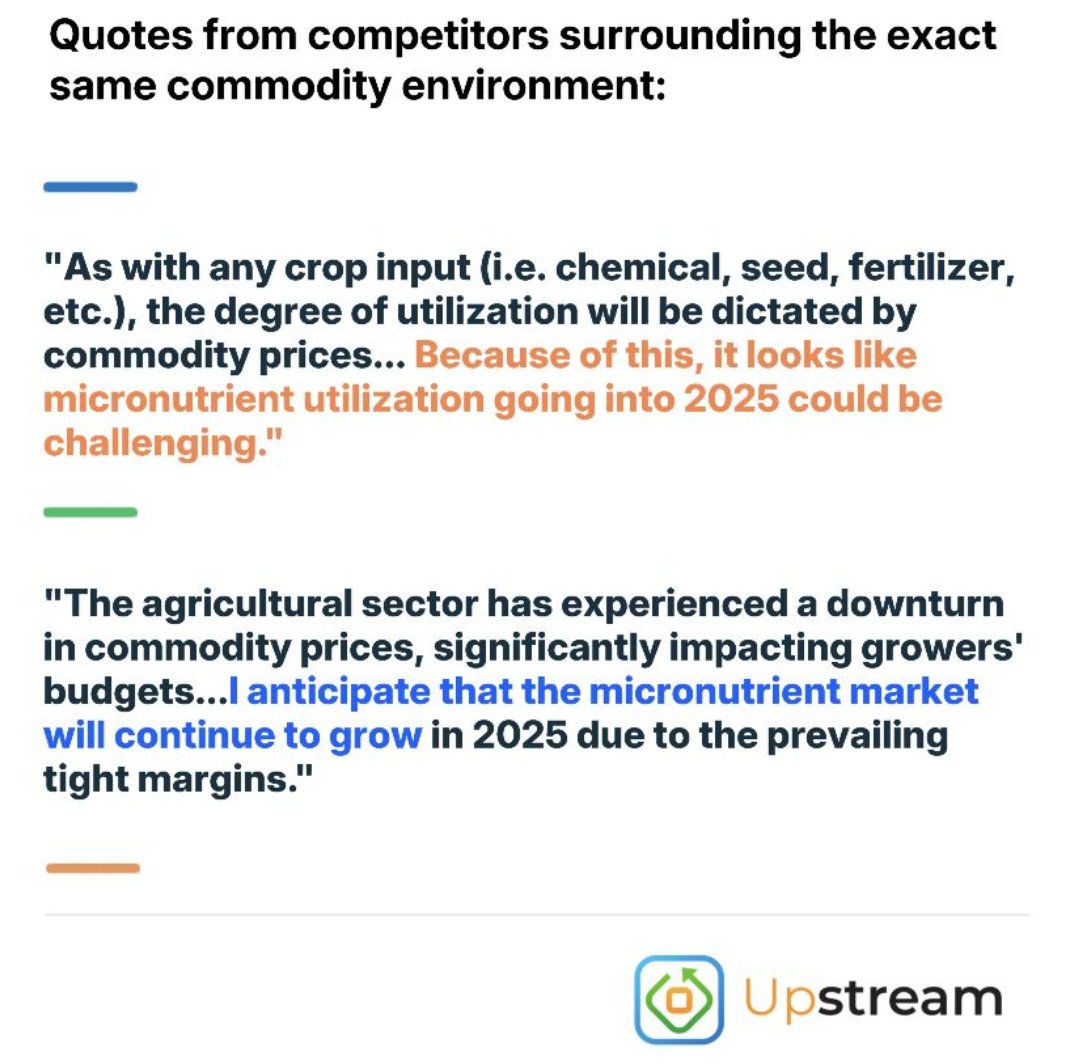
- Two micronutrient companies looking at the exact same season and commodity prices, one forecasting growth and one forecasting struggle.
- How The Mosaic Company's internal view of the market shows up in the numbers behind MicroEssentials and its biologicals business.
- A story from my first year in ag retail, where a list of "waste of time" farmers taught me how perception closes doors on real opportunities.
- The principle that explains why a sales team's belief that "growers aren't spending this year" becomes a self-fulfilling outcome.
No mindset turns low corn prices high. But within any set of fundamentals there is a wide range of outcomes, and where your organization lands in that range depends heavily on the story your team believes about the market.
@UpstreamAg
If you're almost done spraying fungicide, join us next Monday in Saskatoon for dinner, drinks, and chats about how to change the crop input industry by streamlining the supply chain and keeping profits on farms and in communities.
RSVP: https://t.co/eMWymDpuiY
#westcdnag
Today, Bayer signed an exclusive licensing deal with RAGT Groupe for wheat germplasm, with plans to launch hybrid wheat in Europe and North America simultaneously by the early 2030s.
Previously, Bayer had an R&D agreement with RAGT, and was citing a €700 million peak sales, however, today they announced a €1 Billion peak in the 2040s. Bayer has seemingly become more bullish on the potential of hybrid wheat, growing their peak revenue expectations by 40%.
Hybrid wheat has been "almost here" for decades, but now the technology has evolved and seed-production economics are being solved.
Four of the major players have various initiatives around the crop.
1. Corteva Agriscience began amping up messaging ijn 2024 surrounding North America, highlighting their nuclear male-sterility system and a color-marker seed process to fix the cost problem. They are targeting a 2027 North America launch, and have stated they are looking at licensing their tech in other parts of the world.
2. Bayer | Crop Science is partnering with RAGT's for germplasm in Europe on winter wheat and leveraging its WestBred germplasm for winter and spring wheat in the United States. Notably, the GTM for Bayer has been alluded to as a "system" of digital and agronomy tools.
3. BASF (Ideltis) is EU-first and deliberately paused in North America, emphasizing protein premiums where a smaller yield bump pays off.
4. Syngenta has its AgriPro initiative in North America (which has launched in the Northern Plains), and its X-Terra effort targeting Europe. Syngenta has emphasized a systems approach similar to Bayer for Europe.
Interestingly, Bayer and Corteva both now cite their pipeline sales in hybrid wheat as 1 Billion (dollars for Corteva, Euro for Bayer). The other interesting aspect to watch is how winning in the segment will occur: All are claiming and marketing ~10-15% yield gains, which means if they all effectively execute in that range, there is going to be a cost battle, or a systems battle.
I broke down the science, the seed-production math, and each company's strategy in more detail here and will be expanding in this weekend's edition:
https://t.co/moP2c17RZc
We believe in a new way of enabling ag commercial teams - across sales, agronomists and marketing - to prospect and understand farmer operations. Read all about it from @UpstreamAg.
https://t.co/hlHDkUyouI
AgbioInvestor's latest crop protection R&D survey for CropLife International came out last week.
The cost to bring a new active ingredient to market hit $307 million, up from $301 million over the previous time period - it is the smallest increase in the 30-year history of the survey.
Time to commercialization also decreased for the first time, from over 12 years to just over 11. The next report will be interesting to watch on this front given AI capabilities only came out towards the end of the reporting period.
The composition of spend is interesting to look at: Synthesis and formulation jumped 17.4% to $75 million (of the $307 million) and are now the single largest line item. Large-scale field trials are up 22.9% while broad biological screening is down 9.9%. The industry is moving away from brute-force discovery toward hypothesis-driven chemistry and working to overcome Eroom's Law.
Proprietary product share of the total CP market has fallen to roughly 10%. When looking at that data ijn conjunction with the data on proprietary off-patent dynamics, including how prices erode about 50% in the first decade post-patent on top of the 11.4 years from synthesis to first sale and a commercializer has 5-6 years of real pricing power to earn back $307 million plus a return on capital.
The math explains a lot of what we are seeing today in terms of start-up partnerships, spin-outs and even how companies are emphasizing only very large scale molecules markets.
Lastly, biological R&D allocation now sits at 10% of the total, though the line between biological and synthetic is getting fuzzy depending on how companies label naturally derived molecules.
Full breakdown available at @UpstreamAg