This Veterans Day, join us in honoring the patriotic men and women who answered the call to serve in defense of the greatest nation the world has ever known.
Met with German Foreign Minister @AussenMinDE to discuss securing freedom of navigation, strengthening defense cooperation, and deepening our trade relationship.
Our partnership with Germany is important to transatlantic peace and security.
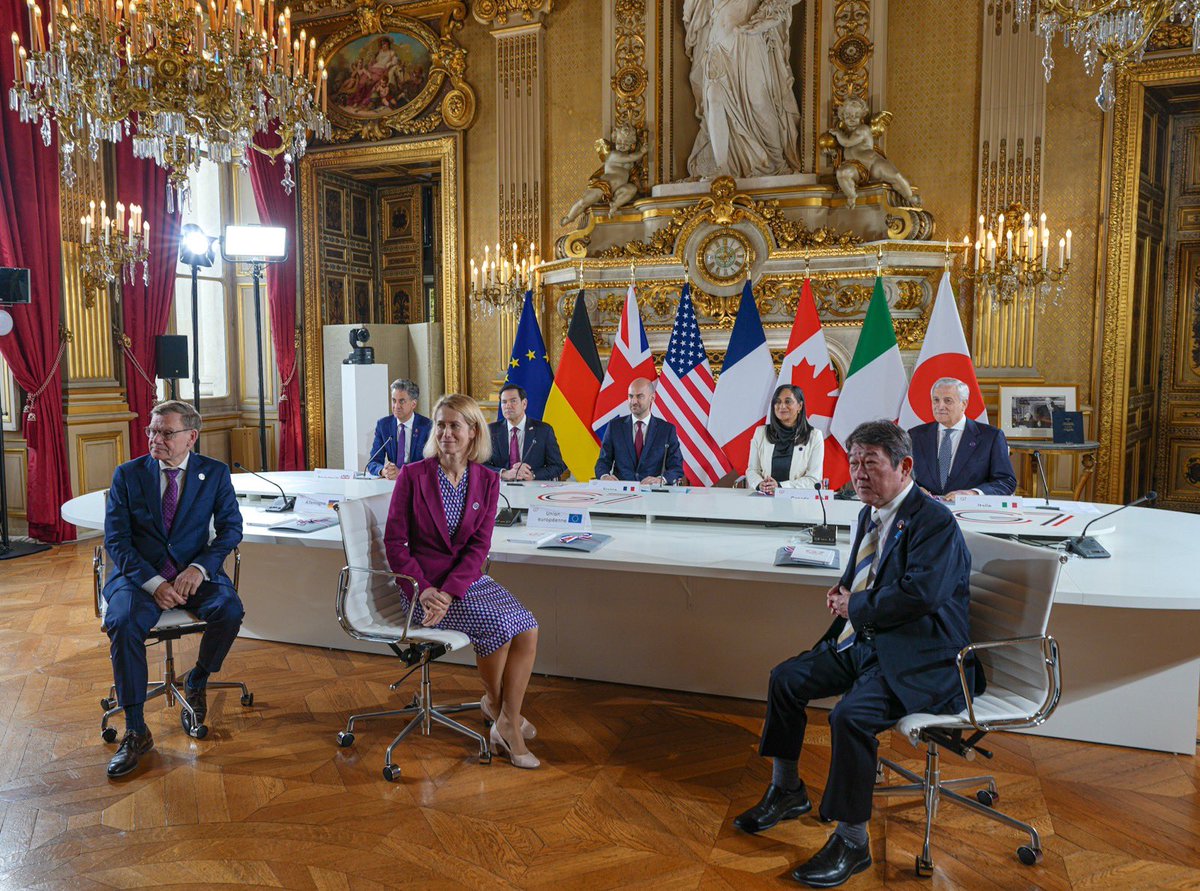
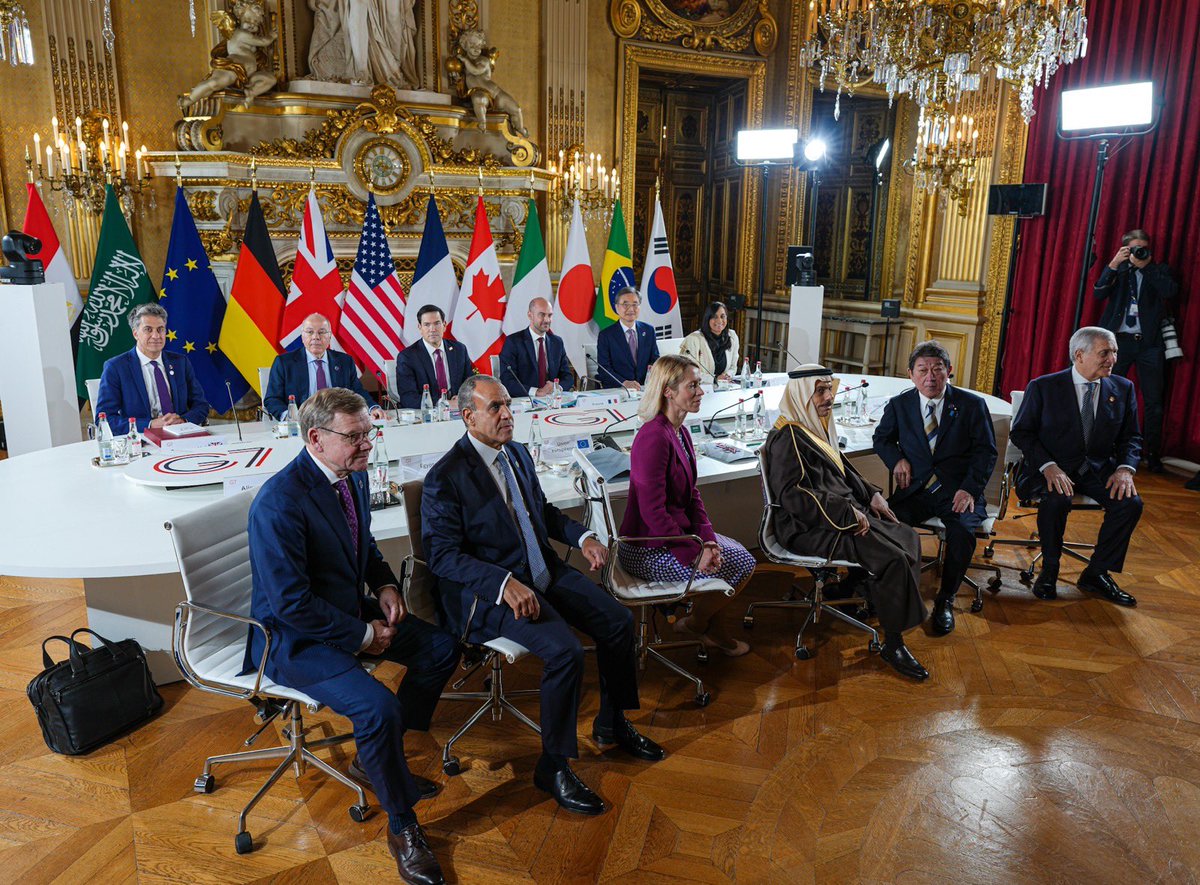
At the G7, I met with French Foreign Minister @jnbarrot to discuss U.S. concerns about the International Criminal Court, the situation in the Middle East, and the challenges faced by U.S. businesses in Europe.
We remain focused on addressing threats to regional stability and working with our partners to confront ongoing security and humanitarian challenges around the world.
In discussions at the G7, I emphasized the need for UN agencies to eliminate wasteful bureaucracy and make humanitarian aid more efficient. Our assistance must remain temporary, targeted, and accountable.
Innovation is driving the Super Intelligence era.
Today at G7, I emphasized how President Trump’s innovation-first approach is keeping American developers at the forefront of this technology, strengthening our prosperity and national security.
G7 countries have a shared interest in protecting frontier models against extraction and misuse.
We need industry-led partnerships, not more regulation and unnecessary red tape. The goal is security and opportunity for the American people and for our partners.
Productive meeting with Ukrainian Foreign Minister @Andrii_Sybiha. We discussed ongoing negotiations to end the Russia-Ukraine war, energy resilience, and defense cooperation.
The United States remains focused on achieving a durable and lasting peace.
Secretary of State Marco Rubio met with German Foreign Minister Johann Wadephul during the G7 Foreign Ministers Meeting in Paris, France. The two leaders discussed bilateral efforts to secure freedom of navigation, strengthen defense industrial cooperation, and deepen our trade relationship. Secretary Rubio also commended recent contributions from the German government to the Gang Suppression Force in Haiti.
https://t.co/xgF8KWTmwj
Secretary of State Marco Rubio met with French Foreign Minister Jean-Noël Barrot. The Secretary and Foreign Minister discussed U.S. fundamental concerns about the International Criminal Court.
https://t.co/ItPElLf1qc
Departing for France to attend the @G7 Foreign Ministers’ Meeting.
Global security demands decisive action, and the United States will press for greater burden sharing from our partners to address global crises and counter instability worldwide.
With a hard winter approaching and energy prices still painfully high – as even Energy Commissioner Jørgensen has warned—the Commission’s handling of the EU Methane Regulation (#EUMR) has failed to deliver the relief the moment requires.
In June, the Commission acknowledged the threat the EUMR posed by announcing a three-year penalty holiday intended to prevent the EUMR from tightening supply and pushing prices higher once it took effect. But it has not worked. A temporary pause on fines does not remove the legal requirement for companies to comply with the legislation – and no publicly owned and traded company will knowingly break EU law even if there is no fear of a penalty. Absent a proper delay in the regulation’s implementation – so companies are not in breach of EU law – the risk that the EUMR will drive tighter supply and higher prices remains.
So, in September, the Commission proposed a one-year implementation delay – again acknowledging the EUMR’s threat to energy supplies and pricing. But one year is too short to fix the problem. One extra year will not give companies and regulators enough time to build verification systems, bring suppliers into compliance, or lock in multi-year contracts at competitive prices. The EUMR still discourages energy imports and the longer-term deals that stabilize supply. This will keep the market tighter – and more expensive – than necessary heading into this winter and beyond.
Industry has been consistent: a three-year delay is required to put robust compliance and verification systems in place, achieve supplier compliance, and ensure reliable volumes. Industry is not asking to repeal the regulation. It is just seeking a three-year delay which is long enough to address the EUMR’s regulatory issues. Do not punish European energy suppliers and consumers because the original regulation was poorly written.
The European Parliament recognized this reality by backing a three-year postponement of key importer obligations. If the Commission is willing to waive EUMR penalties for three years, why not also delay implementation for three years and actually solve the problem as Parliament proposes? The solution is simple – the penalty delay and implementation delay should be the same length – three years. We hope the Council will follow Parliament’s example.
Europe needs practical regulatory timelines that protect both energy supply and affordability. Half-measures that leave Europe’s households and industries exposed are not a solution.
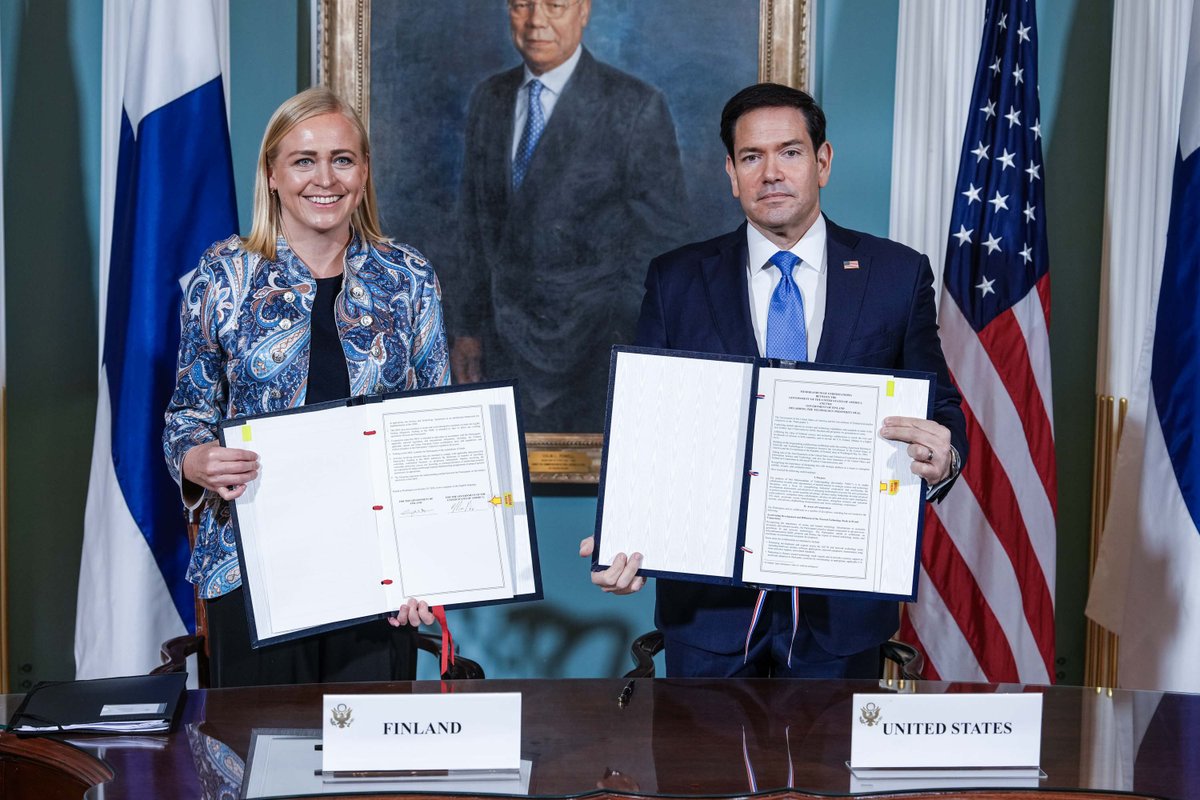
.@SecRubio and Finnish Foreign Minister @elinavaltonen at a Memorandum of Understanding Signing Ceremony on a Critical Minerals Framework and a Technology Prosperity Deal.
https://t.co/z4WojXOGVJ
.@SecRubio and Hungarian Foreign Minister @_OrbanAnita at a Memorandums of Understanding Signing Ceremony on Energy Infrastructure and Regional Energy Security and on Law Enforcement Cooperation and Information Exchange.
https://t.co/6K4IPSsTxj
Finnish Foreign Minister Valtonen and I signed a Technology Prosperity Deal and a Critical Minerals Framework Agreement that will strengthen our economic and strategic cooperation. I welcome Finland’s partnership on critical minerals and commitment to sustained defense investment.
Met with Hungarian Foreign Minister @_OrbanAnita to advance our energy and law enforcement priorities. We signed two documents reinforcing Hungary’s commitment to energy diversification and strengthening our joint efforts to combat far-left terrorism.
Deepening coordination and information-sharing are important for disrupting drug flows to the United States and Europe and taking down the narco-terrorists and criminal organizations that threaten U.S. and European national security and communities on both sides of the Atlantic. U.S. Deputy Assistant Secretary of State for International Narcotics and Law Enforcement Affairs David Bedard met with his EU counterparts for in-depth discussions on tackling shared drug threats during the Oct 27-28 U.S.-EU Political Dialogue on Drugs.🇺🇸🇪🇺
🇪🇺🇺🇸 It was my utmost pleasure to speak on behalf of the @EU_Commission, its DG EAC (Directorate-General for Education, Youth, Sport and Culture) and my own @EU_FPI marking the 80th Anniversary of the @FulbrightPrgrm & the #EU’s decades-long support of the #Fulbright #Schuman Program with @US2EU Ambassador @USAmbEU Andrew Puzder and @fulbrightBELUEU’s Erica #Lutes.
We are particularly proud that, for 2026–2028, the European Union has doubled its financial contribution to €2.8 million over three years supporting about 30 European grantees - students, scholars and professionals - annually to study or conduct research in the United States on EU affairs and #EU–#US relations. Fulbright Schuman is a joint transatlantic undertaking, supporting #European grantees in the US and American grantees in EU Member States, with fellowships generally lasting between three and twelve months offering much more than financial support: preparation, integration, academic and professional exchange, and a lasting alumni network are all part of the experience.
For the European Commission, this is not simply educational funding. It is an investment in the human foundations of the transatlantic partnership helping develop the next generation of transatlanticists. Today’s Fulbrighters will become tomorrow’s researchers, teachers, entrepreneurs, public servants and diplomats — carrying their experiences into institutions and communities on both sides of the Atlantic. In both national diplomacy and European public service, I have seen how much effective international cooperation depends on trust and genuine human understanding. Institutions can fund exchanges. But only people can turn those exchanges into lasting relationships.🤝
Today, the Trump Administration is sanctioning the ICC.
This action should encourage our Allies within the Court to work for solutions to end this threat to U.S. sovereignty forever.
A great moment during my visit to Berlin: standing on the historic Reagan Balcony at U.S. Embassy Berlin, overlooking the Brandenburg Gate. There in 1987, President Reagan issued a challenge that echoed across a divided Europe: “Mr. Gorbachev, tear down this wall.”
The Wall fell. Europe was reunited. Nearly 40 years later, the transatlantic partnership—and our shared commitment to freedom, security, and prosperity—remains as consequential as ever.
Yesterday, @US2EU Deputy Chief of Mission Norman Thatcher Scharpf joined YPFP Brussels for a Freedom 250 fireside chat on the future of U.S.-EU relations. His core message to emerging leaders was clear: look beyond daily headlines, build a well-rounded perspective, think critically, and have the courage to take smart risks to shape our shared transatlantic future. Thank you to YPFP Brussels for an outstanding event!
From the birthplace of democracy, @SecRubio delivered a powerful reminder: America and Europe share a history and a future. A stronger, more confident Europe means a stronger transatlantic alliance.
As the Secretary said in Athens: "Together, we must strengthen an alliance capable of confronting threats of our age. And we can. Because we do not believe the transatlantic friendship should be zero sum. Quite the opposite: our vision is of an alliance whose strength is greater than the sum of its parts."
https://t.co/OM699VUqo2