« La Divine Comédie » est l’œuvre de Dante. Voyage cosmique où l’âme descend dans les abysses de sa propre noirceur pour mieux s’élever vers la lumière et nous y reconnaissons encore, sept siècles plus tard, notre propre visage tremblant devant le mystère. Lu par J. Roland.
This summer I decided to reread "The Magic Mountain" by Thomas Mann.
More than twenty years ago I read it and, like all young people blessed with excessive confidence and insufficient biography, came away with the impression that I had understood the book.
Today I am no longer certain of that.
Which is precisely why I am going to read it again.
Because in the meantime Thomas Mann has remained Thomas Mann, while I have read several hundred more books, worn out a few philosophies, parted ways with a number of illusions, and accumulated enough life to begin suspecting that The Magic Mountain contains entire layers that simply did not exist for me back then.
Great books resemble ancient cities.
You do not see them differently because they have changed.
You see them differently because you are no longer the same person who first walked through their gates.
It will be interesting to discover what I missed.
And even more interesting to discover what has been waiting patiently for more than twenty years to finally be read.
Fregar los platos. Ya lo decía Agatha Christie, los mejores asesinatos se le habían ocurrido así.
Yo añadiría planchar, en Murcia, en verano.
Nada estimula más a escribir una novela de asesinatos.
Frida Kahlo à son mari Diego :
"Je ne te demande pas de m’embrasser,
je ne te demande pas de t’excuser quand je pense que tu as eu tort,
je ne te demanderai même pas de me prendre dans tes bras quand j’en ai le plus besoin.
Je ne te demande pas de me dire que je suis belle, même si ce n’est pas vrai,
ni de m’écrire quoi que ce soit de tendre.
Je ne te demanderai même pas de m’appeler
pour me raconter ta journée,
ni de me dire que je te manque.
Je ne te demanderai pas de me remercier pour tout ce que je fais pour toi,
ni de t’inquiéter pour moi quand mon moral est au plus bas.
Et bien sûr, je ne te demanderai pas de soutenir mes choix,
ni même de m’écouter quand j’ai mille histoires à te raconter.
Je ne te demanderai rien.
Pas même d’être à mes côtés pour toujours.
Parce que si je dois te le demander… alors je n’en veux plus".
Frida Kahlo
"Les gens qui lisent sont moins cons que les autres, c’est une affaire entendue. Cela ne signifie pas que les lecteurs de littérature ne comptent pas d’imbéciles et qu’il n’y a pas de brillantes personnalités chez les non-lecteurs. Mais, en gros, ça s’entend, ça se voit, ça se renifle, les personnes qui lisent sont plus ouvertes, plus captivantes, mieux armées dans la vie que les personnes qui dédaignent les livres.
C’est logique, après tout. Le lecteur développe son intelligence au contact des raisonnements, au frottement des idées, au heurt des chimères ou des apories. Il devient l’intime de héros de fiction dont il a suivi les aventures avec curiosité, souvent avec passion. Il range dans sa mémoire des morceaux d’histoire de France ou d’ailleurs, des vies de personnages illustres, des récits de découvertes, d’exploits, de faits divers, d’existences obscures ou infortunées, de peuples en majesté ou en servitude, de civilisations défuntes. Bref, il collectionne des éclats de ce qui constitue la culture générale dont le livre, même s’il a aujourd’hui des concurrents, reste le principal pourvoyeur.
Beaucoup trop d’hommes politiques, de chefs d’entreprise, de hauts fonctionnaires, de manageurs, de responsables de tout poil ne lisent que des livres utiles à l’exercice de leur profession. La littérature ? Perte de temps. Les romans ? C’est bon pour les femmes. Pauvres types ! (Pas sûr qu’au même niveau de responsabilités les femmes lisent plus et mieux.) Eux qui vivent dans un monde clos de privilégiés et en connaissent les protocoles, ignorent tout de l’évolution des comportements dans les différentes strates de la population dont ils ont directement ou indirectement la charge. Romans et récits leur apprendraient bien des choses. Sur le clair-obscur des mentalités. Sur les raisons des volte-face et des fidélités. Sur les fiertés minuscules et les détresses inavouables. Sur le grand bazar du commerce des corps et des âmes. Et donc, par comparaison, par confrontation, sur eux-mêmes.
Lire des romans, c’est prendre des nouvelles des autres.
Barack Obama : « Grâce à la littérature, j’ai pu imaginer ce qui se passait dans la vie des gens. »
Milan Kundera : « La bêtise des hommes vient de ce qu’ils ont réponse à tout. La sagesse du roman, c’est d’avoir question à tout. »
Lire de la poésie, c’est soulever des chapeaux, des couvercles, des tapis, le ciel.
Lire n’est pas se retirer du monde, c’est entrer dans le monde par d’autres portes.
Lire, c’est prendre Voltaire comme professeur, Proust comme oncle de la ville et Vialatte comme tonton des champs, Duras comme cousine, Stendhal, Dumas, Camus et Semprun comme amis, La Fontaine et Vincenot comme gardes-chasse, Louise Labé comme amante, Colette comme cuisinière, Montaigne, Jean Giono et Julien Gracq comme voisins.
Lire, c’est agrandir sa famille, engager du personnel, se faire des amis, multiplier ses relations, se constituer un fabuleux carnet d’adresses.
Lire, c’est faire entrer un peu de lumière dans le dédale piégeux de nos existences.
Mais si l’on comprend mieux le monde en lisant, la lecture peut aussi le complexifier, le rendre plus énigmatique. Il y a des livres qui décoiffent, qui dérangent, dont on sort troublé et même chamboulé. Ce sont peut-être les meilleurs puisqu’ils nous atteignent au plus profond et qu’ils modifient nos façons de voir et de ressentir. Ils nous poussent à des examens de conscience.
Ils nous encouragent à prendre des résolutions, à tenter des expériences. Ce sont des perturbateurs existentiels.
Lire, c’est courir le risque de se remettre en cause.
Enfin, la lecture est l’une des dernières activités humaines – avec, entre autres, la conversation et l’amour – où il n’y a nulle nécessité de retenir des codes, d’appuyer sur des touches, de consulter des écrans.
Entre les mains les livres ne pèsent pas du même poids au trébuchet du talent.
Lire, c’est avoir de l’esprit jusqu’au bout des doigts."
Bernard Pivot
A High School required reading list from 1978.
Yes, students under 18 years old read:
-Homer's The Odyssey & The Iliad
-Miguel Cervantes' Don Quixote
-Herman Melville's Moby Dick
-Virgil's Aeneid
-Tolstoy's War and Peace
-Dostoevsky's Crime and Punishment.
How many books on this list have you read?
A British biologist looked at 200,000 years of human history and found that the entire reason humans broke out of poverty was not intelligence, not language, not even agriculture, but one mechanism so simple a 6-year-old could explain it.
His name is Matt Ridley.
He is a zoologist by training, an evolutionary biologist by career, and in 2010 he wrote a book called The Rational Optimist that quietly argued the most important fact about human progress had been hiding in plain sight for the entire history of economics.
Naval Ravikant has been telling people to read everything Ridley has ever written for the last 15 years. The reason is the argument inside this one book.
For 200,000 years, anatomically modern humans walked around with the same brain you have right now. Same skull size. Same neural architecture. Same raw capacity for language, planning, and abstract thought.
For roughly 190,000 of those years, almost nothing happened. Generation after generation lived and died inside the same Stone Age toolkit their great-great-grandparents had used. Then somewhere around 50,000 years ago, the line on the chart of human progress started to tick upward. Then it bent. Then it exploded.
The question Ridley spent years on was the only question that mattered. What changed.
It was not the brain. The brain had been the same for 190,000 years. It was not language, which had existed long before the takeoff. It was not even agriculture, which arrived only 10,000 years ago and was actually preceded by the upward bend, not the cause of it.
What changed was that humans started trading with strangers.
This sounds too small to be the answer. Ridley argues that it is the answer to almost everything. The moment one human exchanged a useful object with another human from a different group, something happened that no other species on earth had ever done.
Two ideas that had developed in isolation came into contact. The flint knapper learned what the spear maker had figured out. The fisherman from the coast learned what the hunter from the forest had figured out. The two pieces of knowledge fused into something neither side could have produced alone.
Ridley calls this ideas having sex. The phrase sounds frivolous and it is meant to. The point is that ideas, like genes, get better when they combine with other ideas from different lineages.
An idea sitting inside one head, no matter how brilliant the head, eventually hits a ceiling. The same idea exposed to ten thousand other ideas does something genes do under sexual reproduction. It mixes. It recombines. It produces offspring nobody planned.
The cleanest proof of this argument is the most uncomfortable case study in the book. Tasmania.
Around 10,000 years ago, rising sea levels cut Tasmania off from mainland Australia. A population of roughly 4,000 humans was now isolated on an island, with no possibility of contact with the rest of humanity. They had the same brains. The same language. The same starting toolkit as their cousins 150 kilometers north. The natural experiment was now running.
What happened next is something no economist or geneticist had ever predicted.
The mainland Australians kept inventing. Boomerangs. Spear-throwers. Fishing nets. Bone needles for sewing fitted clothes. Watercraft with paddles. Their technology compounded slowly across the centuries.
The Tasmanians went the other way. They did not just fail to invent the new tools their cousins were developing. They started losing the tools they already had. Fishing was abandoned within a few thousand years. Bone tools disappeared. Fitted clothing disappeared. They forgot how to make fire from scratch and started carrying lit firebrands from camp to camp instead, relighting their fires from a neighbor's whenever their own went out.
By the time European explorers arrived in the 17th century, the Tasmanians had the simplest toolkit of any human society ever recorded. Their material culture had gone backward for 8,000 years.
The archaeologist Rhys Jones called it a slow strangulation of the mind.
Joseph Henrich at Harvard later proved with formal mathematical models that there was nothing wrong with Tasmanian brains. There was something wrong with their network. A toolkit requires a critical mass of people exchanging skills to maintain itself.
The act of teaching a skill is imperfect. Every generation loses a small percentage of what the last generation knew. If your population is large enough and trading widely enough, those losses get caught and corrected by someone else who still remembers.
If your population shrinks below a certain threshold and stops mixing with outsiders, the small losses compound until entire technologies disappear.
This is the part that should haunt anyone reading this in 2026.
Intelligence is not a property of the individual brain. Intelligence is a property of the network the brain is connected to. A genius in isolation will produce less than a mediocre thinker inside a dense exchange of other mediocre thinkers.
The thing your ancestors needed in order to break out of 190,000 years of stagnation was not better brains. It was better connections between brains they already had.
The implication for any individual is direct and uncomfortable. If you are smart and isolated, you will be outproduced by people half as smart who are connected.
The most successful people in any field are almost never the smartest people in it. They are the ones positioned at the intersection of the most idea flows. They are reading more authors than their competitors. They are talking to more people from more disciplines. They are in the rooms where ideas from different lineages bump into each other.
Ridley ends the book on the line that sounds optimistic but is actually a warning its this "The future will be invented by people who connect ideas, not by people who guard them."
50 000 Poles showed up at the main square in Kraków’s Old Town last week to celebrate the promotion of their team Wisla Krakow to the first league.
They cleaned up the square before going home, leaving no garbage behind.
0 arrests, 0 violence, 0 looting
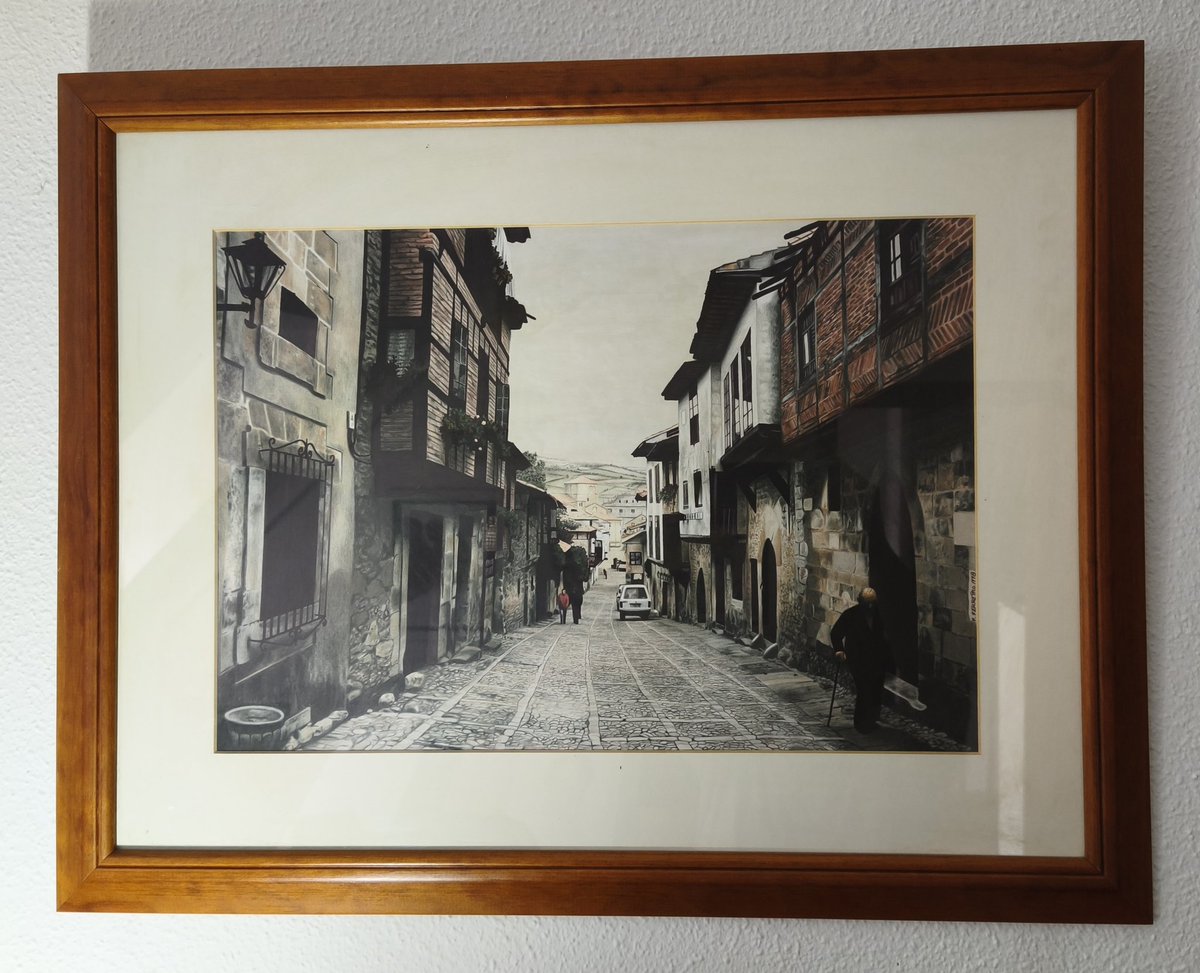
He vuelto a colocar en la pared un viejo cuadro que hice en 1998, de una serie de paisajes cántabros hechos con técnica mixta, lápices de colores sobre base de rotulador. Esto es Santillana del Mar. Estuvieron expuestos un tiempo y ahora duermen en mi estudio plácidamente.
Me hace gracia que lo que pretende mostrar como prueba de las barbaridades de la conquista es justo lo contrario, es una prueba de las garantías jurídicas que había durante la conquista y que eran totalmente adelantadas a su tiempo.
Ese documento es el fallo del juicio de residencia abierto contra Cortés. Esto era un procedimiento ordinario que se aplicaba a todo gobernador indiano al final de su mandato para rendir cuentas. Y ojo, que no acusaba el rey, eso es falso, durante el período de residencia se abría una pesquisa pública en la que cualquier vecino podía presentar querella, incluidos los propios indios a través del Protector de Indios. Caciques de Tepeaca, Texcoco, Cholula y Cuernavaca testificaron contra Cortés. También los frailes que habían acompañado las campañas. Cortés pasó por el procedimiento como cualquier otro. El Consejo de Indias dictaminó que parte de sus actuaciones habían sido "mal hechas" y ordenó liberar a los esclavos.
Básicamente @Claudiashein enseña un papel que prueba que España juzgaba en procedimiento ordinario a sus propios capitanes por los excesos cometidos contra los indígenas, con los propios indígenas como acusadores legítimos en el juicio.