The ARC ID token is now live on @Arguspad
Your onchain identity starts with a name.
CA: 0x2383249ea769f7232f670134951ddd468525340b
Website: https://t.co/BFfWQNazzE
ost people need more than one address, and every one of those addresses is currently a 42-character string nobody can tell apart.
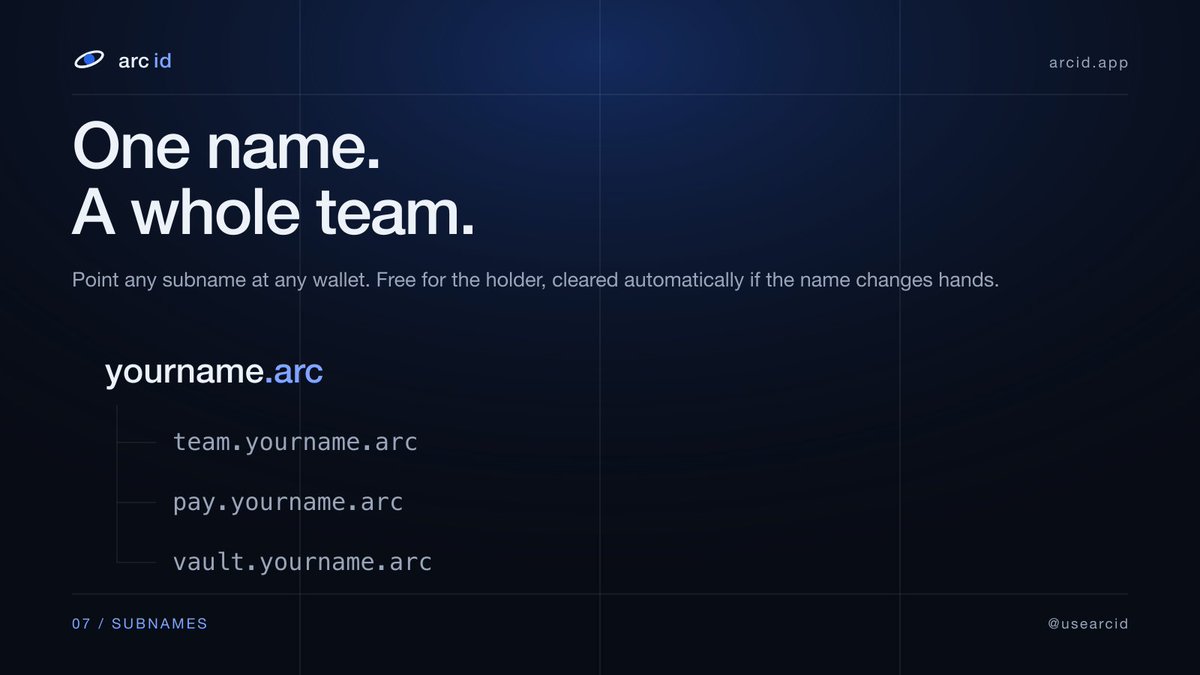
Subnames fix that without making you buy five names.
If you hold yourname.arc, you can point anything under it at any address:
team.yourname.arc → your ops multisig
pay.yourname.arc → the wallet you actually want invoices sent to
vault.yourname.arc → cold storage you touch twice a year
dev.yourname.arc → the hot wallet that signs contract deployments
They cost nothing beyond gas. You are already paying rent on the parent; carving it up is yours to do.
The rule that matters: subnames belong to the parent. If yourname.arc expires, or you sell it, every subname under it stops resolving immediately. We implement that by bumping a record version on transfer, which clears the address, every text record and every subname in one write. The buyer of your name never inherits a live pay.yourname.arc pointing at your treasury.
That is the safe default. A subname that survived a sale would be a genuine security hole — you would be handing someone an address that people already trust.
Practically this is most useful for teams and for anyone separating hot from cold. Publish pay.yourdao.arc once, rotate the wallet behind it whenever you need to, and nobody has to update a link.
Set one with setSubname, read it with resolveSubname.
https://t.co/12y4jBjB5m
Most "web3 profiles" are a database row with a wallet address column. The decentralised part is the login. Everything you actually wrote lives with the company.
ARC ID stores records in the contract, keyed by ENSIP-5 style names:
avatar
description
url
com.twitter
com.github
org.telegram
Those keys are a convention, not our invention, which is the point. An app that already knows how to read text records on another chain knows how to read these.
Reading a profile is one call. records(label, keys[]) returns the resolved address, the current holder, the expiry, and every value you asked for, in a single round trip. No N+1 loop over individual keys, no indexer required to render a profile page.
Writing is also one call. setRecords takes the address and up to twelve key/value pairs together. Keys are capped at 32 bytes, values at 320 enough for a bio or a URL, small enough that nobody turns the registry into a file host.
Two deliberate limits worth knowing.
Avatars are URLs, not uploads. We render them with no referrer and we do not proxy them. Your image is yours to host, and we are not in the business of storing other people's pictures.
Records are public and permanent in the way chains are permanent. Clearing a record changes what resolves today; it does not erase history. Do not put anything in a text record that you would not put in a transaction.
https://t.co/12y4jBj3fO
Every naming service has to answer one question: what stops someone stealing your name out of the mempool?
When you submit a transaction, it sits in public before it is mined. If that transaction says "register bluehour", anyone watching can copy it, pay more gas, and land theirs first. You lose the name and you still pay for the attempt.
The fix is older than most of crypto and it is worth understanding.
STEP ONE — COMMIT. You generate a random 32-byte secret in your browser. The app hashes your label, your address, the duration, that secret, the chain ID and the contract address into one commitment. You send the hash. Only the hash. A bot watching the mempool sees 32 bytes of noise.
STEP TWO — WAIT. Sixty seconds minimum, measured from block timestamps, not from a spinner in the UI. The app polls the chain for the actual commitment age.
STEP THREE — REVEAL. You send the real label and the secret. The contract recomputes the hash, finds your commitment, checks it is between one minute and twenty-four hours old, and mints.
Because the commitment binds your address, nobody else can reveal it. Because it binds the chain ID and contract address, it cannot be replayed elsewhere.
We store the secret in your browser, scoped to the wallet, network, registry, name and duration. Reload mid-flow and the app picks it up again rather than making you pay for a second commit.
Two transactions is not bad UX. Losing your name is.
https://t.co/12y4jBj3fO
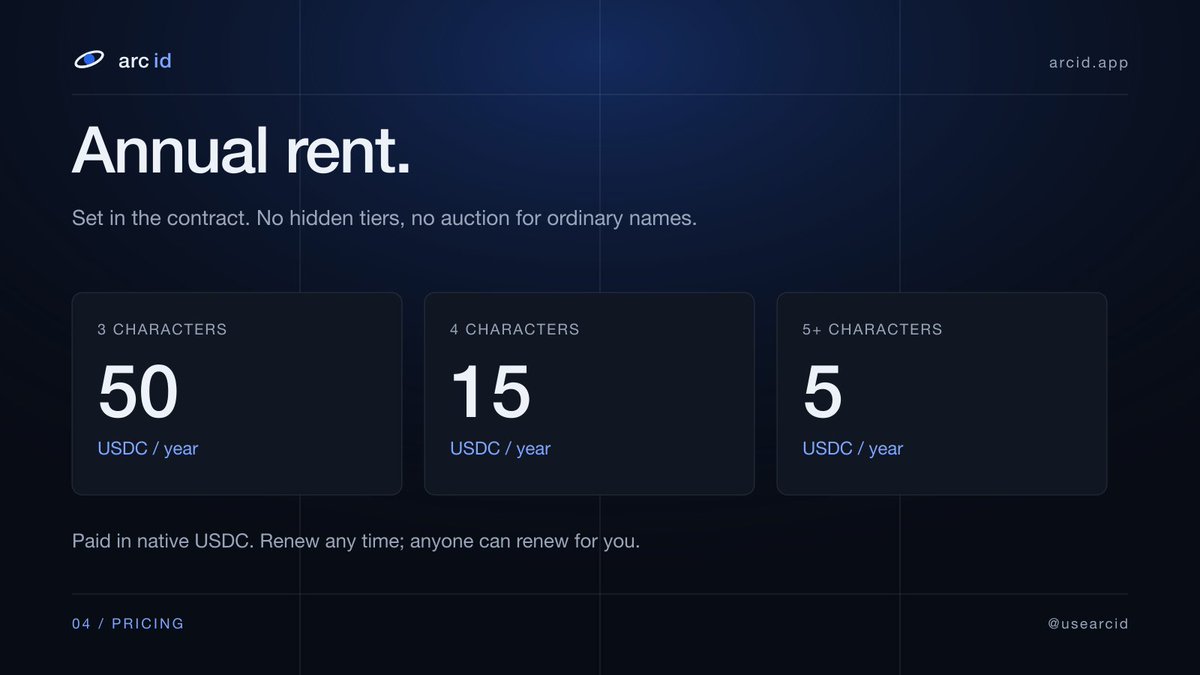
Annual rent, set as constants in the contract:
3 characters — 50 USDC per year
4 characters — 15 USDC per year
5 or more characters — 5 USDC per year
Register for one to ten years at a time. Paid in native USDC, which on Arc means gas and rent are the same asset — no approvals, no separate token dance, no bridging before you can start.
A few things worth saying plainly.
Short names cost more because short names are scarce and would otherwise be swept in bulk on day one. It is a supply mechanism, not a premium tier with extra features. A three-character name resolves exactly like a thirty-character one.
The price you see is quoted by the contract, not by our frontend. The app reads rentPrice and premium directly, shows you the breakdown, and refuses to send a transaction that would cost more than the quote you were shown.
Renewal is the same rate as registration. There is no loyalty discount and no renewal penalty, and anyone can renew any name — including on your behalf.
There is no listing fee, no marketplace cut, and no "premium name" tier that we hand-pick and hold back. Every valid label of the same length costs the same.
The one variable cost is the release premium on recently expired names, which decays to zero over 21 days. More on that in a separate post.
Testnet USDC has no monetary value. Nothing here is an investment.
https://t.co/12y4jBj3fO
Here is a pattern you have probably lived through.
You register a name. Transaction one. Then you set the address record so the name actually points somewhere. Transaction two. Then you set it as your primary name so wallets display it. Transaction three. Three signatures, three gas payments, and two of them exist purely because the app did not bother to batch.
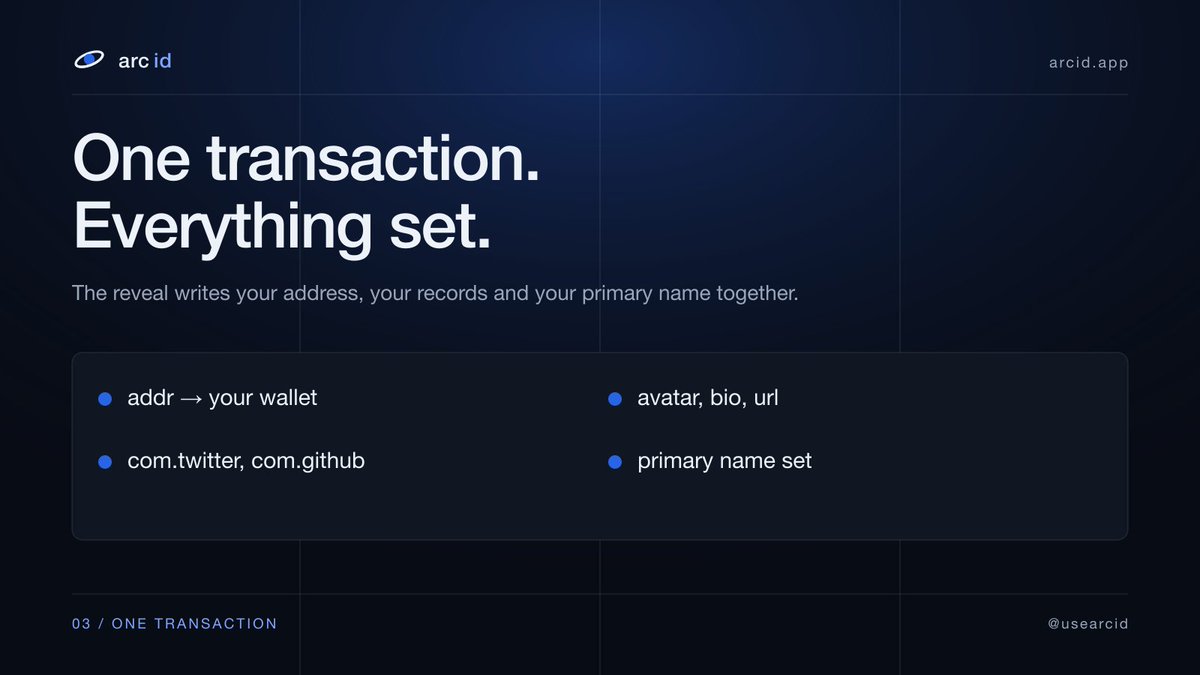
ARC ID writes all of it in the reveal.
registerWithConfig takes your label, duration and secret, plus the address you want it to resolve to, the text records you want set, and a flag for whether to claim it as your primary name. One transaction, and you walk away with a name that is already fully configured.
If you would rather do it in stages, you still can. setRecords writes the address and up to twelve text records together. setText changes one key. clearRecords wipes everything belonging to the current holder without touching ownership.
The same thinking applies to renewals. renewMany takes a list of names and one duration, so a portfolio renews in a single signature instead of eleven. And because renewal is permissionless, you can renew names you don't even own — useful if you manage wallets for other people, or if you just want to stop a friend losing theirs.
Overpay and the contract refunds the difference in the same call. You are never quietly keeping someone's surplus.
None of this is clever. It is just what happens when someone counts the signatures before shipping.
https://t.co/12y4jBj3fO
0x71C7…93a4
Be honest about what happens when that appears in your wallet. You glance at the first four characters, maybe the last four, and you press confirm. Almost nobody compares all forty-two.
Address-poisoning attacks exist precisely because of this. An attacker sends you a dust transaction from an address whose first and last characters match one you've used before. Later you copy it out of your history instead of the real one. The middle was never checked, because the middle is never checked.
A name does not magically fix that, and we are not going to pretend it does. What it changes is the failure mode.
"yourname.arc" is either correct or obviously wrong. There is no near-miss version that your eye slides over. You cannot typosquat a character you would never have read anyway.
ARC ID does two things on top of that:
It always shows you the address a name resolves to, before you sign. The name is the convenience; the address is still the truth, and you get to see it.
It tells you when the forward record is verified — when the address the name points at also claims that name back as its primary. One-way records are trivial to fake. Two-way records are the check worth making.
Readable is not the same as trustworthy. But readable means you can actually perform the check, instead of performing the ritual of pretending to.
https://t.co/12y4jBj3fO
Your wallet is a 42-character string. It doesn't have to be.
Today ARC ID opens on Arc Testnet.
An .arc name is one identity for your address, your profile, and everything you sign. Search a name, read the price the contract quotes back, register it. From that moment your wallet has something a person can read aloud on a call and verify before sending money.
What you actually get:
→ A name that resolves to your address, with a reverse record that proves it points back
→ A profile stored onchain: avatar, bio, website, X, GitHub, Telegram
→ Subnames for your team, treasury or cold wallet, free for the holder to create
→ An ERC-721 you hold, renew and transfer, with artwork the contract renders itself
What we are deliberately not doing: no invented Mainnet chain ID, no fabricated availability, no "10,000 names registered" on day one. Arc's own documentation still lists Mainnet parameters as published separately, so we run on Testnet 5042002 and the interface says exactly that.
Registration takes two transactions. A commit that hides your name behind a hash, then a reveal sixty seconds later. That is not friction for its own sake — it is what stops a bot reading your name out of the mempool and taking it first.
The contract, the tests and the accessibility sweep are all open. So is the audit status: there isn't one yet, and we say so before you put anything of value behind it.
Bring a wallet and some testnet USDC.
https://t.co/12y4jBj3fO
A quick clarification, because "web3 domain" means five different things depending on who is selling it.
An .arc name is not a username on our server. There is no row in a database with your name in it that we could edit, lose, or take away.
It is an ERC-721 token. You hold it in your wallet. The registry, the registrar and the resolver are one contract on Arc, and that contract is the only thing that decides who owns what.
Three separate ideas live inside a name, and it helps to keep them apart:
OWNERSHIP who holds the token. Transfer it and ownership moves, along with the right to change anything below.
RESOLUTION what the name points at. The address record is what a wallet reads when someone types yourname.arc. It does not have to be the holder's own address; a vault can hold the name while it resolves to a hot wallet.
RECORDS everything else you attach. Avatar, bio, links, socials, subnames.
When a name changes hands we bump an internal record version, which clears the address, every text record and every subname in one write. The new owner never inherits the previous holder's profile, and we never have to loop over storage to delete it.
Names last as long as you renew them. One to ten years at a time, ninety days of grace after expiry, and anyone can renew a name for you including a friend who notices yours is about to lapse.
https://t.co/12y4jBj3fO
Your wallet has an address. Give it a name.
Meet ARC ID, an independent naming app bringing readable .arc names and wallet profiles to Arc Testnet.
Here’s a closer look at the product, its purpose, and the opportunity for builders.
Read the full article ↓ https://t.co/h818tOh9Hv