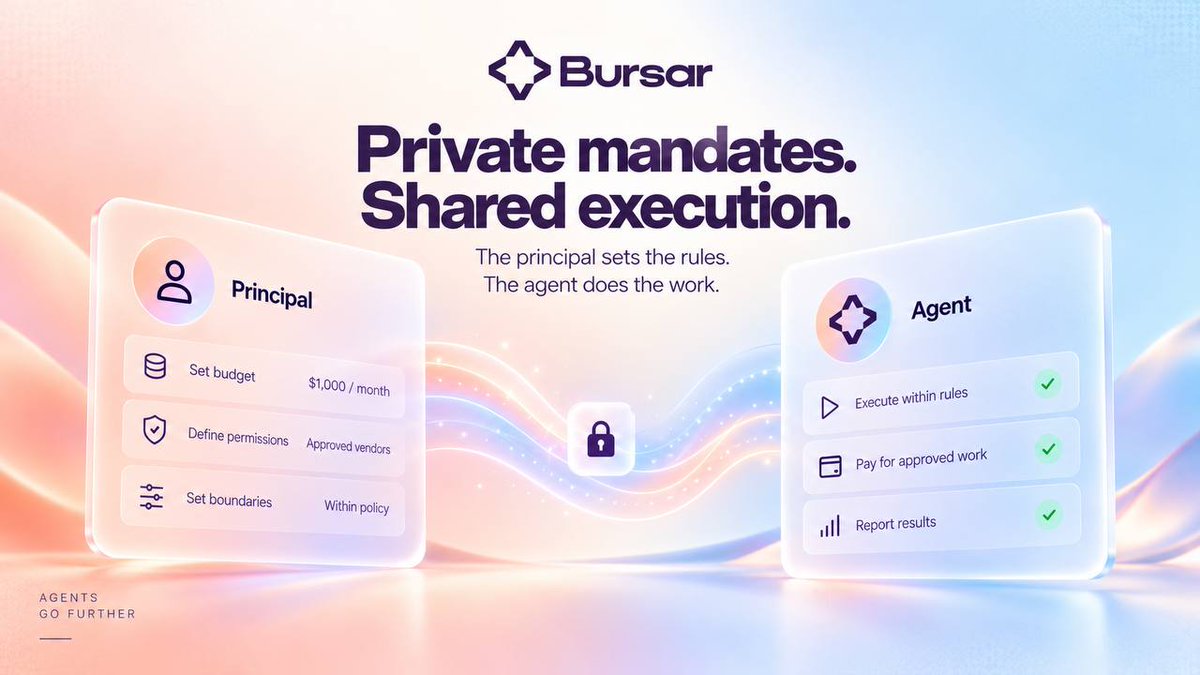
Bursar is an on-chain control layer for agent spending. @robinhoodapp
Principals set private budgets, counterparties and payment rules. Each transaction is checked against its mandate at settlement.
Stealth wallets and ZK proofs protect details while providers verify auth.
Bursar gives AI agents spending mandates not unrestricted wallets.
Budgets are enforced on-chain, funded by tokenized treasuries, and restricted by spend class, counterparty and RWA rules.
ZK proofs and stealth wallets keep mandates private while providers verify compliance.
A Bursar mandate has two different budget questions.
Total budget asks how much capital the job can use overall. Period cap asks how much it can use in one window.
Keeping both prevents a long running agent from exhausting the whole mandate in a single burst.
Built on @RobinhoodApp
Protocol revenue has a route in Bursar before the first fee is collected.
The FeeVault documented split directs value to buyback, stakers, the resolver network and providers.
Settlement economics are part of the build, not a later add on.
There are two different questions before an agent buys an RWA.
Is this asset approved? Is this counterparty approved?
Bursar keeps those permissions separate with an RWA allowlist root and a counterparty root. Passing one check cannot silently satisfy the other.
Multiple agent wallets do not need multiple policy systems.
Bursar control plane keeps linked wallets under the mandate workflow, so provisioning, spending and revocation can be managed from one signed authority without merging the wallets into one public address.
Soon on @RobinhoodApp
A chain indexer is not there to create a second source of truth.
Bursar uses it to follow commitments, receipts, agreements, disputes and epochs.
Contract state remains authoritative while the application gets a usable view of what changed.
The agent should not upload an entire private mandate just to pay for one request.
Bursar WASM prover client builds the proof from the local terms.
The chain checks whether the spend fits, while the budget and permissions stay out of the server request.
A new privacy circuit should not decide whether the first version can ship.
Bursar mandate path has a digest fallback while WithinMandateProof is integrated.
Registry and settlement work can move ahead without pretending the final privacy layer is complete.
Built on @RobinhoodApp
Bursar data model keeps private details out of the row while preserving the links the protocol needs.
A mandate points to funding. Collateral points to a vault.
Settlements keep a receipt hash. State connects without storing the strategy in plaintext.
Deposit is not the same as available credit.
Bursar collateral path runs through deposit, health, withdrawal and repayment.
Asset haircuts apply before credit exists, and withdrawal must respect the position’s current health.
Bursar has a private proof for the mandate and a public proof for the pools.
The first shows a provider that a spend is allowed. The second shows treasury, escrow and collateral remain solvent each epoch.
Privacy covers user data, not system obligations.
Bursar contract base comes from a Trust Core port, not a blank repository.
The port brings registry, reputation limits, escrow, disputes, facilitator lanes and admin timelock into the EVM build.
Bursar extends it with private mandates and RWA funding on @RobinhoodApp
The Bursar test plan is built around failures that should be boring
The fourth spend over a cap fails. A stale RWA price defers.
After hours stress liquidates only the needed slice. An observer cannot link principal to agent.
That is a protocol property, not a demo promise.
A collateral vault needs more than a token balance to describe its condition.
Bursar records the vault reference, raw assets and health in basis points.
That gives the health worker a concrete state to monitor instead of relying on a front end interpretation.
The private part of an RWA purchase does not end when the order fills.
Bursar settles the eligible asset through the router, then shields the resulting position in the agent vault.
The mandate controls the purchase without turning the completed holding into a public signal.
Soon on @RobinhoodApp
A dispute worker should not make a decision from one incomplete event.
Bursar replays the escrow and dispute history before the bonded resolver quorum acts.
The decision is based on the recorded sequence of the agreement, not whichever update arrived last.
Hard to judge a protocol before the market around it is fully here, butursar is focused on one specific layer; private spending mandates for agents, with defined rules checked before payments settle.
Deposit. Check health. Withdraw.
Bursar collateral router keeps those actions tied to the same vault state.
Eligible stock and treasury tokens enter with their asset data, health is updated against debt, and withdrawals cannot ignore the position current condition.
One principal can operate several agents without giving every wallet a public connection back to the same source.
Bursar StealthAgentFactory provisions agent wallets from a hidden principal reference, keeping the relationship private while the mandate still controls what each wallet can do.
Built on @RobinhoodApp
A mandate can sit idle for hours or days before an agent needs to spend.
Bursar park manager watches NAV and schedules the required unpark instead of leaving the full balance exposed.
Treasury funding remains productive until settlement calls for it.