Check this out! 🔥
We just added the ability to add ANY Robinhood token to your STACK.
Users can build diverse baskets of assets of both Stocks + Tokens.
This video demonstrates building a basket of:
- robinhood:0x39dbed3a2bd333467115de45665cc57f813c4571
- $NVDA
- $TSLA
- $APPLE
All under one umbrella.
Osinko Stacks.
Stacks launched with stocks. Next, bring your own token.
We’re building contract-address imports for Robinhood Chain so compatible tokens can sit alongside your stock picks in the same Stack.
First look at the new experience below.
Your thesis just got more room.
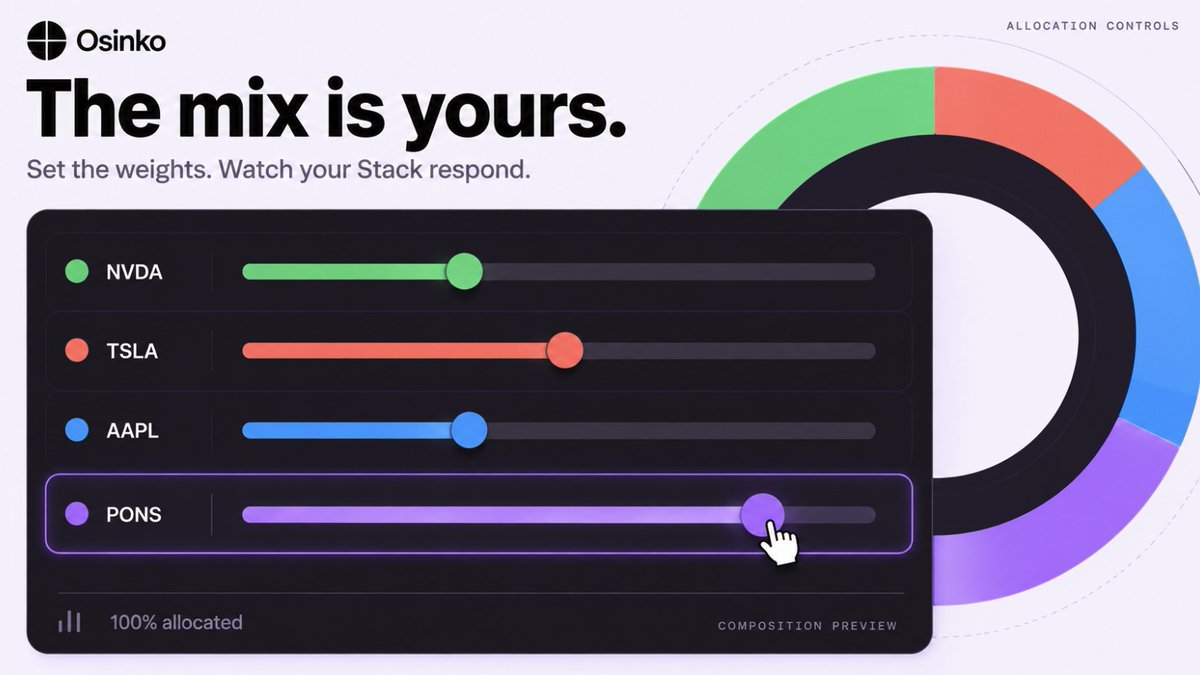
Picking the assets is half the idea. Their weights tell the rest.
Give PONS a small slice or make it the largest component.
Move a slider and the other allocations adjust proportionally to keep your composition at 100%.
The ring shows your choices as you make them.
The starting point is a contract address.
Paste it into “Bring your own token.” Look up the details. Add it to your Stack.
We tried PONS first. It appeared alongside our stock picks, ready to weight.
Dropping this week.
PONS alongside NVIDIA, Tesla and Apple.
That’s the Stack we built in our latest demo.
Token import opens the builder beyond the stock list: bring a Robinhood Chain token into the same composition, then decide how everything fits together.
What would you combine?
Stacks launched with stocks. Next, bring your own token.
We’re building contract-address imports for Robinhood Chain so compatible tokens can sit alongside your stock picks in the same Stack.
First look at the new experience below.
Your thesis just got more room.
Check this out! 🔥
We just added the ability to add ANY Robinhood token to your STACK.
Users can build diverse baskets of assets of both Stocks + Tokens.
This video demonstrates building a basket of:
- robinhood:0x39dbed3a2bd333467115de45665cc57f813c4571
- $NVDA
- $TSLA
- $APPLE
All under one umbrella.
Osinko Stacks.
Stacks launched with stocks. Next, bring your own token.
We’re building contract-address imports for Robinhood Chain so compatible tokens can sit alongside your stock picks in the same Stack.
First look at the new experience below.
Your thesis just got more room.
NVIDIA. Microsoft. Your token.
That’s the next chapter for Osinko Stacks: combining stock picks with compatible Robinhood Chain tokens in a composition you control.
Which token would you add first and which stocks belong beside it?
Give us the mix. Give it a name.
From a contract address to a slice of your Stack.
The flow we’re building:
→ Paste a Robinhood Chain token address.
→ Load its details.
→ Add the compatible token to your composition.
→ Set its weight alongside your stocks.
The ring updates as you build.
Token import is coming.
The next ticker you ape could be yours.
You’ve seen the stocks move into place. The weights change. A Stack take shape.
Now picture the one you’d build.
The companies behind your thesis. Weighted by your conviction. Given a name and a ticker of your own.
That’s what we’re bringing to Osinko.
Stacks brings stock selection, allocation, and creation into one experience starting with an empty canvas and an idea.
We’ve shown you pieces. The full reveal is coming.
Osinko Stacks: composition, backing, and redemption.
The builder is the visible part. The underlying accounting is what makes a Stack meaningful.
Here’s the design we’re building toward, the distinctions that matter, and what the current preview demonstrates.
COMPOSITION
A Stack starts with a set of stock tokens and their intended weights.
For example:
NVDA: 50%
MSFT: 30%
TSLA: 20%
Those percentages describe allocation by value, not token quantities. Different token prices mean a 50/30/20 allocation requires different quantities of each underlying asset.
The builder keeps the total at 100%. Increasing one component redistributes the remaining allocation proportionally across the others.
That is composition logic. Funding that composition requires a separate execution step.
BACKING
The intended model is a basket backed by the stock tokens deposited into it.
A name, ticker, and allocation chart do not establish backing. Backing comes from assets held by the basket contract, with balances that can be inspected onchain.
The accounting needs to connect three things:
• Underlying token balances.
• Outstanding Stack token supply.
• The quantity of each underlying token redeemable per Stack token.
That relationship is the foundation of the product.
WHAT YOU HOLD
In this model, a Stack token represents a proportional claim on the basket’s underlying tokens.
It does not turn those tokens into directly registered company shares. The rights and restrictions of each underlying stock token still apply.
The wrapper adds basket accounting. It does not create additional ownership rights in the companies.
WEIGHTS WILL DRIFT
Initial allocation and current allocation are different measurements.
If NVDA rises faster than the other components, its share of the basket’s value increases—even if the basket holds exactly the same token quantities.
A 50% starting weight can become 55% without any transaction taking place.
Maintaining fixed weights would require rebalancing: actual trades, execution costs, slippage, and explicit rules about who can trigger them.
The builder’s automatic weight adjustment is not automatic portfolio rebalancing.
REDEMPTION
The intended redemption model is proportional withdrawal of the underlying assets.
Ignoring fees for illustration, burning 1% of the outstanding Stack supply would return 1% of each underlying token held by the basket.
Redemption into stock tokens and selling those tokens for USDG are separate operations.
The first depends on the basket’s accounting and transfer rules. The second also depends on available liquidity and execution prices.
WHAT THE PREVIEW ESTABLISHES
The current demo shows stock selection, allocation controls, proportional weight adjustment, and a composition that updates as you build.
It does not, by itself, demonstrate funded backing, a successful mint, or an executed redemption.
For the onchain release, the details that need to accompany it are concrete: supported assets, contract addresses, funding mechanics, fees, permissions, and redemption behaviour.
Those define the launch scope. A preview ticker does not.
The engineering requirement is straightforward: the composition users see, the assets the contract holds, and the assets users can withdraw must reconcile.
A stock ticker tells you which company you’re buying.
A Stack starts with a bigger question: what’s your thesis?
Maybe you believe NVIDIA builds the compute, Microsoft distributes the software, and Tesla brings AI into the physical world.
With Osinko Stacks, you can put that idea together in one composition.
Here’s how the builder works:
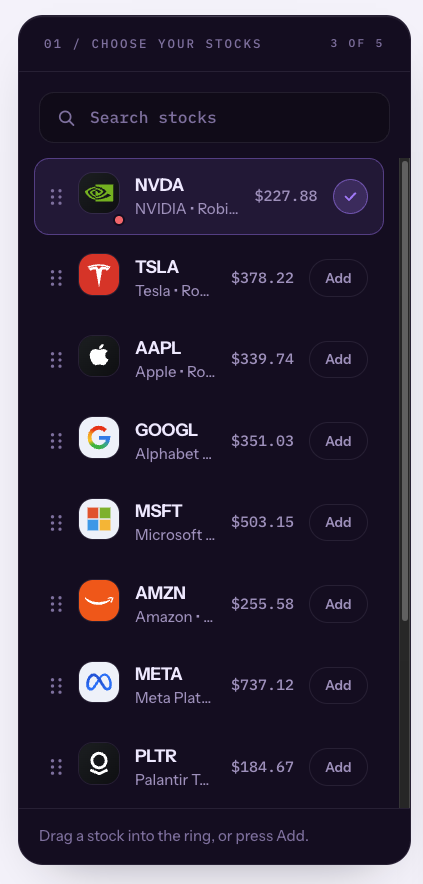
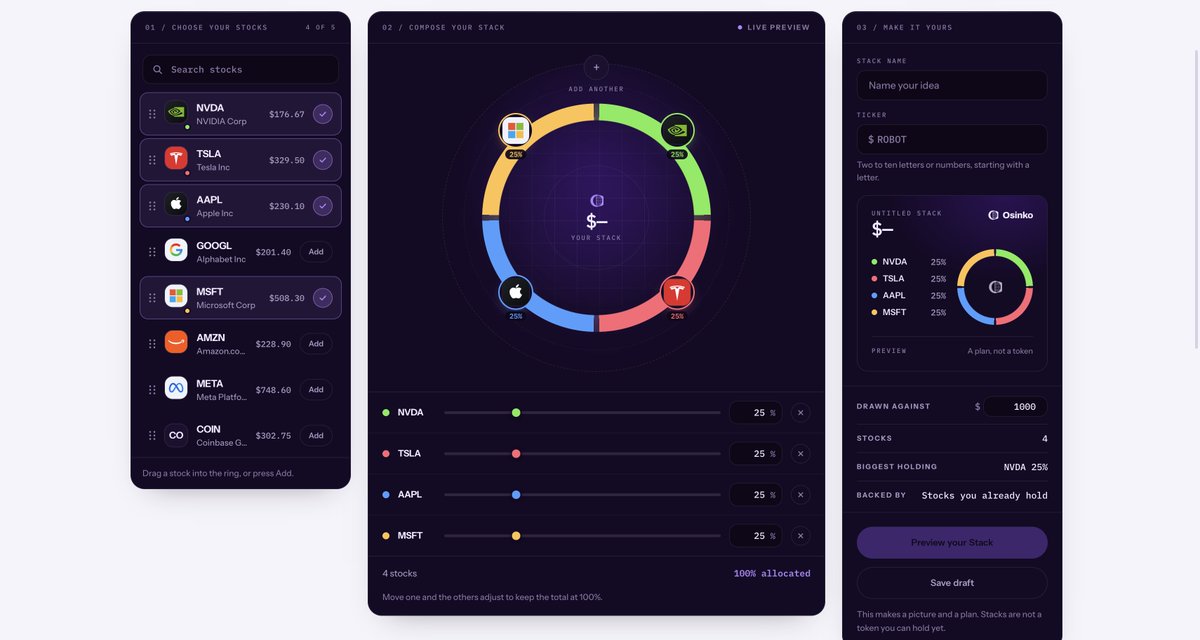
→ Pick your stocks.
Add the companies that express your thesis. Each becomes a component of your Stack.
→ Set the weights.
Choose how much of the composition each stock represents. A 50% NVDA / 30% MSFT / 20% TSLA mix expresses a different conviction than an equal split.
→ Adjust the balance.
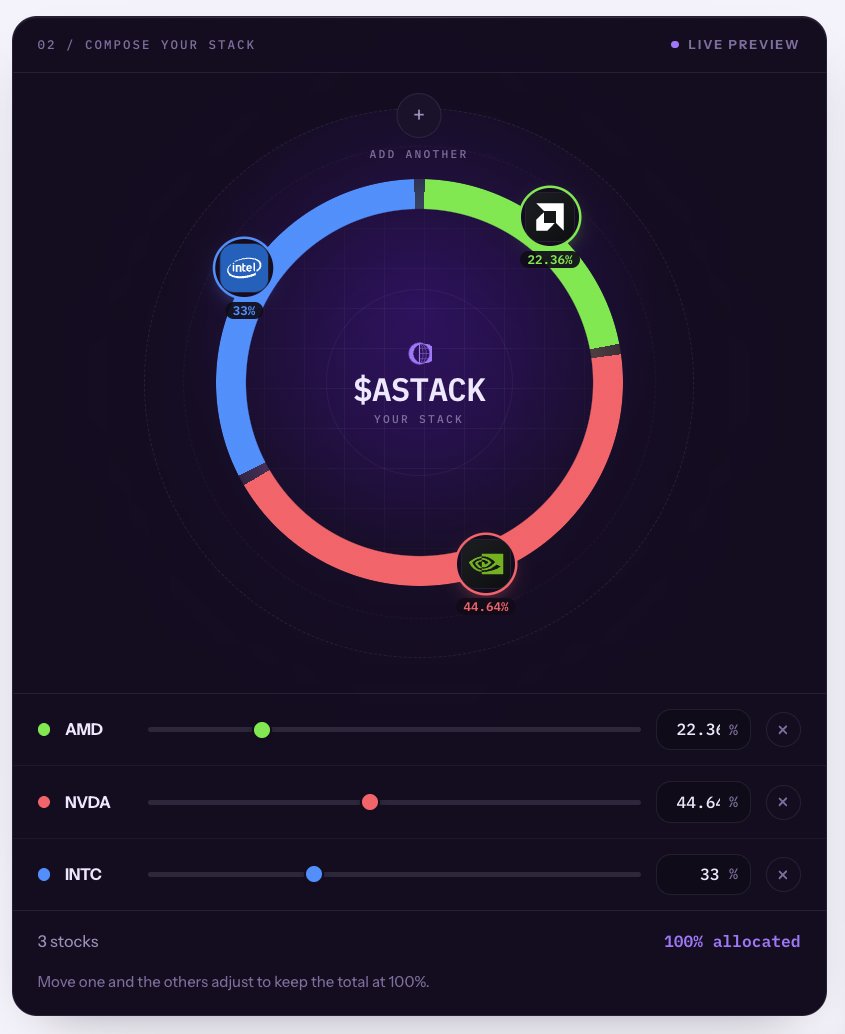
Increase one weight and the builder redistributes the remaining allocation proportionally. Move NVDA from 50% to 60%, and that 30/20 split becomes 24/16. The total stays at 100%.
→ Watch it take shape.
The composition ring responds as you adjust. Every segment represents a stock’s share of the allocation, so you can see what you’re building as you build it.
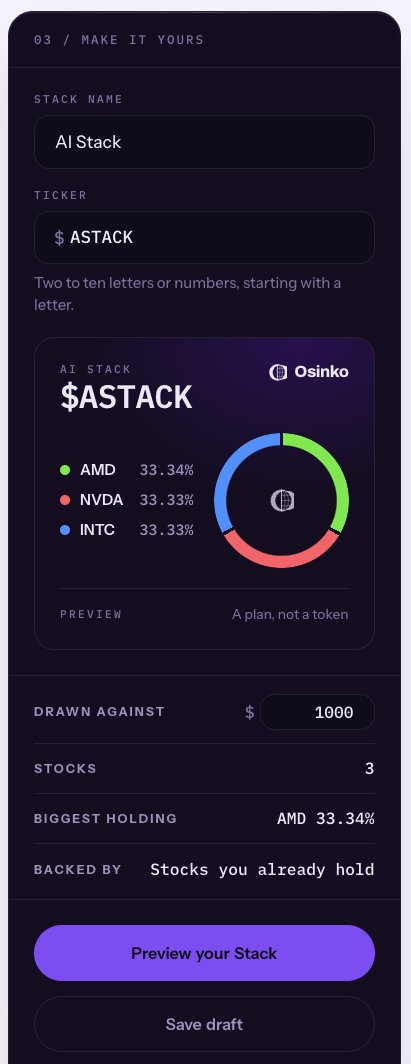
→ Give it an identity.
Name your Stack. Choose its ticker. Turn a collection of stock picks into a clearly defined investment idea.
These controls define the composition in the builder. Moving a slider is a preview edit, not an executed trade.
That’s the starting point for Osinko Stacks: making an investment thesis something you can assemble, inspect, and put your name on.
Your thesis. Your ticker.
Coming next to Osinko.
Three stocks. One thesis.
If you were building your own Stack, what would go in it?
Drop your 3 picks, how you’d split the weights, and what you’d call it.
We’ll bring a few of your ideas to life in the builder.
Here’s how you set the mix inside a Stack.
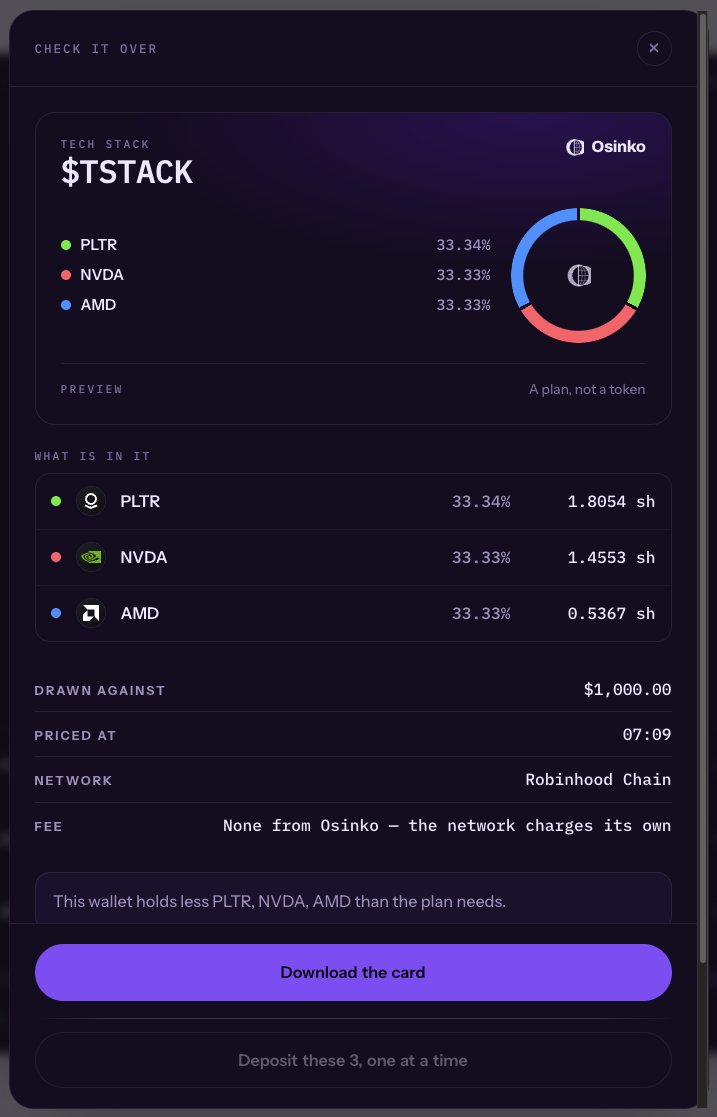
Drag a slider to choose how much goes into each stock. Increase PLTR, and AMD and TSLA adjust proportionally to keep the total at 100%.
The ring updates as you build, so you can see exactly how your allocation is split.
Your picks. Your proportions. Your ticker.
Osinko Stacks. Available soon.
Here’s how you set the mix inside a Stack.
Drag a slider to choose how much goes into each stock. Increase PLTR, and AMD and TSLA adjust proportionally to keep the total at 100%.
The ring updates as you build, so you can see exactly how your allocation is split.
Your picks. Your proportions. Your ticker.
Osinko Stacks. Available soon.
The idea behind Stacks is simple.
You believe in something: AI, robotics, the next wave of energy.
But buying that idea means piecing together separate positions.
We wanted to give the whole idea its own ticker.
That’s what we’re building.
An index fund is someone else's idea of what belongs together.
A Stack is yours. Five Robinhood stock tokens, your weights, your name, your ticker. Build it in a minute, share the card, deposit it stock by stock when you're ready.
Osinko Stacks. Your thesis, your ticker.
https://t.co/DfRCCyPm5y
We said tomorrow... but Here’s an early look.
Meet Osinko Stacks.
Pick your stocks. Set the weights. Give your idea a name and a ticker.
Your thesis, built by you.
Watch one take shape below.
What would you put in yours?
Robinhood stock tokens have a built-in DRIP. Every dividend is reinvested into the token automatically. No cash comes out.
Osinko adds the missing options. Take the dividend as USDG, stream it, keep reinvesting it, or use it to pay interest on a loan against the token.
https://t.co/DfRCCyPm5y