Why follow me?
10 years of experience analyzing U.S. stocks. Daily market views and trading strategies.Long $NVDA $TSLA
Trade US stocks 24/7. No KYC require👇
The Market’s First Stress Test Comes Tuesday: Five Volatility Triggers for Nov. 23–29
For the week of November 23–29, the most concentrated risk window falls between Tuesday and Wednesday. At 8:30 a.m. ET on Wednesday, the United States will publish October Personal Income and Outlays, including the PCE price index. Around the same time, investors will be processing AI hardware earnings, positioning around gold options expiry, and preparing for the Black Friday demand test. Crypto adds a second pressure point on Friday, when monthly Bitcoin and Ether options expire. The key question is whether these events reinforce one market narrative or pull prices in opposite directions.
1. PCE puts rates back in the driver’s seat
The Bureau of Economic Analysis has scheduled the October Personal Income and Outlays report for Wednesday, November 25, at 8:30 a.m. ET, or 13:30 UTC. The report includes the PCE price index, personal income, and consumer spending. The Bureau of Labor Statistics calendar shows no major CPI, PPI, or employment report during November 23–25, so PCE is the week’s clearest scheduled test of the inflation and rate outlook.
That makes the first market reaction relatively simple to read. A hotter inflation print could lift Treasury yields and the dollar while pressuring rate-sensitive equities, especially the Nasdaq and small caps. A softer print could ease that pressure. The more important move may come afterward, when traders compare the data with existing expectations for the Federal Reserve’s December meeting. The number itself will matter, but the change in rate pricing will show whether investors view it as a lasting signal or a one-report surprise.
2. AI earnings move from headlines to cash flow
The AI trade faces company-specific tests on Tuesday. HPE released fourth-quarter fiscal 2026 results on November 23. Dell is scheduled to discuss its fiscal third-quarter results on November 24 at 3:30 p.m. ET, and Analog Devices is scheduled to release fiscal fourth-quarter results at 7:00 a.m. ET that morning, followed by a 10:00 a.m. ET conference call.
The watchlist includes HPE, Dell, ADI, and the semiconductor ETF SMH. The market will look beyond revenue growth. It will focus on whether AI infrastructure demand is converting into orders, margins, backlog, and forward guidance. HPE’s results already move the discussion from “will demand appear?” to “how durable is the spending?” Dell and ADI can broaden that test across servers, networking, industrial demand, and the analog components that sit inside data center systems.
A strong report from one company may lift the group for a session. Investors will need consistent guidance across several suppliers before treating it as evidence of a wider cycle. That is why Tuesday’s reaction may not settle the question. Wednesday’s rates data can still change the valuation investors assign to the same earnings outlook.
3. Black Friday tests the consumer without a final sales number
Black Friday arrives on November 27, but the market is already trading the expectation. The National Retail Federation forecasts that U.S. holiday sales in November and December will reach $1.013 trillion, up 4.2% from 2025. Adobe expects U.S. online holiday spending to reach $275.1 billion, with Black Friday online sales projected at $12.9 billion, up 9.2% year over year.
Those are forecasts, not results. The useful signal this week will come from retailer commentary, traffic data, discount depth, and early reports on electronics and discretionary goods. Adobe’s forecast also points to a retail season shaped by mobile shopping, earlier promotions, and AI-assisted product discovery. If promotions pull demand forward, strong early traffic may say less about total holiday demand than it appears to say.
The market is watching the quality of spending. Consumers can produce higher sales while relying more heavily on discounts, credit, or buy now, pay later services. That would support revenue but weaken margins and raise questions about January demand. Retail stocks may therefore react more to gross margin and inventory language than to a single headline sales figure.
4. Gold options expiry lands inside the macro window
CME rules state that monthly gold options expire four business days before the end of the month preceding the underlying futures month, with an earlier date when the expiry falls before a holiday. Under that schedule, the December 2026 gold options expire on Tuesday, November 24. The timing places the expiry beside the AI earnings cluster and one day before PCE.
Options expiry does not determine direction. It can, however, change hedging flows and liquidity around heavily traded strikes. Gold will also remain sensitive to real yields, the dollar, and any change in the market’s view of monetary policy. If rates rise after a strong inflation signal, gold may face pressure from both macro repricing and post-expiry positioning. If yields fall, the same expiry can amplify a move that was already forming.
The cleanest read is to watch gold together with Treasury yields and the dollar. A gold move without confirmation from those markets deserves less confidence.
5. Crypto faces its largest scheduled test on Friday
Deribit’s calendar places the monthly Bitcoin and Ether options expiry on Friday, November 27, at 08:00 UTC. Deribit says monthly options expire on the last Friday of the month and settle through its delivery process at 08:00 UTC. Market data collected on November 23 showed roughly $6.8 billion of Bitcoin open interest and about $586 million of Ether open interest for that Friday expiry on Deribit. Those figures can change before settlement.
Large expiry positions do not predict whether Bitcoin or Ether will rise or fall. They identify a point where dealer hedges, rolling positions, and short-dated volatility can change quickly. The risk is higher if crypto is already moving sharply after Wednesday’s PCE report. A rate shock can travel from Treasury yields to the dollar, then into equities and crypto before Friday’s settlement removes some of the expiring exposure.
The signal that matters most
This week has a dense calendar, but the events do not carry equal weight. The first decisive test is Wednesday’s PCE release and the rate move that follows it. The second is whether AI companies give investors evidence of durable demand rather than another round of optimistic spending language. Black Friday will add a consumer check, while gold and crypto expiries can magnify moves already underway.
My base case is that volatility will come from interaction between these catalysts, not from one isolated headline. Watch the 8:30 a.m. ET PCE release, the Treasury dollar response, and whether technology stocks hold their first move. If those three signals disagree, the market may stay noisy through Friday’s crypto settlement. If they align, the week’s direction should become much easier to identify.
The S&P 500 fell 0.3% to 7,182.78 on Nov. 25, while the Nasdaq lost 0.6%. That backdrop matters more than the reported -14.19% 2026 WSB basket: the basket concentrated exposure in high-beta AI, space, and crypto-infrastructure names just as investors began repricing the AI trade and inflation risk.
Micron Technology ($MU) shows why this is not a simple retail-stock-picking failure. Micron reported record fiscal 2026 revenue of $133.2 billion and said AI demand should support a stronger fiscal 2027, yet the stock still sold off with the broader AI complex. Fundamentals can improve while valuations compress. My read is that the basket exposed a timing problem: owning the right growth theme at the wrong multiple still produces a bad portfolio.
I'm planning to buy $100,000 worth of Nvidia stock today.
The US stock market could be setting up for a Thanksgiving rebound that extends into next week.
Here's what I'm watching. 👇
After several days of selling, hotter-than-expected inflation and renewed fears of a December Fed rate hike put even more pressure on stocks.
Then came Wednesday's unexpected intraday reversal on heavy volume.
No obvious good news. No major positive catalyst. Yet buyers stepped in.
That's worth paying attention to.
When bad news starts losing its ability to push stocks lower, selling pressure may be fading.
What makes this Thanksgiving particularly interesting is that while Wall Street takes a break, stock perps keep trading.
On @BitunixOfficial , you can:
• Trade US stock perps 24/7, including weekends and holidays.
• Go long or short.
• Trade and settle in USDT.
• React to breaking news outside regular market hours.
Of course, holiday perp prices don't necessarily predict where stocks will reopen.
But they're worth watching.
Are we finally seeing the beginning of a recovery
Why $MU Is the Strongest Pick—But the $1,200 Target Is Too Easy
The best thesis is scarcity, not hype
Among the five names, I would choose Micron Technology ($MU). The reason is simple: AI demand is already showing up in revenue, margins, product qualification and long-term supply agreements. The $1,200 target by 2030 is still speculation. The operating evidence is much stronger than the target price.
The latest quote I checked was about $601.25. At that level, the market is no longer paying for a vague AI story. It is paying for Micron to turn an unusually tight memory market into several years of high earnings. That is the real question.
Micron’s fiscal 2026 revenue reached $133.19 billion, up from $37.38 billion in fiscal 2025. Gross margin rose from 39.8% to 80.7%, while net income reached $84.97 billion. Those numbers are extraordinary, but they also explain the main risk: memory is cyclical, and extraordinary margins attract supply.
Why AI changes the memory cycle
The bullish case is not simply that data centers need more memory. AI systems need faster and more power-efficient memory, and that makes qualification and packaging more important than raw wafer volume.
Micron reported $16.28 billion in fourth-quarter Cloud Memory revenue and $18.00 billion in Core Data Center revenue. Their gross margins were 83% and 90%, respectively. Those figures show where the economics are moving: toward specialized data-center products rather than commodity PC memory.
Micron also began volume shipments of HBM4 for NVIDIA’s Vera Rubin platform in the first quarter of calendar 2026. The company says the 36GB 12-high product delivers more than 2.8 TB/s of bandwidth and over 20% better power efficiency than comparable HBM3E. It has also shipped samples of a 48GB 16-high version to customers.
That matters because a memory supplier does not win merely by producing bits. It wins by getting designed into a platform, passing customer qualification and delivering a product that improves system performance enough to justify a premium. AI customers have more reasons to lock in supply when replacing memory can delay an entire platform launch.
The market is missing the capacity problem
Micron says it has completed agreements covering the vast majority of its calendar 2027 HBM bit supply. Its 2026 10-K also says existing manufacturing capacity is generally being fully utilized and that new DRAM capacity will be needed to support projected demand in the second half of the decade and beyond.
The supply response will take time. Micron expects first DRAM wafer output from its new Boise fab in mid-2027, from its second Idaho fab in late 2028, and from its first New York fab in 2030. That does not guarantee tight pricing, but it shows why the market cannot instantly solve a shortage by turning on a few machines.
The company’s near-term guidance reinforces the point. Micron expects fiscal first-quarter 2027 revenue of $61.5 billion, plus or minus $1.5 billion, with a GAAP gross margin of approximately 85.95%. If that guidance holds, the AI-memory cycle is still converting demand into cash rather than merely producing optimistic presentations.
What would break the thesis
The weak part of the popular argument is calling Micron the “HBM king” and then jumping straight to $1,200. Micron has strong products and customer commitments, but the public filings do not prove that it will dominate the market or compound earnings at the rate required by that price target.
The real threat is supply. If Samsung, SK hynix and Micron add capacity faster than AI customers consume it, memory pricing could fall sharply. Micron is also committing heavily to factories: it expects net capital expenditures of about $11.5 billion in fiscal first-quarter 2027 and about $25 billion in the first six months of the year.
My read is still bullish because the current evidence points to constrained supply, unusually strong data-center margins and customer commitments extending into 2027. But the decisive metric is not whether MU reaches $1,200. It is whether gross margins remain high as new capacity begins to arrive. If they do, Micron can grow into its valuation. If they collapse, the AI label will not save the stock.
Micron is the strongest pick in this group because its AI demand is already visible in reported financials and qualified products. The $1,200 forecast is a guess; the supply shortage, the HBM ramp and the cash generation are the actual thesis.
DO NOT MISS THESE 5 RIGHT NOW!
1. $CRWV at ~$42
Explosive AI cloud compute → $200+ by 2030
2. $ASTS at ~$26
Space internet + direct-to-cell → $100+ by 2030
3. $OKLO at ~$19
Advanced nuclear powering AI data centers → $70+ by 2031
4. $MU at ~$601
HBM & AI memory king → $1,200+ by 2030
5. $CEG at ~$235
Clean energy + nuclear for AI power demand → $500+ by 2030
These are the real next-generation winners.
Like + Follow for daily high-conviction growth stock research. Let’s ride this wave together!
@Codmiver01 The missing piece is valuation and mix: share prices alone don’t show whether you’re buying DRAM, HBM, NAND, or just a different share count. Are you ranking exposure by revenue mix or upside?
Anthropic’s final IPO prospectus says Amazon and Google will hold 14.6% and 13.4% of the company, respectively, through non-voting Class N shares. A founder-controlled Class F share carries 50.1% of general voting power, while Anthropic has committed to spend at least $121.3 billion with Google and $110 billion with Amazon regardless of actual usage.
The headline economic upside for $AMZN and $GOOGL is real, but it comes bundled with a customer obligation that can become a cost burden if demand disappoints. Investors may be underestimating how much Anthropic’s valuation effectively capitalizes cloud revenue that the two companies still have to earn through infrastructure spending.
@b_brito The $10T and $1T calls need a denominator: what revenue, margins, and share-count assumptions get NVDA and PLTR there? Without those, the timeline is doing most of the work.
Some people talk. Some people ship.
Shayne, I hope that applies to accountability too.
I spent nearly a year promoting Polymarket before my $4,861.10 pending affiliate payout was canceled.
Your team has publicly alleged referral fraud. I'm not asking you to overlook violations. I'm asking for a documented explanation of why the entire payout was forfeited.
@williamlegate previously said his team would review my case. Can someone finally provide an answer?
Full story:
https://t.co/XAvLRb6i54
Nvidia ($NVDA) fell 3.9% on Wednesday, Nov. 25, after S&P put its AA rating on CreditWatch Negative and said it could cut the rating within 90 days. The move looks more like a governance warning than a credit crisis: Nvidia remains financially strong, but the board’s decision to reinstate Jensen Huang after consulting senior U.S. officials has made independence and succession risk impossible to ignore.
Moody’s kept Nvidia’s Aa1 rating and stable outlook, saying Huang’s return reduces near-term execution uncertainty. That is the key split. Huang may be the fastest way to stabilize customers and employees, but the board still has to prove that it can oversee him independently while its investigations continue. Until then, the governance discount can keep weighing on the stock even if Nvidia’s AI demand and cash generation remain intact. U.S. markets were closed for Thanksgiving on Nov. 26; the latest completed session was Wednesday’s close at 4:00 p.m. ET.
BOE’s $4 Trillion AI Exposure Warning Misses the Bigger Risk
Bloomberg’s headline is directionally right, but the important detail sits inside the Bank of England’s wording. The BOE estimates that hyperscalers have just over $4 trillion in total potential exposure to AI infrastructure, including debt and off-balance-sheet contractual commitments. That is not a $4 trillion loss estimate, a bank loan book, or a measure of money already at risk.
The market is more likely to misread this number as a debt problem. The sharper concern is that the same companies can sit on several sides of the same transaction. They may fund a data-centre project, commit to buying its capacity, and depend on the project to support future AI revenue. That structure can make growth look financed, contracted, and validated at the same time.
The BOE’s warning is about the connections created by those commitments. If expected AI revenue falls, the pressure can reach debt markets, private-credit funds, insurers, data-centre operators, and equity investors through several channels at once.
Circular Financing Is the Weak Link
The report describes a financing system that increasingly combines bonds, leveraged finance, private credit, public equity, private equity, joint ventures, and special-purpose vehicles. The complexity matters because off-balance-sheet commitments can hide where the final risk sits and how much capital depends on the same future cash flow.
The BOE estimates that hyperscaler bond issuance will exceed $305 billion in 2026, around 8% of global investment-grade issuance. Morgan Stanley analysts estimate that private credit could finance $700 billion of data-centre capital expenditure between 2026 and 2028. The BOE puts the current private-credit market at roughly $2.5 trillion.
Those figures do not prove that AI financing will fail. They show why a modest change in expected returns can travel farther than a single company’s balance sheet. A project can remain solvent while the assumptions supporting its contracts, refinancing, valuation, and collateral weaken together.
The Market Still Prices the Revenue Before the Risk
The BOE says AI-related equity prices fell sharply after the US midterm elections as investors reconsidered the scale, pace, and cost of AI investment. It also says the Nasdaq 100 had fallen around 13% from its October peak by the time of the report, while AI-related companies still represented slightly more than half of the S&P 500’s market capitalisation.
That concentration gives the financing problem a market-wide transmission route. A weaker AI outlook can hit shares first, then reduce collateral values and raise refinancing costs. Leveraged investors may sell into the decline, adding pressure to the same group of stocks that already dominates major indexes.
The popular AI narrative assumes that enormous spending will eventually be justified by enormous revenue. The BOE is pointing to the bridge between those two points. The bridge now carries debt, leases, guarantees, purchase agreements, private funds, and public-market expectations. Its failure would not require AI demand to disappear. A slower path to monetisation could be enough.
Verdict
The $4 trillion estimate is best read as a map of interconnected commitments, not as a forecast of immediate losses. The decisive risk is the gap between contractual confidence today and demonstrated AI cash flow later. Until that gap narrows, the market is underpricing how quickly an earnings disappointment could become a financing shock.
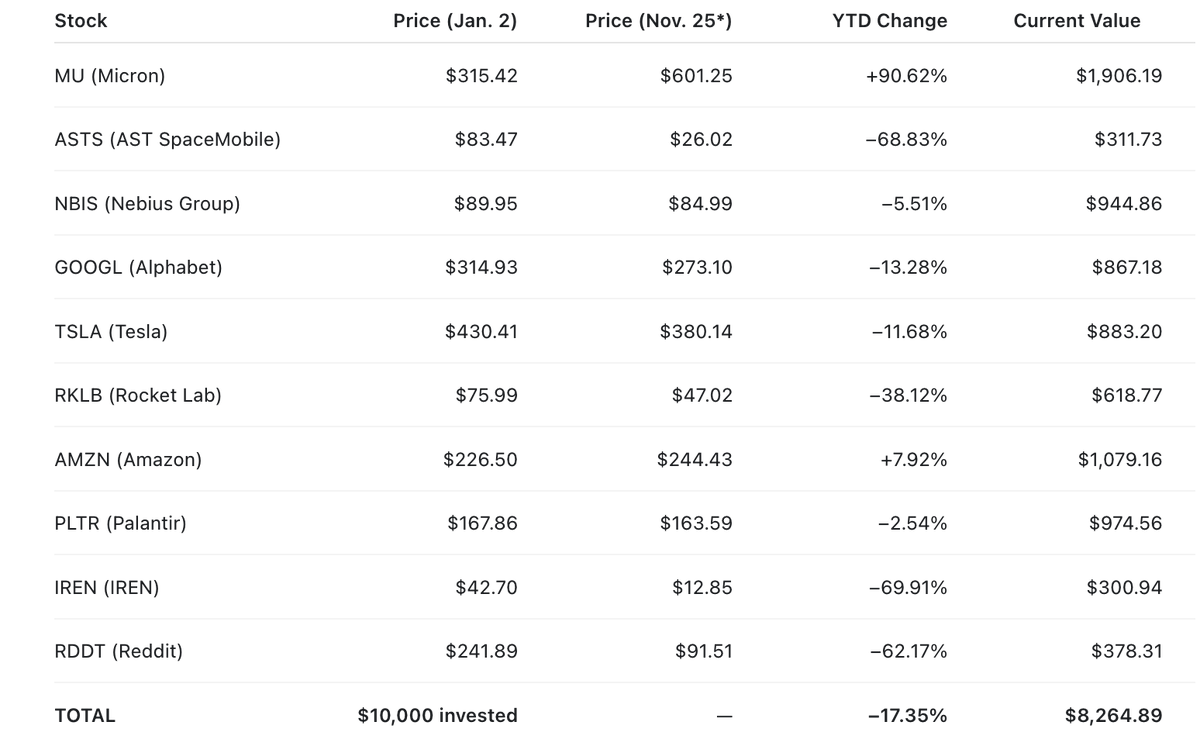
I reran that $10K WallStreetBets basket using Nov. 25 closing prices. It’s worth about $8,265 now, down 17.4%.
$MU nearly doubled from the entry price. It still couldn’t cover the damage from $ASTS, $IREN and $RDDT. One big winner wasn’t enough.
@thelegionmaster Fair, but “wait for confirmation” isn’t always irrational—without a predefined entry, invalidation, and position size, it’s often just a post-hoc excuse.
@Path21Mil The 39% discount needs a reference point—peak price, intrinsic value, or forward earnings? Without that denominator, $149 is just a price, not necessarily a dip.