Six years of collaboration, 20+ projects across 10+ clients, and a growing portfolio of jointly developed solutions are a few pieces of the work that earned UST @Workato's 2026 Partner of the Year award for ANZ.
The award was presented at World of Workato Sydney, where our teams showcased integration and automation solutions and joined Helping Hand's CTO on stage to discuss how governed data and integrations lay the groundwork for AI orchestration.
Alongside delivering client projects, we've modernized UST's own integration environment using Workato. That firsthand experience gives our teams a practical understanding of what it takes to implement, manage, and scale enterprise integrations.
Congratulations to our ANZ team on the recognition and thank you to Workato for the continued partnership.
See what this expertise looks like in practice:
• Helping ERMHA365 reduce overtime spending by 84% and improve scheduling efficiency by 40%: https://t.co/usbx2E6O11
• Modernizing UST's own integration environment, migrating 268 integrations in 10 weeks with zero unscheduled downtime: https://t.co/w2uU3F56tg
“The real value will come from knowing how to trust the work of AI, where to question it and where human judgement still matters.”
In Finance Chief, UST CFO Vijay Padmanabhan explores how AI is changing finance, the skills employees need and the growing responsibilities of CFOs.
Three priorities for #finance leaders as AI adoption grows:
• Finance needs to be involved in technology strategy, helping evaluate major investments and how they support broader business goals.
• AI introduces new costs and risks, from model and computing expenses to uncertain returns on investment. Finance leaders need to keep a close eye on spending and establish clear guardrails.
• As AI handles more routine work, finance leaders need to invest in employees' data literacy and AI skills so they can evaluate results, question assumptions and make informed decisions.
Read the interview for more on how #AI is changing finance leadership: https://t.co/nBOxgf120J
Generative AI has brought great disruption. But standing still is the biggest risk. Amar Chhajer reveals how UST is helping its clients turn this wave of change into an opportunity.
Discover more: https://t.co/3GRSeA40K6
#AI
Schroders manages money for clients in 36 countries. Together, UST and @Schroders delivered a global transformation program that improved cohesion and accelerated innovation across the entire firm.
Hear from Rob Hyde, Chief CIO and Global Head of IT Infrastructure at Schroder’s.
Discover more: https://t.co/6gNFxvVuHi
#Finance
Can a vehicle's software be tested before its hardware exists?
Less than four months after the closing, Italdesign and @USTglobal bring a new project to @CES 2027.
Las Vegas, 6–9 January, West Hall, Booth 4019.
#Italdesign#BEIDENEERS#CES2027
“Every enterprise leader I talk to is constrained by compute, talent and change management, roughly in that order. None of them is constrained by enthusiasm.”
In @WSJ, @adnanmasood, UST’s Chief AI Architect, shares what business leaders should expect as enterprise appetite for AI runs ahead of the resources needed to deliver it.
Hyperscalers aren't likely to cut investment, but some planned computing capacity could arrive months later than expected.
For businesses, that means factoring capacity constraints into AI rollout plans while setting clear measures of success. Adnan expects boards to judge every AI dollar on production metrics such as cycle time and cost per transaction.
“That is capital discipline, and it is healthy.”
Read Adnan’s perspective alongside other enterprise technology leaders:
https://t.co/BmfIwYDJ4Q
Competition for AI talent is fierce. To differentiate, today’s innovators must bring the work to the talent with a bold new approach to outsourcing.
Read more: https://t.co/gMbUwAMtnn
#AI
When @Schroders set an ambitious transformation agenda across its global services, UST and Schroders worked as one team to deliver.
The results: greater scale, global cohesion and depth of innovation, all in under a year.
Hear from Nick Athill, Global Technology Transformation Director at Schroder’s.
Watch the film: https://t.co/282hRDX7rl
#Finance
Organizations that succeed in the next decade will be the ones that deliver the real-time data and context AI systems need to enable the experiences customers demand. Steve Kostyshen discusses how enterprises can build a data foundation for an AI-driven world.
Read the article: https://t.co/7qV8EmoD28
#AI
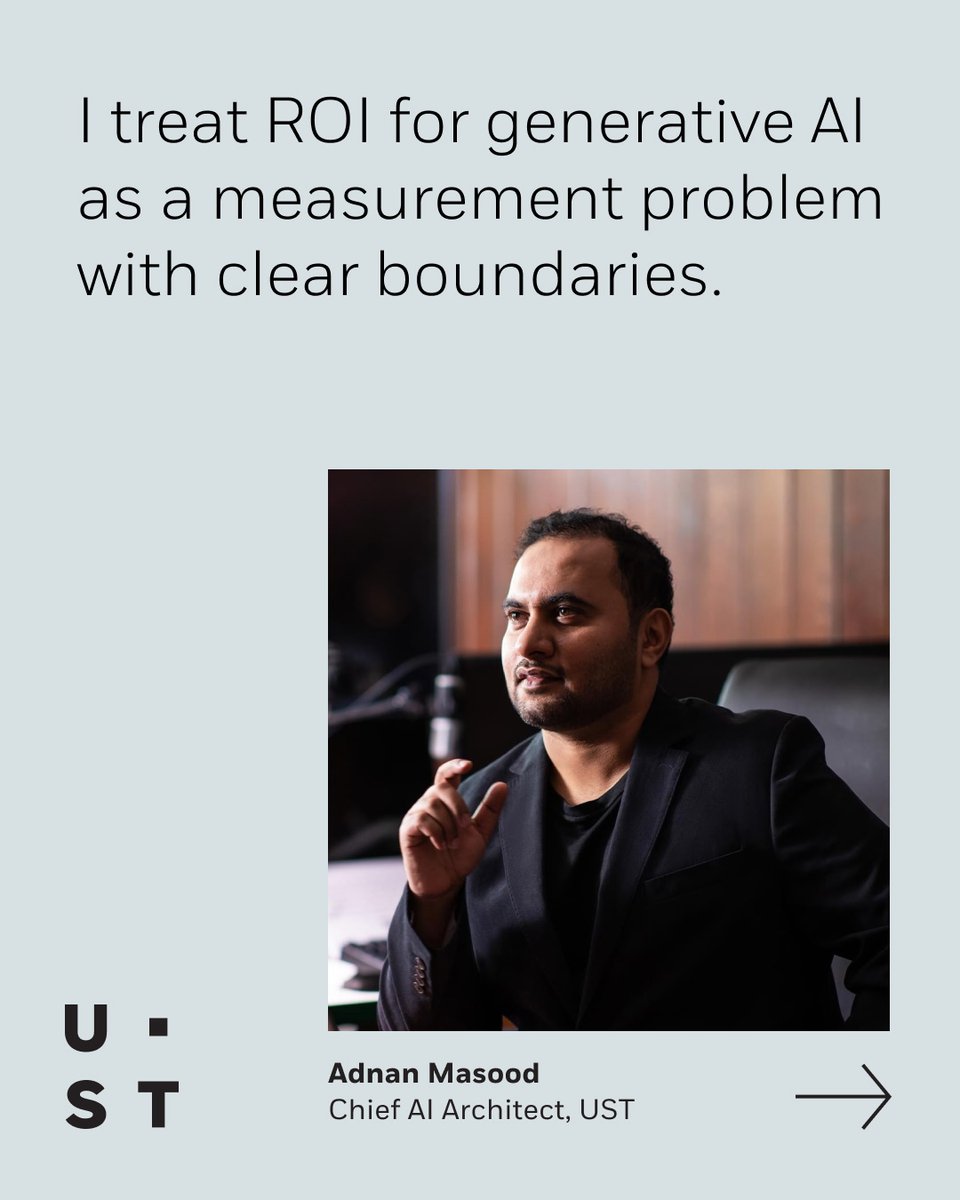
When does a successful generative AI pilot become a credible ROI case?
In his @InfoWorld article, UST’s Chief AI Architect Adnan Masood explains why positive pilot feedback and steady usage alone don't prove ROI in production. He looks at what teams need to measure before deciding whether to scale.
What should your workflow prove before you can call it ROI?
Read more: https://t.co/chXitj9FyC
#AI
UST has been recognized among the 100 Best Companies to Work For in Europe in 2026. 🎉
This recognition from @GPTW_US and @FortuneMagazine reflects what's at the heart of UST: our people. Their talent and passion drive our growth, fuel innovation, and create an environment where everyone can reach their full potential.
Being named among Europe’s best companies to work for is an achievement we all share. Thank you to everyone who makes this possible.
#LifeAtUST
Engineering is moving to the center of business strategy, and the organizations pulling ahead are approaching AI, agentic systems, simulation, and governance as one connected shift.
In this UST CXO Insights cover story, Chief Operating Officer Gilroy Mathew explores how engineering is evolving, from simulation-native R&D and agentic product development to connected engineering ecosystems built for speed, adaptability, and human oversight.
🔗 https://t.co/agH8geXJNg
Also in this issue:
• How silicon, software, and AI are converging to reshape engineering.
• What happens when AI meets manufacturing and mobility?
• How predictive validation helps teams detect issues earlier and make more confident decisions.
• The engineering playbook: Four practical moves that connect hardware, software, digital twins, and AI to reduce risk and scale innovation.
If ransomware takes primary systems offline, how will clinicians access critical patient data?
For healthcare organizations running Epic, an isolated recovery environment (IRE) on Microsoft Azure can help preserve access during a disruption. But preparing for recovery also means addressing architecture, testing, costs, and operational procedures long before systems go offline.
On October 29, experts from Dayton Children's Hospital, Microsoft, and UST will explore:
• How to move an Epic IRE from architecture and deployment to testing and recovery runbooks
• How pilot-light approaches and Azure consumption optimization can support cost-conscious recovery strategies
• Where Microsoft funding pathways may support Epic on Azure initiatives
• How a hospital CIO approaches Epic resilience, recovery planning, and operational readiness
Register to join the virtual event: https://t.co/27rca24YsT
#HealthcareIT #Epic #Ransomware
AI transformation can’t succeed without culture change. Smitha Dunwell, Industry Partner Lead for #AI at @awscloud, explains how to balance innovation with responsibility to create real business value.
Watch the film: https://t.co/M05onWpGqL
“Our question is, where is the value trapped in the business today, and how can we quickly unlock it?”
Kailash Attal, Chief Solutions Officer, breaks down how to set the groundwork for self-funded transformation in your organization. Listen to the full episode to learn how businesses can unlock value in existing operations and reinvest it in modernization and future growth.
Available anywhere you listen to podcasts:
Spotify: https://t.co/nrDVKhC04Q
Apple: https://t.co/xBWHYdgWq1
YouTube: https://t.co/ZtgcqUTrXr
Web: https://t.co/5fZAgRc08k
The AI era demands a smarter approach to outsourcing. Vaidyanathan Seshan explains how you can evolve your Global Capability Center to enhance intellectual property, differentiate, and accelerate AI-led innovation at scale.
Read the article: https://t.co/7tNeIW7etm
#AI
Legacy systems served their purpose. When the application landscape is in the cloud and SaaS, it’s time to modernize your legacy integration platform too.
When it came to update UST’s own systems, our team selected @Workato for three key criteria:
✅The ability to scale with the organization.
✅A low-code approach that could make development accessible to a broader team.
✅An architecture that could support future innovation beyond point-to-point integration.
Phase one of the transformation saw our teams execute 268 integrations with zero downtime in a 10-week timeline.
Phase two sees Workato connecting AI agents, enterprise systems, and human-facing processes at scale.
Explore the impact of a modern integration platform: https://t.co/Xp7vxWZ9Xi
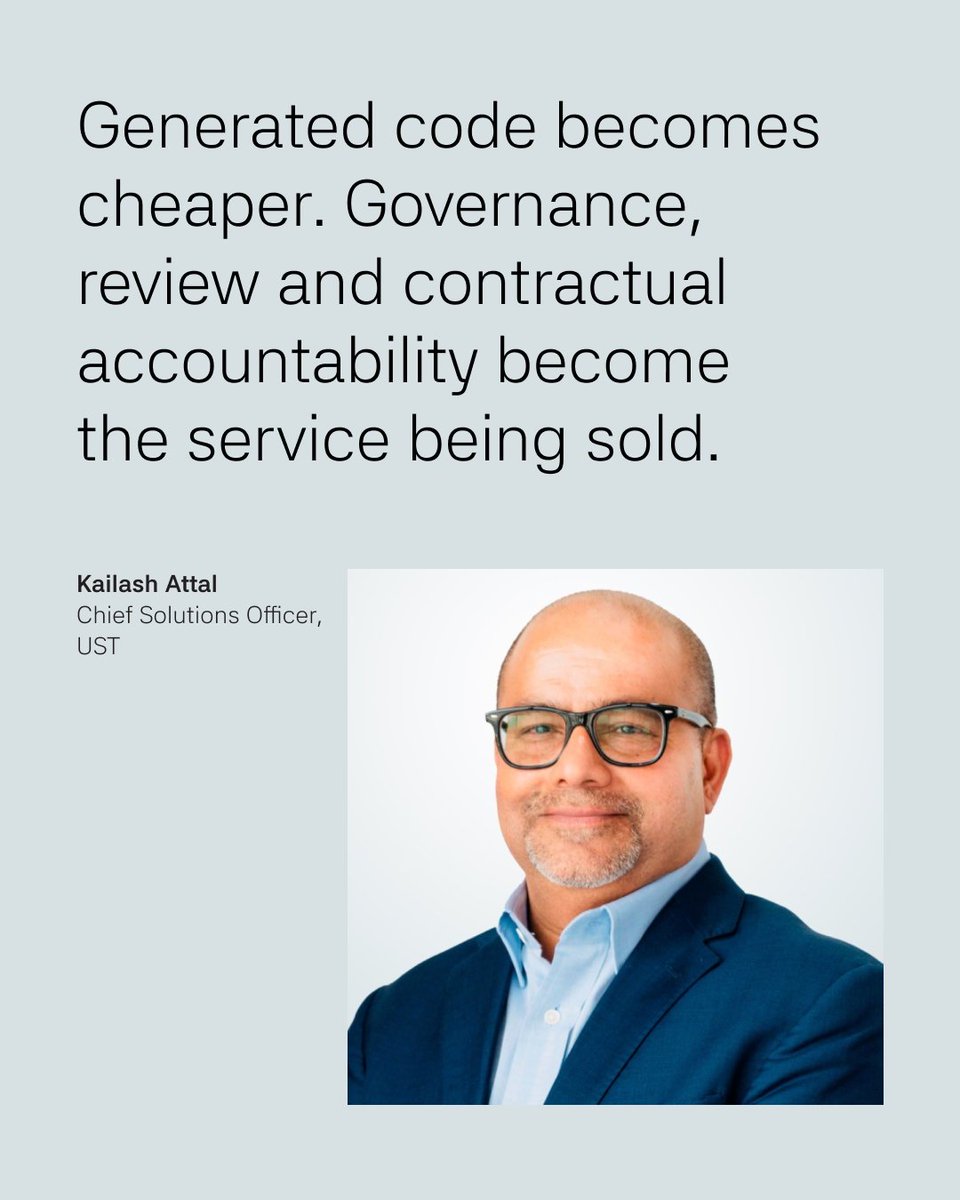
AI can take on the first pass of development, while experienced practitioners remain accountable for what moves forward.
UST Codon, our AI workspace for building and changing applications across five major enterprise platforms, applies that approach through a governed delivery process. Developers describe a requirement in plain English, and UST Codon plans the work and assembles a proposed change for human review.
In @runtimewire, Kailash Attal, Chief Solutions Officer at UST, explains how Codon supports AI-assisted development with practitioner oversight before changes reach customer approval and deployment.
Read more: https://t.co/7Nosws0acC
#AI
With UST’s innovation lab, Cogstate was able to develop two AI-focused MVPs in just 12 weeks.
Now, we’re creating AI solutions, such as a digital avatar, that will support neuropsychologists when they take patient assessments – and remove the noise from the data.
Watch the film: https://t.co/Tl78mWvjoy
#AI