WHY I POST 🔍
Utility is the future.
I fact-check crypto news before it goes out — primary sources only, speculation always labeled as speculation.
No price targets. No borrowed hype. No "it's happening" without a source attached.
See something that needs checking? Tag me. If I get something wrong, I'll correct it publicly. That's the deal.
📌 🧵 THREAD: XRP's Real Bottleneck Isn't Price. It's Liquidity Depth.
We keep hearing "XRP needs to be higher for institutions to use it." That's backwards. What institutions actually need is deep liquidity — the ability to move large size without moving the price. Here's what the real data says about that gap.
⬇️
📌 The honest takeaway: XRP's price appreciating and XRP's liquidity deepening reinforce each other, but they're not the same thing. A 1,000% price move with no corresponding liquidity growth doesn't get you closer to institutional-scale settlement capacity.
Real infrastructure, still years from matching the stated goal. Worth knowing before betting on price alone.
🧠 💭
📌 Combined scenario: 100x price + liquidity depth growing 50x through real institutional market-making → the gap closes to roughly 0.76x. Essentially solved.
That's the actual scale of buildout implied by Ripple's own 2030 target. Not a price prediction — a liquidity-infrastructure roadmap spanning years.
⬇️
📌 Russia Excludes XRP From Retail Trading — Here's the Actual Criteria, Not Just Speculation
Real, today: the Bank of Russia's draft directive approves only Bitcoin, Ethereum, and USDT for non-qualified (retail) investors, capped at 300,000 rubles/year. This is a draft open for public comment until August 24, ahead of a September 1 framework start — not yet finalized, despite some Russian state media reporting it as completed.
Worth the context: the stated criteria are market cap, average daily trading volume, and at least five years of pricing history on foreign platforms — a liquidity/track-record filter, not a ban. Deputy Governor Vladimir Chistyukhin said most altcoins simply lack sufficient liquidity and long-term stability by this standard; even USDT only qualified on volume grounds despite acknowledged freeze/blocking vulnerabilities.
Decrypt's own reporting adds a real, specific wrinkle: XRP would seemingly meet the stated criteria on paper, but its history of SEC litigation-driven delistings and relistings across exchanges may be a contributing factor to its exclusion — though this isn't confirmed as the central bank's stated reasoning.
Worth knowing XRP isn't shut out of Russia's regulated market entirely: qualified (accredited) investors can trade XRP without restriction, and the Moscow Exchange already runs a MOEXXRP index plus ruble-settled XRP futures for institutional access — real, existing regulated infrastructure, just not open to retail yet. 👀
📌 XRP $28,000 by 2030? Here's the Actual Math Behind That $28 Target
Real, published yesterday (Sam Daodu, 24/7 Wall St.): 1,000 XRP bought at July 2025's $3.65 peak cost $3,650 — worth $1,030 today, a 72% loss. At Standard Chartered's $28 2030 target, that same 1,000 coins would be worth $28,000.
Worth the actual math behind it: reaching $28 requires XRP to attract $2.06 trillion in new capital by 2030 — 76% more than Bitcoin has absorbed since 2019, and in four years instead of six and a half. Standard Chartered's own framing ties anything above $2.80 (their 2026 target) entirely to CLARITY passing and institutions holding XRP as collateral rather than just moving it through as a bridge asset. A more moderate path — $12,680 by 2030 — becomes reachable if CLARITY clears the Senate in September specifically. The full $28 target would require the entire $2 trillion collateral pool concept moving into XRP, which the piece itself calls a bigger shift than anything crypto has ever seen. 👀
Chainlink's CCIP has moved $23.3 billion across chains and is live on 78 networks
@chainlink's cumulative transfer volume reached $23.32 billion with 268 cross-chain tokens supported. Total cross-chain token value is over $65 billion.
Value locked in CCIP pools jumped 25% over the past month to $1.81 billion, per DefiLlama, recovering ground lost through the spring after topping $2 billion late last year.
🇺🇸BREAKING: SEC set to consider new crypto offering framework this Friday.
The SEC has scheduled an open meeting Friday, August 14 at 10 AM ET to consider proposing a regulated framework for investment contracts involving crypto assets.
The proposal could replace outdated securities frameworks with fit-for-purpose rules for token issuers, including streamlined disclosure standards, safe harbors and registration exemptions, marking a step toward clearer rules in the U.S.
📌 LINK — Syntetika Launches, First Offering Is a Publicly-Traded Company's BTC Strategy
Real: Syntetika, a new tokenization hub for regulated investment strategies, launched with its first offering — BTC Basis+, managed by publicly-traded Hilbert Group. The platform enables direct wallet access to strategies within regulated funds, with independent custody and third-party NAV attestation.
Worth the context: this is a real, concrete new adopter in the regulated tokenization space, distinct from the SWIFT/DTCC/BitGo integrations — adds to Chainlink's growing list of named institutional deployments beyond just the Standard Chartered $200 narrative. 👀
📌 XRP ETFs Locked Up 900M Tokens — Here's Why That Hasn't Squeezed the Price
Real: XRP ETFs have pulled in $1.51B since November 2025, locking ~930 million tokens (1.49% of the 62.5B circulating supply) in custody. Monthly inflows have collapsed from $650M (Nov 2025) to just $1M (Aug 2026).
Worth the context: Ripple's escrow releases 300 million XRP monthly — more than offsetting every coin the ETFs remove. A real squeeze needs buyers taking coins off-market faster than holders and escrow releases replace them; at 1.49% of supply, there are always sellers to meet the bid. JPMorgan and Standard Chartered estimate CLARITY passing could unlock $667M in monthly ETF inflows — enough to finally outpace escrow releases, if it happens.
Price level doesn't drive squeezes, liquidity depth relative to supply does. 👀
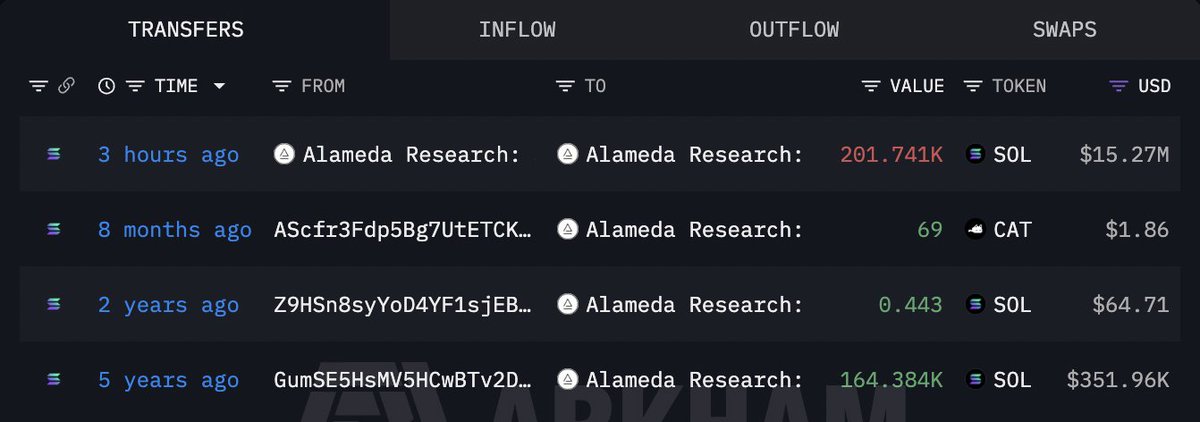
📌 Alameda Unstakes 201,741 SOL ($15.27M) — Correction: This Isn't a "5-Year Position"
Real: Confirmed on-chain — a wallet tagged "Alameda Research" unstaked 201,741 SOL (~$15.27M) recently. This is genuinely current activity.
Worth the context:
First, "Alameda Research" collapsed alongside FTX in November 2022 — this isn't an active trading firm making a decision, it's the FTX bankruptcy estate periodically unstaking SOL to fund court-mandated creditor repayments (part of a $12.7B repayment plan). These unstakes happen almost monthly — 197K SOL in March, 198K in April, 200K in June, all in similar ~200K-SOL tranches — so this is routine, not a standalone event.
Second, the "$352K originally, now $15.27M after 5 years" framing conflates two different transactions. The screenshot shows a separate, smaller inflow (164,384 SOL, $351.96K) from 5 years ago — that's not necessarily the same position that just got unstaked; the current unstake amount (201,741 SOL) doesn't match that older transfer's size. The estate still holds roughly 3+ million SOL on-chain, so tracing one exact chain from a single 5-year-old deposit to today's unstake isn't something the screenshot actually supports.
More accurate framing: "FTX estate unstaked another ~$15M in SOL for creditor repayments — routine monthly activity, not a surprise move." 🔍
📌 Can XDC Become a Real Stablecoin Player? Here's the Actual Gap Between Volume and Standing Supply
Real, worth the distinction: XDC has moved over $1.3 billion in cumulative USDC transfers and handles roughly $100 million in daily trade finance volume through Liqi — but that's transaction throughput, not standing stablecoin supply sitting on the chain. Those are two different metrics, and a chain can process real volume while still ranking low on total stablecoin market cap if capital moves through rather than parking there.
Worth the real target to watch: Liqi's own stated goal is $500 million in stablecoin liquidity on XDC — a concrete, disclosed benchmark from one of XDC's own ecosystem partners, worth checking progress against directly.
Worth the honest framing: XDC trades at #73 by market cap despite processing 938 million total transactions — a real, documented gap between usage and price, the same "fundamentals up, token lagging" pattern we've across the space.
Breaking into stablecoin market cap's top tier would need standing capital, not just transfer volume, to actually settle on-chain. 👀
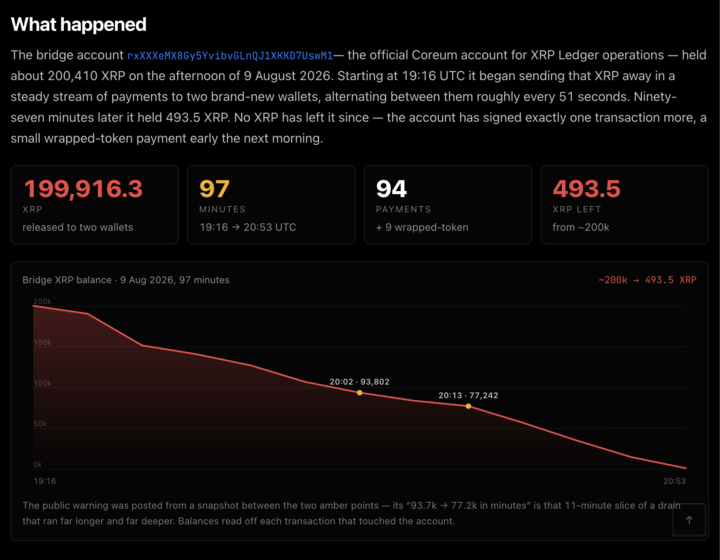
📌 200,000 XRP Drained From Coreum Bridge — XRPL Itself Wasn't Touched, But Price Fell Below $1 Anyway
Real: on August 9, an attacker drained 199,916 XRP from the Coreum-XRPL bridge across 94 payments in just 97 minutes (19:16-20:53 UTC), taking the bridge from ~200,410 XRP down to 493.5 XRP. Bridge remains halted, no official incident report from Coreum yet.
Worth the context: this was a relayer logic flaw, not an XRPL vulnerability — the bridge validated deposits by checking transaction memos only, never verifying the actual destination address. The attacker moved their own wrapped Coreum tokens between wallets they controlled, attached a bridge-formatted memo, and the relayer code accepted it as a genuine deposit — triggering real XRP payouts authorized by 17 of the bridge's 28 legitimate relayer keys. No keys were stolen; the consensus mechanism was fooled, not broken.
https://t.co/gOWmVmlY8O also debunked an early theory blaming XRPL's "rippling" function — native XRP has no trust lines, so that mechanism is technically impossible for it.
ALERT: Nearly 200,000 $XRP drained from the Coreum cross-chain bridge, exploiting a flaw in the bridge's deposit verification to create fake balances and trigger real withdrawals