built a creatine gummy sales page. ROAS went 3x. only difference? I designed around how the buyer thinks, not how the brand wants to look. that's all I do
🔥🔥 Hot take:
If your hero section needs explaining, it’s already failing.
No one reads paragraphs.
No one hunts for the CTA.
No one scrolls to find trust.
High-converting landing pages are obvious.
Make the value undeniable in 3 seconds.... or lose the sale.
🔥🔥 Hot take:
If your hero section needs explaining, it’s already failing.
No one reads paragraphs.
No one hunts for the CTA.
No one scrolls to find trust.
High-converting landing pages are obvious.
Make the value undeniable in 3 seconds.... or lose the sale.
The hero section is the store's first handshake.
Blow it and the ad spend bleeds quietly.
Three things it has to do, in this order:
1. Name the moment your buyer is already living
2. Promise the result, not the product
3. One CTA. That's it.
Working on a More Labs rebuild right now, their copy leads with "goodbye to rough mornings" before it touches the product.
That's desire before mechanism.
That's the right order.
Flip that sequence and you're selling to someone who hasn't felt anything yet.
They won't buy.
The hero section is the store's first handshake.
Blow it and the ad spend bleeds quietly.
Three things it has to do, in this order:
1. Name the moment your buyer is already living
2. Promise the result, not the product
3. One CTA. That's it.
Working on a More Labs rebuild right now, their copy leads with "goodbye to rough mornings" before it touches the product.
That's desire before mechanism.
That's the right order.
Flip that sequence and you're selling to someone who hasn't felt anything yet.
They won't buy.
The hero section is the store's first handshake.
Blow it and the ad spend bleeds quietly.
Three things it has to do, in this order:
1. Name the moment your buyer is already living
2. Promise the result, not the product
3. One CTA. That's it.
Working on a More Labs rebuild right now, their copy leads with "goodbye to rough mornings" before it touches the product.
That's desire before mechanism.
That's the right order.
Flip that sequence and you're selling to someone who hasn't felt anything yet.
They won't buy.
Most brands design desktop first.
That’s backwards.
70%+ of paid traffic is mobile.
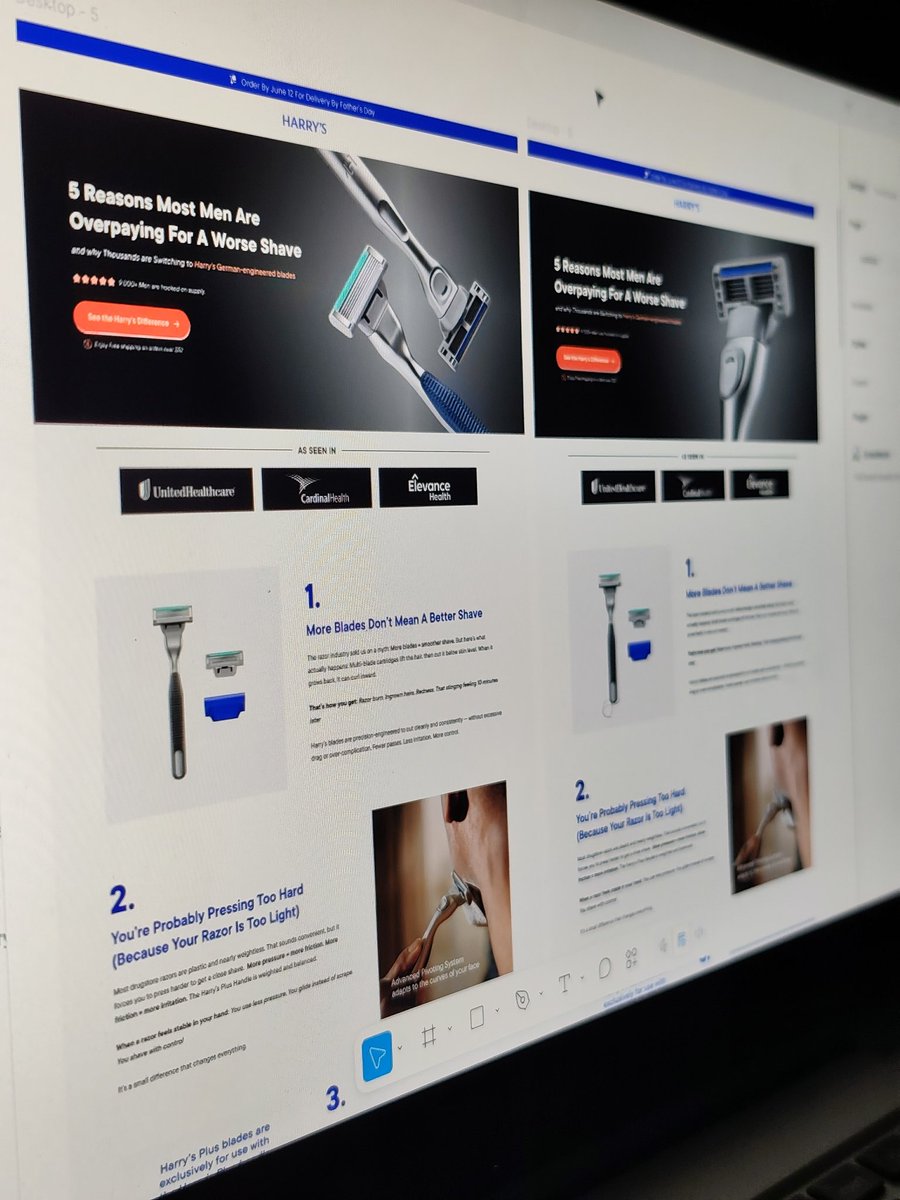
Just finished the mobile version of a razor advertorial.
Here’s the thing:
Mobile isn’t a smaller desktop.
It’s a different psychology.
Desktop = scanning.
Mobile = commitment scroll.
Every swipe is a decision.
If your sections don’t build belief fast enough, bounce wins.
Responsive design isn’t enough.
Mobile needs its own sequence.
Most brands design desktop first.
That’s backwards.
70%+ of paid traffic is mobile.
Just finished the mobile version of a razor advertorial.
Here’s the thing:
Mobile isn’t a smaller desktop.
It’s a different psychology.
Desktop = scanning.
Mobile = commitment scroll.
Every swipe is a decision.
If your sections don’t build belief fast enough, bounce wins.
Responsive design isn’t enough.
Mobile needs its own sequence.
Yesterday I kept “improving” a landing page.
More tweaks. More adjustments. More ideas.
It got worse.
Closed the tabs.
Stepped away.
Came back with one question:
“What doubt am I actually trying to remove?”
Deleted half of it.
It got better.
Clarity builds better work than intensity ever will.
Yesterday I kept “improving” a landing page.
More tweaks. More adjustments. More ideas.
It got worse.
Closed the tabs.
Stepped away.
Came back with one question:
“What doubt am I actually trying to remove?”
Deleted half of it.
It got better.
Clarity builds better work than intensity ever will.
Happy Birthday Big Ufot.
I started following your page recently, and I'm blessed already.
Thanks for the impact, the mindshifting training and setting the bar for excellence in design.
This is another cycle of God's Faithfulness.
Happy birthday boss. 🎉
Count your blessings
Name them one-by-one
Count your blessings
See what God has done
Count your blessings
Name them one-by-one
And it will surprise you what the LORD has done
Happy Birthday to me 🎉🎂
Earlier today, we debated the hero image.
Here’s what actually matters.
This page isn’t a PDP.
It’s an acquisition bridge.
Sequence:
Problem → Mechanism → Cost anchor → Irritation → Identity �� Comparison → Social proof → Close
Cold traffic converts when doubt is removed in layers.
Not when the design “looks clean.”
Screen recording attached.
Where would you test first?
Earlier today, we debated the hero image.
Here’s what actually matters.
This page isn’t a PDP.
It’s an acquisition bridge.
Sequence:
Problem → Mechanism → Cost anchor → Irritation → Identity → Comparison → Social proof → Close
Cold traffic converts when doubt is removed in layers.
Not when the design “looks clean.”
Screen recording attached.
Where would you test first?
Designers pick A.
Performance marketers pick B.
That’s why most hero sections underperform.
I rebuilt a razor advertorial.
Only changed the hero image:
A - full product shot
B - blade close-up
Same headline. Same CTA.
Here’s the difference:
A signals brand.
B signals mechanism.
Cold traffic doesn’t convert on brand.
It converts when doubt drops.
If you had to ship one without testing, which are you choosing?
A or B ?
Designers pick A.
Performance marketers pick B.
That’s why most hero sections underperform.
I rebuilt a razor advertorial.
Only changed the hero image:
A - full product shot
B - blade close-up
Same headline. Same CTA.
Here’s the difference:
A signals brand.
B signals mechanism.
Cold traffic doesn’t convert on brand.
It converts when doubt drops.
If you had to ship one without testing, which are you choosing?
A or B ?
Most people think this debate is about aesthetics.
It isn't.
It's about belief sequencing..
Cold traffic asks two questions:
1. Do I feel something here?
2. Can I act without friction?
Version A answers emotion first.
Version B answers clarity first.
If your product is a commodity, clarity often wins.
If your product is identity-driven, immersion can outperform.
Conversion is not about contrast.
It's about what reduces uncertainty for your audience.
Most brands optimize for what they prefer.
High-performing brands optimize for how buyers decide.
Most people think this debate is about aesthetics.
It isn't.
It's about belief sequencing..
Cold traffic asks two questions:
1. Do I feel something here?
2. Can I act without friction?
Version A answers emotion first.
Version B answers clarity first.
If your product is a commodity, clarity often wins.
If your product is identity-driven, immersion can outperform.
Conversion is not about contrast.
It's about what reduces uncertainty for your audience.
Most brands optimize for what they prefer.
High-performing brands optimize for how buyers decide.
Most founders default to contrast.
Most designers default to brand world.
But conversion is not about preference.
It is about what reduces friction for your traffic.
Would you optimize for immediate action?
Or emotional commitment first?
Curious how you think about it.