Why Euclid Is a Genius (Even Lincoln Read Him)
2,300 years ago, a mathematician named Euclid walked into the Library of Alexandria and wrote a book that revolutionized science. "The Elements" — 13 books, 465 theorems, and each one proved flawlessly.
His genius wasn't in the discoveries themselves. His genius was in the METHOD. Euclid started with a few definitions and postulates — basic truths that don't need proof. Then, using only logic and reason, he derived ALL the rest of mathematics. One brick after another. Bridge after bridge.
Why this was revolutionary:
No angles measured in degrees. No functions, no trigonometry, no calculus. It's old math. But it's so pure, so logical, that 2,000 years later people still considered it perfect.
Who read this book:
Archimedes (a few generations later) — constantly cited it
Cicero — revered it
Newton — thought very highly of it
Thomas Jefferson and Benjamin Franklin — knew it well
Abraham Lincoln — left his law practice, went home to his father's house, and studied Euclid's theorems until he could recite them by sight. "I then found out what demonstrate means," he wrote. Then he went back and won.
Albert Einstein — declared: "If Euclid failed to kindle your youthful enthusiasm, then you were not born to be a scientific thinker"
The funniest story:
Ancient Epicurean philosophers said: "Why prove that two sides of a triangle are longer than the third? Even a donkey knows this! Put a donkey at one vertex with food on the other side — it'll take the shortest path, not the long way around."
Later, Proclus (a Greek commentator) replied: "Yes, the donkey knows it. But WHY is it true? Fire warms — that's obvious to perception. But science's task is to understand HOW it warms. That's what Euclid did."
And he was right. 📐✨
Randomness Is Not as Chaotic as It Seems
When we hear the word "randomness," we often think of complete chaos. However, probability theory shows that even random processes follow certain patterns, especially when they are repeated many times.
One of the most important concepts is the Law of Large Numbers. It states that if a random experiment is repeated enough times, the observed frequency of an event gets closer to its true probability. For example, when rolling a six-sided die, the probability of getting a three is 1/6. After only a few rolls, the results may differ greatly, but after thousands of rolls, the proportion of threes will be very close to the expected 16.7%.
Another interesting feature of randomness is that it often creates the illusion of patterns. Randomly placed points may form clusters, and repeated coin flips can produce long streaks of heads or tails. Although these streaks may seem unusual, they are a normal part of random processes.
Randomness also has no memory. If a coin lands on heads ten times in a row, the probability of getting heads on the next flip is still 50%. Each flip is an independent event and is not affected by previous outcomes.
Probability theory also helps explain rare events. Winning the lottery or receiving a specific hand of cards is extremely unlikely, but if there are enough attempts, such events are bound to happen. That is why rare events occur regularly in real life.
Studying randomness helps us better understand the world, avoid common thinking mistakes, and make more informed decisions. Although randomness may seem chaotic, it follows mathematical laws that describe many natural and everyday phenomena.
Randomness Is Not as Chaotic as It Seems
When we hear the word "randomness," we often think of complete chaos. However, probability theory shows that even random processes follow certain patterns, especially when they are repeated many times.
One of the most important concepts is the Law of Large Numbers. It states that if a random experiment is repeated enough times, the observed frequency of an event gets closer to its true probability. For example, when rolling a six-sided die, the probability of getting a three is 1/6. After only a few rolls, the results may differ greatly, but after thousands of rolls, the proportion of threes will be very close to the expected 16.7%.
Another interesting feature of randomness is that it often creates the illusion of patterns. Randomly placed points may form clusters, and repeated coin flips can produce long streaks of heads or tails. Although these streaks may seem unusual, they are a normal part of random processes.
Randomness also has no memory. If a coin lands on heads ten times in a row, the probability of getting heads on the next flip is still 50%. Each flip is an independent event and is not affected by previous outcomes.
Probability theory also helps explain rare events. Winning the lottery or receiving a specific hand of cards is extremely unlikely, but if there are enough attempts, such events are bound to happen. That is why rare events occur regularly in real life.
Studying randomness helps us better understand the world, avoid common thinking mistakes, and make more informed decisions. Although randomness may seem chaotic, it follows mathematical laws that describe many natural and everyday phenomena.
The financial system is the foundation of the modern economy, where every participant plays an important role. Financial institutions help allocate capital, manage cash flows, and support the stability of economic activity.
A key figure in the development of economics is John Maynard Keynes. His ideas on the role of government, consumer spending, and monetary policy have had a lasting impact on modern macroeconomics and continue to influence economic thinking today.
I’ve already earned over $12,000 on Upwork as an AI Creator, yet I still do free test tasks. Does that make me an Indian? 😅
This was a test assignment for a client in the interior design industry. They need realistic AI-generated videos that look like real-life footage.
They want 20 videos per month, each 25 seconds long.
Here’s the catch: they pay $400/month, plus performance bonuses. If a video gets more than 1,000 views, they add a $10 bonus for that video.
And just to be clear: I did not agree to this job. But I made them an offer and asked
⚠️ THE FUTURE OF PHYSICAL WORK JUST GOT A LOT CLOSER
Everyone is watching the swords.
They’re looking at the wrong thing.
What matters isn’t the performance.
It’s the control.
A humanoid that can:
— balance under constant motion
— manipulate tools with both hands
— react without losing stability
— repeat complex actions again and again
…is learning the exact skills that translate into real work.
Factories won’t care about the swords.
Construction sites won’t care either.
They’ll care that the same machine can work for hours without fatigue and execute tasks with incredible consistency.
This isn’t a video about martial arts.
It’s a preview of what physical AI could look like over the next decade.
About a year ago, I came across a Reddit meme that made me realize how impossible it is to find old files, screenshots, and documents once they disappear into your phone.
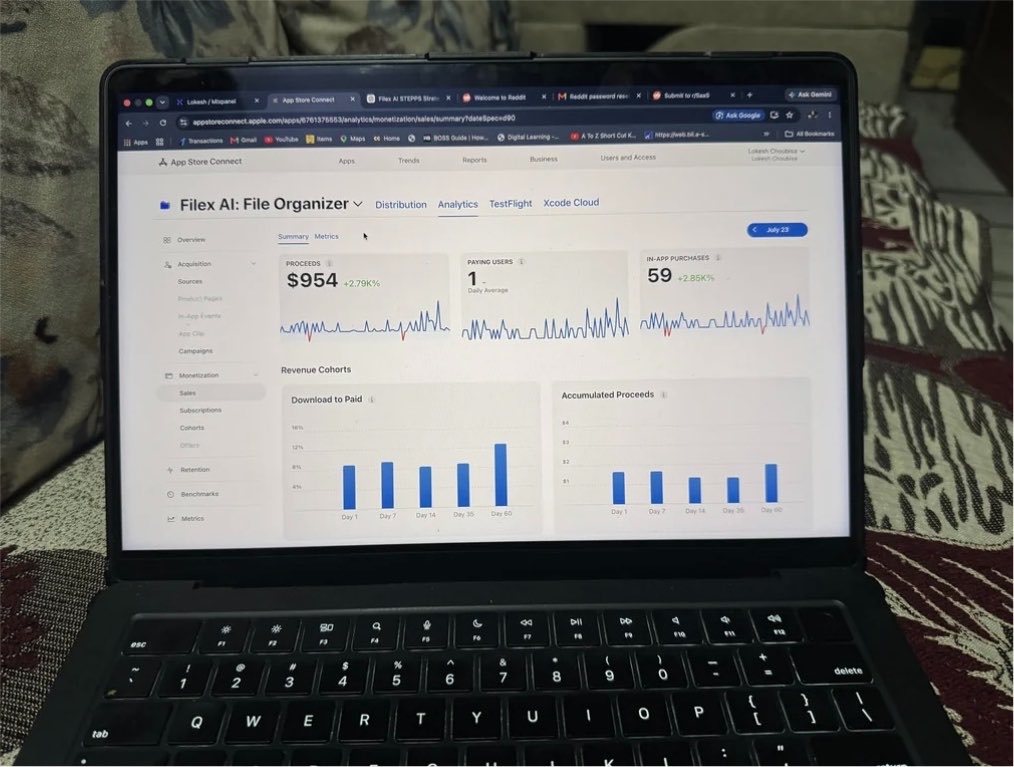
Today I’m about $46 away from my first $1,000 in App Store proceeds.
The interesting part is that reaching this point wasn’t just about building the app.
When I started, I barely knew more than HTML. AI helped me learn and build much faster, but the hardest part wasn’t writing the code—it was figuring out how to get people to discover and pay for the product.
I kept improving my App Store listing, redesigned my screenshots four times, researched keywords, and focused heavily on ASO until I started ranking for searches that mattered.
I also invested in SEO by publishing 40+ blogs and 20+ programmatic landing pages, all connected through strong internal linking. That gradually brought consistent organic traffic.
I experimented with Reddit, Instagram Reels, and X too, but as a solo founder it’s hard to stay consistent when you’re also writing code, fixing bugs, answering support, and shipping new features.
Looking back, building the product was only half the work.
Learning how people discover it was the other half.
Still a long way to go, but it’s crazy to think a meme I almost scrolled past eventually turned into something people pay for.
For founders who’ve made it past this stage, what would you do next if you were me?