Prediction markets are quickly becoming one of the most talked-about sectors in finance.
Kalshi, the U.S. prediction market leader, now controls over 90% of the market after recording $16.81 billion in trading volume in May alone.
The company recently raised $1 billion, pushing its valuation to $22 billion, more than double its valuation from December 2025.
Major investors, including Sequoia Capital and Morgan Stanley, are backing the platform as prediction markets gain recognition as potential hedging tools for institutions.
While discussions around a future IPO are reportedly targeting 2027–2028, Kalshi continues to face challenges from regulatory scrutiny and state-level lawsuits related to sports-event contracts.
The bigger picture is clear: prediction markets are evolving from a niche concept into a growing financial sector, attracting both retail traders and institutional investors.
#IPO #BingX
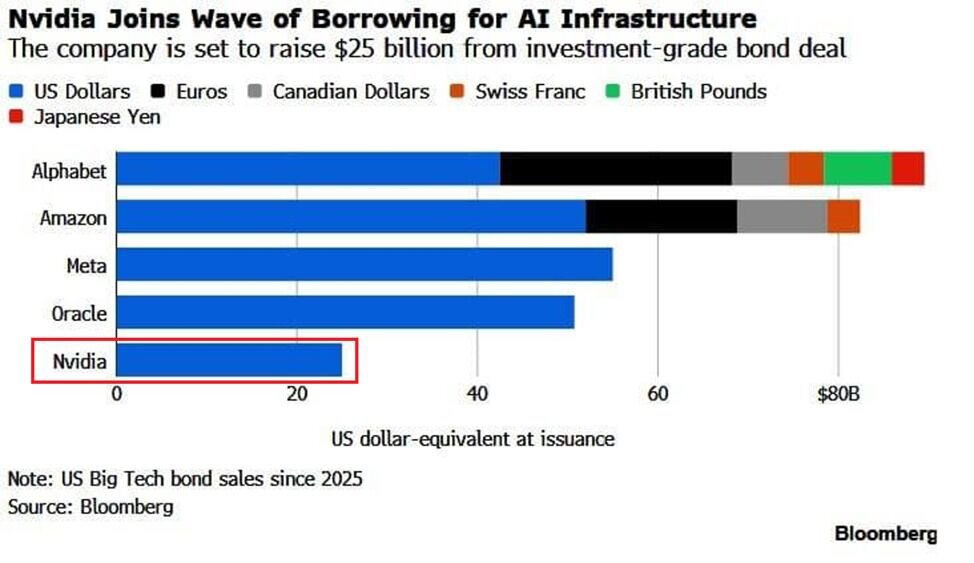
$NVDA raising $25B through bonds says a lot about where the AI race is headed.
Big Tech isn’t slowing down. They’re borrowing aggressively to keep building data centers and AI infrastructure.
Was looking at AI-related markets on BingX earlier, and it’s hard not to notice how much capital is flowing into this narrative.
The real question now is:
Are we still early in the AI boom, or are companies already pricing in years of growth?
#Nvidia #AI #Markets #Stocks
Agent commerce will not scale on traditional L1 rails. The reason is simple: machines don’t operate in minutes or seconds—they operate in milliseconds and at high frequency.
Forcing every agent-to-agent interaction through on-chain settlement introduces friction that breaks the entire economic model. Micro-payments become expensive due to gas fees, latency accumulates with every block confirmation, and the system quickly becomes inefficient as transaction volume increases. What looks secure at the base layer becomes a bottleneck at the application layer.
This is where the architecture needs to evolve.
Yellow Network introduces a different model built around state channels. Instead of settling every interaction on-chain, agents transact off-chain at real execution speed. Thousands of interactions can happen instantly, with cryptographic guarantees maintained throughout the session. Final settlement only occurs when necessary, dramatically reducing congestion and cost.
The result is an environment where agents can actually behave like autonomous economic actors rather than constrained users of legacy infrastructure. Cross-chain liquidity is unified without relying on fragile bridging systems, meaning agents are not locked into isolated ecosystems. Value can move freely while maintaining security guarantees.
This shift matters because agent economies are not a theoretical future—they are already emerging across trading systems, APIs, automated services, and AI-driven marketplaces. But without proper settlement infrastructure, they remain limited in scale and efficiency.
The next phase of Web3 infrastructure is not just about faster chains or cheaper transactions. It is about removing unnecessary settlement from the critical path of computation and allowing economic activity to happen at the speed of software.
That is the core idea behind @Yellow: a custodian-free, instant settlement layer designed for autonomous systems operating across chains, without friction or fragmentation.
Learn more at https://t.co/0nStx8BJIe
$YELLOW
🚨 $GALAXY Genesis Private Sale is LIVE. No vesting. No cliff. FCFS allocation. $25K hard cap, token launch next week. Cardano and Solana wallets supported. This fills fast. Check your email now : https://t.co/mNK2vcdEz7 @GalaxySwapLabs
The strongest innovations solve tomorrow's problems before they become today's emergencies.
@qlabsofficial is bringing quantum-resistant security into Web3 today, with $qONE helping power a safer, stronger, & more future-ready blockchain ecosystem.
#qONE#qLABS#QuantumSecurity
Built a small research playground with Nimble API.
You enter a prompt:
→ Research OpenAI competitors
→ Find AI startups in (Any country of your choice)
→ Analyze the AI coding agent market
The app turns it into a structured research report with summaries, findings, and source cards.
Here's the workflow 👇