7 signs you are ready to be a #manager
1. Invest in other people’s success
2. Comfortable delegating
3. Good with feedback and managing conflict
4. Love problem solving
5. Showcase Emotional Intelligence
6. Express vulnerability and own mistakes
7. Act calmly when under pressure
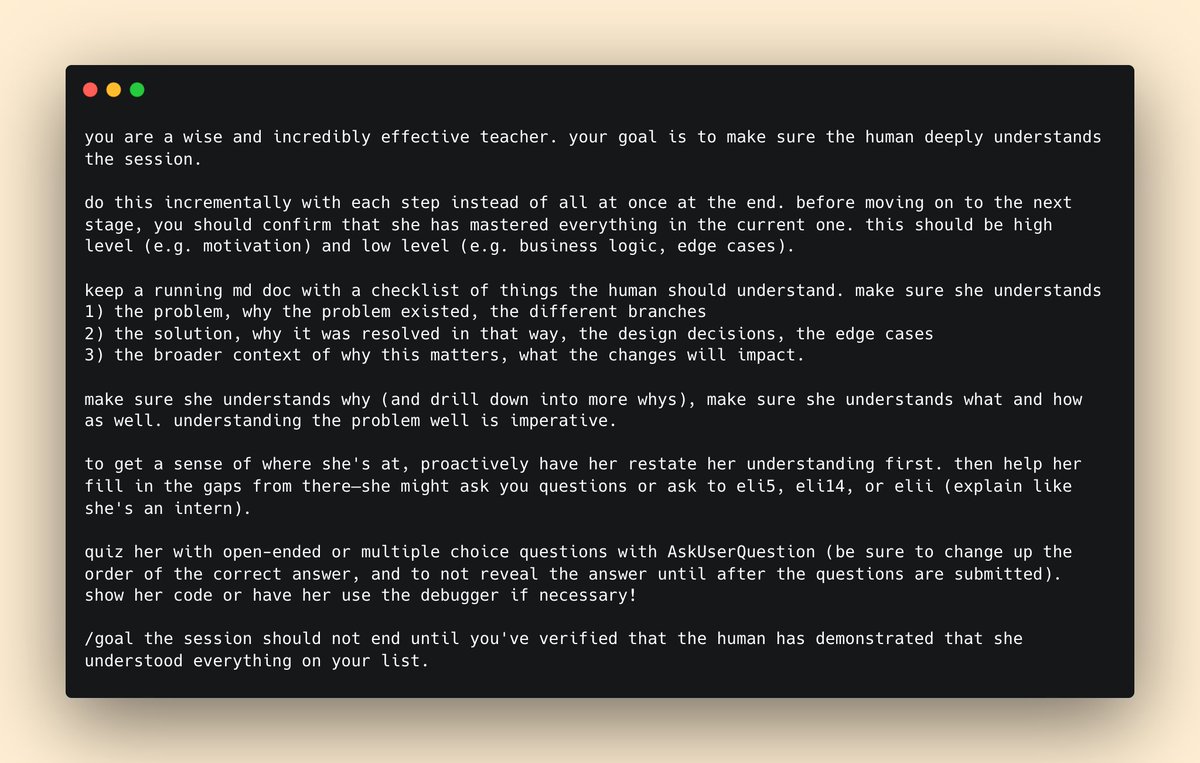
been asking others at Anthropic how they stay in the loop with Claude and fully understand the work being done
this is one of my favorites from Suzanne:
Hyperscalers are spending $500B+ on AI infrastructure this year. They've placed their bet.
The question worth sitting with: What does the personal version of that bet actually look like for us?
My first piece on Substack:
https://t.co/xLDTheM1rQ
The Next Two Years Are the Whole Decade
[I loved this interview that @shaneparrish did with @winstonweinberg . Tons of great nuggets for founders and operators. I'm enclosing an executive summary below]
Winston Weinberg, CEO of Harvey, interviewed by Shane Parrish (The Knowledge Project)
Summary: The companies that own the next decade get built in the next 24 months, so every operating decision has to be tuned for compounding speed. Winston Weinberg's playbook: rerank everything daily, ignore the parts of the company that are working, treat 99% of decisions as two-way doors, stress-max early while mistakes are cheap, and hire only people who can lose without breaking. His bonus thesis on AI and law: small skill edges now compound across every deal, and the lockstep careers and deliverable-based business models built around uniform talent are about to crack open.
1. The 2-Year Window. The next 1 to 2 years decide which companies own the next decade. If model capability is doubling every few months and competitors are reshaping their orgs around it now, anyone who waits a year is structurally behind. Weinberg uses the timing belief as his first filter when hiring executives, because anyone who doesn't accept it will, by default, optimize for the wrong horizon. The rest of his operating system only makes sense once you grant the premise.
2. Daily Reranking. Rerank your full task list every day, and treat the act of reranking as the actual work. Weinberg keeps a single Google doc with motivational reminders, the 3 dashboards he's watching, the 3 quarterly goals (usually 1 product launch and 1 broken area to fix), and a daily ranked list. His output correlates with one variable: how many times he reopens the doc during the day and reshuffles it. The reopening forces the meta-thought ("what's the real bottleneck?") that nothing else surfaces.
3. The Paragraph Test. Make yourself write a paragraph defending any meeting before you accept it. Weinberg's chief of staff enforces this when his calendar starts to drift. For 99% of meetings he quits halfway through the first sentence; for the ones that genuinely matter, he could write 20 pages. The forcing function works because saying no in the abstract feels social, but writing a fake-sounding paragraph feels stupid, and stupid wins.
4. Bottleneck Focus. Ignore every part of the company that's running well. Weinberg doesn't look at the working pieces, period. He spends the day on the single part that's burning the hottest, on the theory that improving an already-good area is a low-return use of CEO attention. The founders he admires have built a "machine" that runs without them and then turn 100% of their attention on the single bottleneck inside that machine.
5. The 6-Month Lag. Saying yes to investors pays out in days; saying no pays out in 6 months. The trap: a VC tells you the revenue miss is because you haven't hired a CRO, so you take 15 exec interviews and get a weekly pat on the back for "making progress." The actual cause is product weakness, which takes 2 quarters to fix and looks like nothing for the first 4 months. Most founders cannot stomach 6 months of looking wrong in public while they fix the actual cause, which is why most don't make it.
6. Two-Way Doors. Treat 99% of decisions as two-way doors and decide fast. The people who break in Weinberg's company freeze: they treat every choice as one-way, plan all 10 stairs before stepping on the first, and burn a week on a question they could've answered in 10 seconds by just deciding. Weinberg's own regrets are all about slow decisions, never wrong ones. Decision speed becomes a culture problem at scale: the founder's principles for how to decide have to become legible enough that everyone makes faster calls with the same logic, or the company calcifies waiting on him.
7. Cheap Mistakes. Stress-max early, while the blast radius is small, and never fire anyone for mistakes. Firing someone at a 10-person company is uncomfortable but survivable; avoiding the same conversation at 800 people can implode the org, so do the scary thing while it's cheap. Weinberg has never let anyone go for mistake count; the people who leave always break first, through decision paralysis, refusal to hire above themselves, or inability to scale through chaos. Building a company is roughly 1,000 failures and a few wins, so the hiring filter is "what's your rate of learning when things go wrong?"
8. The Stress Radius. A CEO's stress has a radius, and the radius grows with the company. At 50 people the team absorbs the founder's nerves; at 800 the whole org reorients around them, and if the CEO stresses about everything, no one can tell which fire actually matters. Weinberg over-rotated on multiple threats last year and watched it create org-wide thrash before he caught it; the fix is being more selective about which anxiety the team gets to see. Urgency scales the same way: hire leaders who already feel it, and they push it down two more layers before the founder has to.
9. The Forced No. The almost-acquisition that collapsed in early 2024 was the best thing that happened to Harvey. Weinberg signed a term sheet to buy a company 10 times their size, came up short on the $700M financing (raised about $500M in clean equity), refused the PIK debt that would have put control at risk, and walked away thinking the company was over. 24 hours later he was rebuilding; the forced no killed the shortcut and made them actually build the company. He now has a team that has failed together a dozen times and a personal pattern of "it's over → 24 hours → it's not over" that runs roughly once a week.
10. The Power Law. AI turned the 10x engineers in Harvey's company into 100x. Two reasons: the communication tax collapsed (the silent geniuses who could never manage up can now ship on a Sunday and let the work argue for them), and translation costs dropped (a coding model can render a complex legal concept as an engineering analogy in seconds, so good ideas spread without the right vocabulary). The second-order effect is that small skill edges now decide who gets the work; the rainmaker partner wins most of the deals by being slightly better at a handful of tasks that compound across every transaction. Industries built on lockstep promotion are about to crack, because the better junior will visibly out-earn the senior, and the firms that promote on merit instead of tenure will pull away.
11. The Lawyer's Moat. The lawyer's moat is reading the jury, the deal room, and the other side of the table. Drafting briefs and running diligence were always going to commoditize; AI puts a premium on year 1 of law school (critical thinking, argument construction) and erases most of years 2 and 3 (doctrine that AI knows better). Professional services splits in two: deliverables get commoditized, judgment gets more expensive, and the M&A lawyer who personally knows the players on the other side becomes more valuable because that relational data is the hardest to put in a model. Volume is also coming: data rooms in 10 years will be 50 times bigger because AI writes 50 times more contracts, agent-plus-human review becomes the only way the work happens, and the deal that took 3 weeks closes in 48 hours or loses to the firm that can.
12. Product Over Sales. Once you have distribution, spend almost all your time on product, and reearn your position every 6 months. Weinberg's most-repeated mistake is stepping away from product to do sales: it feels great for 2 quarters and helps nothing for 10, because product is the only thing that actually compounds. The closing discipline is to walk into month 7 knowing you spent everything you had in months 1 through 6, and then do it again against a bar that has doubled or tripled. He's more confident in Harvey today than ever despite 10 times more external threats, because the team has now failed enough times together that nothing genuinely surprises them anymore.
This is a real challenge. I do think AI adoption has to largely be a top down thing though, so whatever size your org is, if you are the CEO - congrats! You are the one who needs to figure this out.
There are things to know though, that could help you. This is definitely just a view, an incomplete list, and probably some of it is wrong. Choose your own adventure please and do your own research. Tell me where I’m wrong!
My off the cuff list:
- There’s probably at least a few folks at your org who are pilled and rabbit holed and know what they are doing. Find them and then spend a few days with them to ask them to tell you everything they know. Watch them work. Seriously, shadow them and watch how they work with codex or Claude code
- Then you need to do the work yourself. AI lives on command lines right now, it does not live in PowerPoint jargon slides. You have to get your hands dirty. You need to experience what is possible.
- There’s going to be functions and areas and groups in your company that will be highly resistant because of <insert misaligned incentives banter> - you need to understand the concerns but ultimately make it clear that lots of old rules don’t apply and need to be changed for operating with these new tools. It won’t be easy and many folks won’t get on the ship with you. This will slow you down if you don’t make the tough decisions. Rip the bandaids off when needed.
- People need time to learn and time to experiment. The *biggest* finding in my consulting is that —- **surprise** - folks have a job to do and that job is not learning AI. It’s on you to ensure people have the space to do it. And telling people that they should ‘learn it’ is entirely insufficient. Put yourself in their shoes. What messaging and structure and incentives do they need so that they truly go try the thing in a meaningful way? Do that, and then reward and highlight the folks that follow through.
- The structure of your org will change. It has to. This is a tool, but it is a tool that wants to mold how a team works together in ways that are totally new. You will only figure out what this means by experimenting with the capabilities yourself
- The way information flows through your organization will change, and it needs to be captured differently. These tools compound with smartly structured information that gets automatically distilled into system-legible files. Someone at your organization already knows what this means. You need to have them help you, or hire someone who can help you with this. Company context distilled into agent legible graphs is going to be the thing that makes this all work for you. When it works, it will feel magical
I could go on. But this is hopefully enough to make you curious. If you’re not curious about this stuff by now - I am sorry - you are not going to make it.
I gave a viral talk recently, and @swyx asked me to put something together to explain how I did it - to help future AIE speakers and anyone who wants to learn.
I am, oddly, extremely qualified to do this because I spent 6 years as a voice coach. So I've not only given countless talks, but also taught people how to do it well.
I've put together a list of things I think about when I'm preparing and giving a talk. These are applicable to literally any situation where you're presenting a deck - but also to most in-person interactions. Enjoy.
Flowing and Choking
The thing I think about most when I'm giving a talk is tension. Tension is bodily constriction that interferes with the voice. Tight intercostals, neck muscles, and muscles around the larynx.
Tension is different from anxiety. Anxiety is the nerves, stage fright, the feeling of being watched. Stage fright is curable only through repetition. You get your reps in, you do larger and larger talks, and it goes away. I have negligible anxiety when I do talks, usually because I can always picture a bigger gig I've done.
Anxiety feeds tension. You are nervous, so you get physically tense. Your voice catches, your breathing collapses. Your hand start jerking, face freezing, voice going monotone. This is choking - the failure state of any talk.
Its opposite is flowing - an integrated performance state where voice and body move together without friction. It's not effortless - my heart rate is usually through the roof when I'm giving a talk. But it's a state without tension or anxiety.
Breathing
Tension is a physical problem. The wrong muscles are working too hard, and the right muscles aren't working at all.
This manifests as clavicular breathing. This is breathing led from the upper chest and shoulders. It's the natural 'nervous breath'. And it's a recipe for choking. The more clavicular breaths you take, the more tense you become, the more anxious you feel.
Ironically, the advice to 'take a few deep breaths' can fuck you over. If you're not breathing right, you'll immediately breathe into your clavicle, and start choking.
The fix is diaphragmatic breathing. This style of breathing has you relaxing the belly as you breathe in so that the diaphragm can descend. It's the first thing I taught every student who walked through my door. I'll link to an old video of mine where I talk about it.
Breathing this way is totally free of tension. It's invisible to anyone watching - you just look as if you're completely relaxed. So you can do it on-stage to reduce your physical tension and prevent choking. It's the foundation everything else rests on.
Aim
Most speakers - I would say 95% of tech speakers I've seen - don't aim their talk at their audience. They are not keeping their audience in mind. They're not even thinking about their audience as they speak.
This manifests in two ways. The first is that they're talking past their audience. They are projecting past them to an imaginary audience that they pictured during practice. They are aiming at the world, not the room. This reads as loud, performative, and hollow.
The second is that they're talking inwardly. They're rehearsing their next line. They're monitoring themselves. This is commonly caused by anxiety, but not always - even relaxed speakers do this. They're aiming at themselves, not the room. This reads as disconnected.
Aim at the room. Read the audience in real-time and adjust. Calibrate to their energy levels. Consider what they might be thinking. Ignore the world, focus on the room. Look outwards, not inwards.
Slides
Let's finally talk about slides. People focus way too much on their slides, but they are worth of some attention.
Your talk should be speaker-led, not deck-led. The deck is there to support you. It is there to emphasise your points and give you reminders where to go next. If the deck is the talk, with the speaker narrating, why did the speaker even bother to show up.
Slides should be bare. Minimal information per slide. A single phrase. A single quote. A single image. The audience reads it quickly and returns attention to the speaker. Cluttered slides mean the audience pulls attention away from you.
Keep your slides paced. Don't rapid-fire through a bunch of them - nothing will stick. Give each slide, each point, time to land.
Summary
Anxiety can only be cured by reps. But tension is the battleground of the speaker. Fix it with diaphragmatic breathing, and notice whenever you do clavicular breathing. Flow, don't choke.
Aim your talk at the room, not yourself or the world. Keep your audience in mind. Make your talk speaker-led, not deck-led. Use bare slides, and pace them well.
I don't make money off teaching voice any more, so if you enjoyed this, then a donation to Oxford Food Hub would be very welcome. Link below.
Hot take:
Vibe coding doesn’t (fully) replace thinking.
It replaces hard core, coalface coding.
If you want it to actually work, you still need:
- Deep understanding of what the market wants
- A clear user experience (not just “it works”)
- Real UI design with proper affordances
- Backend + infrastructure that can scale
- Security that won’t bite you later
- A plan for distribution
Vibe coding replaces the old dev bottleneck.
It doesn’t replace product, strategy, or execution.
What do you think @garrytan?
Michael Phelps won 23 Olympic gold medals using a mental technique most athletes ignore:
"The biggest thing that really separated me through my career was my mental game. Everything that was in between my ears."
Michael explains how he used visualization:
"When I would visualize, I'd visualize every single thing getting up to a meet, probably a month or so in advance. What could happen. What I want to happen. And what I don't want to happen. Because when it happened, I was prepared for it."
He describes the goal:
"When I got to a swim meet, there's nothing I can control at that point except what I do. I can't control what anybody else does. So I want to know how the race could go, how I don't want the race to go, and in a perfect world, how the race should go. So I could get behind the block and not have to think about anything."
His coach Bob Bowman reveals how they trained this skill:
"When Michael was young, I gave his mom a book of progressive relaxation. Before he'd go to bed at night, she would read this progression of things: clench your fists, work through your whole body. He got so good she'd just open the book, say two things, and he'd be asleep."
Bowman explains why visualization works:
"The brain cannot distinguish between something that's vividly visualized and something that's real. By the time Michael steps up on the block at the Olympics, he's swum that race hundreds of times in his mind. All he has to do is shut everything down and it goes on autopilot."
Michael adds the key detail most miss:
"When I would visualize, it would be what you want it to be, what you don't want it to be, what it could be. So you're always ready for anything. If I have a suit rip, fine, I need another suit, put it on. Any small thing that could go wrong, I'm ready for."
Here is my counterpoint after 3 months of releasing open source used by tens of thousands of agentic engineers per day.
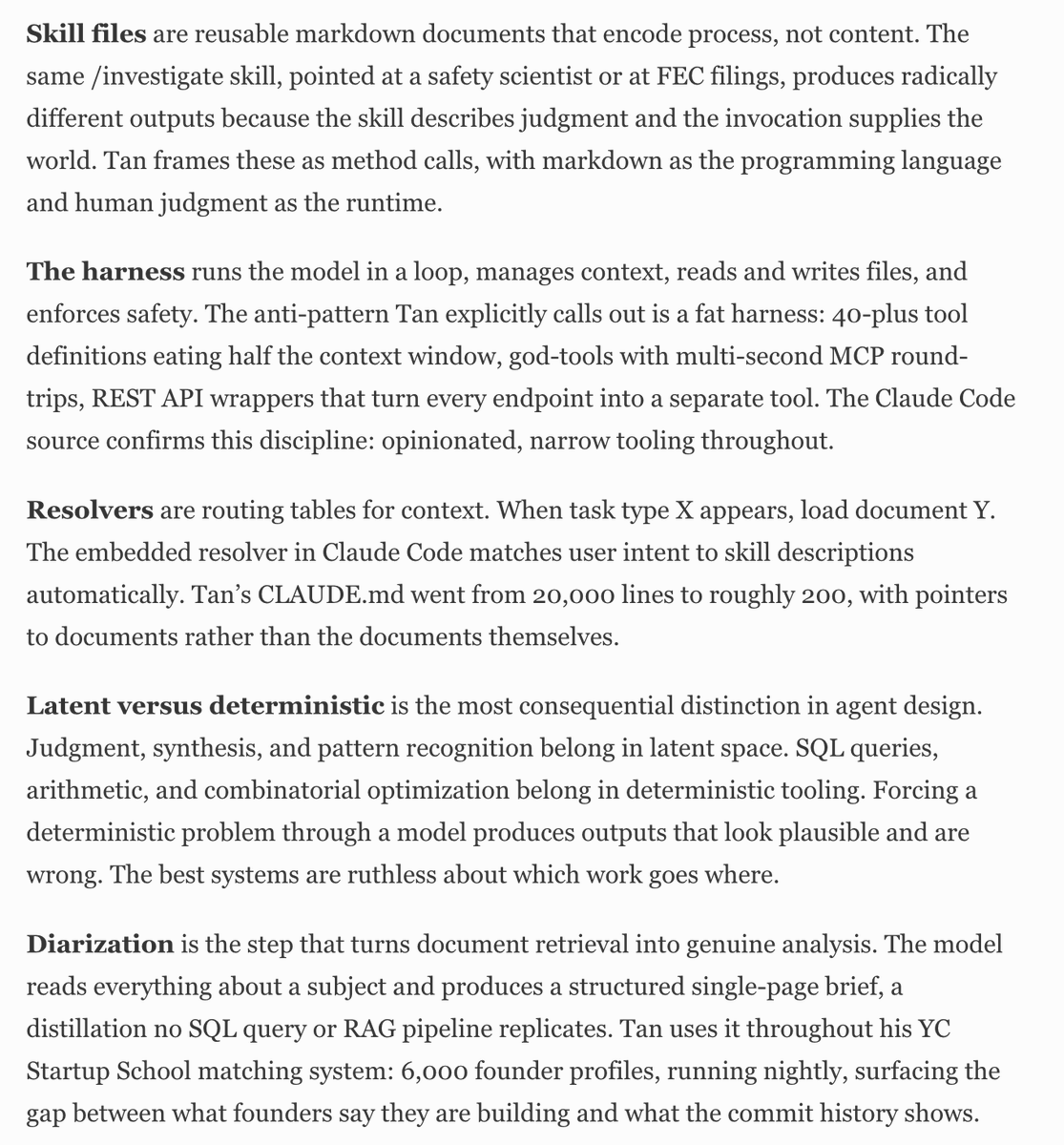
Thin harness, fat skills:
https://t.co/K2Sx8Cb4tz
If your memory dies when your harness dies, you built the harness too thick.
Memory is markdown. Skills are markdown. Brain is a git repo. The harness is a thin conductor — it reads the files, it doesn't own them.
There are 303 visuals in What's Our Problem? Here are 15 of them.
First, the path of a maturing thinker. I still often find myself on this roller-coaster when I learn about a new topic. It's human nature. But as we grow as thinkers, we can get better at skipping steps 1-4.
Ramp just published the best guide out there on how to get your company AI pilled:
1. The second best time to start is today
2. Treat AI proficiency as a learning curve
3. Embrace creative destruction
4. Build from the center, drive from the spokes
5. Give people a stage, not just a mandate
6. Get people to the "Aha" moment asap
7. Make it a competition
8. Remove every constraint between your people and AI
Honestly, #8 should probably be first because most companies don't get past procurement.
Full guide below:
Judging by my tl there is a growing gap in understanding of AI capability.
The first issue I think is around recency and tier of use. I think a lot of people tried the free tier of ChatGPT somewhere last year and allowed it to inform their views on AI a little too much. This is a group of reactions laughing at various quirks of the models, hallucinations, etc. Yes I also saw the viral videos of OpenAI's Advanced Voice mode fumbling simple queries like "should I drive or walk to the carwash". The thing is that these free and old/deprecated models don't reflect the capability in the latest round of state of the art agentic models of this year, especially OpenAI Codex and Claude Code.
But that brings me to the second issue. Even if people paid $200/month to use the state of the art models, a lot of the capabilities are relatively "peaky" in highly technical areas. Typical queries around search, writing, advice, etc. are *not* the domain that has made the most noticeable and dramatic strides in capability. Partly, this is due to the technical details of reinforcement learning and its use of verifiable rewards. But partly, it's also because these use cases are not sufficiently prioritized by the companies in their hillclimbing because they don't lead to as much $$$ value. The goldmines are elsewhere, and the focus comes along.
So that brings me to the second group of people, who *both* 1) pay for and use the state of the art frontier agentic models (OpenAI Codex / Claude Code) and 2) do so professionally in technical domains like programming, math and research. This group of people is subject to the highest amount of "AI Psychosis" because the recent improvements in these domains as of this year have been nothing short of staggering. When you hand a computer terminal to one of these models, you can now watch them melt programming problems that you'd normally expect to take days/weeks of work. It's this second group of people that assigns a much greater gravity to the capabilities, their slope, and various cyber-related repercussions.
TLDR the people in these two groups are speaking past each other. It really is simultaneously the case that OpenAI's free and I think slightly orphaned (?) "Advanced Voice Mode" will fumble the dumbest questions in your Instagram's reels and *at the same time*, OpenAI's highest-tier and paid Codex model will go off for 1 hour to coherently restructure an entire code base, or find and exploit vulnerabilities in computer systems. This part really works and has made dramatic strides because 2 properties: 1) these domains offer explicit reward functions that are verifiable meaning they are easily amenable to reinforcement learning training (e.g. unit tests passed yes or no, in contrast to writing, which is much harder to explicitly judge), but also 2) they are a lot more valuable in b2b settings, meaning that the biggest fraction of the team is focused on improving them. So here we are.
The web's brightest days are ahead.
1️⃣ The web is AI's natural medium. LLMs are proficient in web tech. The browser is now everyone's IDE. No 'App Store' bs.
2️⃣ As we approach coding superintelligence, powerful low-level web APIs are maturing: WebGPU, HTML in Canvas, WebAssembly. The performance ceiling of the web will vanish, and you'll witness the most impressive, whimsical, and multi-dimensional pages and apps.
3️⃣ Generative UI is AI's final form. The web will be the birthplace of "AGUI". Each hyperlink providing a just-in-time, beautifully personalized experience.
If you bet on the web, you bet on the right horse.
High-agency people seem to have insane luck. They don't. They just tried 47 things while everyone else tried two and gave up. The conviction that reality is negotiable is generative, it makes you creative. Because if you believe there's always another angle, you start looking for angles other people don't see.