@GyftrIndia@HDFCBank_Cares
I am trying to access my airport lounge access voucher using GYFTR.
The website shows scheduled maintenance for next 3 days.
Extremely frustrated with the service.
https://t.co/zibtrysODt
@Anuragg_CA 100% true ! But the world of fundamentals is kind of non-deterministic, what signals to take and ignore are important to distinguish between.
What all things do you look at?
"Dont go outside the system"
I agree.
But what is a system?
Is it a set of static execution rules (partly borrowed partly self built) that we follow so we dont succumb to our emotional volatility ?
Or is it a decision making framework, that is constantly questioned, refined and rebuilt to fit you, your lifestyle and a market that never stops changing ?
A system isn't made just to make you feel disciplined. It's made to consistently put you in the best opportunities across market cycles (bull, bear and choppy) and generate profits that are sustainable, repeatable and scalable.
If your system isn't intentionally trying to make itself better, it isn't really a system. It's muscle memory. Mindless repetition disguised as discipline.
And this is also where a lot of traders quietly plateau. Not because they lose money but because years later they are still running the same static playbook waiting for the perfect setup, perfect market and perfect mindset to line up. And that rarely happens.
This is not the first choppy market you have traded through, and it will surely not be the last.
If your system looks exactly the same after every 3-6 quarters, you have probably stopped evolving as a trader.
So yes, don't go outside the system.
But spend years building one that evolves so well, you rarely need to.
P.S. - not at all a shade on Nishit. Just my Rs 1.91
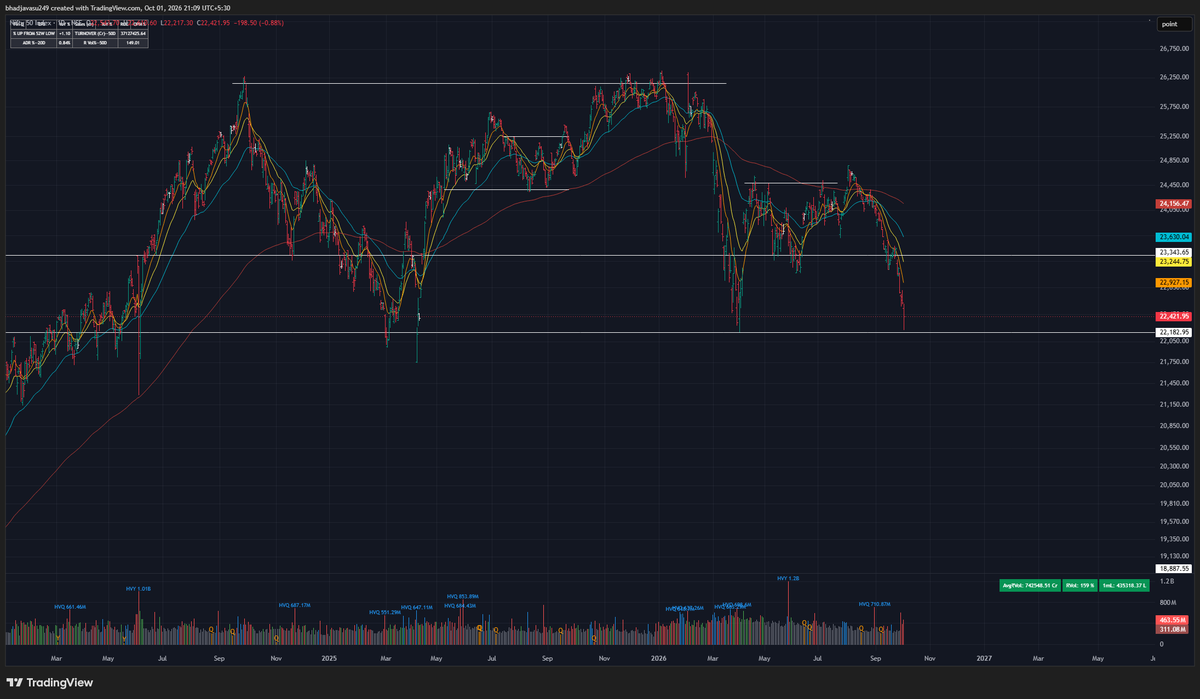
In these choppy markets, the most common confusion among traders is exits. Although it is a complex topic and there is no correct answer, but understadning different approaches matters.
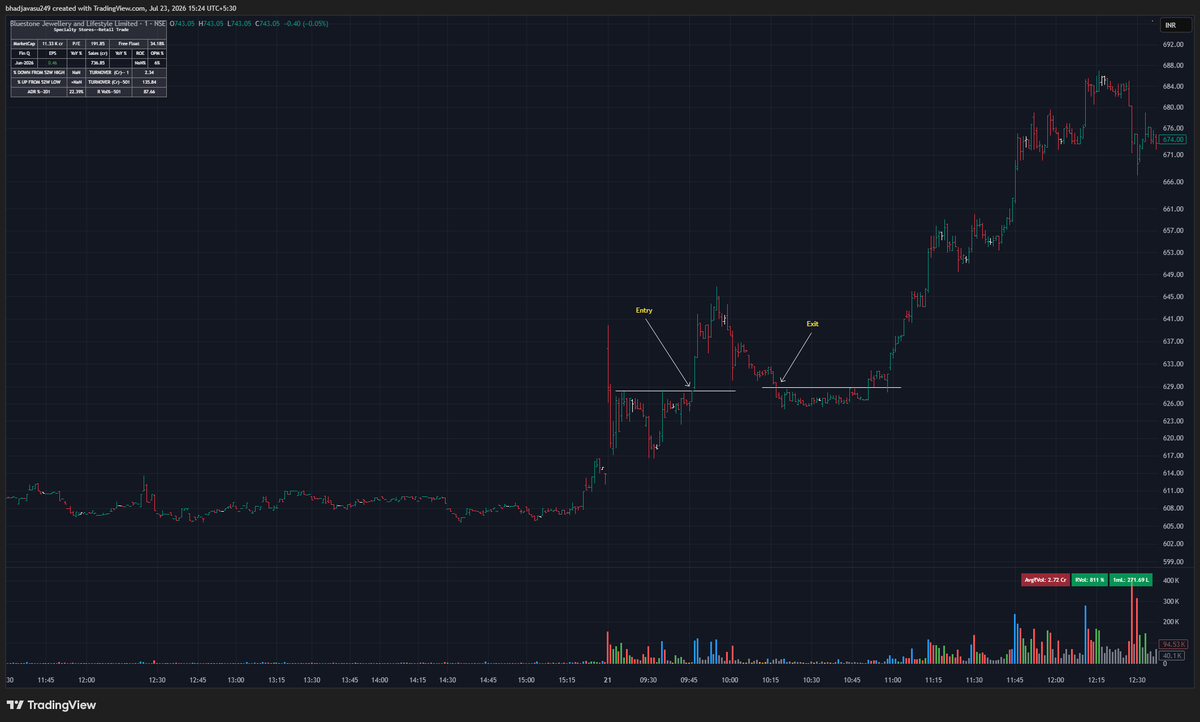
How would you have managed the trade in this case and why?
@swing_ka_sultan@Anuragg_CA How would you have managed it?
These guys have touched on this topic on their YT channel. I recommend all to check the video out (https://t.co/FbGiM49Axp).
This is probably my most important post.
The FED stole your future and there is no going back
"The system is rigged. The deep state does not want us to be free. The American dream is dead."
Statements like these conjure images of deep pessimism, a worldview where you have no agency, where you are merely a puppet dancing for malignant powers you cannot see or touch. We are not people who live in that camp. But sometimes, certain data points are so damning that they leave us no choice but to admit: something is seriously wrong, and it needs to be laid out in the open.
Every time I visit India now, I find people agitated. Even those in the top 10% of the income bracket, earning anywhere from ₹50 lakhs to a crore per year, feel like they are running on a treadmill that keeps accelerating. No matter how fast they move, it is never enough. At the ground level, the situation is far worse. It is the same story everywhere. In Canada, both partners in a household work full time and still fall short each month. In Australia, young professionals earn well and own nothing. In Germany, the middle class quietly shrinks. The geography changes. The exhaustion does not.
And the origins of this mess are not in New Delhi or Ottawa or Berlin. They are in Washington D.C. All of us are paying the price for a policy disaster handed down from ivory towers, by people most of us never elected and, frankly, never even saw.
Consider this: the U.S. money supply (M2) grew by 40% in just 2 years
*The Federal Reserve United States Money Supply M2*
January 1, 2020: $15.4 trillion
January 1, 2022: $21.6 trillion
A staggering ~40% increase
As of Mar-26, $ 22.6 Tn
( so they never reversed the increased money supply although Covid got over)
Unprecedented in the history of the Federal Reserve post-World War 2 era. (Source: FRED) This massive injection of liquidity created asset bubbles across the economy. Wages stayed stagnant. Those who owned capital benefited enormously. Everyone else got the inflation.
Most people have not yet identified the cause of their frustration, but they have begun to feel its effects viscerally. And that feeling, that the system simply cannot deliver on their aspirations, has become the quiet tailwind driving a very dangerous behavioural shift.
The more people sense that conventional paths are closed off, the more they reach for asymmetric bets, even knowing the odds are stacked heavily against them. The explosion of betting apps and prediction markets, Kalshi, Polymarket, Dream11 and their many cousins, are not trends. They are symptoms of a broken economy. The feverish rise in F&O trading and the massive uptick in exchange volumes are different expressions of the same underlying truth: when people stop trusting the system to reward honest effort, they start gambling on outcomes instead.
I have been trading EP for the last 3 quarters with a proper system. I also made decent 20% gains at the PF level in the last quarter of EPs. I caught Raymond Realty, Rubicon, and Cempro on Day 0.
All Thanks to
@swing_ka_sultan@Anuragg_CA@tradetm_org for the fantastic EP content 🔥
The good thing about them was I bought them at ORB, and they were locked in UC for 1-2 consecutive days, hence made big money.
This quarter, every EP I take goes up really well and then squats back.
So what do you guys do in this scenario? Asking this as you have not covered the exit part of an EP yet.
I have attached all Day 0 entry/exits marked.
So in Tanla, CRAMC -> It squatted after going up really well.
In JustDial, Blustone -> Trailing SL really fast choked the trade, hence missing out on huge gains.
I know there is no way to avoid this fully, but any framework you use for Traling/SIS in EPs?
Also if you gets shaken out like in Bluestone/JustDail, do you keep attempting for intraday entries in lower TF. Because there will be so many available? How to differentiate good ones in intraday entries?