Most EU VAT advice treats input VAT as a yes/no question.
Article 173 of the VAT Directive doesn't.
If the same laptop, the same hosting bill and the same accountant serve both your taxable sales and an exempt one, you neither lose that VAT nor keep it. You keep a percentage of it.
Art. 173(1): "In the case of goods or services used by a taxable person both for transactions in respect of which VAT is deductible pursuant to Articles 168, 169 and 170, and for transactions in respect of which VAT is not deductible, only such proportion of the VAT as is attributable to the former transactions shall be deductible."
And the proportion is built from turnover, not from invoices. Art. 174(1):
— numerator: "the total amount, exclusive of VAT, of turnover per year attributable to transactions in respect of which VAT is deductible pursuant to Articles 168 and 169"
— denominator: that amount, plus turnover "attributable to ... transactions in respect of which VAT is not deductible"
Art. 173(1) ¶2 makes it one number "for all the transactions carried out by the taxable person" — a year-level ratio, not a judgement call per receipt.
Two details that catch people:
1. It rounds up, and the Directive says so. Art. 175(1): the proportion is "determined on an annual basis, fixed as a percentage and rounded up to a figure not exceeding the next whole number." 60.2% is 61%.
2. You spend the year on last year's number. Art. 175(2): the provisional proportion is "that calculated on the basis of the preceding year's transactions" — then Art. 175(3): deductions made on it "shall be adjusted when the final proportion is fixed during the following year."
And the reason your accountant's answer may not match a stranger's online: Art. 173(2) lets a Member State authorise or require a proportion per sector of the business, or deduction "on the basis of the use made" of the goods and services, instead of the fraction. Same Directive, different machinery, depending on where you're established.
We don't calculate deductions — that's your accountant and your national rules. VatForge keeps your EU sales in one ledger across Stripe, Gumroad, Substack, Patreon and Lemon Squeezy, tracks the €10,000 threshold and prepares your quarterly OSS numbers. Advisory, EU-only: we prepare, you file.
All of the above read today in the current consolidated text of Directive 2006/112/EC (14/04/2025). Arts. 173–175 carry no amendment marker — base text.
https://t.co/fuzEvZTpko
You didn't sell anything. You bought something — an ad account, a design tool, a hosting plan — from a supplier that isn't established in your country.
That purchase can be the thing that puts a VAT number on you.
Four articles, read today against the current consolidated VAT Directive (14/04/2025):
Art. 292a — an "exempt small enterprise" means "any taxable person benefitting from the exemption". Exempt, yes. Still a taxable person.
Art. 44 — a service supplied to a taxable person is supplied "where that person has established his business". Your country.
Art. 196 — the VAT "shall be payable by any taxable person… to whom the services referred to in Article 44 are supplied, if the services are supplied by a taxable person not established within the territory of the Member State."
Read that test as written. It says not established in THE Member State — yours. It does not say "established in another Member State."
Art. 214(1)(d) — "Member States shall take the measures necessary to ensure that the following persons are identified by means of an individual number: … every taxable person who within their respective territory receives services for which he is liable to pay VAT pursuant to Article 196."
Then the small-business escape hatch, and where it stops.
Art. 292b lets a Member State release exempt small enterprises from Art. 213 and Art. 214 altogether — and then adds: "except where those enterprises carry out transactions covered by point (b), (d) or (e) of Article 214."
Point (d) is the one you just read.
The wider release, Art. 292d, reaches "Articles 217 to 271" — invoicing, accounting, returns. Identification sits at 213–216, outside it. And Art. 272(1) no longer has a point (d) at all: Council Directive (EU) 2020/285 deleted it, applied from 1 January 2025.
What we are not saying: whether your country switched on any of these options, what its own rules require of you, or whether a particular supplier is "not established" where you are. National law and facts — not decided here.
VatForge does not handle VAT registration, VAT numbers, or VAT on what you buy. It keeps your EU sales across Stripe, Gumroad, Substack, Patreon and Lemon Squeezy in one ledger, tracks the €10,000 threshold and prepares your OSS numbers. Advisory · EU-only — we prepare, you file.
https://t.co/2SM7qHoFlW
Your EU VAT base is an "everything" rule. The Directive then lists exactly three things it leaves out — and one of them carries conditions most people miss.
Article 73 sets the base: the taxable amount "shall include everything which constitutes consideration obtained or to be obtained by the supplier, in return for the supply, from the customer or a third party, including subsidies directly linked to the price of the supply."
Two phrases there do a lot of work. "From the customer or a third party" — money that never came from your buyer can still sit in your base. "Subsidies directly linked to the price" — so can a grant that lowers what the buyer pays.
Article 79 is the other side, and it is a closed list of three:
(a) price reductions by way of discount for early payment;
(b) price discounts and rebates granted to the customer and obtained by him at the time of the supply;
(c) amounts received as repayment of expenditure "incurred in the name and on behalf of the customer, and entered in his books in a suspense account."
(c) is the pass-through limb, and it is two conditions in one sentence, not one. In the customer's name and on their behalf, AND booked to a suspense account. Miss either and it is not on the list.
The second paragraph of Article 79 attaches a price to using it: you "must furnish proof of the actual amount of the expenditure" and "may not deduct any VAT which may have been charged." Out of the base means out of your deduction.
And the mirror image: Article 78(b) puts incidental expenses — "commission, packing, transport and insurance costs, charged by the supplier to the customer" — firmly in. The same reimbursed euro lands either side depending on whose name the expense was in.
What we are not saying: whether any particular cost you recharge is an Article 79(c) disbursement. That turns on your contract and your bookkeeping, and it is not a question a dashboard answers.
VatForge does not separate reimbursed expenses from your taxable amount — there is no expense, disbursement or pass-through handling in the product today. What it does do is keep your EU sales across Stripe, Gumroad, Substack, Patreon and Lemon Squeezy in one ledger, track the €10,000 threshold, and prepare your quarterly OSS numbers. Advisory and EU-only: we prepare it, you file it.
Source: VAT Directive 2006/112, consolidated text of 14/04/2025 — Articles 73, 78 and 79, all base text, read at EUR-Lex today.
https://t.co/aQDxGpjHnV
#EUVAT
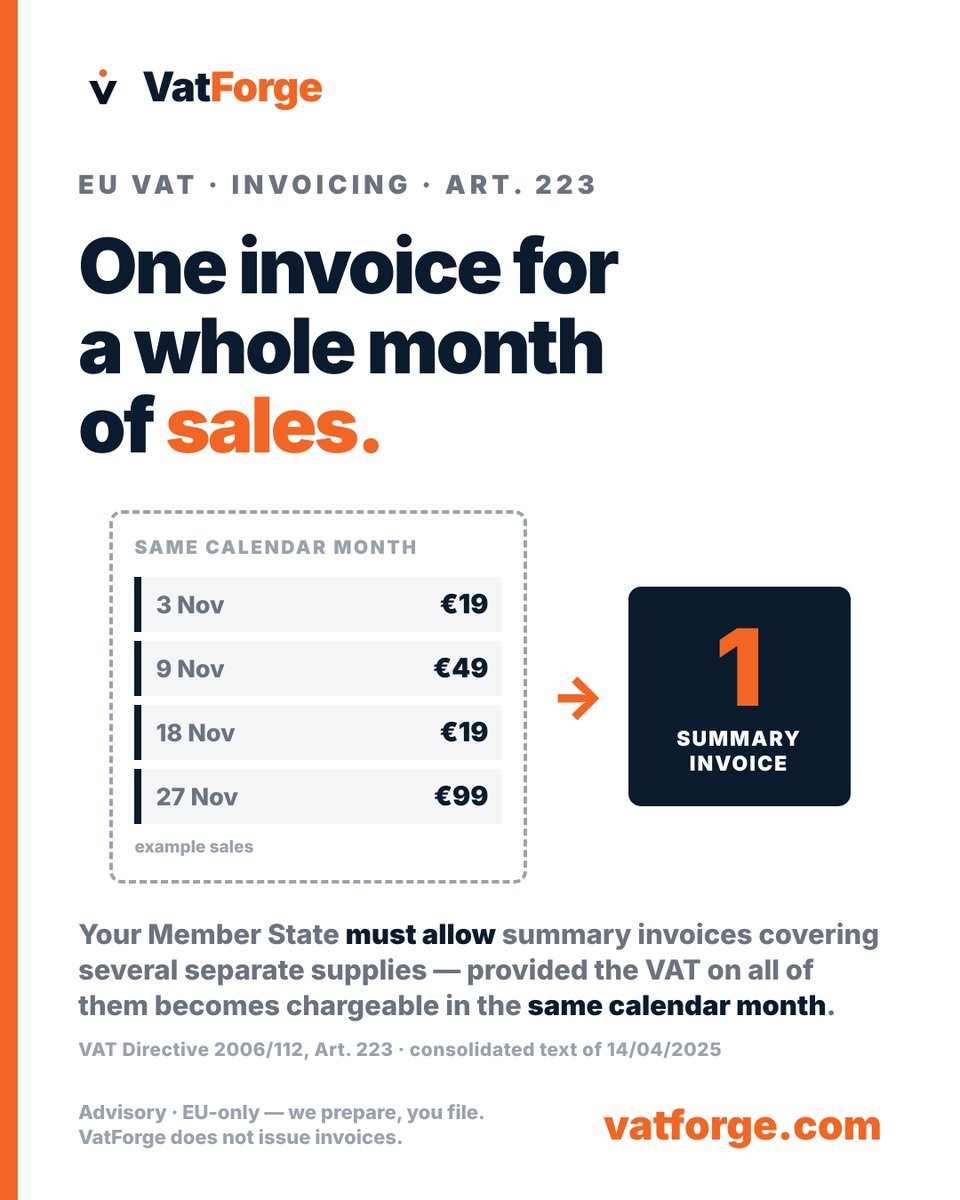
If you sell digital products across the EU, you do not have to cut one invoice per sale.
VAT Directive 2006/112, Art. 223: "Member States shall allow taxable persons to issue summary invoices which detail several separate supplies of goods or services provided that VAT on the supplies mentioned in the summary invoice becomes chargeable during the same calendar month."
Shall allow. Not may. Your Member State has to let you bundle, and the condition is the calendar month — not the customer, not the amount, not how many sales there were.
Two things sit next to it:
The Directive sets only one invoice deadline of its own. Art. 222: for intra-EU goods (Art. 138) and services where your customer pays the VAT (Art. 196), "an invoice shall be issued no later than on the fifteenth day of the month following that in which the chargeable event occurs." For other supplies, Member States "may impose time limits". So the deadline you are actually working to is national, not European — and we are not stating any country's here.
A correction is not a different kind of document. Art. 219: any document or message that amends and refers specifically and unambiguously to the initial invoice "shall be treated as an invoice."
From 1 July 2030 this tightens, and it is already on the books. Council Directive (EU) 2025/516 is adopted and published, and Member States apply these changes from 1 July 2030. It rewrites Art. 222 to "no later than 10 days following the chargeable event", gives summary invoices their own deadline of 10 days after the end of the month they cover, and lets Member States exclude summary invoices in "certain fraud sensitive sectors".
Read in full against the consolidated VAT Directive of 14/04/2025 and the published text of 2025/516.
Straight about our own scope: VatForge does not issue invoices — B2B invoice generation sits under "Later" on our roadmap. What we do is pull your Stripe, Gumroad, Substack, Patreon and Lemon Squeezy sales into one EU VAT position and prepare your OSS return. EU-only, advisory: we prepare it, you file it.
https://t.co/6PZNHt4Ch3
#EUVAT
Your OSS return has a deadline the VAT Directive writes itself.
Your domestic VAT return does not.
Art. 369f fixes the OSS clock: a return every calendar quarter, "submitted by the end of the month following the end of the tax period covered by the return."
For the return you file at home, Title XI, Chapter 5 does something different. It sets a ceiling and walks away.
Art. 252(1): "The VAT return shall be submitted by a deadline to be determined by Member States. That deadline may not be more than two months after the end of each tax period."
The date is your country's. The latest it may be is not.
Art. 252(2) does the same to the period itself — "one month, two months or three months" — then lets a Member State set different periods "provided that those periods do not exceed one year."
Three more things sit in the same chapter:
Art. 206 — you pay when you submit, unless your country sets another payment date, or requires interim payments.
Art. 261 — your country may also require an annual return repeating every particular for the whole preceding year.
Art. 253 — the Directive names one country out loud: Sweden, a simplified SME procedure for taxable persons trading only at national level.
We are not going to tell you your country's deadline. The Directive doesn't, and we won't guess it. What it gives you is a number to check against: if a date you have been told sits more than two months past the end of your tax period, Art. 252(1) is the sentence to ask about.
All of the above read verbatim today against the current consolidated text of Directive 2006/112 (14/04/2025).
Honest limit: VatForge does not track return deadlines. We prepare quarterly OSS figures for sellers registered in SE, DE, NL, BE or FR. Advisory, EU-only — you file in your national portal.
https://t.co/KZMFkOUVnV
#EUVAT
The VAT you paid on a business purchase isn't one event. The Directive splits it across three separate chapters of Title X.
CHAPTER 1 — when the right arises.
Art. 167: "A right of deduction shall arise at the time the deductible tax becomes chargeable."
Not the day you paid the invoice. Not the day you filed.
(Art. 167a lets a Member State run an optional scheme postponing the right until the VAT "has been paid to his supplier". Its threshold may not exceed EUR 2 000 000 of turnover. Whether your country runs one is national law.)
CHAPTER 4 — when you may use it.
Art. 178(a): you "must hold an invoice drawn up in accordance with Sections 3 to 6 of Chapter 3 of Title XI".
Art. 179, first paragraph: the deduction is made "by subtracting from the total amount of VAT due for a given tax period".
A document, and a period to put it in.
CHAPTER 5 — adjustment. The one nobody expects.
Art. 184: "The initial deduction shall be adjusted where it is higher or lower than that to which the taxable person was entitled."
Both directions. Art. 185(1) names the triggers — "purchases are cancelled or price reductions are obtained".
Art. 185(2) then carves out: no adjustment for transactions totally or partially unpaid, for destruction, loss or theft duly proved, or for goods reserved for small-value gifts or samples. But Member States may require adjustment anyway for unpaid transactions or theft.
And the fence, Art. 186: "Member States shall lay down the detailed rules for applying Articles 184 and 185."
So the mechanism is national law. We are not going to tell you your country's — that is not a thing to settle in a post.
Every provision above read today in-browser against the current consolidated text of Directive 2006/112 (14/04/2025).
VatForge tracks the VAT you charge, across Stripe, Gumroad, Substack, Patreon and Lemon Squeezy. Input VAT is not in the product. Advisory, EU-only — we prepare, you file.
https://t.co/1hYcziR1P5
#EUVAT
Your platform keeps a record of your sale.
Not your invoice. Not your accounts. Its own record — and the Directive sets the clock on it.
Art. 242a of the VAT Directive: where a taxable person "facilitates, through the use of an electronic interface such as a market place, platform, portal or similar means, the supply of goods or services to a non-taxable person within the Community", that person "shall be obliged to keep records of those supplies".
Then the part people miss:
"Those records must be kept for a period of 10 years from the end of the year during which the transaction was carried out."
Ten years — and the clock starts at the end of the year, not on the day of the sale. A sale made in January 2026 sits in that record until the end of 2036.
Set it against your own duty. Art. 242 is one sentence:
"Every taxable person shall keep accounts in sufficient detail for VAT to be applied and its application checked by the tax authorities."
No period. No list. And for invoices, Art. 247(1) hands the retention period to each Member State — so your number is national law. The platform's ten years is in the Directive itself.
The record also isn't for you. Art. 242a(2): it "must be made available electronically on request to the Member States concerned." The seller whose sales it describes isn't named in that sentence.
What it holds, where the platform is not itself the supplier — Reg. 282/2011 Art. 54c(2): your name, postal address, electronic address or website; your VAT or national tax number, if available; your bank or virtual account number, if available; the services, their value, and the information that establishes place and time of supply.
When does a platform count as "facilitating"? Art. 54b(1) defines it, then lets a supply out only where all three are true: it sets none of the terms and conditions, it is not involved in authorising the charge to the customer, and it is not involved in the ordering or the supply of the services. All three. Art. 54b(2) adds that processing payments, listing or advertising, or redirecting customers never count on their own.
Whether a particular platform of yours is facilitating is a facts-and-contract question. We won't answer it for you.
What you can do is make your own numbers reconstructable: one ledger across Stripe, Gumroad, Substack, Patreon and Lemon Squeezy, with customer-location evidence collected as you go.
Advisory, EU-only — we prepare, you file.
https://t.co/TG5ySRjGYC
Sources: consolidated VAT Directive 2006/112/EC and Implementing Regulation (EU) 282/2011, current versions as at 14/04/2025, read on EUR-Lex.
Your country can add VAT obligations the Directive never lists.
That isn't a loophole. It's Article 273.
"Member States may impose other obligations which they deem necessary to ensure the correct collection of VAT and to prevent evasion…"
Open-ended — but two limits sit in the same sentence: equal treatment between domestic and intra-EU transactions, and no obligations that give rise to formalities connected with crossing a frontier.
Then the second paragraph draws the only fence:
"The option under the first paragraph may not be relied upon in order to impose additional invoicing obligations over and above those laid down in Chapter 3."
Chapter 3 of Title XI is Invoicing. So the add-lever reaches identification, accounting, returns and recapitulative statements. It does not reach invoicing.
There is a second lever, pointing the other way. Art. 272(1): Member States "may release the following taxable persons from certain or all obligations referred to in Chapters 2 to 6". Its second subparagraph fences invoicing off again — but only for the taxable persons in point (b), not for all five categories. The two fences are not mirror images.
Further than either lever allows? Art. 395(1): the Council, acting unanimously on a proposal from the Commission, may authorise a Member State to derogate. Unanimity — not a national decision. And a simplification measure "may not, except to a negligible extent, affect the overall amount of the tax revenue of the Member State collected at the stage of final consumption."
So: three separate powers — add, waive, derogate. Which ones your country actually used is national law. We're not going to tell you that, and anyone answering it in a comment without knowing your Member State is guessing.
Every line above is quoted from the current consolidated text of Directive 2006/112 (14/04/2025), opened and read rather than summarised.
What we do: one view of your EU VAT position across Stripe, Gumroad, Substack, Patreon and Lemon Squeezy. Advisory, EU-only — we prepare, you file.
https://t.co/vOrOvBYI25
"It was free, so there's no VAT." Mostly true. The VAT Directive writes its own exception to it, and the exception doesn't turn on the price.
Article 2(1)(c) taxes "the supply of services for consideration." No consideration, nothing to tax. That's the rule.
Then Article 26(1)(b): a supply of services carried out "free of charge" by a taxable person "for his private use or for that of his staff or, more generally, for purposes other than those of his business" shall be treated as a supply of services for consideration.
Read that trigger again. It is a purpose test, not a price test. Zero is zero in both cases — what moves is why you gave it away.
And if it is caught, Article 75 says the taxable amount is "the full cost to the taxable person of providing the services." Article 73, the general rule, excludes itself from this by its own opening words: "other than as referred to in Articles 74 to 77." Zero price, non-zero taxable amount.
Two honest limits, both in the text. Article 26(2) lets Member States derogate from the whole of paragraph 1. Article 27 runs the other way: a Member State may, after consulting the VAT Committee, treat a service supplied for business purposes as one for consideration where the VAT on it would not be wholly deductible. Which of those applies to you is national law, and we're not asserting it for any country.
One asymmetry worth seeing. Article 16 does the same job for goods — and it carries an express carve-out: "samples or gifts of small value" are not treated as a supply for consideration. There is no small-value line for services anywhere in Article 26. For services, only the purpose test.
Whether a specific giveaway lands on one side or the other turns on its facts and on your country's law. That part is a conversation with your advisor, not a post.
All quotes read today from the consolidated VAT Directive, current version of 14 April 2025.
VatForge pulls your sales from Stripe, Gumroad, Substack, Patreon and Lemon Squeezy into one EU VAT view and prepares your OSS numbers. Advisory, EU-only — we prepare, you file with your national portal.
https://t.co/eAoS7FSeUm
Your platform sends you a monthly statement with your name on it, your VAT number and a total. You didn't type a word of it.
Under EU VAT that's allowed. It's also still your invoice.
Art. 220(1) of the VAT Directive: every taxable person "shall ensure that, in respect of the following, an invoice is issued, either by himself or by his customer or, in his name and on his behalf, by a third party."
Three parties may type it. The duty to ensure it exists never leaves the supplier.
When the one typing is your *customer* — self-billing — Art. 224 attaches two conditions, and both have to hold:
1. "a prior agreement between the two parties"
2. "a procedure exists for the acceptance of each invoice by the taxable person supplying the goods or services"
Each invoice. Not one tick at signup.
Two more that surprise people:
→ Art. 229: "Member States shall not require invoices to be signed." That's what makes the whole arrangement work.
→ Art. 219: any document that "amends and refers specifically and unambiguously to the initial invoice shall be treated as an invoice" — so the credit note your platform issues is an invoice too.
What we're not telling you: whether your platform's particular arrangement satisfies Art. 224. That's your contract and your country's law. Art. 224 also lets a Member State require self-billed invoices to be issued in your name and on your behalf, and Art. 225 lets Member States add conditions when the issuer is established outside the EU. We're not guessing at any country's rule in a post.
All of the above read today against the consolidated VAT Directive 2006/112 as at 14/04/2025.
Where VatForge sits: not here. B2B invoice generation is on our roadmap, not in the product. What's live is the pan-EU view — Stripe, Gumroad, Substack, Patreon and Lemon Squeezy in one ledger, threshold tracking, and your OSS figures prepared.
Advisory · EU-only — we prepare, you file.
https://t.co/0zJ06lrKlG
You got paid for *not* doing something. Under EU VAT, that is still a supply.
The definition is a leftover. Directive 2006/112, Art. 24(1):
"'Supply of services' shall mean any transaction which does not constitute a supply of goods."
Not goods → service. There is no third box.
Art. 25 then names three, "inter alia":
(a) the assignment of intangible property
(b) the obligation to refrain from an act, or to tolerate an act or situation
(c) the performance of services in pursuance of an order made by or in the name of a public authority
So an exclusivity clause, a licence, a buyout, a takedown agreement — each is a candidate. Whether a particular contract is one of them turns on its facts and on national law, and we're not deciding that here. The narrower point: "no work was done" is not the test the Directive uses.
Where it's taxed then depends on who paid you:
• Business customer → Art. 44 — where the customer has established his business
• Consumer in the EU → Art. 45 — where the supplier has established his business, unless it's telecoms, broadcasting or an electronically supplied service (Art. 58(1))
• Consumer outside the EU → Art. 59 — where that person is. That list includes (a) copyrights, patents, licences, trade marks and (d) obligations to refrain from pursuing or exercising a business activity or a right
Art. 2(1)(c) is what puts any of it in scope: a supply of services for consideration, by a taxable person acting as such.
All read verbatim against the current consolidated text (14/04/2025). ViDA (Council Directive (EU) 2025/516) does not amend Arts. 24, 25, 44, 45 or 59.
Advisory · EU-only — we prepare, you file.
https://t.co/u77Lz3O9rk
Crossing your SME cap doesn't always end the exemption that day.
The EU small-enterprise exemption has two ceilings, and they behave differently the moment you go over.
Your national cap — each Member State sets it, and Art. 284(1) caps that at "no higher than EUR 85 000 or the equivalent in national currency."
Art. 288a(1), second subparagraph, gives it a default band. Over by "not more than 10 %" and you "shall be able to continue to benefit from the exemption… during that calendar year." Over by more than 10 % and it "shall cease to apply as of that time."
But the band is optional. The third and fourth subparagraphs let your Member State set a 25 % ceiling instead, or no ceiling at all (never exempting turnover above €100 000 in that state), or no band whatsoever — the exemption ending the moment you cross.
Four possible rules. Which one is yours is national law, not Directive text.
The €100 000 Union cap has no band in any version. Art. 284(2)(a) sets the condition; Art. 288a(2) says that if your Union annual turnover is exceeded during a calendar year, the exemption "shall cease to apply as of that time."
And the part that makes early November the moment to look — Art. 288a(1), first subparagraph: exceed the threshold in one calendar year and you cannot use the exemption for the next one. The Member State granting it "may extend this period to two calendar years."
Two months left in 2026. What happens in them decides 2027.
One cumulative figure across Stripe, Gumroad, Substack, Patreon and Lemon Squeezy — now, not reconstructed in January.
https://t.co/ye5qhdadSU
Advisory, EU-only: we prepare the figures, you file.
Source: VAT Directive 2006/112/EC, current consolidated text (14/04/2025), Arts. 280a, 284, 288a.
The OSS return doesn't round.
Council Implementing Regulation (EU) No 282/2011, Article 60 — current consolidated text, 14/04/2025:
"Amounts on VAT returns made under the special schemes shall not be rounded up or down to the nearest whole monetary unit. The exact amount of VAT shall be reported and remitted."
Two verbs, both mandatory. Reported — and remitted. The cents you declare are the cents you pay.
Round up to tidy the figure and Article 63 decides what happens to the difference:
→ if your Member State of identification still holds it, that Member State "shall reimburse the overpaid amount directly to the taxable person concerned";
→ if it has already passed the money on, "those Member States of consumption shall each reimburse their respective part of any overpaid amount directly to the taxable person."
So a rounding overpayment doesn't come back as one tidy credit. It comes back in pieces — one from each Member State of consumption that had already received its share.
And you can't quietly net it off next quarter. Article 59(1): any return period "shall be a separate return period." Article 62: a payment is specific to one return, and an adjustment "may neither be allocated to another return nor adjusted on a subsequent return."
VatForge keeps one ledger across Stripe, Gumroad, Substack, Patreon and Lemon Squeezy, each sale carrying the rate and the country it was taxed at — so the per-country figures come out of the data rather than being reconstructed at the end of the quarter.
Advisory: we prepare the return and export it. You file it. EU-only, no UK or US.
https://t.co/ZHYqWhXsoP
#EUVAT
Your buyer is in São Paulo. Which EU VAT rate applies?
None — and the article that says so is the same one that charges you for Berlin.
Article 2(1)(c) of the VAT Directive sets what VAT reaches: "the supply of services for consideration within the territory of a Member State by a taxable person acting as such".
So the only question is ever: where was this supply made?
Article 58(1) answers it for a sale to a private customer. The place of supply is "the place where that person is established, has his permanent address or usually resides" — and point (c) names "electronically supplied services".
Read it again. It sets no EU condition on that place. If your customer usually resides in Brazil, that is where the supply is, and Art. 2(1)(c) was never engaged. Article 59 reaches the same place for customers outside the Community.
Three consequences worth having straight.
1. Your OSS return has no box for it. The Union scheme "applies to all those goods or services supplied in the Community" (Art. 369b), and the return is completed "for each Member State of consumption in which VAT is due" (Art. 369g(1)). A supply placed outside the Community has no Member State of consumption.
2. It doesn't count toward the €10,000 either. Art. 59c(1)(b) counts supplies to customers "in any Member State other than" the one you're established in.
3. One carve-back, and it's permissive. Art. 59a lets a Member State "consider the place of supply … if situated outside the Community, as being situated within their territory if the effective use and enjoyment of the services takes place within their territory". Optional and national — check the one you're registered in.
What we're not telling you: what Brazil charges. Outside the Directive is not untaxed everywhere, and that's a separate question we make no claim on.
All read today against the current consolidated text (14 April 2025).
Advisory, EU-only: we prepare the OSS return, you file it.
https://t.co/oALrq8b7aW
A sentence that does not exist today is being inserted into the €10,000 article.
Council Directive (EU) 2025/516 — "VAT rules for the digital age" — was adopted 11 March 2025 and published in the OJ on 25 March 2025. It amends the VAT Directive in five dated instalments. Article 2 of it is headed, verbatim: "Amendments to Directive 2006/112/EC with effect from 1 January 2027."
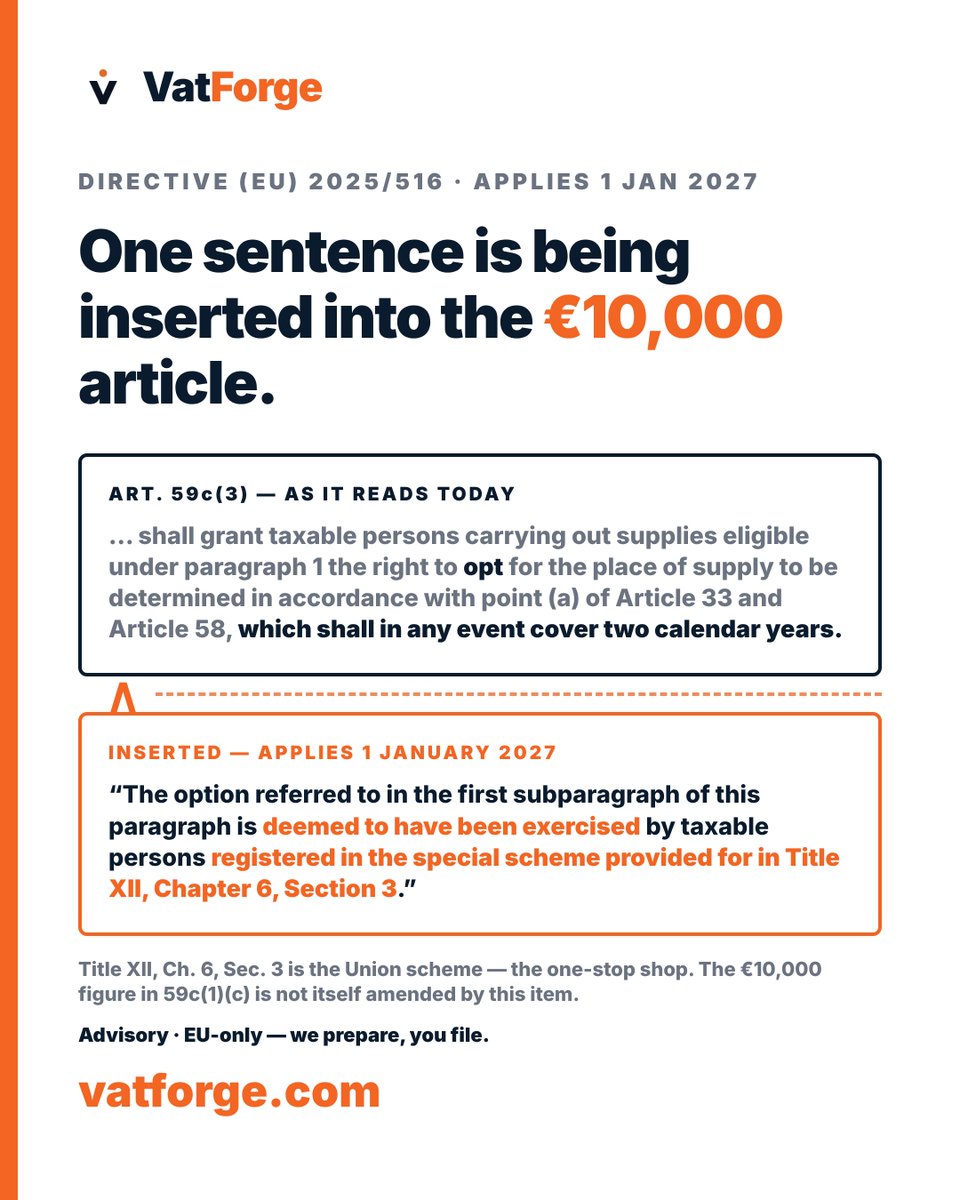
One of those amendments rewrites Article 59c(3).
Today, 59c(3) says the Member State "shall grant taxable persons carrying out supplies eligible under paragraph 1 the right to opt for the place of supply to be determined in accordance with point (a) of Article 33 and Article 58, which shall in any event cover two calendar years."
A right to opt. Not a word about the one-stop shop.
From 1 January 2027 a second subparagraph is added:
"The option referred to in the first subparagraph of this paragraph is deemed to have been exercised by taxable persons registered in the special scheme provided for in Title XII, Chapter 6, Section 3."
Title XII, Chapter 6, Section 3 is the Union scheme. The OSS.
So from 2027 the Directive says it in its own words: registered in OSS = treated as having opted for destination-country place of supply. And by the first subparagraph, that option "shall in any event cover two calendar years."
What we are not telling you: what the position is *today* for a seller who is OSS-registered and under €10,000. Today's text is silent on it, and silence is not a rule. We didn't check 27 national practices, so we're not going to pretend.
The €10,000 figure in 59c(1)(c) is not itself touched by this item — current and preceding calendar year, exclusive of VAT, unchanged.
Fourteen months is plenty of warning. January 2027 is not.
We prepare and export your OSS return — you file it. EU-only, by design.
https://t.co/lAYH1cXFIH
#EUVAT
Your Q3 OSS return is due Saturday 31 October.
Not "the next working day". Saturday.
There is an EU rule that moves a deadline off a weekend. Regulation (EEC, Euratom) No 1182/71, Article 3(4):
"Where the last day of a period … is a public holiday, Sunday or Saturday, the period shall end with the expiry of the last hour of the following working day."
Then the same Regulation switches it off. Article 5(1):
"… the provisions of Article 3 shall, with the exception of paragraphs 4 and 5, apply when an action may or must be effected … at a specified moment."
Paragraph 4 is the weekend extension. Submitting a return by a fixed date is an action effected at a specified moment. Article 5(2) spells out what that leaves you: the act may be done "between the beginning of the first hour and the expiry of the last hour of the day falling on that date".
That date. Not the one after it.
What the texts do not settle is whether your own Member State of identification applies an extension of its own. Neither provision says. We are not claiming it does, and we are not claiming it doesn't — and that is the entire argument for not finding out on the 31st.
The date with no argument is Friday 30 October.
Three things worth knowing before you file:
— The euro conversion rate is already fixed. Art. 369h takes the ECB rate for the last day of the tax period, so 30 September. Nothing you do in October moves it.
— A nil return is still due. Art. 369f: a return "for each calendar quarter, whether or not supplies of goods and services covered by this special scheme have been carried out".
— The payment carries the same deadline as the return (Art. 369i).
Sources, read in full rather than summarised: Directive 2006/112/EC, consolidated text of 14 April 2025, Arts. 369f, 369h, 369i. Regulation (EEC, Euratom) No 1182/71 (in force; original 1971 text is the current consolidation), Arts. 3(4), 5(1), 5(2).
VatForge pulls Stripe, Gumroad, Substack, Patreon and Lemon Squeezy into one ledger and prepares the quarterly OSS return. Advisory, EU-only — we prepare it, you file it.
https://t.co/mkeg9MnDMB
Your OSS registration doesn't start the day you apply.
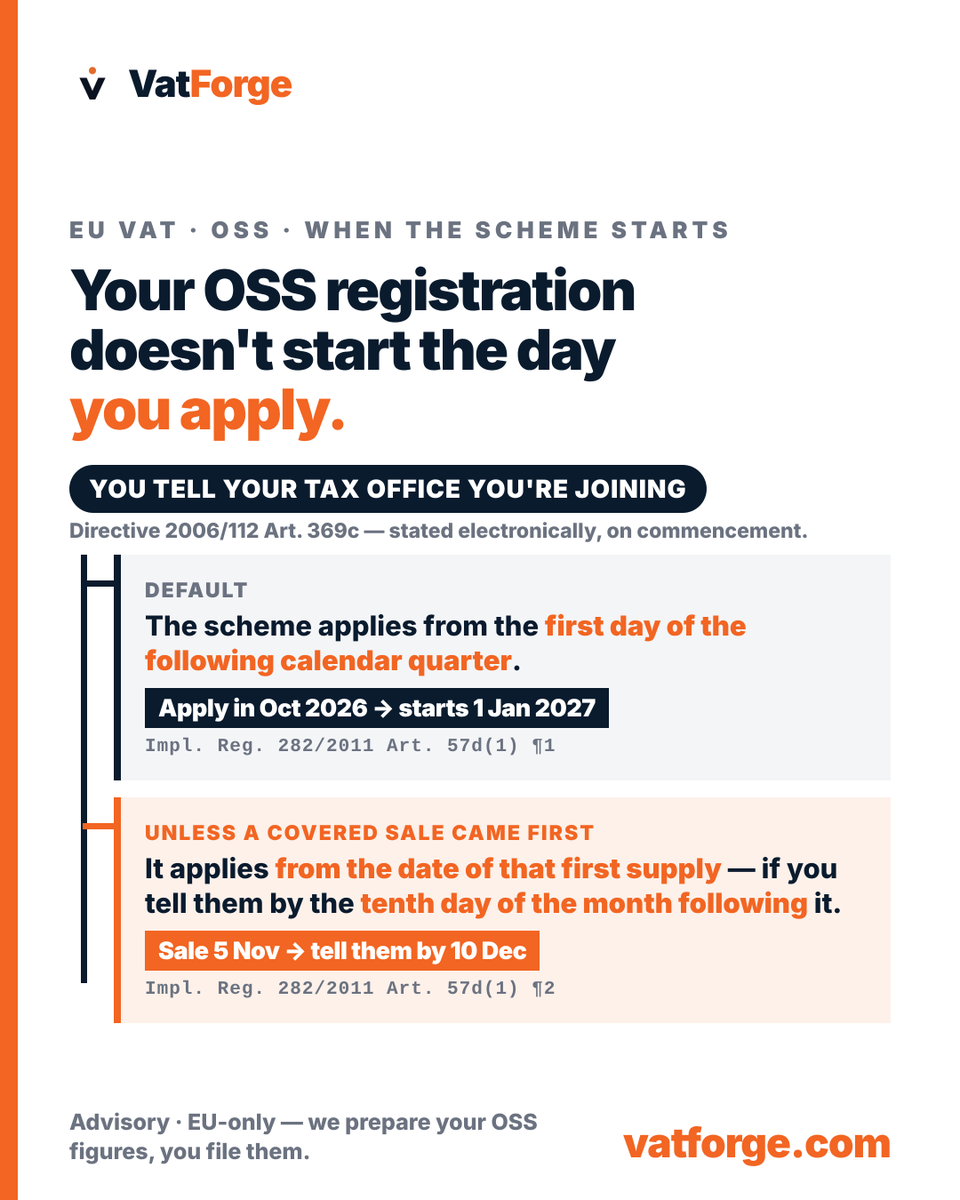
Council Implementing Regulation (EU) No 282/2011, Article 57d(1), first subparagraph:
"Where a taxable person informs the Member State of identification that he intends to make use of the non-Union or the Union scheme, that special scheme shall apply as from the first day of the following calendar quarter."
Tell your tax office this month and the scheme covers you from 1 January 2027 — not from the day you filled in the form.
There is one way back. Second subparagraph:
"However, where the first supply of goods or services to be covered by the non-Union scheme or the Union scheme takes place before that date, the special scheme shall apply from the date of that first supply, provided the taxable person informs the Member State of identification of the commencement of his activities to be covered by the scheme no later than the tenth day of the month following that first supply."
So a covered sale on 5 November can sit inside the scheme — if you tell them by 10 December. The tenth is the hinge.
Note that these are two separate messages to your tax office: the one saying you intend to join, and the one saying you have started.
The import scheme runs on a different trigger again — Art. 57d(2) starts it from the day the IOSS number is allocated.
Read verbatim today against the current consolidated text (14 Apr 2025) on EUR-Lex.
We prepare your OSS figures across Stripe, Gumroad, Substack, Patreon and Lemon Squeezy. You file them. EU-only.
https://t.co/NXHh6gOmxJ
Does a €9 sale to a consumer in another EU country even need an invoice?
The Directive's answer is narrower than most people assume.
Art. 220(1) lists the supplies an invoice *shall* be issued for. First on it: supplies "to another taxable person or to a non-taxable legal person". Business customers. A consumer digital sale is not on that list.
That doesn't mean no invoice. Art. 221(1) lets Member States require one "in respect of supplies of goods or services other than those referred to in Article 220(1)" — so for consumer sales, your own country decides. And on OSS, Art. 219a(2)(b) fixes which country that is: the one where you're identified for the scheme. One rulebook, not 27.
Then the part worth knowing. Where an invoice is required, Member States **shall allow** a simplified one where "the amount of the invoice is not higher than EUR 100". *Shall allow* — under €100 the short form is an entitlement, not a concession. Above it, Art. 238(1)(a) lets a country stretch the short form to €400, but that one is optional and needs the VAT Committee consulted first.
Short isn't blank, though. Art. 226b still requires five things: date of issue, who supplied it, the type of goods or services, the VAT payable or how to calculate it, and an unambiguous reference to the invoice it amends, if it amends one. Your tax office also "may not require details on invoices other than those referred to in Articles 226, 227 and 230".
All of it read in-browser today against the current consolidated Directive (14 Apr 2025).
VatForge keeps one ledger across Stripe, Gumroad, Substack, Patreon and Lemon Squeezy and prepares your per-country OSS figures for review. It does not issue your invoices. Advisory, EU-only — we prepare, you file.
https://t.co/tTfwXIyoET
A customer types a VAT number into your checkout. You switch the VAT off, label it reverse charge, and move on.
The implementing regulation is more careful than that.
Council Implementing Regulation (EU) No 282/2011, Article 19, first paragraph:
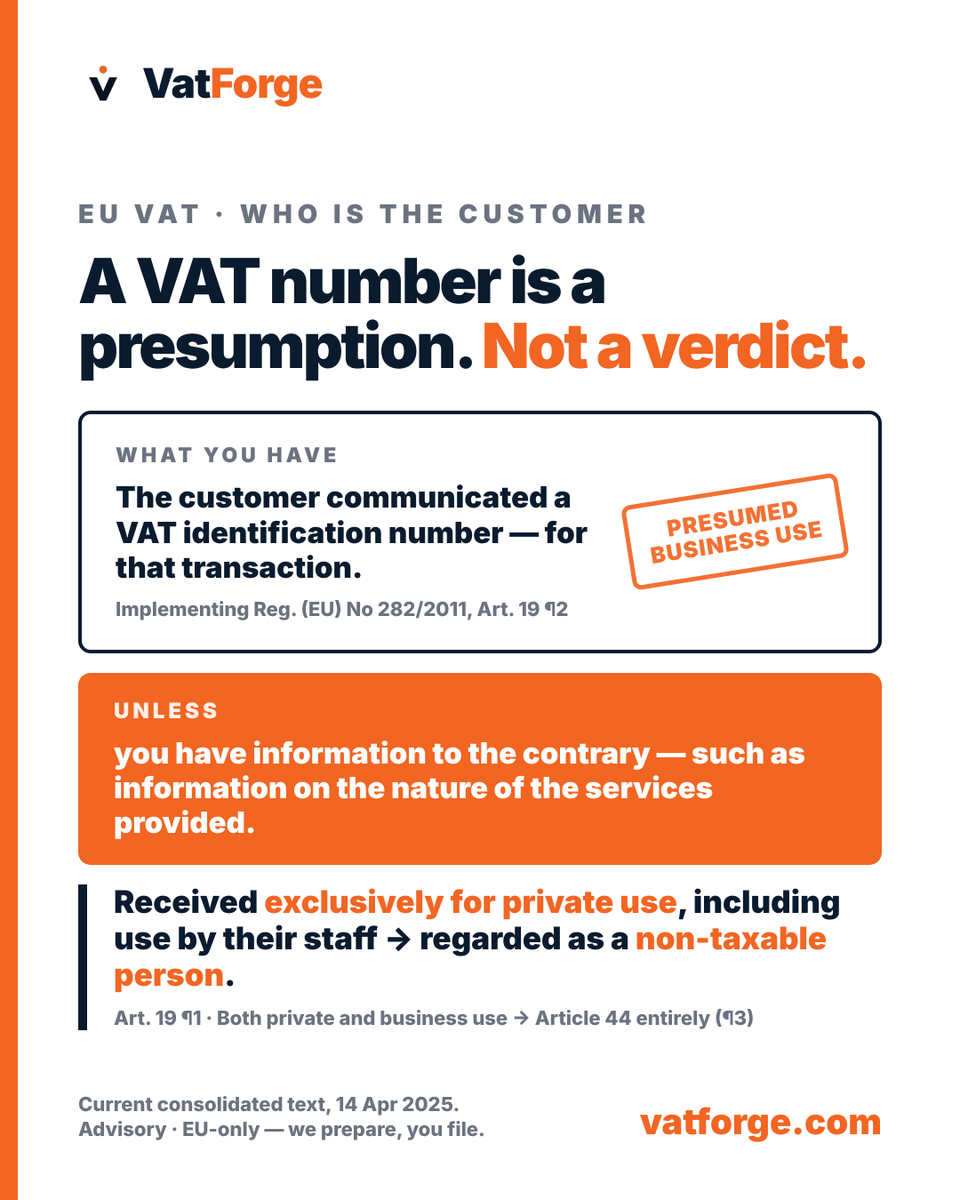
"a taxable person, or a non-taxable legal person deemed to be a taxable person, who receives services exclusively for private use, including use by his staff, shall be regarded as a non-taxable person."
A business customer buying purely for private use is, for place-of-supply purposes, a consumer.
The second paragraph is the one that protects you:
"Unless he has information to the contrary, such as information on the nature of the services provided, the supplier may consider that the services are for the customer's business use if, for that transaction, the customer has communicated his individual VAT identification number."
Three things are sitting inside that sentence.
"may consider" — it is a presumption you are allowed to rely on, not a fact the number establishes.
"unless he has information to the contrary, such as information on the nature of the services provided" — and the example the text itself reaches for is what you sell. If the thing can only be personal, the number does not rescue the treatment.
"for that transaction" — a number given for the sale in front of you, not one sitting in a profile since last year.
Mixed use is settled in the third paragraph: where one and the same service is intended for both private and business use, the supply is covered exclusively by Article 44 — provided there is no abusive practice. Part-business is business.
Why any of this touches the money: Article 44 sends the sale to the customer's business country and Article 196 makes the customer liable for the VAT, so you charge nothing. Close that route and an electronically supplied service lands under Article 58(1)(c) — taxed where the customer is established, has his permanent address or usually resides. You charge their rate, and it belongs in your OSS return.
Same customer, same price, two different returns.
Read in-browser today against the current consolidated texts, both dated 14 Apr 2025: Implementing Reg. 282/2011 Art. 19, and Directive 2006/112 Arts. 43, 44, 58(1) and 196.
What we do with it: VatForge keeps each sale with the country it was taxed in and the location evidence behind it — Stripe, Gumroad, Patreon, Lemon Squeezy, Substack, CSV — and prepares per-country OSS figures for your review. It does not validate VAT numbers and it does not decide whether your customer was buying for business. That call is yours, and a hard one belongs with your adviser.
Advisory, EU-only. We prepare, you file.
https://t.co/KoqTG2SGsm
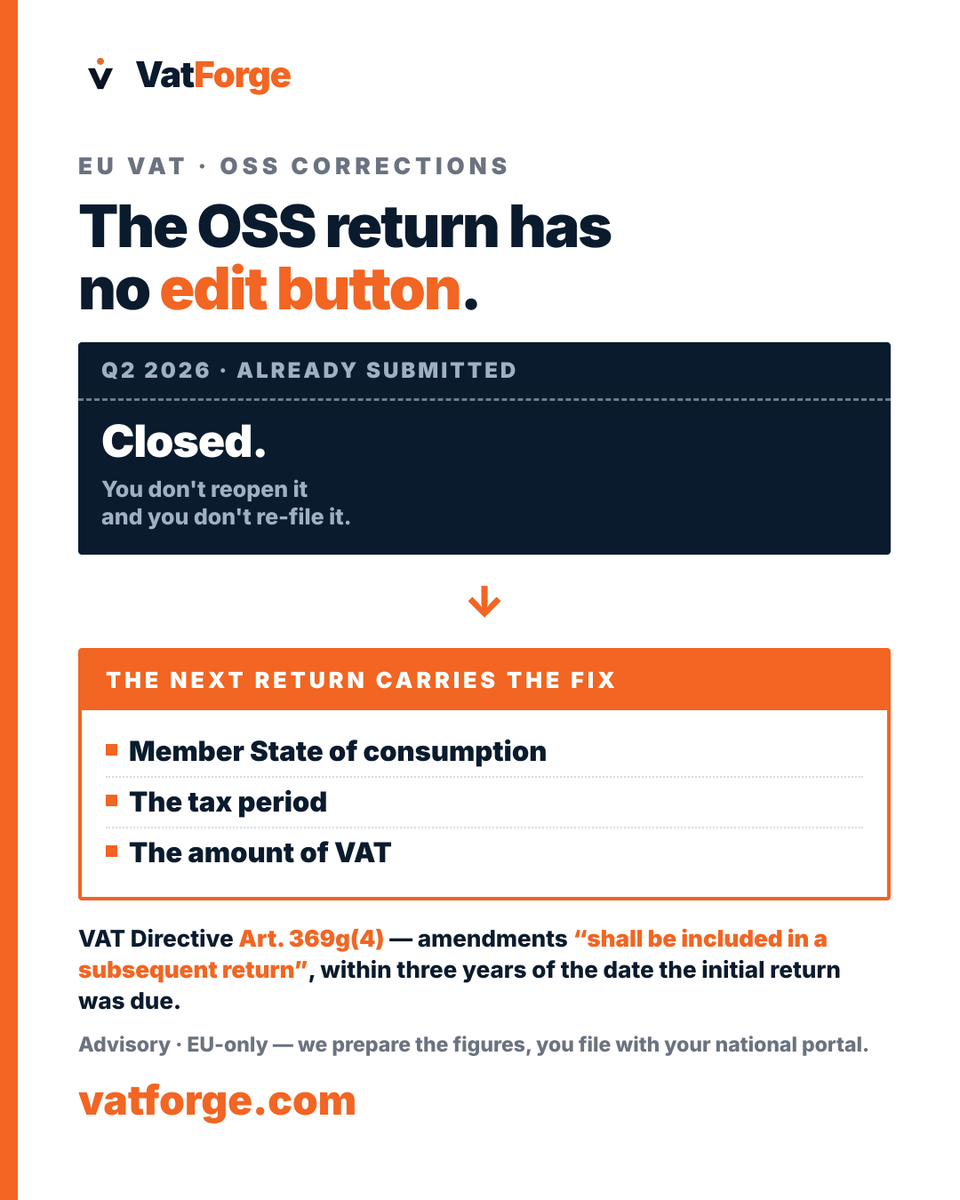
The OSS return has no edit button.
You filed Q2. In September you spot that a German sale went in at the wrong rate. The instinct is to go back and amend the Q2 return.
For every period from the third return period of 2021 onwards, that route is closed. Implementing Regulation 282/2011, Art. 61(1): changes to the figures in a submitted return "shall ... be made only by adjustments in a subsequent return." (Before that cut-off the rule ran the other way round — which is why older guidance still tells you to amend the original.)
So the fix travels forward. VAT Directive Art. 369g(4): amendments "shall be included in a subsequent return within three years of the date on which the initial return was required to be submitted" — and that later return has to identify three things:
- the Member State of consumption
- the tax period
- the amount of VAT being amended
Two details that catch people out:
1. Three years is the OSS channel, not a universal clock. Art. 61(2) routes amendments to your Member State of identification within three years, then adds that "the rules of the Member State of consumption on assessments and amendments shall remain unaffected." Your own portal closing the door doesn't mean the consumption country has.
2. If you have left the scheme — ceased, been excluded, or changed your Member State of identification — Art. 61a says corrections arising after your final return are "discharged directly with the tax authorities of the Member State of consumption concerned." No portal in the middle.
The Union-scheme return is quarterly, due by the end of the month following the tax period (Art. 369f) — so Q3 2026 falls due 31 October 2026. If something in Q2 was wrong, the return you are about to file is where it gets fixed.
We bring your revenue together across Stripe, Gumroad, Substack, Patreon and Lemon Squeezy and prepare per-country OSS figures for your review. Advisory, EU-only — you file with your national portal.
https://t.co/m7mmd3dGsL