One thing that continues to stand out about Snap: @evanspiegel seems genuinely obsessed with building a great product experience for users, not just optimizing near-term financials.
Yes, 12 years investing in Specs is objectively a long time. But the world may finally be catching up to the vision:
a) the enabling technologies especially generative AI + hardware miniaturization are finally arriving
b) vertical integration gives Snap unusually tight control over the end-user experience
c) integrated hardware/software platforms are dramatically harder to copy than standalone app features (many of which competitors cloned from Snap over the years!)
The market also may be underestimating the strategic value of 25MM+ paying subscribers across Snap+ and related offerings. That’s not just “subscription revenue”... it’s proof a meaningful segment of users is willing to directly pay for a unique product experience. And frankly, for competitive reasons, I wouldn’t disclose churn rates either.
Financially, the 1K layoffs should materially reduce stock-based compensation pressure. Hopefully compensation increasingly shifts toward cash-based incentives tied to durable operating performance and free cash flow generation.
And for financial analysts modeling the business: try adding back the quarterly Specs R&D spend to better understand the underlying economics of Snap’s core platform today. Specs are not ordinary operating expenses. They are a long-duration strategic investment that could create entirely new revenue streams and margin pools in the future, while strengthening a moat.
One final thought for activists: if you engage with management, try to add value. Great founder-led companies are often built through long-duration conviction that looks irrational before it looks obvious. Being constructively challenging is useful. Being a pain in the ass usually isn’t.
$SNAP
WELCOME TO THE AI BOWL
And if you've seen this movie before, you already know how it ends.
Tonight, while 130 million Americans watch the Seahawks and Patriots, they'll also witness something that should make every serious investor deeply uncomfortable:
The single largest concentration of AI advertising in television history.
16 tech companies bought Super Bowl ads this year.
OpenAI, Google, Amazon, Meta, Anthropic, Genspark, Base44, Rippling, Ramp - and more.
Tech ad spending is DOUBLE what it was during the 2022 "Crypto Bowl," the last time NBC broadcast the game.
At $8-10 million per 30 second spot, plus production costs pushing all-in budgets north of $20 million per ad, hundreds of millions of dollars are being spent tonight by companies trying to convince you their AI product will change your life.
I've been in markets for 45 years.
When an entire sector floods the most expensive advertising real estate on the planet, it's not a signal to buy. It's a signal to think VERY carefully about what comes next.
My friend @DougKass has been beating this drum for years with his "Stock Market Super Bowl Indicator".
The more intensely a single sector dominates Super Bowl advertising, the more likely those stocks underperform in the year ahead.
Doug's been right far more often than he's been wrong on this one.
Because we've seen this exact playbook twice before...
2000: The Dot-Com Bowl. 14 internet startups bought Super Bowl ads at $2.2M per spot. Pets .com spent $1.2M on its famous sock puppet commercial.
Within 10 months it was dead - stock went from $11 to zero.
8 of 11 startups that advertised were bankrupt or sold in fire sales within a year.
2022: The Crypto Bowl. FTX, Coinbase, Crypto .com, and eToro collectively spent $54 million on Super Bowl ads.
Larry David told 100M viewers "Don't miss out on crypto."
9 months later, FTX was bankrupt.
Bankman-Fried is now in prison.
Coinbase shares fell 70% within a year.
By the next Super Bowl, crypto had "zero representation."
Now 2026: The AI Bowl.
And the parallels are impossible to ignore.
The Duke CFO Survey tells us the vast majority of CFOs report "no change" in productivity, decision-making, or customer satisfaction from AI investments over the past 12 months.
US tech giants spent $380 BILLION on AI infrastructure in 2025. Goldman Sachs says measurable GDP impact doesn't start until 2027.
The companies SELLING AI tools are getting rich. The companies BUYING them can't measure the returns.
And tonight, the sellers are spending record sums to convince even more buyers to pile in.
The data on Super Bowl advertisers as investments is damning.
Bridgewise found that after 6 months, companies running Super Bowl ads trailed the S&P 500 by an average of 9.2%.
Only 25% outperformed the index at 6 months.
Now look at who's advertising tonight:
OpenAI and Anthropic are pre-IPO companies burning billions in cash, racing to prove they can monetize before capital markets demand accountability.
Genspark and Base44 are startups most Americans have never heard of, spending $8-10M per spot to introduce themselves.
The real rivalry tonight isn't Seattle vs. New England.
It's Anthropic vs. OpenAI, fighting for "mindshare and legitimacy as both prepare for massive IPOs."
That's a NARRATIVE CAMPAIGN to justify valuations before public markets scrutinize the books.
Every bubble has a moment where the hype sector dominates the Super Bowl.
Dot-coms in 2000. Crypto in 2022. AI in 2026.
Peak advertising spend correlates with peak euphoria, not peak fundamentals.
Dot-com companies told you to click.
Crypto companies told you not to miss out.
AI companies are telling you the future is here.
The future may well arrive. But the stocks are priced like it already delivered and exceeded expectations.
It hasn't.
Enjoy the game tonight.
But the best contrarian indicator in markets isn't some fancy algorithm.
It's a $10 million Super Bowl ad.
We delight in the beauty of the butterfly, but rarely admit the changes it has gone through to achieve that beauty.
— Maya Angelou
via the 5-Bullet Friday newsletter (https://t.co/IjMDKmUdKr) from @tferriss
I played a lot of tennis in September, and one match in particular taught me a lesson I didn’t expect.
That day, I played terribly. Not because my opponent overpowered me, but because of something embarrassingly small: my cotton t-shirt. It was drenched, clinging, heavy. Every point I felt its drag—a tug here, a sticky patch there. I wasn’t playing tennis, I was managing discomfort.
The next week, I made one tiny change: I wore a @Nike Dri-Fit shirt. That’s it. No new racket. No new strategy. Just a better shirt.
Suddenly, I wasn’t distracted. I wasn’t fussing with fabric or weighed down by sweat. I could just play. The game felt lighter, freer, more fun. I played some of my best tennis.
The lesson wasn’t really about clothing—it was about friction. One subtle distraction was enough to limit my performance. Removing that distraction unlocked focus, flow, and joy.
This is exactly how improvement in business works. We often assume progress requires a massive leap: a bold new strategy, a complete overhaul, a “10x” innovation. But sometimes, the breakthrough is far smaller. It’s about noticing the friction we’ve grown accustomed to—the meeting that always runs too long, the tool that constantly crashes, the process everyone secretly hates. Each one is a sweaty cotton t-shirt.
The problem is, we adapt. We normalize the drag. We compensate for it day after day, thinking that’s just the cost of doing business. Until one day, we make the smallest of changes—a new tool, a clearer process, a faster decision—and suddenly realize how much lighter everything feels.
Focus is an underrated competitive advantage. When your mind is free to lock fully onto the work itself—not the distractions, not the annoyances—the quality of your output transforms. It feels less like grinding effort, more like flow.
So now I'm going to ask myself regularly: what’s my cotton t-shirt right now? What small, fixable friction is weighing me down? And what’s my Dri-Fit—my simple switch that could remove the drag and unlock better performance?
On the court, it made tennis more enjoyable and let me play to my potential. In business, it can mean the difference between constant firefighting and sustained excellence.
Sometimes peak performance doesn’t come from massive breakthroughs. Sometimes it just comes from 'swapping the shirt'.
"I only use the Brave browser and Brave Search for this reason. I don't want my search history saved somewhere. F--k that." - Jason Calacanis on the latest episode of @theallinpod
Thanks for the shoutout, @jason! Proud to be your choice for private browsing and search!🫡
How many GPUs could be bought in the coming years? Well, how many networked neurons are in the human brain? Answer: 86 billion. There are 5 major frontier models - OpenAI/ChatGPT, Amazon/Anthropic, Google/Gemini, Meta/Llama, xAI/Grok - all racing to build super intelligence. The outcome is the ultimate human that has PhD level understanding of 10,000+ subjects that nearly everyone will have access to. Let's just say 5 of these companies have the cash flow to keep buying networked neurons. 86 billion x 5 = 430 billion. Nvidia sold 3.8MM Grace Hopper integrated data center GPUs in 2023, and data center revenue was up 217% 2024. Blackwell has been very well received in 2025. #LongWayToGo $NVDA
Last week, we witnessed something extraordinary: The Picture of Dorian Gray @DorianGrayPlay on Broadway. Sarah Snook didn’t just perform—she transformed. For two straight hours, she became every character on stage. A full-body, full-heart performance that somehow felt effortless and impossible all at once. One person carrying that much story, emotion, and intensity with zero breaks? Unreal.
Dozens of voices, postures, and personalities, all pouring out of one person with unbelievable precision. Hilarious one moment, gut-wrenching the next. She shape shifted into every character on stage—switching voices, expressions, and energy like it was magic, all brought to life with her voice, body and soul. The show wasn’t just a performance..it was a masterclass in stamina, storytelling, preparation and total command of the room.
While there wasn’t a big set or flashy tricks, the show’s use of technology and screens will set a new standard in live performances and storytelling. We walked in expecting a play and left feeling in awe, like we witnessed something extremely rare.
Sarah Snook is in a league of her own and a generational talent.
Words to live by, from Pope Francis: “Rivers do not drink their own water; trees do not eat their own fruit; the sun does not shine on itself and flowers do not spread their fragrance for themselves. Living for others is a rule of nature. We are all born to help each other. No matter how difficult it is…life is good when you are happy; but much better when others are happy because of you.”
For those still traumatized by the SAT verbal:
Restaurants : DoorDash :: Books : Amazon
Why?
-Product created from true customer obsession
-First category is the lowest common denominator with tremendous variation
-New innovation come from solving observed problems while executing above
The question is, what is their AWS?
-Dashmart
-Doubledash
-???
$DASH
I recently had the chance to play tennis on the iconic US Open courts in Flushing. Swinging a racket where the best in the world compete was surreal. The setting was inspiring, but let’s just say the scorecard wasn’t in my favor that day—bagels may have been involved (IYKYK). My opponent, a master of consistency, taught me a humbling lesson. He did not overpower me; he didn’t need to. Rarely did he hit out, into the net, or double fault. His game was all about pace, placement, and relentless precision. Sure, I had many flashes of brilliance—overhead winners, blazing shots down the line—but I couldn’t replicate them point after point.
Key takeaways from the court that apply to business and life:
1- Consistency outlasts intermittent brilliance.
2- Consistency is built on preparation (physical conditioning and mental preparation).
3- Deliberate practice matters—practicing the wrong thing consistently only reinforces bad habits.
Sustained excellence comes from showing up, doing the work, and refining the right skills.
1. As the third and final electoral verdict on Donald Trump - and a potential generational shift to Kamala Harris - this election will do much to determine the future of US foreign policy and how the world looks at us.
Enjoyed an unusually warm day of doubles tennis in New York yesterday! A flip of the racket decided our sides—and left me staring straight into the sun every time I had to serve. At first, I really struggled, squinting against the glare and had to grab my sunglasses for help. But then I let go, trusted the rhythm I'd practiced countless times, and found my stride. Key lessons:
-Play the hand you're dealt and don’t overthink it.
-Adapt to circumstances with the tools you’ve got.
-Trust yourself to navigate obstacles in front of you—you’ll find a way.
After his second year at Michigan, Tom Brady wanted to transfer.
He wasn't playing in games, and he was so low on the depth chart that he only got 2 reps in practice.
Brady met with his coach to express his frustration, “The other quarterbacks get all the reps.”
Coach replied,
“Brady, I want you to stop worrying about what all the other players on our team are doing. All you do is worry about what the starter is doing, what the second guy is doing, what everyone else is doing. You don't worry about what you're doing.”
Coach reminded him, “You came here to be the best. If you're going to be the best, you have to beat out the best.”
And then he recommended that Brady start meeting with Greg Harden, a sports psychologist who worked in Michigan's athletic department.
Brady went to Harden's office and whined, “I'm never going to get my chance. They're only giving me 2 reps.”
Harden simply replied, “Just go out there and focus on doing the best you can with those 2 reps. Make them as perfect as you possibly can.”
“So that's what I did,” Brady said. “They'd put me in for those 2 reps, man, I'd sprint out there like it was Super Bowl 39. 'Let's go boys! Here we go! What play we got?'”
“And I started to do really well with those 2 reps. Because I brought enthusiasm, I brought energy.”
Soon, it went from getting 2 reps to getting 4 reps. Then from 4 to 10, “and before you knew it,” Brady said, with this new mindset that Greg instilled in me—to focus on what you can control, to focus on what you're getting, not what anyone else is getting, to treat every rep like it's the Super Bowl—eventually, I became the starter.”
Takeaway 1:
Greg Harden telling Brady to just focus on being great during his 2 reps reminded me of a piece of advice from the entrepreneur Mark Cuban.
“People come to me all the time and tell me they're stuck,” Cuban explained. “They're stuck in a job they don't like. They're stuck working for a boss they don't like. They're stuck on a team they don't like.”
“I just tell them, 'Be great.'”
“The reality of life is that you can't just always quit your job. You can't just always go to your boss and say, 'Give me the promotion, or I'm out of here.'” You can't just always go to your coach and say, 'Give me more reps, or I'm transferring.'
“So when you're stuck, you've gotta find it within yourself to say, 'Ok, this is where I am. And if I'm going to be here, I'm going to be great.'
Because if you're great at your job, typically other people and companies find out, so it creates opportunities.”
Takeaway 2:
I've written before about “lead measures”—the actions and behaviors that predictably drive success.
The core characteristic of a lead measure, the authors of The 4 Disciplines of Execution (4DX) write, is that “a lead measure is influenceable; it can be directly influenced by you.”
To achieve your goals, they recommend (echoing what the Michigan Coach told Brady), apply a disproportionate energy to the things that are in your control.
Starting at Michigan and for the rest of his career, that’s what Brady did, that’s what drove his success.
In his first media call after he was selected by the New England Patriots with the 199th pick in the 2000 draft, Brady was asked: “Are you aware that [along with starting quarterback, Drew Bledsoe] there’s another quarterback here that they drafted last year?”
Brady said he was aware of that. “And I know he’s a heck of a player,” Brady said. “But I’ve always really concerned myself just with the things I can control. I don’t put a lot of thinking into the other guys because I know I’m not at my best when I’m not just thinking about playing as well as I possibly can.”
- - -
“I never once in my life ever said I wanted to be the best of all time. Ever. I wanted to be the best I could be, period. I learned that in college. It didn’t matter what the other guys were doing. It mattered what I was doing.” — Tom Brady
Follow @bpoppenheimer for more content like this!
Wow. As we exit the Age of ZIRP Excess, great to see a poster child for the Age of Efficiency. Just $15M of VC to get to $600 M in revs and billions in market cap! Instead of celebrating billions raised, perhaps we can celebrate how scarcity drives innovation. @abialecki 🚀
Make money by making concentrated bets on yourself.
Lose money by making diffuse bets on others.
Invest money by betting on people you would work with, running businesses that you could run.
Tesla's FSD v12 is a REALLY big deal.
Last night @elonmusk livestreamed a ~45-minute video of a Model S driving itself around using Tesla's latest self-driving software, FSD v12.
Self-driving is something the company has been trying to solve since Tesla Autopilot was released in 2015. Since then, Tesla has made steady progress improving the code to handle all kinds of road situations, has added cameras around the car, and removed sensors, all the while rewriting the code multiple times to solve for things the car couldn’t handle.
And even though Tesla cars can drive themselves in many situations, the biggest challenge with self-driving cars is the thousands (or millions) of situations drivers face on a daily basis that are completely unexpected or difficult to solve for, like other drivers acting irrationally, inclement weather, debris on the road, weird (or lack of) lane markings, etc.
Up to this point, Tesla and other companies have to spend a large amount of time running through simulated scenarios to generate code that would teach the system how to handle these situations. This code is oftentimes written by a human and needs to account for every variation of something happening on the road. And even then, there are thousands (or millions) of situations that a simulation won’t come with, since real life is so damn complicated and complex.
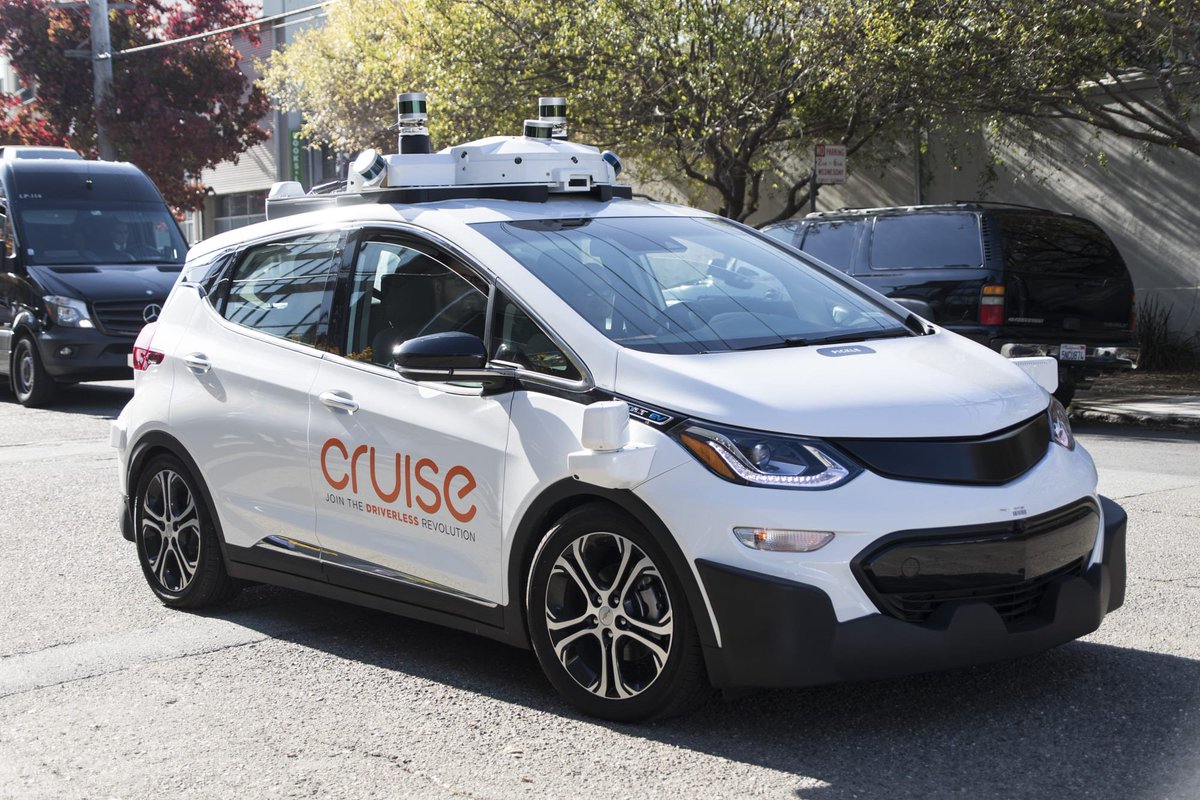
The approach many have taken to try and solve this problem is by overfitting their self-driving cars with a ton of different sensors like LIDAR, radar, ultrasonics, cameras, and other sensors in addition to generating High-Definition maps of the areas where the cars are meant to be driven in. They’ve done this in hopes that there’s a combination of sensors and map data that would allow them to solve for the most unexpected situations. Here’s a picture of a GM Cruise vehicle that uses this approach.
However, yesterday’s video has demonstrated a breakthrough in how self-driving cars can operate.
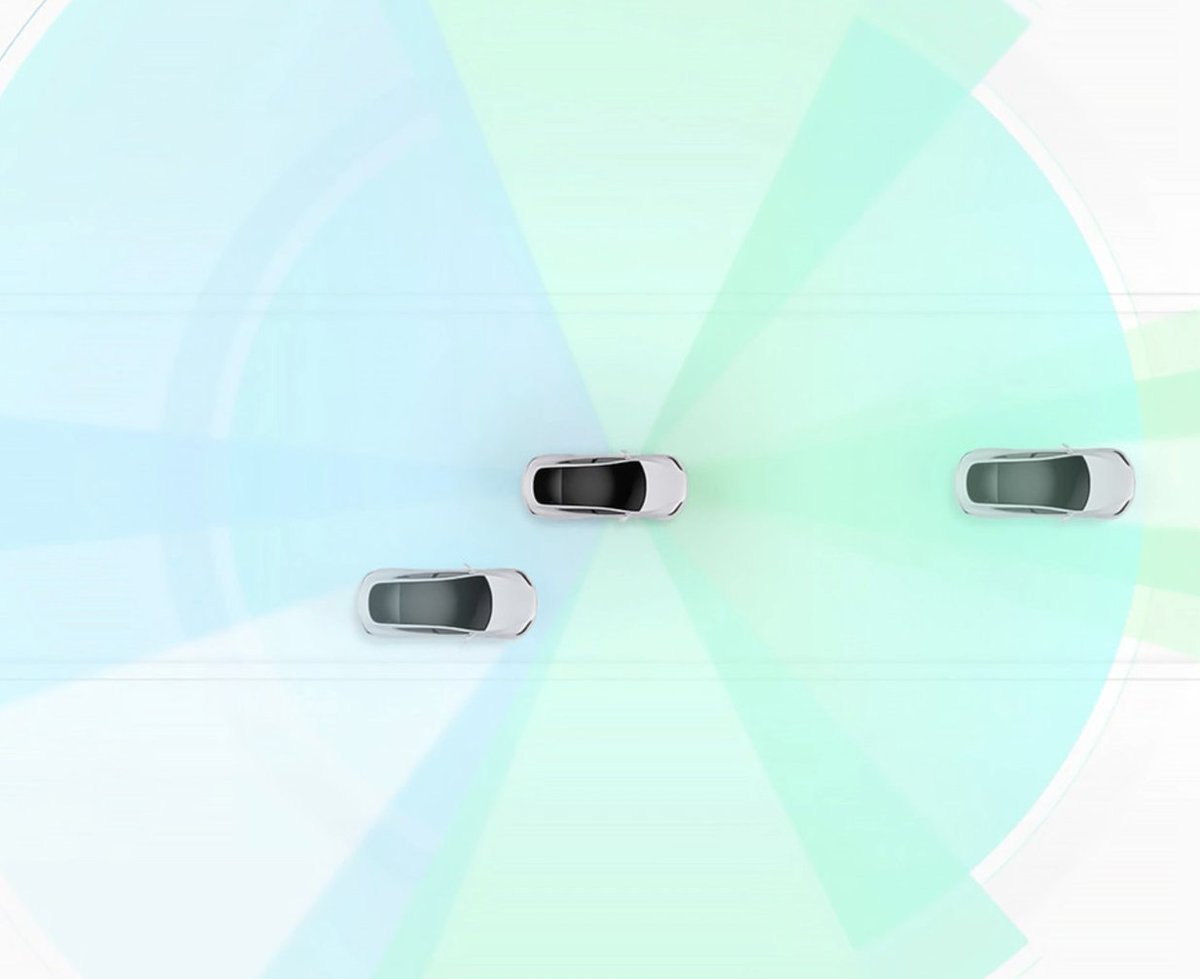
Instead of using many sensors and hardware on their cars to process the world, Tesla is using 8 cameras and a computer that’s specifically built to process video data. That’s 9 total parts vs everyone else’s 30, 40, 50+ parts to process the world.
Using only vision to process the world and not needing things like LIDAR, radar, and other sensors to interpret the physical objects around the car is impressive enough, but HOW the car learns to do this is what the real breakthrough is.
With FSD v12, Tesla takes the video data that is collected by its fleet of ~4 million cars and runs it through an AI that is built using Neural-Nets (like ChatGPT but for the real world), and then the AI figures out what the car should do based on what it sees.
What’s important to highlight here is that Tesla has done 0 work in telling the car how it should interpret the world. That means that the AI doesn’t explicitly know what a lane is, what a traffic light is, what a stop sign is, what a cone is, what a pothole is, what rain is, etc.
What Tesla does is it shows the AI a metric-ton of video of a car driving around using the 8 cameras that are outfitted around the car, and the AI learns how to do the same. The more video Tesla feeds it, the better the system gets. The more unique situations that are collected from the fleet of Teslas, the better the system gets at accounting for those situations.
This “AI code” will then be beamed to every Tesla in the world, and the on-board computer will be able to process its surroundings without the need to connect to Tesla’s AI server. It’s no different than you or I getting into a car and driving it. Instead of our 2 eyes collecting video around us and using our brain to process the info, the 8 camera system will collect the video and Tesla’s on-board computer will process it using the “AI code”.
In other words, Tesla has moved away from humans figuring out how to write code that tells the car what to do, and instead feeds video to an AI, and the AI figures out the best way to account for every situation.
The only thing Tesla needs moving forward is more video and more compute power (chips) to process videos.
That’s it.
This is profound. Everything that is captured on video with the 8 camera system is something the AI will be able to figure out how to navigate through. Snow. Potholes. Deer. Cyclists. Aliens. You name it. And this “code” that is generated by the AI will get better and better as Tesla’s compute capabilities grow with their purchases of NVIDIA’s H100 chips and the build-out of their in-house DOJO compute system. Not to mention the growing fleet of Teslas that will capture more and more video data around the world. Every Model S, 3, X, and Y that is sold today is a video-capturing robot that feeds the AI. And every Cybertruck and Compact Car will be the same.
And believe it or not, it gets even crazier.
Now that Tesla has come up with a real-world data collection and processing system with its cameras and on-board computer, this same system can be used on other physical products that can learn how to move around its surroundings.
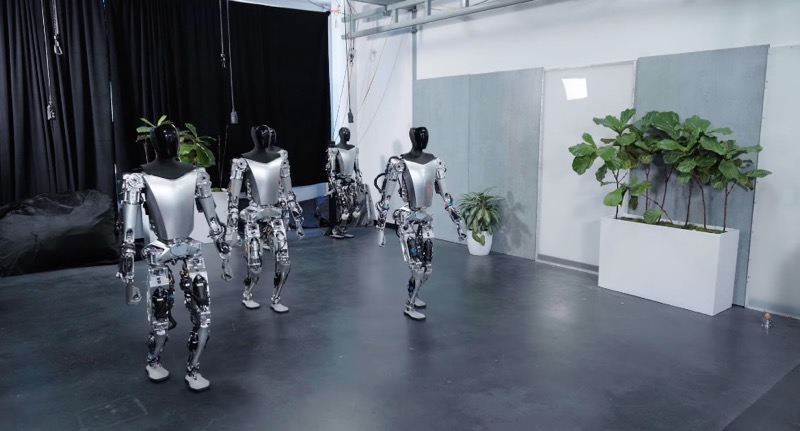
This is where Tesla’s Optimus Bot comes into play. Tesla will be able to use its 8 camera system on the Tesla Bot to collect video of its surroundings, beam it back to the AI, the AI figures out how to best do that thing that it’s collecting video for, and then beam back the “AI code” for the Bot to process with its on-board compute.
We are not far away from a world where a humanoid robot watches you do the dishes, sends back the data to the mothership to process it, and then the next morning the Bot has learned how to do the dishes - not only using the video it gathered from you doing it, but from every other person in the world washing dishes.
Do this process with literally anything.
ChatGPT showed the masses what the potential of AI can be. NVIDIA showed the masses just how much demand there is for hardware that is used by AI systems.
And now, Tesla just showed the masses what AI means for real-world physical applications.
The world has changed - again.









![bpoppenheimer's tweet photo. After his second year at Michigan, Tom Brady wanted to transfer.
He wasn't playing in games, and he was so low on the depth chart that he only got 2 reps in practice.
Brady met with his coach to express his frustration, “The other quarterbacks get all the reps.”
Coach replied,
“Brady, I want you to stop worrying about what all the other players on our team are doing. All you do is worry about what the starter is doing, what the second guy is doing, what everyone else is doing. You don't worry about what you're doing.”
Coach reminded him, “You came here to be the best. If you're going to be the best, you have to beat out the best.”
And then he recommended that Brady start meeting with Greg Harden, a sports psychologist who worked in Michigan's athletic department.
Brady went to Harden's office and whined, “I'm never going to get my chance. They're only giving me 2 reps.”
Harden simply replied, “Just go out there and focus on doing the best you can with those 2 reps. Make them as perfect as you possibly can.”
“So that's what I did,” Brady said. “They'd put me in for those 2 reps, man, I'd sprint out there like it was Super Bowl 39. 'Let's go boys! Here we go! What play we got?'”
“And I started to do really well with those 2 reps. Because I brought enthusiasm, I brought energy.”
Soon, it went from getting 2 reps to getting 4 reps. Then from 4 to 10, “and before you knew it,” Brady said, with this new mindset that Greg instilled in me—to focus on what you can control, to focus on what you're getting, not what anyone else is getting, to treat every rep like it's the Super Bowl—eventually, I became the starter.”
Takeaway 1:
Greg Harden telling Brady to just focus on being great during his 2 reps reminded me of a piece of advice from the entrepreneur Mark Cuban.
“People come to me all the time and tell me they're stuck,” Cuban explained. “They're stuck in a job they don't like. They're stuck working for a boss they don't like. They're stuck on a team they don't like.”
“I just tell them, 'Be great.'”
“The reality of life is that you can't just always quit your job. You can't just always go to your boss and say, 'Give me the promotion, or I'm out of here.'” You can't just always go to your coach and say, 'Give me more reps, or I'm transferring.'
“So when you're stuck, you've gotta find it within yourself to say, 'Ok, this is where I am. And if I'm going to be here, I'm going to be great.'
Because if you're great at your job, typically other people and companies find out, so it creates opportunities.”
Takeaway 2:
I've written before about “lead measures”—the actions and behaviors that predictably drive success.
The core characteristic of a lead measure, the authors of The 4 Disciplines of Execution (4DX) write, is that “a lead measure is influenceable; it can be directly influenced by you.”
To achieve your goals, they recommend (echoing what the Michigan Coach told Brady), apply a disproportionate energy to the things that are in your control.
Starting at Michigan and for the rest of his career, that’s what Brady did, that’s what drove his success.
In his first media call after he was selected by the New England Patriots with the 199th pick in the 2000 draft, Brady was asked: “Are you aware that [along with starting quarterback, Drew Bledsoe] there’s another quarterback here that they drafted last year?”
Brady said he was aware of that. “And I know he’s a heck of a player,” Brady said. “But I’ve always really concerned myself just with the things I can control. I don’t put a lot of thinking into the other guys because I know I’m not at my best when I’m not just thinking about playing as well as I possibly can.”
- - -
“I never once in my life ever said I wanted to be the best of all time. Ever. I wanted to be the best I could be, period. I learned that in college. It didn’t matter what the other guys were doing. It mattered what I was doing.” — Tom Brady
Follow @bpoppenheimer for more content like this!](https://pbs.twimg.com/media/F85l1KpWUAAeAcO.jpg)