Something quite unique about Uruguayan football.
In the morning, watching Albion FC vs Danubio FC with around 1,000 people in the stadium.
In the evening, watching Peñarol vs Cerro Largo in front of more than 30,000 fans at the Campeón del Siglo.
The contrast is incredible, but both experiences represent the same football culture.
12 out of 16 teams in the Uruguayan top flight are based in the capital. Around 75% of the clubs are from Montevideo, making it one of the most football cities in the world.
Football is very accessible for fans. Tickets for some stadiums cost just 3-4 USD.
A country of just over 3 million people, but with a football culture that feels much bigger.
Variasi corner kick yang dilakukan Kwon Chang-Hoon di Gimcheon Sangmu.
Menarik ditunggu, apakah Persija di bawah STY juga akan menghadirkan variasi set-piece yang kreatif?
Very proud of the players in Mexico who are finally taking action to fight for the return of promotion and relegation.
Something is changing. Now they need our help. Keep sharing their message and supporting their fight.
The Mexican Football Federation can no longer ignore them.
Players from Mineros, Venados, Morelia, Cancún and Leones Negros covered their mouths in protest, a symbol of a federation that refuses to listen and continues to sanction them whenever they speak out.
The players have made one thing clear: they won't stop. They will continue taking action until the federation finally listens and takes meaningful steps toward restoring promotion and relegation.
Liga MX players, many of whom came through the promotion system themselves, should also support them. Defending promotion and relegation means defending the pathway that allowed so many players to achieve their dreams.
The players have the power to stop the league if they choose to. Seeing clubs stand together like this is powerful.
The fans are standing with them too. Chants of "¡Ascenso, Ascenso!" around Liga Expansión stadiums.
Players are not asking for a place in the top division. They are asking for the right to earn it. They are not asking for privileges. They are asking for equal opportunities to compete and progress through sporting merit.
Mexican football fans, this is your moment. Time to fight for the future of your game. Stand with the players. Stand for promotion and relegation.
Let's talk about Peñarol.
Yesterday I visited one of the biggest clubs in Uruguay and in South America. A club founded by British railway workers in Montevideo, with a fanbase that proudly embraces its working-class roots.
You can read a banner behind one of the goals that says: "Working-Class and Popular Origins."
The iconic black-and-yellow stripes were inspired by the Rocket, one of the earliest successful steam locomotives built in England.
Peñarol has more than 50 Uruguayan league titles and 5 Copa Libertadores trophies.
Peñarol vs Nacional, "El Clásico Uruguayo", isn't just Uruguay's biggest match. It's one of football's oldest rivalries, dating back to 1900.
The rivalry between Peñarol and Nacional goes beyond football. Peñarol considers itself to have been founded on 28 September 1891 as the direct continuation of the Central Uruguay Railway Cricket Club (CURCC). Under that interpretation, it is the oldest football club in Uruguay and therefore El Decano, "the oldest".
Nacional rejects that continuity, arguing that CURCC and Peñarol are different institutions. Founded in 1899, Nacional instead claims to be the oldest club founded by Uruguayans.
Peñarol has been home to legendary players such as Alberto Spencer, the all-time top scorer in Copa Libertadores history; Fernando Morena, the club's all-time leading goalscorer; Pablo Bengoechea, one of the greatest #10 in Uruguayan football history; and Pedro Rocha, the brilliant attacking midfielder from the 1960s who was admired by Pelé.
More recently, the club has produced players such as Diego Forlán, Darwin Núñez, Federico Valverde and Facundo Pellistri.
For a club from a country of just over three million people, that production line is extraordinary.
A new generation is already emerging, with players such as centre-back Nahuel Herrera (2004), attacking midfielder Leandro Umpiérrez (2004), striker Brandon Álvarez (2007) and right-back Brian Barboza (2008), all of whom are attracting interest from clubs abroad.
Yesterday, in Peñarol's 3-0 win over Cerro Largo, another young talent stood out: 20-year-old Leonel Jaime, who is on loan from River Plate.
Under Diego Aguirre, a club legend as a player and a coach with experience in Brazil and Mexico, Peñarol lined up in a 4-2-3-1 that often became a 4-4-2 in possession, with two strikers: Matías Arezo (23), recently re-signed from Gremio for around €3 million and still a player with considerable upside, alongside veteran forward Abel Hernández (35), formerly of Hull City.
It's not common for Peñarol to play with two strikers, as they usually operate in a more traditional 4-3-3.
Peñarol currently sit top of the overall league table and have also added experienced striker "Cabecita" Rodríguez (33), formerly of América, Cruz Azul, Benfica and Deportivo de La Coruña.
There are also rumours that Flamengo attacking midfielder Nicolás De La Cruz (29) could return to the club in the coming days.
One final curiosity: Peñarol play at the Campeón del Siglo stadium. On rainy days, the area surrounding the stadium often turns into mud, and it's almost impossible to reach the stadium without getting your shoes dirty.
Rival fans use it to mock the club, but many Peñarol supporters embrace it as another symbol of their working-class identity and origins, almost as if "coming from the mud" reflects the values they are proud of.
Today I'll be visiting Uruguay's other historic giant: Nacional.
La Federación Mexicana de Fútbol ha decidido sancionar a los equipos de Liga Expansión, la segunda división de México, por sus protestas.
Imaginad por un momento que sois futbolistas de Liga Expansión.
Os cierran la puerta del ascenso a Liga MX y os arrebatan el sueño de llegar a la máxima categoría. Cada temporada vuestros salarios disminuyen. Cada vez menos gente acude a los estadios porque el sistema ha acabado con la ilusión de competir por un ascenso.
Protestáis durante apenas un minuto y, en lugar de escucharos, sentarse a dialogar y buscar soluciones, la respuesta es una sanción.
Si los futbolistas de verdad quieren cambiar las cosas, tienen más fuerza de la que creen.
Secuestraron el fútbol mexicano para proteger sus intereses.
Pero el fútbol nunca les perteneció. Sin los jugadores, no son nada.
Mexico, the 10th most populous country in the world, where football is, by far, the nation's number one sport.
No domestic cup. No promotion and relegation.
Salaries and attendances in the second division and lower leagues have fallen by more than 50%.
Very few players are exported to stronger leagues.
Yet the priority remains the same: maximizing profits and following what benefits the US market, despite the two countries having completely different football histories, cultures, and identities.
It's hard to imagine doing more damage to a country's football than what has been done in Mexico.
Guido Pizarro deja hoy de ser entrenador de Tigres.
Calidad humana, sencillez, humildad y un profundo respeto por una institución como Tigres y por su gente.
Una auténtica persona de fútbol, apasionada por el juego y con un gran futuro por delante como entrenador.
One week after the World Cup came to an end, I just want to say thank you to everyone who followed my work over the past two months.
20 million impressions.
More importantly, I had the chance to connect with football fans from very different countries like South Africa, Saudi Arabia, England, Argentina, Spain, Mexico, the United States, Brazil and more.
I watched around 150 matches before and during the World Cup to get to know every team properly, understand their playing ideas, and offer thoughtful and more accurate analysis rather than quick and superficial opinions. It meant countless hours of work behind the scenes, but every minute was worth it.
I've always enjoyed talking about teams that don't receive the attention they deserve. Football is far bigger than the biggest nations and clubs, and I want to keep telling the stories of players, coaches and teams doing great work away from the spotlight. The most rewarding part is learning how people from different cultures see, understand and experience football.
As long as I can balance it with my professional playing career and my other projects, I'll be back in August covering different leagues and teams through this account and The Game Changer.
Thank you once again. We've been able to discuss football with respect, exchange different perspectives, and simply enjoy the game together.
The kind of football community I want to keep building.
Mexican football needs our help.
Instead of restoring promotion and relegation, the Mexican Football Federation has announced that there will be no promotion or relegation going forward.
The process has been driven by commercial interests and conflicts of interest rather than by what is best for Mexican football.
After years of promises that promotion would return, those promises have not been kept.
It's unfair to the many clubs, players and supporters in Mexico's lower divisions.
This should be the moment to strengthen the football pyramid, not close it.
Mexican football has enormous potential. The national team has just enjoyed one of its best World Cups, a talented new generation is emerging, stadiums are full of passionate supporters, and football is deeply rooted in the country's culture.
A few years ago, the Mexican Football Federation suspended promotion and relegation, arguing that clubs needed greater financial stability after the COVID-19 pandemic. The measure was presented as temporary, with the promise that promotion would return once second-division clubs had become stronger financially and institutionally.
During that period, clubs were told they would receive financial support, improve their infrastructure, strengthen their youth academies and work towards a certification process that would allow them to earn promotion to Liga MX.
That promise has not been fulfilled.
The consequences go far beyond the clubs themselves. Thousands of players now see their pathway to the top division blocked, regardless of their performances. Historic clubs with passionate fan bases have no sporting route to Liga MX, even if they win the league. Supporters are losing hope because their teams can no longer dream of reaching the highest level through sporting merit.
The issue is also financial. According to the clubs involved, Liga de Expansión teams receive only a tiny fraction of the television revenue earned by Liga MX clubs. They also argue that they do not receive a share of key commercial revenues generated by Mexican football, making it even harder to close the financial gap that is then used to justify keeping promotion closed.
The certification process was also criticised by the clubs, who argue that the final decision depended on a voting committee that included Liga MX representatives, creating what they believe to be a conflict of interest.
Several clubs have already taken their case to the Court of Arbitration for Sport (CAS), arguing that access to the top division should continue to be determined by sporting merit.
If you care about football, please help make this story heard.
Promotion and relegation are more than just a competition format. They represent hope, ambition and opportunity for every player, coach, club and supporter.
Football should reward sporting merit. Every club should have the right to dream of reaching the top division by earning it on the pitch.
Back to the Azteca yesterday to watch Cruz Azul vs Puebla.
First time seeing "La Máquina" live.
Cruz Azul is one of the most interesting projects in Liga MX. I started following them under Martín Anselmi in 2024, and their positional play remains one of the league's most distinctive identities.
They have assembled a squad full of midfielders: Erik Lira, Jeremy Márquez, Palavecino, Charly Rodríguez, Paradela, Amaury García and Luka Romero.
With profiles like these, it's only natural that they constantly look to overload central areas. Cruz Azul don't rely on traditional wingers. Instead, attacking midfielders like Paradela and Luka Romero start wide but drift inside, while even Márquez, a natural midfielder, is now playing at right-back.
It's not unusual to see Cruz Azul field five or even six natural midfielders in the starting XI.
Erik Lira is important to allow them to switch between a back four and a back three by dropping into the defensive line as an extra centre-back.
One of the most possession-oriented teams in Mexican football and champions of the last tournament under Joel Huiqui.
Spain 1 - 0 Argentina | World Cup 2026 Final Review.
I'll try to explain what were the main differences between both teams and take some conclusions.
You can explain Spain's dominance through five key game aspects.
1. Rodri's positioning outside Argentina's defensive block and Spain's ability to find always the free player.
I wrote this in the final preview:
"Argentina usually defend in a 4-4-2 that easily transforms into a 4-4-2 diamond, with one of the midfielders stepping out to press the #6. They defend in a very man-oriented way inside their block, often not worrying about leaving space in front of the defensive line because both centre-backs are comfortable stepping out to challenge opponents. However, if one of Spain's midfielders drops outside Argentina's block to dictate play, Argentina's midfielders will probably not follow. That could allow Spain to control possession."
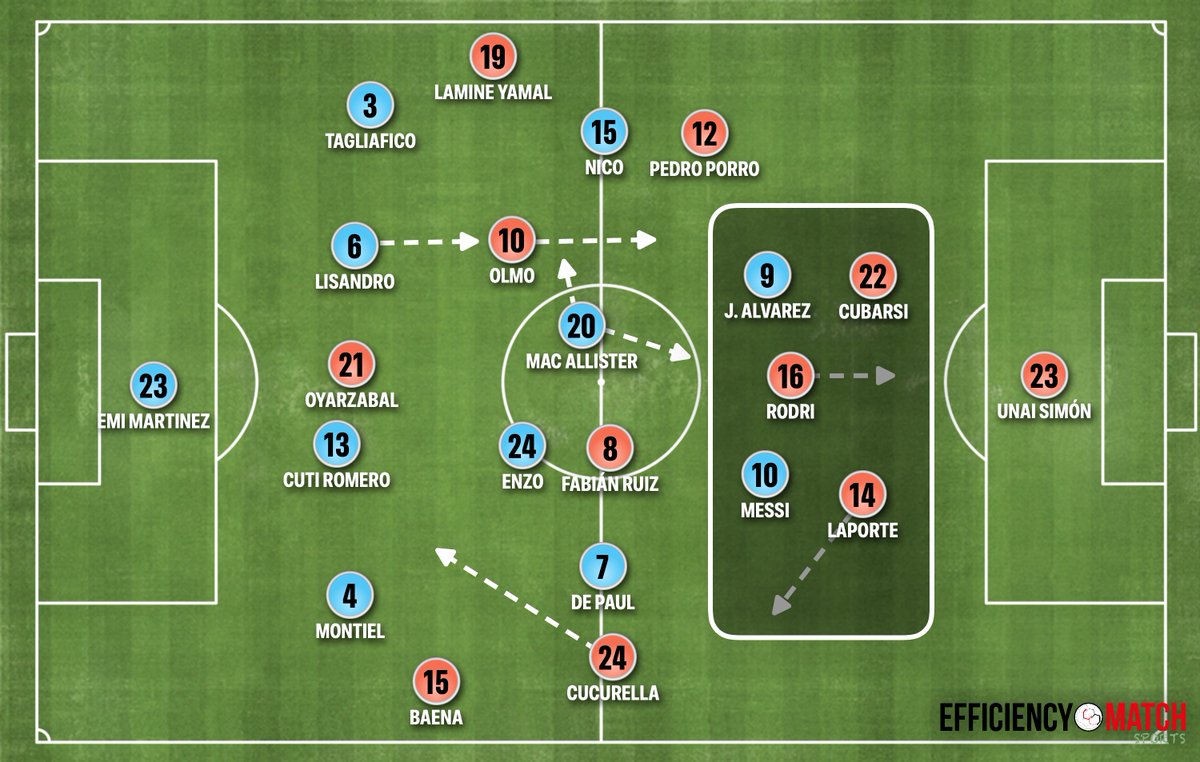
That's what happened. Rodri dropped alongside the centre-backs countless times, and Argentina didn't know how to deal with him. Whenever they didn't follow him, Spain created a 3v2 with Rodri and the two centre-backs against Messi and Julián Álvarez. In reality, it was even easier than a normal 3v2 because Messi wasn't really involved in the press. Spain consistently found the free player and progressed comfortably. That's why we saw Aymeric Laporte driving forward with the ball so often. Messi stayed with Rodri, Julián pressed Cubarsí, and Laporte was left completely free.
Spain are too good at finding the free player through third-man combinations, positioning and decision-making.
2. Argentina not pressing man-to-man often enough.
Argentina were too reluctant to press Rodri aggressively. The alternative was clear: allow one of the midfielders to jump onto Rodri and accept that Dani Olmo would have to be taken by Cuti Romero or Lisandro Martínez, which is not necessarily a problem because both centre-backs are great at stepping out aggressively to win individual duels. In those situations, you sacrifice the spare man at the back and essentially defend man-to-man across the pitch.
Interestingly, Argentina looked at their best whenever they pressed this way. One midfielder would jump onto Rodri, Lisandro would step into Olmo, Spain were forced to play long, and Argentina recovered the ball almost every time. If Spain had one weakness, it was their deep build-up against an aggressive man-to-man press. They lacked a true reference for direct balls and didn't really have specialists attacking in behind.
The problem for Argentina was that this approach depended heavily on their centre-backs stepping out. Once both defenders got injured, they could no longer defend this way. From that point onwards, Spanish players started receiving freely between the lines far more often, allowing Spain to dominate the second half.
3. Argentina's long distances in deep build-up.
Argentina are usually characterised by having many players comfortable progressing through short combinations in very close distances. We barely saw that in the final, especially during the deep build-up phase. Too often, players moved away from the ball. Nico González constantly threatened in behind, Tagliafico stayed very high, and the midfielders rarely dropped close enough to offer support. As a result, Lisandro Martínez was frequently isolated and forced to play long. I understand why playing Nico changes some of these dynamics. A player like Thiago Almada naturally comes short much more often. However, you can still play Nico and progress through short combinations while always keeping at least one option threatening in behind.
Strangely, Argentina played in much shorter distances once they reached the final third, with some occasional very good combinations, but they played in very large distances in deep build-up.
4. Spain's press and the work rate of Olmo and Oyarzabal.
It was a fantastic defensive plan from Luis de la Fuente. Spain pressed in a 4-4-2, with Dani Olmo and Mikel Oyarzabal consistently guiding Argentina towards their left side. The reason was simple. Whenever Spain shifted into a 4-4-2 diamond, it was usually Fabián Ruiz who had to step out to press Enzo Fernández. Doing so would leave the space where Messi likes to receive. By forcing Argentina towards the opposite side, Spain reduced those situations considerably. Even better, Spain often didn't need Fabián to jump at all because the work rate of Olmo and Oyarzabal was exceptional. Olmo repeatedly used his cover shadow to block the passing lane into Enzo before stepping forward to press Lisandro. He executed that action countless times throughout the match. Argentina aren't as efficient as Spain at finding the free player through third-man combinations, so they struggled to exploit the numerical advantage.
Simply put, Olmo and Oyarzabal managed that 3v2 much better than Argentina's front two managed theirs. You could even describe it as a 4v2 because whenever Argentina recycled possession back to the goalkeeper, Oyarzabal immediately jumped to press. Whenever Fabián needed to step forward, he did. The conclusion is clear. Spain could defend in a more conservative structure while still keeping the spare man at the back because of the incredible work rate of their two forwards.
Argentina, on the other hand, only looked effective when pressing man-to-man. Whenever they tried to keep the spare man behind the press, Spain played through them with relative ease.
Spain also never became passive in the press. Every backward pass immediately triggered another aggressive press from Olmo and Oyarzabal, while they continued using their cover shadows to block the #6.
5. Spain's counter-press and rest defence.
Spain suffocated Argentina with their counter-press. Every time they lost possession, the reaction was immediate. Every player committed to it, including Lamine Yamal. The difference between both teams in this phase was enormous. Argentina forced Spain to play long on several occasions and often won the initial duel. However, by the time they tried to secure the second ball, Spain already had multiple players surrounding the area and quickly regained possession.
The same applies to Spain's rest defence. For years, Spain have consistently used a 2+3 rest-defence structure. The two concepts are closely connected. Spain can counter-press so aggressively because they are already well organised against defensive transitions. The two centre-backs stay behind the ball, with Rodri positioned in front of them. Alongside Rodri, you will almost always find Fabián Ruiz or Cucurella on the left and Pedro Porro on the right. A very clear 2+3 rest defense. That organisation provides constant protection while also allowing Spain to immediately attack the ball after losing possession.
You can't explain Spain's remarkably low number of goals conceded or chances allowed without acknowledging the quality of both their rest defence and their counter-press.
Rewatching the World Cup Final between Spain and Argentina.
Tomorrow I’ll talk about it in detail.
One thing that really surprised me was Argentina in deep build-up. The distances between players were much larger than usual.
You can argue that starting Nico González naturally made them more direct, but the reality is that every time Lisandro Martínez received the ball, the team lacked the close support and short passing options that have defined this Argentina side under Scaloni.
Qué gran Mundial 2026 hemos vivido en @ApuntesRabona.
Cubrir un Mundial en México, siendo el país anfitrión, junto a buenos amigos y con la sensación de haberlo hecho desde el respeto por el juego y por la gente que nos escucha.
Un proyecto que trabaja para ser un poco mejor cada día. Un proyecto que no se conforma. Un proyecto que me ha permitido acercarme más a México y al fútbol mexicano, pero que al mismo tiempo ya trasciende México. Hoy ya se habla de Apuntes de Rabona en España, Uruguay, Colombia, Chile y muchos otros países hispanohablantes.
Gracias a toda la gente que forma parte de Apuntes de Rabona por acogerme y hacerme sentir como en casa. Gracias también a todos los que nos seguís y nos escucháis, y a los amigos de @LaMediaInglesa por sumarse y confiar en este gran proyecto.
Y, por supuesto, gracias a mi buen amigo @PepedelBosque por confiar en mí desde el primer día y hacerme partícipe.
Spain are the 2026 World Cup champions.
The most complete team in the tournament.
Intelligence. Technique. Tactical discipline. Work Rate.
A team above individuals.
A long-term project that never abandoned its footballing philosophy.
Football was fair this time.
Spain - Argentina.
World Cup 2026 Final Preview.
Starting with Argentina, they should look to press Spain man-to-man from goal kicks and other restarts. This is the phase of the game where Spain can suffer the most.
Compared to Euro 2024, this Spain side no longer has Nico Williams attacking in behind or a direct reference like Morata for long balls. Instead, they have Baena and Oyarzabal, who both prefer to drop and receive the ball to his feet. That suits Argentina because their centre-backs are excellent at stepping out of the defensive line and anticipating passes into the forwards' feet.
If Argentina go man-to-man, they must be careful when pressing the goalkeeper. Spain are very good at finding the free centre-back through third-man combinations. Even so, this is a good opportunity for Argentina to recover the ball without taking excessive risks because Spain are not as dangerous in this phase of the game as they were in 2024.
In deeper defensive phases, Argentina usually defend in a 4-4-2 that easily transforms into a 4-4-2 diamond, with one of the midfielders stepping out to press Rodri. They defend in a very man-oriented way inside their block, often not worrying about leaving space in front of the defensive line because both centre-backs are comfortable stepping out to challenge opponents.
However, if one of Spain's midfielders drops outside Argentina's block to dictate play, Argentina's midfielders will probably not follow. That could allow Spain to control possession. I expect Rodri and Fabián to position themselves deeper and outside Argentina's midfield block at times, creating space between the lines for Dani Olmo and Oyarzabal.
This is also one of the few matches where it makes sense to allow Lamine Yamal to move inside more often. If Spain can consistently pull Mac Allister and Enzo out of position through Argentina's man-oriented pressing, spaces could appear between the lines. With Argentina's centre-backs occupied by Olmo and Oyarzabal, Lamine could receive freely in central areas. Argentina haven't been defending very zonally, so if the midfielders are pulled out of position, we might not see the wingers covering the inside spaces.
The big tactical question for Spain is who joins the front line when they attack in their usual 2-3-5 structure. Will it be Cucurella, Fabián or Pedro Porro? They have used all three options at different moments. Usually, they look more comfortable when Cucurella pushes up and Fabián stays deeper to protect the team and maintain the 2+3 rest defence, with Porro relying more on occasional dynamic advantages by arriving late from behind.
Overall, Spain have better defensive organisation than Argentina. They usually defend in a zonal 4-4-2 mid-block that becomes a 4-4-2 diamond when pressing higher. Argentina, however, may be able to create overloads on either side of Fabián, who often steps out to press, or on either side of Rodri. Argentina are brave enough to look for those advantages. Spain rarely press man-to-man, usually keeping Rodri in front of the defensive line to maintain a +1.
One potential weakness for Spain appears when Fabián leaves his position to press the opposition's #6 in their 4-4-2 diamond. That movement opens the space where Messi usually operates.
Spain could suffer if Argentina manage to pin them back and force them to defend deep inside their own half. When defending deeper, Spain can move into a situational back five, with Rodri covering the right half-space or Baena dropping into the defensive line on the left. Oyarzabal and Olmo will be crucial because of how much defensive work they do.
If Argentina push their right-back into the last line and Baena follows him, Spain could end up defending in a 5-3-2. That might leave Messi with too much space to operate in wide areas, as he did against Egypt and England. On the other hand, the good thing for Spain is that Olmo and Oyarzabal work very hard without the ball and could help Spain defend in a situational 5-4-1 by protecting the midfield line. Spain should be aware of what happened against Egypt and England.
Argentina are generally weaker than Spain in terms of rest defence. They often defend with only a 2+2 structure, committing many players forward, sometimes including both full-backs. Against Spain, however, that may be a worthwhile trade-off. By pushing both full-backs high, Argentina can force Spain to defend deep for long periods and pin them inside their own half. The risk of leaving fewer players behind is reduced because Spain are not especially dangerous in transition.
The same is true of Argentina. They have excellent players for attacking against an organised defence and dominating possession, but they are less suited to defending deep and relying on counter-attacks.
Both teams are filled with players who excel in tight spaces and on the ball rather than in open-field transitions. Messi, Mac Allister, Enzo, Julián Álvarez, Dani Olmo, Baena, Oyarzabal and Lamine Yamal are all technical specialists rather than transition players.
For that reason, the game should naturally evolve into the type of match both teams want: one dominated by possession. Both Argentina and Spain need the ball because that is the phase of the game in which their best players can have the greatest influence.
We’re back with our videos at The Game Changer.
We discussed France vs Spain, England vs Argentina, and also took a first look at the World Cup final between Spain and Argentina.
This tweet was from Chelsea 6-1 Middlesbrough in January 2024, a Carabao Cup game where Morgan Rogers announced himself on a big stage.
A few days later, Aston Villa paid 9.4m for him.
Two years of individual development at Aston Villa, where he improved massively as a player.
Chelsea are now paying 117m.
Great scouting, perfect timing, and elite player development = More than 10x return on the initial investment.