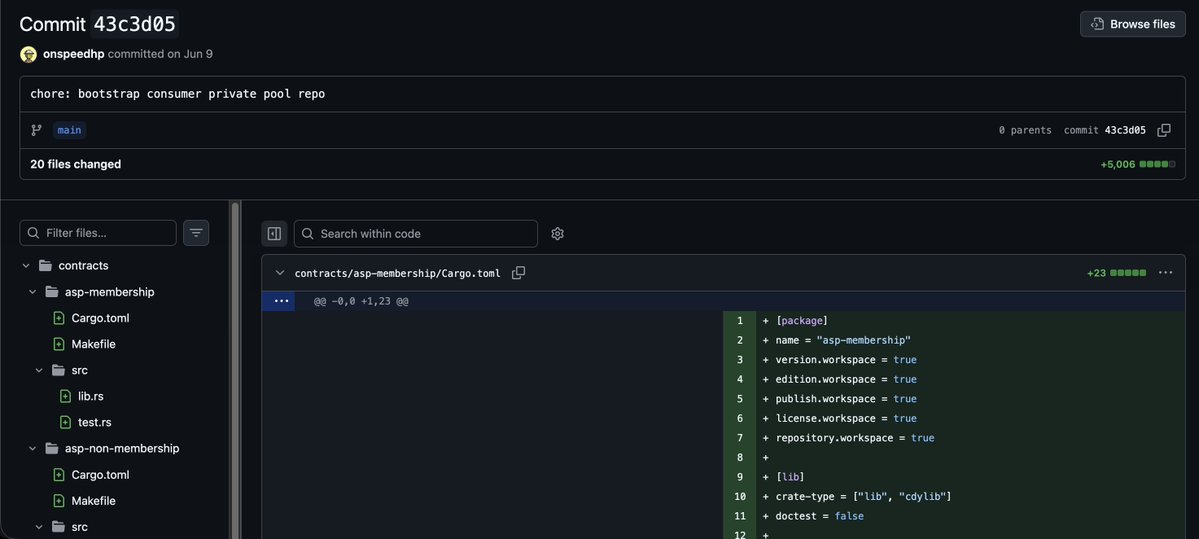
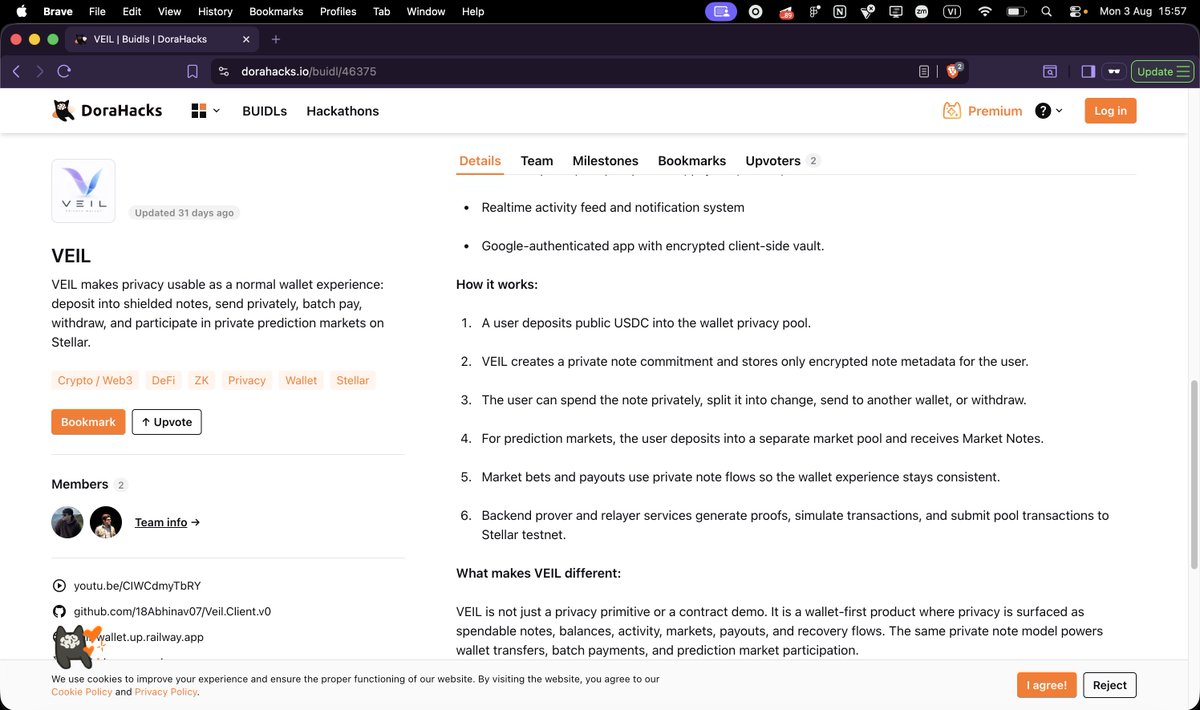
@abhinavpangaria@riseinweb3 We had a commit for handle verifier proof onchain and pool at Jun 9 and I already checking the timeline hackathon Dora Hack so the Submission Open is even after than us so we cannot copy your idea at that time.
@abhinavpangaria@riseinweb3 I think we all learn the concept private payment using ZK from Tornado Cash so you can have some confuse. I totally understand that. So if you have any question you can bring it on table, happy to solve that for you.
@abhinavpangaria@riseinweb3 My Project build a Shield Pool for all of user, each user will deposit fund into same pool, create a commitment they already deposit fund on that, and when they want to transfer fund to another user they will copy the address that is generated by X25519 (is our technical)
@abhinavpangaria@riseinweb3 On our side, everything sensitive stays on the user's device: proofs are generated client-side in the browser, note secrets never leave it, and spends are authorized by a Groth16 proof verified on-chain, smart contract is the verifier.
@abhinavpangaria@riseinweb3 The backend is just a read-only indexer of public chain date. Your side handles the prover in Backend So It totally different because we make everything transparent by transaction in onchain, is very important for Institution, this serve for institution.
@abhinavpangaria@riseinweb3@SahityaRoy07@0xkaankacar@lumenloop@merthxyz@yahya_tx My Project build a Shield Pool for all of user, each user will deposit fund into same pool, create a commitment they already deposit fund on that, and when they want to transfer fund to another user they will copy the address that is generated by X25519 (is our technical)
@abhinavpangaria@riseinweb3@SahityaRoy07@0xkaankacar@lumenloop@merthxyz@yahya_tx The backend is just a read-only indexer of public chain date. Your side handles the prover in Backend So It totally different because we make everything transparent by transaction in onchain, is very important for Institution, this serve for institution.
Grateful for the invaluable feedback on our product and business direction. Special thanks to @Tiffany_herefen , @HarryTran_RWA , and @minhbear_1904 for supporting every team through the feedback loop! 🚀
🎉 Thrilled to place 3rd in the APAC Stellar Hackathon — Payment & Consumer Applications track!
Huge thanks to @VN_Stellar and @riseinweb3 for the opportunity 🙏
@abhinavpangaria@riseinweb3 We also target a different audience: institutional pools with an on-chain ASP compliance/whitelisting layer, no wallet product, no prediction markets.
Our repo is open if you'd like to compare. Happy to chat and to figure out the name overlap in good faith. 🤝
@abhinavpangaria@riseinweb3 On our side, everything sensitive stays on the user's device: proofs are generated client-side in the browser, note secrets never leave it, and spends are authorized by a Groth16 proof verified on-chain. The backend is just a read-only indexer of public chain data.
@abhinavpangaria@riseinweb3 The core tech actually goes in opposite directions. In your design, a backend prover and relayer generate the proofs meaning the server participates directly in the private flow.
@abhinavpangaria@riseinweb3@SahityaRoy07@0xkaankacar@lumenloop@merthxyz@yahya_tx We serve institutions through dedicated pools, each configurable with its own compliance and whitelisting layer. All proving and note secrets stay strictly client-side, no server-side prover ever touches user secrets, and our backend is a read-only indexer of public on-chain data