Explore a Vellum Series in our new demo. See who gets paid and who takes the loss.
Follow the full lifecycle:
Deposit → Mint → Trade → Settle → Redeem
Choose your perspective:
• Liquidity provider (LP)
• Revenue Bond (RB) buyer
• Upside Token (UT) buyer
• Backstop S taker
• Keeper
• $VELLUM holder
Adjust the scenarios, compare illustrated payouts, and follow the steps for your role and see how the outcomes change.
No wallet connection. No real money required.
Try the demo now:
https://t.co/RUUIG9dinB
Create an LP position directly on Vellum.
Enter USDG, review the matching NVDA amount, and move from position creation into deposit. All on the Mint page.
How it works
Enter your USDG amount. Check projected fees and wallet balances. Follow the approval checklist, create your position, then continue to deposit.
The page handles the details:
• Matching NVDA amount shown before creation
• Projected fees and wallet balances in view
• Step-by-step approval checklist
• New position IDs filled in automatically
• Positions created on your device available as selectable buttons
Below the minimum size? The page shows what’s needed to reach 1 USDG in projected fees per series.
Less copying. Fewer steps.
Create your next position on Vellum.
https://t.co/KyuxJBPI1R
The opportunity on Robinhood Chain goes beyond trading tokenized assets.
It includes trading the fee revenue those markets could generate.
Vellum’s thesis: the same fee stream can serve two different buyers.
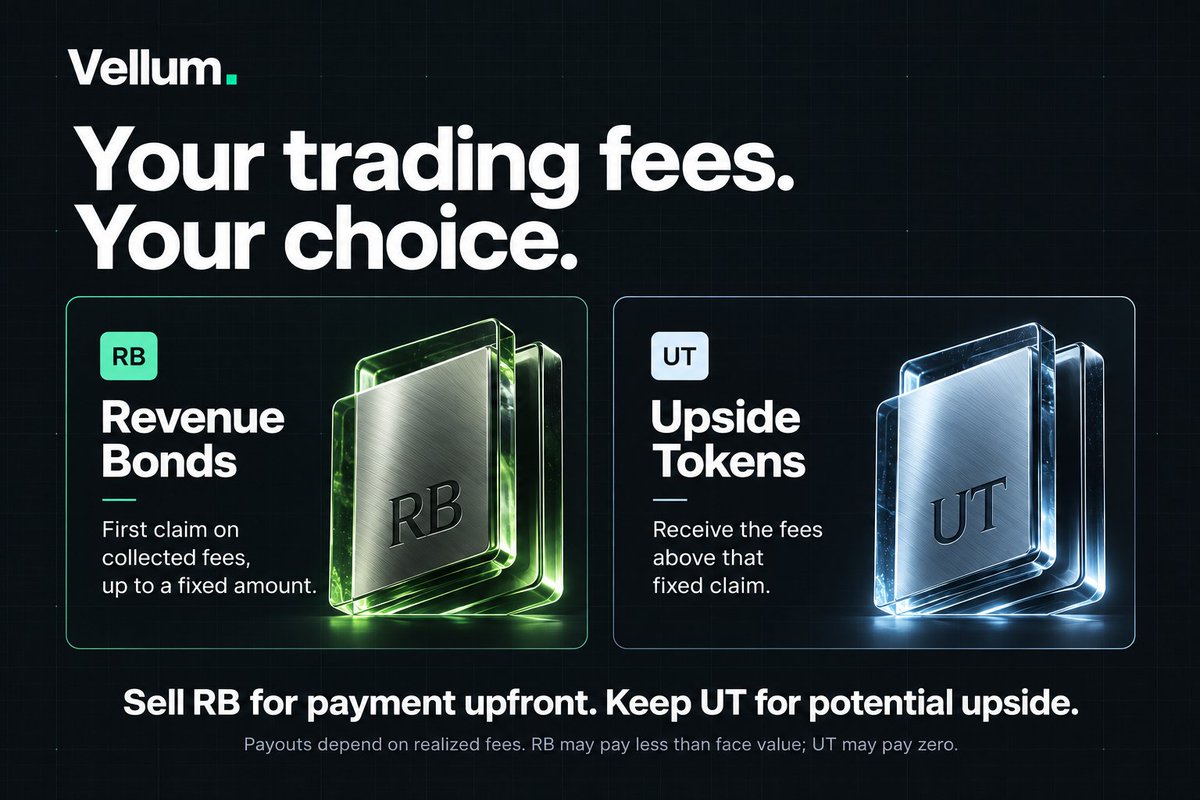
• A treasury seeking a senior claim with a defined face amount.
• A trader seeking uncapped upside when fee revenue exceeds that claim.
RB serves the first.
UT serves the second.
That creates a way to express a view on trading activity, not just asset prices.
A stock token can rise while its pool earns little. A volatile, sideways market can generate substantial fees. UT’s payout depends on realized fee revenue above RB’s threshold.
Start with one pool and one term. Prove demand for both legs.
Protocol fee-switch revenue is a potential next source, subject to integration and a partner.
The goal: make trading revenue a market of its own.
One deposit. Two tokens. One settlement.
Vellum’s design, step by step:
1. Lock a full-range Uniswap v4 LP position for a 30-day term.
2. Project fees P from trailing on-chain fee growth. Set the fixed claim at F = 70% of P.
3. Mint RB for the fixed claim and UT for the residual fee upside.
4. Hold or sell either leg. RB and UT each trade against USDG.
5. At maturity, RB receives fees first, up to F. UT receives the remainder. Available backstop cover can supplement an RB shortfall.
Treasuries can keep RB and sell UT. Traders seeking exposure to stronger fee revenue can buy UT.
The projection sets the split. Realized fees determine the payout.
RB and UT claim fees, not the LP principal, which returns to the depositor under the settlement design.
No borrower. No off-chain oracle for the intended fee projection. Current owner controls over maturity, fees and coverage are disclosed in the docs.
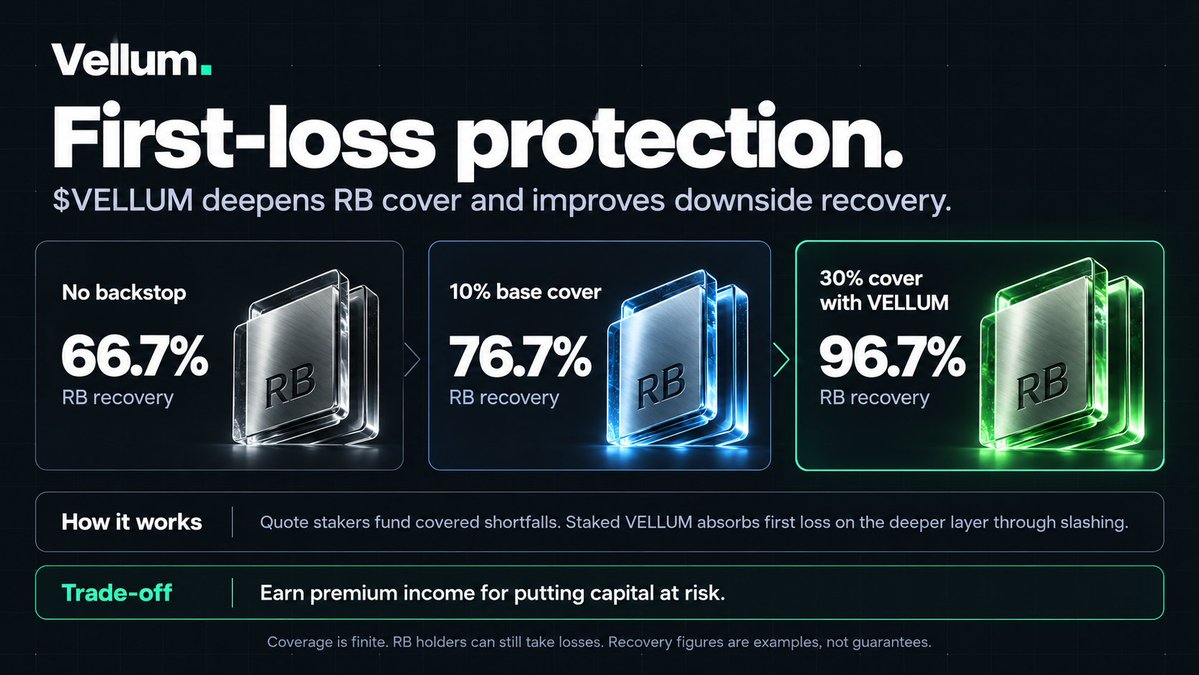
$VELLUM has a specific role in the design: first-loss capital for deeper protection of Revenue Bonds.
The docs’ illustrative Down case shows the difference:
• No backstop: RB recovers 66.7% of face.
• Base cover at 10% of face: 76.7%.
• VELLUM-backed cover deepened to 30%: 96.7%.
Quote stakers supply the funds that pay covered shortfalls. Staked VELLUM absorbs first loss on the deeper layer through slashing, with slashed tokens transferred to quote stakers.
Covered series pay an underwriting premium. After creator and keeper allocations, proceeds flow to eligible stakers.
The economic bargain is explicit: earn premium income for putting capital at risk.
Coverage is finite. RB holders can still take losses. The recovery figures are examples, not guarantees.
Vellum is live on Robinhood Chain mainnet. Deposits are open.
We split a pool's future fees into two tradeable legs:
RB: the Revenue Bond. Fixed, senior, a zero-coupon bond on fees. Redeems at face if fees cover.
UT: the Upside Token. Floating, junior, leveraged upside on volume. Zero if fees go flat.
One deposit. Two tokens. One settlement.
1. Lock a full-range Uniswap v4 LP position, 30-day tenor.
2. Project fees on-chain → fix the claim at F = 70%.
3. Mint RB + UT in the same deposit.
4. Sell the leg you don't want. Treasuries keep the bond, degens buy the upside.
5. Maturity: RB gets up to F, UT takes the rest, your principal always returns.
Why now: every protocol earns fees it can't trade. A DEX knows it'll make ~X over 30 days but can't sell that claim today. Vellum turns dead cashflow into fixed income + leverage.
No oracle. No borrower. No admin key on your principal.
$VELLUM is the backstop. Stake it, and bond cover deepens from 10% → 30% of face. First-loss capital is slashed if it fails, paid the underwriting premium.
DeFi has no risk-free rate. This is the first native fixed-income collateral; The $100T bond market, coming on-chain.
Sell the fixed. Keep the upside.
Deposits open now
We are live.
Every protocol earns fees over time.
Vellum’s thesis: make that future fee stream tradeable today.
One pool. Two legs:
• RB , Revenue Bond. A senior claim on a fixed amount of fees at maturity. Bought at a discount, redeemable at face when fees and available cover are sufficient.
• UT , Upside Token. A junior claim on everything above that fixed amount. Uncapped upside; zero payout if fees don’t clear the threshold.
An LP can sell the fixed claim and retain the upside. A treasury can buy RB. A trader bullish on fee revenue can buy UT.
Both legs claim fees, not the underlying LP principal.
Sell the fixed. Keep the upside.
Vellum. Built for Robinhood Chain.
CA: 0xeb4641bc510277848984ef9539d54ba05ebd7777