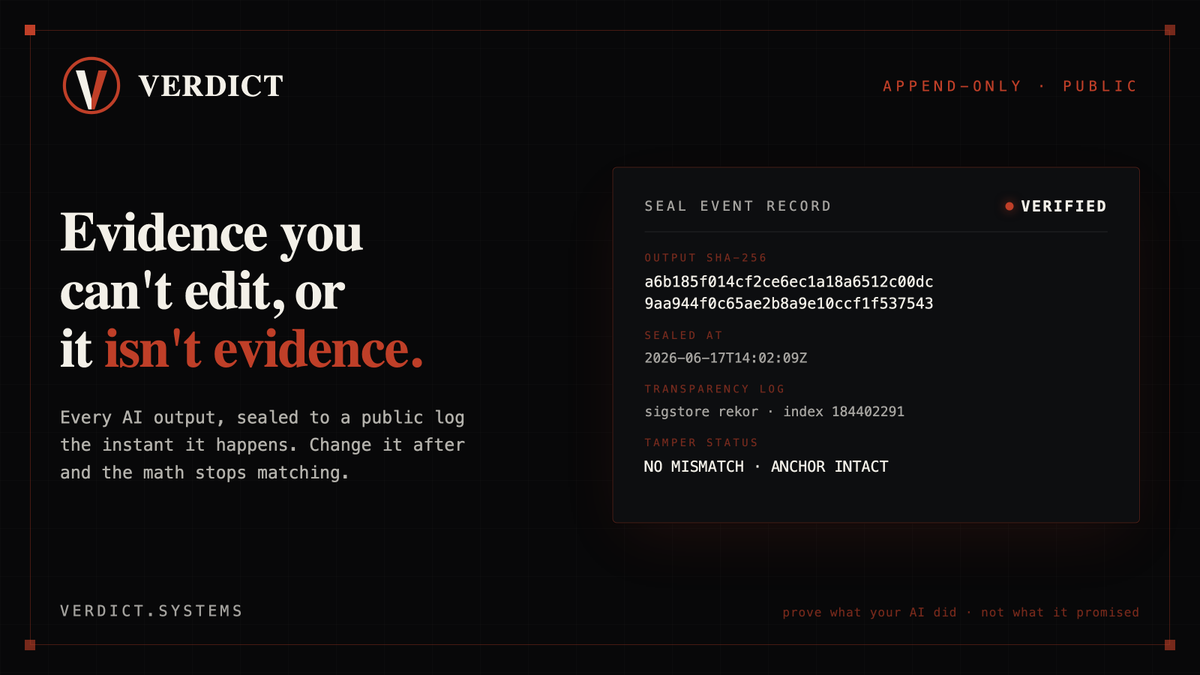
The Evidence Layer for AI. Cryptographic Sealed Evidence Records — Court-Preparable Proof your AI output is what it says it is. The record survives the verdict.
Every AI output is now a potential exhibit.
LangSmith traces and Datadog logs don't survive cross-examination. A Sealed Evidence Record does: SHA-256 + Merkle root + Sigstore anchor + chain of custody.
Seal one yourself, in-browser, no install:
https://t.co/UFTnJlXhmc
The first billion-dollar AI verdict won't ask whether the AI did it.
It will ask what evidence proves it.
LangSmith traces and Datadog logs don't survive a Daubert challenge. Sealed Evidence Records do.
https://t.co/050hP3iEsY
Sakana Fugu routes one request across multiple model providers and won't show you which did what.
Great for a coding sidebar. A liability the second it drives a regulated decision.
Black-box routing produces no chain of custody. The deployer is the defendant.
Seal what the orchestrator won't show you.
Building https://t.co/tCB5ugcrlf tamper-proof records for AI output, anchored to a public transparency log the moment it's generated. Targeting enterprise buyers in regulated industries who need to prove what their AI actually did after the fact, not just trust that it did the right thing.
The people I need to find are GCs, compliance leads, and enterprise AI buyers who are already losing sleep over AI auditability. Would love to know who Boardy surfaces in that lane.
Congrats on the launch. The open connecting layer is the right call. A standard for trusted AI lives or dies on one thing: whether the evidence behind a conformity claim stays verifiable as it moves between parties, so a "conformant" label can't quietly harden into a guarantee it was never tested for. Keeping that evidence portable and checkable downstream is the exact problem we're working on at Verdict. Would love to compare notes as this builds.
Your AI's logs can be edited. That's the whole problem.
A log file proves nothing if whoever holds it can rewrite it. That's not evidence, it's a Google Doc.
Verdict writes a cryptographic seal of every AI output to a public append-only log the instant it happens. Nobody can quietly change it after. Not you, not us.
Evidence you can't edit, or it isn't evidence.
Every AI vendor says "trust our output."
Wrong word. Trust is what you ask for when you can't prove it.
Verdict seals the AI's output the moment it's generated, hashes it, and writes that hash to a public log anyone can check. Tamper with it later and the math stops matching.
You don't trust the record. You verify it.
@Bencera nothing makes people want something more than being told they can't have it
if that's the play, it's the best distribution strategy in tech history and i'm genuinely mad i didn't think of it first
building Verdict — tamper-proof records for AI output
every agent decision gets sealed into a cryptographic proof anchored to a public log. when a client, regulator, or lawyer asks "what did the AI decide?" — you can prove it
for: AI teams selling into enterprise, legal, finance, healthcare
https://t.co/EmC2YpzxHd
AI agents are about to act on real capital at scale. The companies that can PROVE what their agents did will win the audits, the lawsuits, and the insurance pricing.
We are building that evidence layer in public.
Follow @VerdictSys to watch it happen.
Yesterday we anchored a legal fact into a public transparency log that can never be edited.
Cost: $0. Time: 10 seconds. Verifiable by anyone, forever.
Here is why this matters for every AI agent that touches real money ��
This is not a mockup. Seal a fact yourself right now — in your browser, no install, no signup:
https://t.co/2t3jvTAdAk
You get a real entry in a public transparency log, with a verify link anyone can check independently.
Every tool call. Every model decision. Every policy gate.
Hash-chained. Merkle-rooted. Rekor-anchored.
Court-admissible under FRE 902(14).
That's what Verdict seals.
https://t.co/050hP3iEsY
Your agents are in production.
Your logs are not evidence.
The deployer is the defendant.
(N.D. Cal., April 14, 2026)
That ruling is 57 days old.
How many of your tool calls are sealed?
Three forces colliding:
→ ISO CG 40 47/48 live Jan 1 — 82% of US P&C carriers writing AI exclusions
→ 97M MCP installs as of March 2026
→ EU Product Liability Directive: December 9, 2026
Insurers are pricing the risk faster than enterprises are building the evidence.
Most AI audit trails are logs a developer can edit.
Evidence is different: signed, hash-chained, anchored to a public transparency log.
Seal a fact yourself — no install, takes 10 seconds: https://t.co/2t3jvTAdAk
This week I talked to builders working on:
→ Agent identity (who is this agent)
→ Agent coordination (how they communicate)
→ Agent execution (what they actually do)
Every single one of them needs the same missing piece: proof of what happened.
That's not a coincidence. The accountability layer is the last thing everyone builds and the first thing everyone needs when something goes wrong.
Building that layer at https://t.co/EmC2YpzxHd.
Anthropic, June 4: the AI industry "has a gas pedal but no brake pedal."
A brake works only if everyone can verify the rules.
Agents now take real actions with no tamper-evident record of what they did or who approved it.
That's the layer we're building. https://t.co/050hP3iEsY