Vidhi Co-Founder Debanshu Mukherjee spoke to BBC News हिंदी (@BBCHindi) on the NCLT’s approval of a repayment plan in the personal insolvency of Subhash Chandra.
Read the full article here: https://t.co/CadOQYnPsy
#insolvency#subhashchandra#IBC#vidhilegal
Meet the author | Sobhāna K. Nair
@SobhanaNair is Senior Deputy Editor at The Hindu, with a journalistic career spanning over two decades. She has previously been associated with The Indian Express, Hindustan Times, The Telegraph and Mumbai Mirror.
Her work covers Indian national politics, parliamentary proceedings and public policy. She also hosts The Rearview, a podcast for The Hindu, and is the author of Ram Vilas Paswan: The Weathervane of Indian Politics (Roli Books, 2024).
Join us for a Book Adda discussion on Housing the Republic: A Biography of the Indian Parliament by Sobhāna K. Nair.
Event Details:
🗓️ 2 September 2026
⏰ 5:00 PM – 6:00 PM
📍 Milon K. Banerji Library and Research Centre, Vidhi Centre for Legal Policy
👉 Register here: https://t.co/iebdEWiRG5
@S_Tripathi07
#indianparliament #indiandemocracy #parliament #publicpolicy #politicaljournalism #delhievents
Representation is not symbolic; it changes whether people from vulnerable communities feel safe enough to seek justice at all.
The issue is not only legal recognition. It is whether institutions actually become accessible after recognition.
Read the full story: https://t.co/EdX1zJjCuy
One survivor in Kanpur said he stopped pursuing his assault complaint because he feared the consequences of being “outed” more than the assault itself.
More than a decade after the NALSA judgment, representationof trangender person within the legal aid systems remains minimal across many districts.
Even recruitment notices for legal volunteers reportedly continue using language like “men and women can apply,” excluding transgender persons from the outset.
#WATCH | Delhi: BJP MP PP Chaudhary chairs the Joint Committee meeting on the "One Nation, One Election"
The agenda includes interactions with Congress MP and former Union Minister P. Chidambaram, Padma Awardees from Delhi, representatives of Nation First, Policy Research Centre, and representatives of the Vidhi Centre for Legal Policy.
(Source: JPC Chairperson's Office)
6/ Why does this matter?
MSMEs contribute:
• 30.1% of India’s GDP
• 35.4% of manufacturing
• 45.73% of exports
This Act represents a significant step forward for MSMEs, which form the backbone of India’s economy.
1/ The MSMED (Amendment) Act, 2026 received Presidential assent on 13 August 2026. Vidhi Centre for Legal Policy assisted the Ministry of Micro, Small & Medium Enterprises in the preparation of these amendments.
The Act significantly strengthens support for India’s MSME ecosystem by making critical changes to the Micro, Small, and Medium Enterprises Development Act, 2006.
What changes?
5/ Stronger recovery of unpaid dues
The Act promotes recovery by MSMEs of unpaid dues by public sector enterprises by giving statutory backing to the use of the RBI’s Trade Receivables e-Discounting System (TReDS).
This will also promote wider use of bill discounting and factoring to ease cash flow concerns.
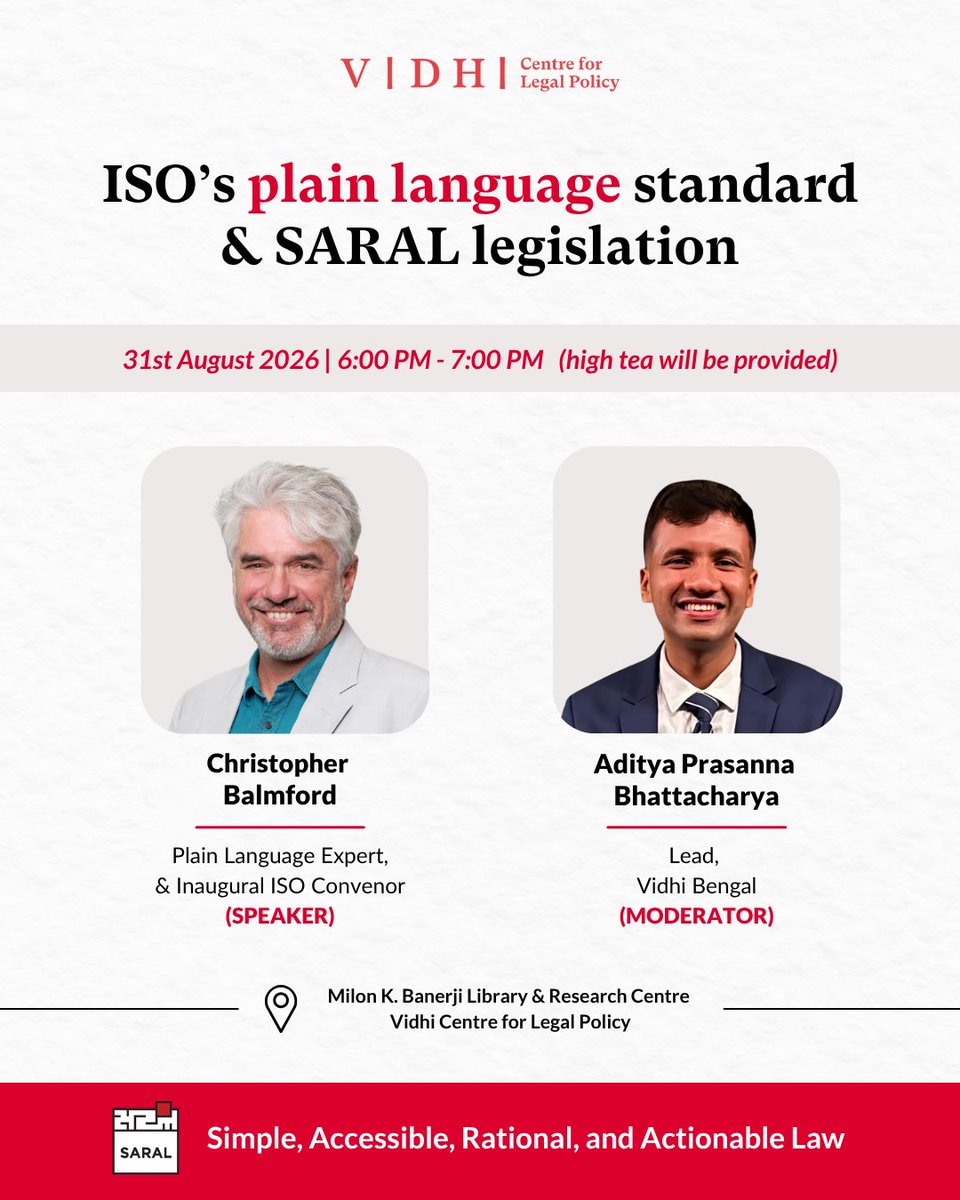
How can plain language principles make legislation and legal documents clearer, more accessible, and more effective?
Join Vidhi for a conversation with Christopher Balmford, Plain Language Expert and Inaugural ISO Convenor, on the development of the ISO plain language standard and its implications for legal drafting.
The discussion will examine the three published parts of the standard, the growing availability of Part 1 through translation, the work towards developing a shared international framework for plain language.
👉 Learn more about the event and register here (link in bio) 🔗 https://t.co/NOA8DTPyIp
Event details:
🗓️ Monday, 31 August 2026
⏰ 6:00 PM – 7:00 PM (High tea will be served)
📍 Milon K. Banerji Library and Research Centre, Vidhi Centre for Legal Policy, New Delhi
📹 A virtual meeting link will be provided for those unable to attend the discussion in-person.
10/ Increasing the Lok Sabha from 543 → 850 may improve representation today...
But if population and representation continue to change, Parliament could face the same question again.
So the challenge is designing a durable framework for the size of the Lok Sabha while balancing representation, State interests, accountability and parliamentary capacity.
Read the full note 👉 Beyond Women’s Reservation: The Implications of an Expanded Lok Sabha.
🔗https://t.co/FSPChGnQCU
1/ What happens when the Lok Sabha gets bigger?
A proposed increase from 543 to 850 MPs could significantly change how India’s Parliament represents people, balances State interests, holds government accountable, and functions in practice.
Here’s what to know 🧵
9/ A larger House would have practical consequences:
💰 Higher expenditure on salaries, staff, accommodation, security and infrastructure
🏛️ Greater administrative and committee capacity
⏱️ Potential need for more sitting days and more time for Question Hour, debates and Private Members’ Business.