This is the woman “pastor” who told me I needed to get any social media post I wanted to share regarding Israel or Gaza, approved by her.
She told me that no children in Gaza were starving.
Lies.
I learned the truth about the Catholic Church on 𝕏 and YouTube, thanks to faithful Catholics who thought it was worthwhile to have conversations with confused Protestants. There are millions of people just like me who will convert, but more evangelists are needed.
The Grift that is Protestantism…
"I'm not moving."
With those three words, Paula White-Cain brought her conference to a standstill, refusing to pray over her audience until they proved their obedience with an offering envelope.
Father János Brenner saved the Eucharist while being stabbed dozens of times🇻🇦
On December 14, 1957, Father János Brenner, a Cistercian Hungarian priest, was called to give Last Rites and final Eucharist to a dying man. The call was a lie. The priest was being set up by Communists. Revolutionaries in Hungary had been suppressing Catholics for years.
Father Brenner was ordained during the worst of the persecutions. Now, as he went out on the fake sick call, he carried the anointing oils and the Blessed Sacrament in a pyx. Attackers leapt out of the trees and stabbed him 32 times. His body was found the next day, still clutching the Eucharist in his hands, refusing to give it up. The ambush backfired: The priest is revered as a martyr, and a chapel was built on the spot where he died. His bloody surplice hangs inside as a relic.
Father János Brenner was beatified by Pope Francis on May 1, 2018.
After electing a lady bishop as the Archbishop of Canterbury and being super gay and progressive for years, the Church of England suddenly be like, "Actually, we are a bit conservative ourselves."
I was attempted to be removed from a religious freedom commission because I stood against this violence. I guess our government protects war criminals over Catholics.
Blessed Jerzy Popiełuszko: Martyr for Faith & Freedom🇻🇦🩸 🧵 (1/3)
In 1984, Polish priest Fr. Jerzy Popiełuszko was brutally assassinated by agents of the Communist Security Service. He was kidnapped, beaten to death, and his body was thrown into a water reservoir.
Father Popiełuszko was a Polish priest who became a symbol of the struggle for freedom, human dignity and truth. His unwavering stance, courage and deep faith made him a hero in the fight against the communist regime, and his tragic death shocked Poland and the entire Catholic world.
Blessed Jerzy Popieluszko was born September 14, 1947, on a farm in the small village of Okopy located in North Eastern Poland. His parents Wladyslaw and Mariana were devout Catholics and he was baptized Alphons Popieluszko two days after his birth. Blessed Jerzy was a fragile child but as his parents stated he made up for any physical infirmities in strength of character.
The country into which Blessed Jerzy was born was one suffering from the aftermath of the reign of terror by the Nazi’s and the ongoing persecution of the Church by the Communists since the country’s occupation by the Russians in the Second World War. Okopy, the geographical center or “heart” of Poland was a rural village and thus its school system was not as deeply infiltrated with the sociology of the communist regime, but nevertheless Bl Jerzy suffered for his Faith while yet in school. Each morning before classes began Bl Jerzy would walk three miles to serve Mass, and then after classes were over in the evening, would return to the Church to pray the Rosary. His spirituality was ridiculed and he was accused by his teacher of praying too much.
As a precaution due to the harassment he received Bl Jerzy kept secret his intention to join the seminary for fear that if it were known the results of his exams would be altered. After graduating high school in 1965 while his friends were at the school ball, Blessed Jerzy Popieluszko was on a train headed for the seminary in Warsaw. He had chosen Warsaw due to its closeness to the monastery of St Maximilian Kolbe, a favorite saint of Bl Jerzy. Although against the agreement of 1950 between the Church and State, after one year of seminary training Bl Jerzy was drafted into the military for a two year tour in a special unit for clerics in Bartoszyce.
The plan for drafting clerics into the service was to indoctrinate them with the communistic ideal and cause them to lose their vocation. In spite of bitter persecution ensuing from the practice of his Faith, Blessed Jerzy Popieluszko firmly defied the authority’s attempt to marginalize Catholicism. On one occasion, when Bl Jerzy refused to crush his rosary beneath his heel he was cruelly beaten and placed in solitary confinement for a month. Also on account of his refusal to remove a medal from about his neck he was forced to stand for hours in the freezing rain. He was also made to crawl around the camp on his hands and knees as a punishment for saying the rosary. The results of this barbarity were that on the completion of his two year tour, Bl Jerzy had to undergo a life threatening surgery to undo the damage done to his heart and kidneys from his beatings. The recovery caused his ordination to be delayed, but on May 28, 1972, he was ordained with his name changed from Alphons to Jerzy by Cardinal Wyszynski.
Blessed Jerzy Popieluszko was first stationed taking care of several small parishes where his work was greatly appreciated. In January of 1979 he collapsed while saying Mass, and was sent to stay in a hospital to recover. Afterwards, he was given the duty as chaplain for the medical niversity of St Ann in Warsaw. A year later he was transferred to his last parish, St Stanislaus Kostka in Warsaw.
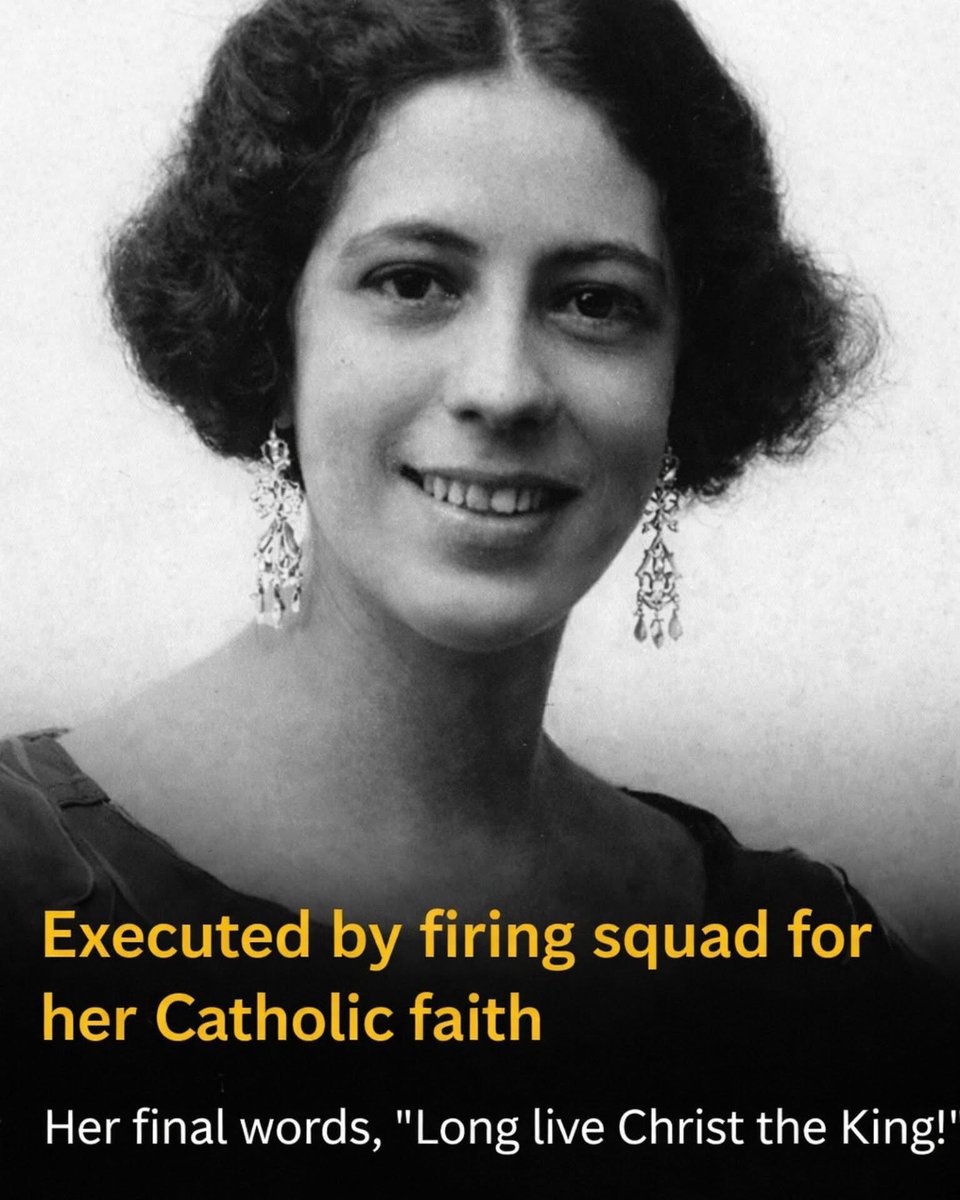
Blessed Victoria Díez Bustos de Molina was a Spanish educator and martyr whose faith and dedication to teaching left a profound spiritual legacy. Born on November 11, 1903, in Seville, Spain, Victoria grew up in a devout Catholic family. Drawn to education as a vocation, she became a teacher at a young age, excelling in her profession and inspiring her students not only academically but also spiritually. She joined the Teresian Association, a Catholic lay organization dedicated to promoting Christian education and values in society.
Victoria taught in the rural town of Hornachuelos, where she became a beloved figure, transforming the lives of her students and their families through her kindness, moral integrity, and deep commitment to faith. Amid the political upheaval of the Spanish Civil War and the rise of anti-Catholic persecution, Victoria remained steadfast in her religious convictions, encouraging others to hold fast to their beliefs. Her courageous faith and refusal to abandon her community made her a target during this turbulent time.
On August 12, 1936, Victoria was arrested by anti-religious forces and offered her life as a testament to Christ. She was executed by firing squad at the age of 32, her final words being, "Long live Christ the King!" In recognition of her faith, courage, and sacrifice, Victoria Díez was beatified on October 10, 1993, by Pope John Paul II🇻🇦
@EYakoby If you’re really concerned about Islamic jihadists in France, you’d be calling for the restoration of the French monarchy (which was overthrown based on lies) to remove jihadists, but I don’t see you calling for that.
>>>Trick people into saying a phrase
>>> Declare them muslim
This makes the Protestant "sinner's prayer" look like a deep period of catechesis.
Some high school kids were playing with a ouija board.
One of them got spooked and went out to his car to put on his scapular that was hanging from his rear view mirror.
The ouija board stopped working.
Mary is stronger than all of hell.
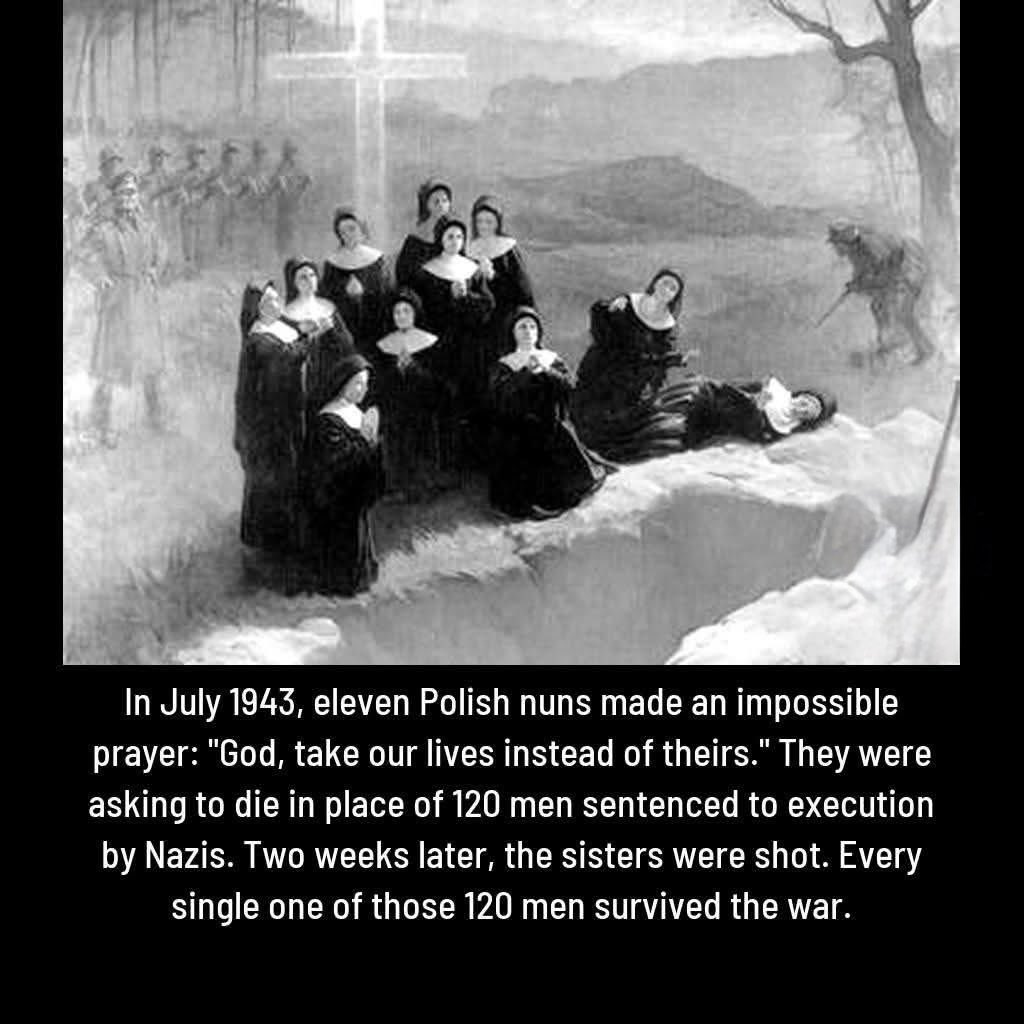
The women of Nowogródek came running to the convent that terrible night in July 1943. They were crying. Begging. The Nazis had just arrested their husbands, their fathers, their sons. One hundred and twenty men. All sentenced to die by firing squad.
"Please," they sobbed to the sisters. "Pray for them. They're all we have left."
The eleven nuns gathered in their small convent room. Outside, Nazi-occupied Poland was a nightmare. Half their town was already dead. The Jewish families who had been their neighbors? Gone. The priests who had served alongside them? Shot.
These women had already lost everything else. Now they were about to lose even more.
Sister Maria Stella was 54, the mother figure of their little community. She looked at her sisters' faces in the candlelight. They were teachers. Nurses. Women who had given their lives to serve others.
They had no weapons. No political power. No way to fight the monsters who controlled their world.
But they had one thing.
"We could offer our lives instead," Sister Maria Stella said quietly.
The room went silent.
Think about that moment. Eleven women, sitting in a tiny room, calmly discussing whether to volunteer to die. Not in a moment of passion. Not in a burst of heroic emotion. Just quiet, determined love.
They talked it through. These 120 men had wives who needed them. Children who would starve without them. The sisters were free from family obligations. They could be spared more easily than fathers.
One by one, each sister agreed.
The next morning, Sister Maria Stella walked to the parish priest. "Father," she said, "if sacrifice of life is needed, accept it from us and spare those who have families. We are even praying for this intention."
They were literally asking God to kill them instead.
What happened next defies explanation.
The execution was suddenly canceled. No reason given. The 120 men were loaded onto trains and sent to labor camps in Germany instead. Some were even released outright.
The sisters' prayer seemed to be working. But God wasn't finished.
Two weeks later, the Gestapo came for the nuns.
No charges. No trial. No explanation. Just an order: "Report to headquarters at 7:30 PM."
Before she left, Sister Maria Stella gave one last instruction. She told Sister Małgorzata to stay behind at the convent. Someone needed to tend the church after they were gone.
Sister Małgorzata watched her eleven sisters walk up the street in their black habits. The townspeople lined the windows, knowing they would never see them again.
The sisters spent their last night in a basement jail cell, praying the rosary together.
At dawn on August 1st, 1943, they were loaded into a covered truck. Five kilometers outside town, in a forest of birch and pine trees, a grave had already been dug.
Eleven women knelt side by side in the dirt.
They said goodbye to each other. Then, one by one, starting with Sister Maria Stella, they were shot.
Their bodies fell into the mass grave together. The youngest was 27. The oldest was 54. Teachers, nurses, servants of God who had asked to die so that strangers might live.
The war dragged on for two more years.
Sister Małgorzata stayed in the empty convent, tending to their secret grave in the woods. The parish priest they had tried to save survived. He joined the underground resistance and kept fighting.
And in 1945, when the war finally ended, something miraculous was revealed.
Every single one of the 120 men survived.
The ones sent to labor camps came home. The ones who had been released lived through the occupation. Not one father. Not one husband. Not one son had died.
One hundred and twenty families were reunited because eleven women had knelt in the dirt and died in their place.
Their prayer had been answered completely.
@KaceeRAllen@disclosetv I don’t see the same outrage over anti-Catholic bigots from Ted Cruz, when Catholics are treated worse than Jewish people by woke leftists and Protestants, not that I like antisemitism.