Centralized price setting simply doesn't work. Hayek eloquently showed this decades ago, yet we still rely on price setting for how we run US healthcare.
Imagine we paid for food this way. The department of agriculture sets a code for "hamburger" and assigns a price. "Hotdog" "popcorn" "steak" & "glass of red wine" also all recieve codes and fixed prices.
Those prices don't reflect how much people actually want those types of food.
If there's a local shortage of beef, there's no way for the prices paid for beef-based codes adjusts in response. So nobody offers those products any more. The menu only has chicken and rice now.
If steak is in high demand, yet the code for steak doesn't pay enough for restaurants to make money off of selling steak, then there will be no steak for hungry patrons. They're not allowed to raise the price of steak to meet the increased demand or the increased cost of beef.
It also allows for gaming the codes. Some chef comes up with a chunk of meat-type substance that technically meets the defintion of the "steak" code, and all of a sudden he gets paid at the filet mignon rate. Furthermore, a steak from the best chef in the world is sold for the same price as a tough piece of meat from your local bargain chain.
There's no way for restaurants to make more money with higher quality, or for providing an in-demand service. So they make up for it on volume. You only get five minutes at your table. You must book months in advance. If you want dessert, you need a separate reservation.
A key role of dynamic prices is that they help relieve shortages.
Want to know why it takes so long to get an appointment with some doctors? This is why. Prices are set, so independent doctors can't charge more when costs or demand goes up. They can't be used as a signal for new doctors to open up clinics or new firms to invest in infrastructure.
In fact, Medicare payment rates to doctors are about 50% lower than they were in the 1990s. That's a major reason independent clinics are shutting down and being bought by health systems. The payments go down while the costs of running a practice continue to go up.
We need prices in healthcare. It's the moral and ethical thing to do.
Most of health policy world that has designed our current system are Ken Arrow acolytes. They very much believe that patients are not smart enough to make health care choices for them — a unique feature that means no market can be allowed to exist in healthcare.
Same people have no problem with consumers shopping for health insurance.
That isn’t an accident.
If you don’t lock in Original Medicare + a Medigap supplement during your one-time 6-month window when you first become eligible, you may never be able to get it later. Choose Medicare Advantage instead and, in most states, Medigap insurers can reject you for preexisting conditions (or ones you develop) if you try to switch back.
Seniors I talk to almost universally don’t understand this and are enticed into Medicare Advantage plans with lower monthly premium sales pitch.
They also don’t realize Advantage plans typically have higher medical copays than Original Medicare + Medigap Plan G. MA plans also apply much tighter management (prior auth + step therapy) to Part B drugs like chemo and infusions.
@dr_huffer I remember those days as an intern, my job was to collect all the films and have it ready for rounds. If you were lucky and nice to the rad tech they would help you. Also remember wet reads because the films would still be wet when the radiologists looked at it. Great Memories!!
@anish_koka@DrDiGiorgio Decrease in physician reimbursement increases hospital employment, leading to increased costs, leading to decreased reimbursement to physicians, leading to …….. ad infinitum!!
This is not a popular opinion. But true. When I explain that the average Pediatrician is earning less than a Buc-ee’s gas station manager, and the average surgical specialist earns around what a Walmart General Manager earns, then the idea starts to ring true. #txlege
@dr_huffer You do learn a lot with an even a cursory exam. I am surprised haw many times patients remark that nobody has examined them.
The flip side though is insurance asking for imaging for clinical diagnoses!
Med Students yesterday:
"After 10 years, including a gap year and 2 years in a non ACGME accredited fellowship, I'm pleased to announce I've matched in Neurosurgery. Happy to serve."
Van Nuys Home Health Care operators:
"Lulz. Let me show you my new Maybach"
In 1944, the USS Johnston went down fighting the Imperial Japanese Navy in the Battle of Samar. It had taken a lot of fire and had started to split apart. The captain ordered his men to abandon ship. As they climbed into lifeboats, it is said that a Japanese crew sailed by and
One of the most consequential healthcare policy mistakes of the last 15 years? The 2010 ban on physician-owned hospitals.
I wrote about why repealing Section 6001 of the ACA isn’t a partisan issue. It’s a pro-competition, pro-patient, pro-community reform.
The data are clear: physician-owned hospitals deliver lower readmission rates, lower mortality, higher patient satisfaction, and lower costs. ASCs have proven for decades that physician ownership doesn’t produce runaway utilization but instead produces efficiency.
Meanwhile, 140+ rural hospitals have closed since the ban. Large systems are walking away from Medicare Advantage contracts. And yet independent physicians are blocked from stepping in with local solutions for local problems.
It’s time to restore competition to American healthcare.
https://t.co/VZwd6XXYHE
𝐈𝐧𝐝𝐞𝐩𝐞𝐧𝐝𝐞𝐧𝐭 𝐩𝐡𝐲𝐬𝐢𝐜𝐢𝐚𝐧𝐬 𝐝𝐞𝐥𝐢𝐯𝐞𝐫 𝐭𝐡𝐞 𝐥𝐨𝐰𝐞𝐬𝐭-𝐜𝐨𝐬𝐭 𝐜𝐚𝐫𝐞 𝐢𝐧 𝐌𝐞𝐝𝐢𝐜𝐚𝐫𝐞.
Academic "non-profit" Centers are the most expensive.
Non-Profit Health Systems are next.
For-Profit Health Systems are third.
Independent practice of medicine is the lowest cost.
The entire economic structure of American healthcare is designed to eliminate the cheapest model and protect the most expensive one.
Would someone let Dr. Oz and Secretary Kennedy know they're in charge of a cartel?
URGENT:
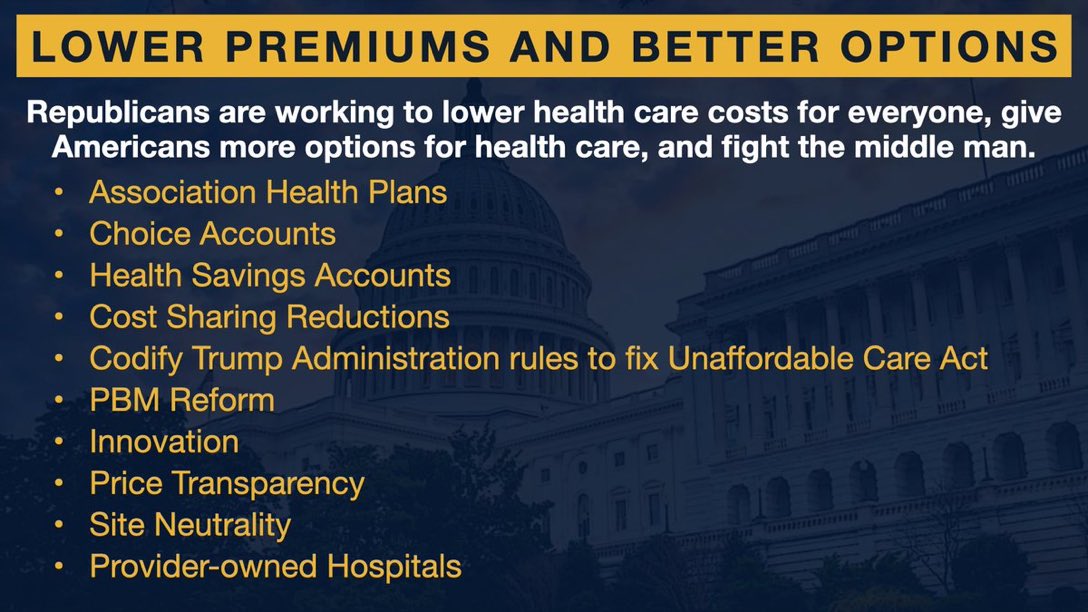
The Republican healthcare plan includes “provider owned hospitals”! Today is a massive breakthrough for everyone who has been fighting to reverse the injustice. As quickly as I am typing this, members of the AHA and FAH will be working to protect their monopoly on hospitals ownership.
Remember that this policy will reduce costs and improve quality. Call your Congressman today and let them know that the “provider owned hospitals” cannot be stripped out of the plan. They cannot back down to pressure from hospitals. We have let large corporations put in their monopoly granting regulations for far too long. Let’s take back our healthcare system!
There might be decent individual provisions in ACA but overall it’s been a fundamental disaster.
Currently, ACA subsidies go to insurance companies, not patients or physicians. The money never reaches the person receiving care, and it keeps the middleman in control instead of empowering the patient.
Also, Healthcare spending is extremely skewed, and the ACA does nothing to correct that imbalance. Most people use very little care in a given year while a small percentage drives the overwhelming majority of costs.
Key data:
• Average spending: ~$14,500 per person
• Top 5% of patients: ~50% of all spending
• Bottom 50%: ~$374 a year
• Most people: ~$1,000–$5,000 a year
ACA subsidies by tier simply support insurers.
• Bronze: $350–$550/month
• Silver: $500–$750/month
• Gold: same subsidy as Silver applied to a higher premium
A better approach is redirecting a major share of those subsidies straight into each qualified recipient’s HSA. A predictable $10,000 annual deposit—funded through subsidies and income-based contributions—would grow for most people because they spend far less than the deposit.
Low-spend users could build six-figure balances in a decade, and moderate-spend users still accumulate meaningful reserves over time. Only high-cost patients would use the full amount and rely on catastrophic insurance where risk pooling actually belongs.
The system-wide impact compounds. Unused dollars roll over, grow, and stay with the patient. Over time, millions build real savings instead of watching their money disappear into premiums and administrative waste.
As these accounts grow, routine care becomes patient-funded, insurers focus on true high-cost cases, and the nation shifts from bureaucratic churn to patient-controlled capital that strengthens long-term financial stability.
The ASCs give a great amount back to society. They provide an excellent service at a fraction of the cost that nonprofit hospitals do.
Think about that for a second, the nonprofit hospitals paid no taxes. ASCs have to pay every tax, and yet are able to provide the same service the hospital does but at a much lower cost and with much better customer service.
So the sad part is that even when you own your own practice, own the land/building, and own your own ASC … you still have to balance revenue and expenses.
1. Revenue - at any point in time a drastic cut to reimbursement can be unilaterally made by Medicare/Medicaid and suddenly your budget doesn’t balance ... the only way to adapt is increase throughput in same unit of time.
2. Inflation - while revenue is fixed the cost of everything goes up which means your top line erodes in purchasing power while your bottom line rises so you get squeezed in the middle … this by design leads you to sell to PE or hospital system
3. Different Pay for same services - as an independent practice you are unable to charge facility fees while your competition of the large academic or hospital systems can … this means they can outspend you to hire your staff away as well as acquire you
4. Different Tax Status - independent practices pay taxes and don’t have the benefit of hiding behind a non profit status
5. Leverage - a smaller practice has less leverage with negotiating with private payers as well as equipment purchases.
This means the independent practice just to survive has to run tighter, more efficient, and has more skin in the game at all times. They are literally making a huge leveraged bet with their entire livelihood and retirement savings to buy into a practice, the land, the building, and the ASC. All this to serve and care for their community in which they have pride in doing.
Not crowded with administrators all collecting salary and benefits w/ no skin in the game.
This has become unsustainable and these people are a dying breed … you won’t like what is left behind
I ask the physician to go calls the same question. Very single time they say, these are the guidelines and they cannot change it. So the charades continue
So, I say to the physician that called
Me: guidelines were set up to get us to a peer-to-peer so that we could discuss the patient and let me explain why this guideline doesn’t work for her and how 3 months of pain ruins the last 30 years where she has worked to stay in shape
Medicare physician: I can’t change anything
Me: then why am I talking to a doctor? I can talk to an operator or secretary.
Medicare doctor: I don’t know
Me: Because they need your medical license to pull off this charade