AI is creating massive anxiety and FOMO among business leaders.
Not because they don't believe in AI. Because they do.
Every CEO, every board, every business unit head can see what's coming. They know AI matters. They know their competitors are experimenting. They know the technology is improving at a breathtaking pace.
And yet... most organizations are stuck.
OpenAI put it bluntly when launching Frontier:
"This is happening for AI leaders across every industry, and the pressure to catch up is increasing. What's slowing them down isn't model intelligence, it's how agents are built and run in their organizations."
The problem isn’t the technology. The bottleneck is organizational.
Companies spent the last decade figuring out how to deploy software. Now they need to figure out how to deploy intelligence.
Who owns the agents?
How do they access data?
What permissions do they get?
How do they work together?
How do you trust them?
How do you redesign workflows around them?
These aren't technology questions. They're management questions.
And that's exactly why so many smart leaders feel lost right now.
The Final Question.
Adam sits in a packed auditorium. The president is about to unveil Ultron, the ultimate superintelligent computer, that can answer any question perfectly. Truthfully. Without hallucinating.
Adam’s mother, the chief designer of Ultron, sits proudly in the front row.
His father sits elsewhere. In prison. Charged with plotting to destroy Ultron before it could be activated.
The president throws the switch, and Ultron comes to life with lights glowing. The steady hum of its trillion circuits fills the auditorium.
The presenter steps forward. “Ladies and Gentlemen. Would someone like to ask Ultron its very first question?”
Silence. No one volunteers. Nobody wants to look foolish before the most intelligent thing ever created.
Then Adam raises his hand. Unlike the others, he has never been intimidated by computers. He has grown up with them.
Adam asks Ultron its very first question. The cursor on Ultron’s screen blinks. Ultron is thinking.
A few moments later, the blinking stops. The hum disappears. The lights go out. The audience gasps. Ultron has crashed.
What question did Adam ask?
As some of you may know, this story is inspired by Roger Penrose's The Emperor's New Mind, with a few embellishments of my own.
I’ve been pondering about this since I first read it more than a decade ago, long before ChatGPT existed. Today, as we rush to build machines that can answer every question, I find myself wondering whether we are asking the right questions.
The Final Question.
Adam sits in a packed auditorium.
The president is about to unveil Ultron, the ultimate superintelligent computer, that can answer any question perfectly. Truthfully. Without hallucinating.
Adam’s mother, the chief designer of Ultron, sits proudly in the front row.
His father sits elsewhere. In prison. Charged with plotting to destroy Ultron before it could be activated.
The president throws the switch, and Ultron comes to life with lights glowing. The steady hum of its trillion circuits fills the auditorium.
The presenter steps forward. “Ladies and Gentlemen. Would someone like to ask Ultron its very first question?”
Silence. No one volunteers. Nobody wants to look foolish before the most intelligent thing ever created.
Then Adam raises his hand. Unlike the others, he has never been intimidated by computers. He has grown up with them.
Adam asks Ultron its very first question. The cursor on Ultron’s screen blinks. Ultron is thinking.
A few moments later, the blinking stops. The hum disappears. The lights go out. The audience gasps. Ultron has crashed.
What question did Adam ask?
As some of you may know, this story is inspired by Roger Penrose's The Emperor's New Mind, with a few embellishments of my own.
I’ve been pondering about this since I first read it more than a decade ago, long before ChatGPT existed. Today, as we rush to build machines that can answer every question, I find myself wondering whether we are asking the right questions.
Enjoyed participating in the panel discussion on mental health and AI at @PunePPF. Whether we like it or not, people are already using AI for self-care. Yes, there should be regulations. But, no, tech development shouldn’t wait for policy to catch up.
As AI tools enter therapy, diagnosis, and wellbeing platforms, questions of access, trust, ethics.
This conversation explores how digital and AI-driven mental health innovations can improve care while protecting dignity, safety & accountability. @malpani@ashwinnaik@VirajZero
India is facing a quiet mental health crisis, and technology has real potential to help at scale. But can this be done responsibly? Who sets the limits? What red lines should AI never cross? Who is accountable when things go wrong?
Should technology be allowed to replace human care? What if no qualified human care if available miles in sight?
I’ll be discussing these questions with Dr. Aniruddha Malpani, Dr. Ashwin Naik and Nikunja Gujar at a panel moderated by Amit Gandhi at the Pune Public Policy Festival.
If you care about the future of mental healthcare in India, join us on the 9th of Jan.
@malpani, @ashwinnaik, @PunePPF, @DeoSahil
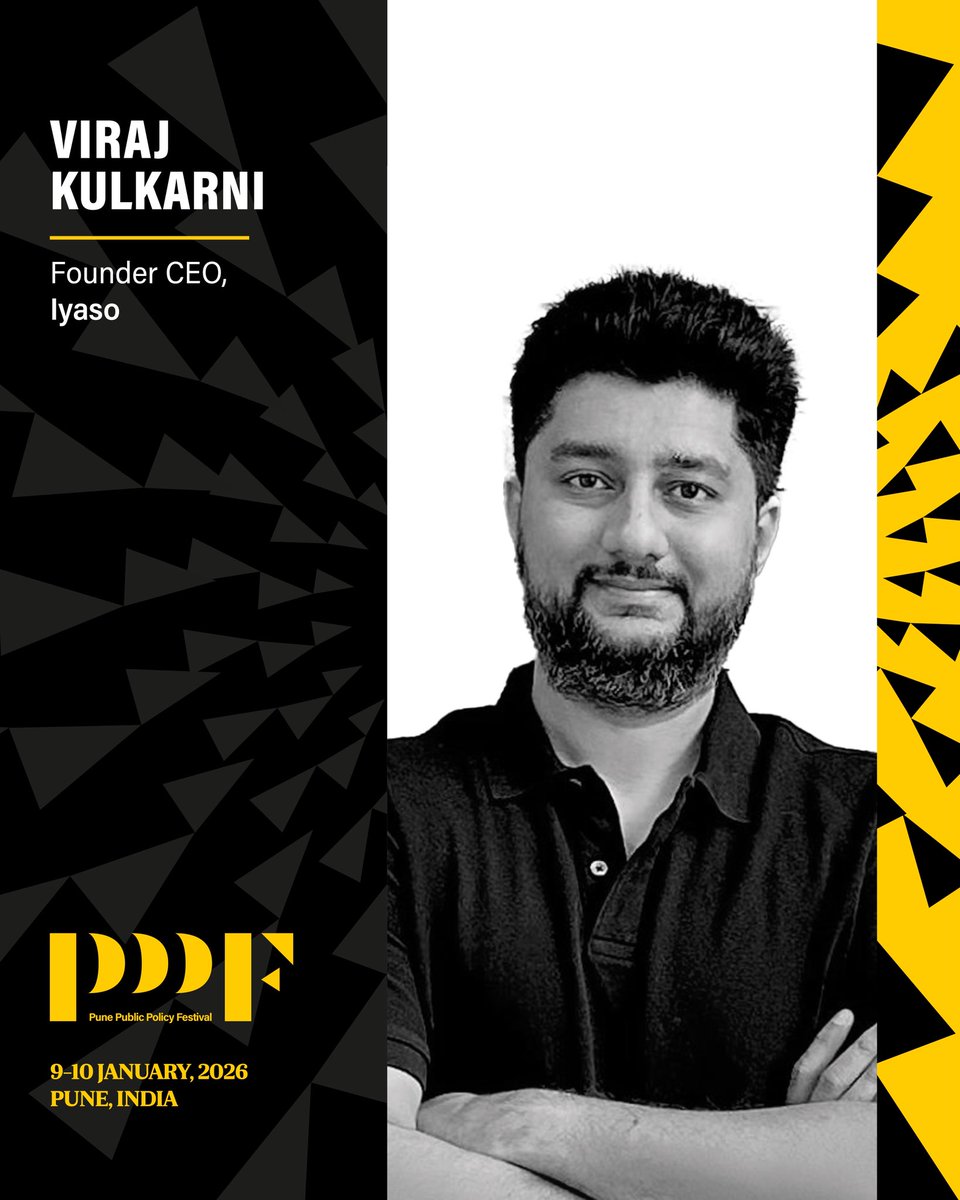
Thrilled to welcome Viraj Kulkarni to #PPPF2026—Founder of Iyaso, where he translates rigorous AI research into scalable speech therapy solutions, backed by 20+ papers and a UC Berkeley background.
#PPPF2026#AIinHealthcare#Speakers2026@VirajZero
Enough of “Jai Jawan, Jai Kisan”. Time to add “Jai Industrialist” to this.
The single reason why we have been pissing off the world when it comes to trade deals is farmer protectionism.
We subsidize, shield, and coddle farming. Not because it’s efficient or futuristic, but because it’s a massive vote bank.
On the other hand, our government shields Ambani and Adani as if they are their sons, because they are.. well.. literal banks!
So Ambani can keep buying cheap oil from Russia, export refined products and make money, while ordinary citizens like you and me pay exorbitant rates for Ethanol-contaminated petrol!
Farmers are protected. Oligarchs are protected. But the real engine of innovation - the common entrepreneur, the ambitious industrialist, and the small business owner - is demonised, taxed to death, and red-taped into oblivion!
If it comes to choosing between protecting farmers or protecting industry, we must choose protecting industry.
If our government is not able to secure trade deals because they are protecting farmers, it's time to rethink.
There is no upward mobility or economic progress without industrial growth. And our industries need foreign markets to prosper.
Killing H1B is terrible for India. Make no mistake about it. It is not a blessing in disguise. It is not going to bring innovation back to India.
All our best engineering minds did not go to the US. Some privileged ones (like me) got the opportunity and took it.
But many equally talented people who stayed back weren’t any less talented than those who went. If they could not foster innovation in the country, the returning folks aren’t going to be able to do that either!
Because the problem was never the talent. India has world-class brains. The problem is the ecosystem. The rampant corruption, pathetic bureaucracy, cowardly capital, and the skewed incentives. Until those change, shutting doors abroad won’t magically open doors at home.
But there’s also a bigger problem. India doesn’t have a domestic market for innovation.
Suppose all these engineers who come back from the US start innovative startups in India. Whom do these startups sell to? Ghosts?
The domestic market for innovation in India is negligible. We cannot accommodate a wave of innovation, because we don’t have anyone who will pay for it.
Remember the line VCs and founders love to parrot “Build in India for the World”? When they say “the world”, they usually mean “USA”, because that’s where the money flows from.
If that tap shuts, it kills innovation, because there’s no one left to appreciate for that innovation (and pay money for it).
So what should we as a country do?
I don’t know, but we need to start by recognizing the reality as it is without dressing up as a blessing.
One thing that could boost innovation in this situation is government modernization through tech. Accelerate tech adoption across the breadth and depth of government administration. Big projects. Give them to startups and not just TCS and Infosys.
And urgently improve ease of doing business, lower taxation burden on corporates, and remove forever red-tape compliances.
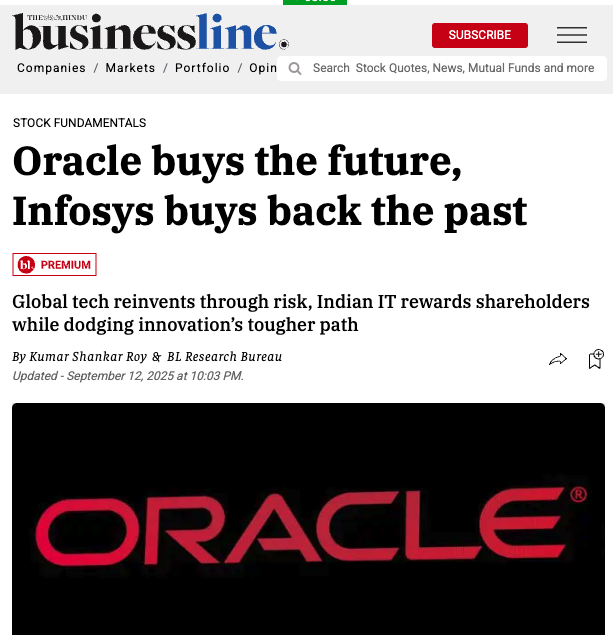
Oracle buys the future. Infosys buys back the past.
That’s literally the headline of this article. And, boy, doesn’t it say it all?
Oracle is throwing billions at AI, cloud infra, next-gen software. Meanwhile, Infosys is throwing ₹18,000 crore at… its own stock!
Why? Because our dear Infy has no clue what to build next. And it’s easier to juice the stock than to imagine the future.
This is Indian IT in a nutshell. For decades, we’ve been addicted to outsourcing and headcount billing. It’s safe. Gives great margins. And you need only low doses of conviction and boldness.
But the penalty for being caught in a safe golden cage has never been higher!
India has the talent. We just don’t have the ambition. How do we finally stop playing it safe and start playing to win?
Our government needs to grow a spine and stop glorifying its own paralysis as cautiousness.
For months, I've watched brilliant founders sit on potentially game-changing ideas, waiting for someone in the government to give clear directions on what's allowed and what isn't.
Take the crypto saga in India.
While Dubai rolls out the red carpet for crypto innovation with clear guidelines, our bureaucrats are still "studying the matter." The result? Our best crypto engineers are booking one-way tickets to Dubai, Singapore, and anywhere else that offers clarity.
It's not that these countries don't have regulations. They do. But they had the guts to make decisions, draw lines, and say "this is how it's going to work."
Our honourable Supreme Court urged the government multiple times to formulate a “clear cut policy”.
Judges lamented it was “unfortunate” that the government did not have a law to regulate digital currencies.
Then they “reminded” the government again to create regulation and highlighted the “challenges that law enforcement will face in the absence of a legal definition or framework for crypto assets.”
Meanwhile, what did the government do?
They “sought more time to secure instructions”...
But, of course, they decided to go ahead and impose heavy punitive taxes on crypto investments. Regulation or not - tax to bharna hi padega!
This isn't caution. It's shameless cowardice wrapped in red tape.
Every day of government indecision is a day of innovation lost. A startup killed. A potential unicorn strangled in its crib.
And we wonder why there is so little innovation in India!
@TheVivekSinghal You will have instant access to 140 crore customers who will want everything for free 😬. India may have the numbers, but it really doesn’t have the spending capacity anywhere close to the US.
Another week, another “You’ve won an award!” email.
Translation: Please pay us to print your face on a JPEG.
As a founder, I get 2-3 of these every week. Always grand names:
- ET Edge 40 Under 40
- India's Most Trusted Company to Watch in 2025
- Indian Business Excellence Awards 2025
- Business Elite Award 2025
- National Business Ratna Award 2025
- Entrepreneur Award 2025: India’s Top Companies of the Year
- Best Company to Work For
- Global Titan Company of the Year
The list goes on…
If an award asks for money, it’s not recognition. It’s retail.
This is shameless vanity laundering.
The companies selling these “awards” aren’t harmless.
They prey on founders’ insecurity.
They sell the illusion of credibility to anyone willing to swipe a card.
They dilute what real recognition means.
If you see a paid award on someone’s profile, be very suspicious.
Because genuine achievements don’t come with an invoice attached.
@malpani Agree. Some doctors get irritated when patients ask questions. Now these same doctors also get irritated when patients use Google or ChatGPT to find answers themselves. A patient has an absolute right to know their diagnosis and understand what treatment they’re prescribed.