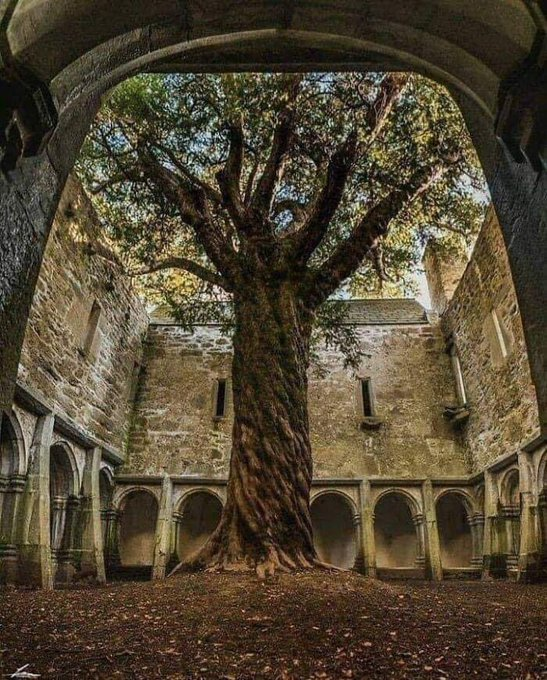
The yew at Muckross is one of the best examples of its kind in Ireland and is said to be as old as the abbey itself.
One theory is that the courtyard and cloisters may even have built around the already mature yew which would make the tree over 600 years old.
Next in the HSR tarot deck, by far some of the hardest Aeons to draw. I /know/ I got some of their details wrong qvq
Suit of Pentacles;
Fuli/Knight
Tazzyrnoth/Queen
Qliphoth/King
Tazzyrnoth being Queen is...weirdly fitting--
#HonkaiStarRail
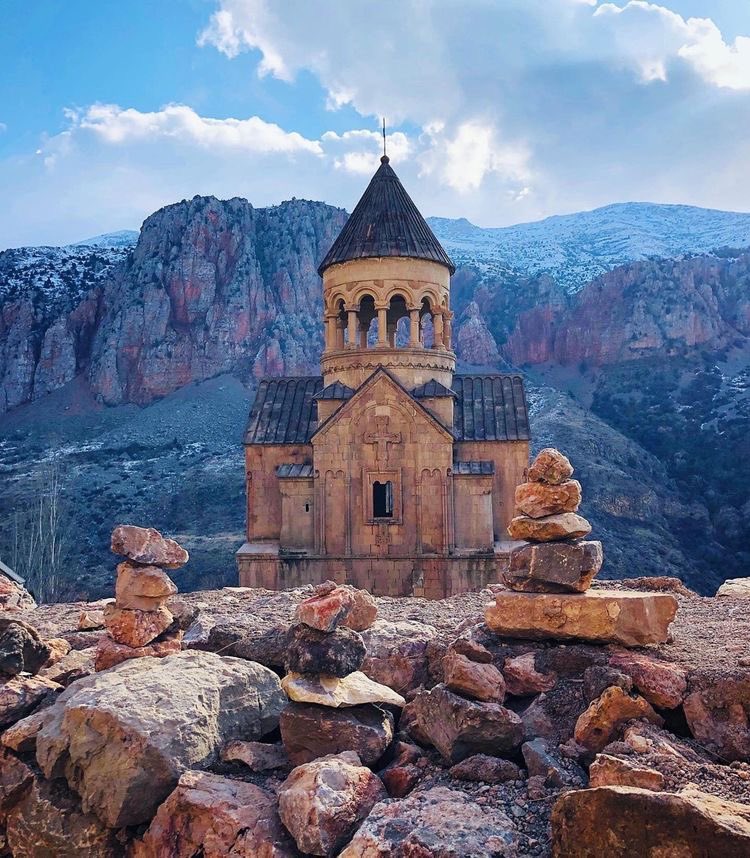
Armenia, as the world's first Christian country, is extremely rich in monuments of spiritual culture. The monastery of Noravank – the pearl of Armenian medieval architecture, one of most admired shrines in the country. The monastery complex is located 10km south of the village of Areni, in the Vayots Dzor region, in the picturesque gorge of the Amaghu River.
Noravank Monastery was founded by Bishop Hovhannes in 1105 CE, and in 13th-14th Centuries CE, thanks to the ruling Orbelian family, Noravank flourished and became a spiritual, educational, and cultural center of Syunik province. The complex consists of two chapels and three churches: St. Karapet, St. Stepanos the Precursor and the Holy Mother of God. In 2002, Noravank Monastery was included in the UNESCO World Cultural Heritage list.
The main church of Noravank is St. Stepanos the Baptist, built-in 1216-1221 CE. The churchyard gradually became a cemetery for Orbelian family, on behalf of which the church was built. Church of St. Karapet (9th Century CE) is located on the south side of the complex. It is a simple rectangular hall with a bell-shaped altar and a tomb. The church was opened during the excavations of 1982-83. The neighborhood is rich in ancient tombstones, on which you can see some holes that were intended for smoking incense.
The most influential structure of the complex is the Church of the Blessed Virgin Mary of the 14th century, which belongs to the group of two-tiered three-stage churches, widespread in medieval Armenia. Church of the Blessed Virgin belongs to the well-known medieval architect and sculptor Momik and is considered one of his masterpieces due to the elegance of architectural forms and the highest quality. Here you can also find ancient khachkars belonging to the hand of the master. Delicate stone carving, cross-stones, sculptures and bas-reliefs of the master Momik, which adorn the monastery of Noravank, are recognized as one of the finest in Armenia.
📷 : Credit to the Owner
#archaeohistories
The Lady of Elche - an iconic and controversial ancient Iberian funerary urn with a hauntingly penetrating gaze...
In the muted galleries of the National Archeology Museum of Madrid you can witness the eerily penetrating gaze and haughty expression of this ancient sculpture, which seems to radiate authority and be imbued with a uniquely commanding presence. Discovered by accident in Valencia in 1897, bewitching and inscrutable Lady of Elche has puzzled archeologists and been subject of fierce debate for over a century. It is said that a young boy of 14 had overturned a stone when he came across the bust. The bust shows the woman’s head, neck, and shoulders, and extends down to her chest. However, it is possible that the bust was originally part of a larger, full-body statue.
There have been many theories over the years as to what this mysterious limestone bust represents. She’s been called a Moorish queen, a witch, and stranger still, an ��extraterrestrial visitor from another planet.” But archeologists believe the bust is actually a uniquely Iberian portrayal of the Carthaginian mother goddess, Tanit, used as a funerary urn in antiquity.
There have always been rumors of forgery surrounding the discovery and debate about the authenticity of the Lady of Elche. But in 2011 research carried out using electron microscopy and x-ray technology found that the piece is an original, and confirmed its use as an ancient urn. Traces of ashes containing fragments of human bone were detected in the study and carbon-dated to be more than 2500 years old, making it contemporaneous with the ancient Iberian epoch.
The complex headdress features two large coils known as “rodetes” on either side of the head and face. It is thought that this was a ceremonial headdress, and that the woman may be a priestess. The headdress runs across the forehead, with a pattern of raised marble-shaped bumps. Tassle-like pieces hang in front of the ears, and elaborate necklaces grace her chest. The woman’s face contains an expressionless gaze, and when it was found, contained traces of red, white, and blue decorative paint. The composition of the stone indicates that it was carved at L'Alcúdia.
The origin of the sculpture is puzzling and has become a matter of heated debate. Some scholars suggest that the sculpture is Iberian, and may be associated with Tanit, the goddess of Carthage, while others have proposed the work reflects an Atlantean Goddess. The unusual features of the sculpture, such as the apparent elongated head and the spools on the side of the head, have also prompted numerous alternative theories to be proposed. For example, according to some independent researchers, the spools are not part of a unique headdress, but are in fact a type of technological headgear that reflects the highly advanced nature of the supposed Atlantis civilization.
There are others who argue that the statue doesn’t deserve the attention it receives because it is, in fact, a forgery. Art historian John F. Moffitt argues that the shape of the lady’s eyes and nose are “too delicate to have been carved in pre-Christian Spain.” This argument has been dismissed by many other scholars, who view the bust as a great accomplishment of the early Iberian civilization.
#archaeohistories
A 5200-year-old pottery bowl from Shahr-e Sukhteh bearing what could possibly be the world’s oldest example of animation. It shows 5 images of a wild goat leaping, and if you put them in a sequence, the wild goat leaps to nip leaves off a tree, Museum of Ancient Iran.