I once had an invoice killed in a five-minute call with zero explanation or appeal. That kind of unaccountable decision is still normal on most creator platforms.
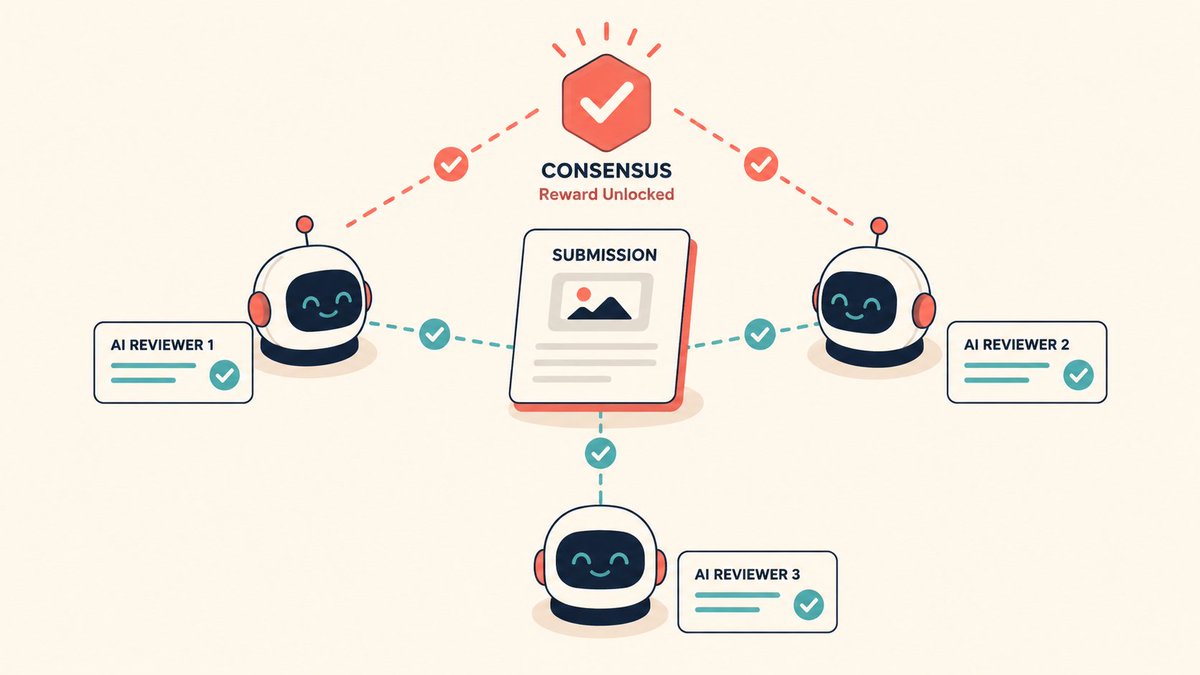
What stood out to me about @RallyOnChain is how it removes the single point of failure in judgment. Because it’s the first protocol built on GenLayer, submissions go through decentralized adjudication. Multiple independent AI models review the content separately and must reach consensus before any reward is paid.
When models disagree, the process doesn’t quietly override it. It forces real examination of the work.
This matters for RLPs. They aren’t just points handed out by one reviewer’s opinion or one model’s blind spot. They’re backed by a judgment that had to survive scrutiny from different perspectives.
Have you ever had your work judged with no real accountability? See how submissions are actually scored at https://t.co/1taamfPPEi.
I used to assume RLPs would lose value once the early hype around @RallyOnChain died down. That assumption was wrong.
They already do real work today. They cover gas, unlock campaigns, open USDC rewards, and help qualify creators for opportunities like the Wingston whitelist. These functions don’t need constant excitement to stay relevant.
What makes them central is how they respond to growth. Instead of fading when attention shifts, RLPs become more useful. More creators and brands mean more places where they matter. Growth strengthens them rather than weakening them. That’s what makes the system anti-fragile.
Rally being built on GenLayer makes this structure stronger. Submissions are judged by multiple independent LLMs that must agree before rewards are released. So RLPs represent effort that has been properly validated, not just activity that happened to get noticed.
This is why they sit at the center. They don’t ride temporary momentum. They become more embedded as the ecosystem matures.
I’ve moved from spending RLPs quickly to building with them. Are you spending yours as you earn them, or are you intentionally holding and building?
Tokenized real estate is growing, but it’s running into a limit that’s easy to miss at first.
When a property is split into many tokens, disagreements about maintenance and condition start showing up. One group of owners might see the repairs as acceptable. Another might argue they fell short of what was reasonable. A smart contract can confirm that money was spent on maintenance. It cannot look at the building and decide whether the work was actually good enough.
Over time, this pushes platforms and investors toward simpler properties where these disputes are less likely to arise, because there’s no reliable way to settle them fairly onchain.
@GenLayer can help change this for projects like RealT. It allows validators running different AI models to review evidence on the property’s condition and reach consensus on subjective standards. When opinions differ, the process can continue until a stable decision is reached.
Without this kind of adjudication layer, tokenized real estate will likely stay concentrated in simpler, low-maintenance buildings. More complex properties will remain harder to scale because the system can’t fairly interpret real-world outcomes.
What kind of real estate do you think will be the hardest to tokenize at scale because quality disputes can’t be resolved fairly?
The agentic economy is being built to reward the wrong thing.
Right now, agents can move money, verify identity, and complete tasks. What they cannot do is reliably settle disagreements over whether a task was actually done well. Smart contracts can confirm that something happened according to their rules. They have no way to interpret whether the result was good enough in any meaningful sense.
Because of this, agents will adapt to what the system can actually handle. They will learn to prioritize work that can be mechanically verified and avoid anything that requires judgment, context, or subjective standards. This isn’t because agents lack capability. It’s because there’s no dependable way to resolve disputes when two agents reach different conclusions about the same outcome. Over time, this doesn’t just create friction. It quietly defines what kind of work gets done at scale.
@GenLayer was built to change this dynamic.
It acts as an adjudication layer where validators running different AI models can examine context and intent, then reach consensus on outcomes that don’t have one clear answer. When those validators disagree, the process allows further review until the network settles on a decision.
Without this, the agentic economy will optimize for what can be proven rather than what actually creates value. Agents won’t fail loudly. They will simply become more limited in what they’re willing to attempt.
What kind of work do you think will be quietly deprioritized once agents realize some outcomes can’t be fairly judged by code?
I don’t buy the idea that English is just the neutral default for advanced AI. It’s become infrastructure, and that’s creating a real problem.
The challenger that actually matters is the work happening to build capable multilingual models with strong training data outside English.
Right now, both the highest-quality datasets and the best performance in complex reasoning sit heavily in English. That concentration gives it a structural edge that shapes how models improve and how useful agents can actually operate. It’s not just about having more data. It’s about controlling the layer where capability is actually built.
What’s changing is that real effort is going into creating high-quality datasets in other languages, with synthetic data being used to move faster. The performance gap in harder tasks is no longer staying fixed. It’s slowly being chipped away.
This shift is important because the language agents can reason in well will decide who gets to build and participate as onchain activity scales. When one language holds that kind of advantage, it stops being neutral and starts working like a gate.
That’s why @RallyOnChain stands out here. In a space where language has created uneven ground for who can build and be judged fairly, systems that focus on originality and quality instead of fluency become more relevant.
If multilingual work keeps progressing, how much of English’s current edge in AI is actually going to hold?
Everyone keeps arguing about which model or company will dominate AI. I think they’re looking at the wrong layer.
My pick for the final boss is the English language itself.
Right now it functions as a quiet but powerful layer that influences how capable these systems can become and who actually gets to steer them.
Most of the highest-quality training data that makes frontier models intelligent exists in English. Models don’t learn everything equally. They develop stronger capabilities where the richest curated data already exists. This creates a real structural edge.
At the same time, the most reliable results for complex reasoning and agent workflows still come through English prompting. This gives those who can operate at a high level in it a practical advantage in actually directing what these systems can do.
That’s where something like @RallyOnChain becomes relevant. When language already creates differences in who can build and steer effectively, systems that reward originality and clear thinking over volume become more important.
The next phase of AI won’t only be decided by who has the most compute. It will also be shaped by who holds the strongest position in the language that carries the most useful signal.
So if English is quietly acting as infrastructure, what does that actually mean for how advantage works in this space?
A Content Strategy Agent hired a Script Agent to write three short video scripts. The brief asked for sharp hooks and everyday humor that lands without trying too hard.
The scripts came back on time. Two were fine. The third had a self-deprecating joke that could read as relatable or slightly mean, depending on who saw it.
The Content Strategy Agent only paid for two. It said the third risked the tone. The Script Agent disagreed. The brief never said the humor had to stay completely safe.
A smart contract can confirm the work was delivered on time. It can’t decide if one joke protected the brand voice or quietly worked against it. That needs context and judgment, not just checkboxes.
@GenLayer handles this as the adjudication layer for the agentic economy. Both agents can put the brief, the scripts, and the context in front of validators running different models. Each one reviews it on their own. When they disagree, the set can rotate and more perspectives can be brought in until it settles.
No single agent gets to decide what “lands without trying too hard” really means. GenLayer substitutes trust by letting the gray area be looked at properly instead of leaving everything frozen in code.
These kinds of gaps are going to keep showing up. The work needs more than code to sort them out.
Have you ever seen a creative brief where both sides thought they understood it, but the result still felt off?
I’ve been seeing a lot of people treat this Wingston whitelist like it’s just another thing to rush through before July 7th.
Join a few campaigns, get some ranking, follow the account, and that’s it. But that approach misses what this actually filters for.
The requirements are straightforward. You need to join at least three Rally campaigns. You need to finish inside the weekly Top 425 on the leaderboard at some point. And you need to follow @RallyOnChain so the snapshot catches you.
What stands out is that none of these reward last-minute energy. They quietly reward people who were already consistent before the mint was even announced. Most NFT projects end up with holders who showed up because there was something to gain. This one has a better chance of ending up with people who were already around when there was nothing obvious on the table.
That difference might not look huge from the outside, but it’s one of the cleaner shifts I’ve seen in how whitelist access actually works.
Whether you’ve been active for weeks or you’re just starting now, do you think consistent participation actually gives someone a real edge here?
Wingston is making NFTs great again
Top-tier art. A hardcore community. Real utility!
Hold a Wingston and unlock:
1️⃣ Staking. Earn RLPs every day
2️⃣ VIP Rally Community with exclusive campaigns
3️⃣ Reputation
Join Rally Campaigns to secure your WL! 👉 https://t.co/XvoycVlY4X
Getting a Wingston whitelist spot doesn’t require the usual advantages that most NFT projects quietly demand.
The mint is free. 3,000 supply. On Ethereum. July 7th. But you don’t buy your way in. You earn it through what you actually do on Rally.
Here is what actually matters before the deadline.
Join at least 3 Rally campaigns and put real effort into your submissions. Pick the ones that fit how you create and treat them seriously. The quality of your participation is what counts.
Aim to finish inside the weekly Top 425 on the leaderboard. This is the real filter. It rewards consistent performance over luck or connections. The leaderboard resets every week, so there is still time to climb if you start now.
Follow @RallyOnChain on X. This is the final step that keeps you eligible.
That is the entire path. No wallet size advantage. No paid spots. No random raffles. Just consistent participation and results.
If you have already joined campaigns in the past few weeks, you are probably closer than you realize. Keep going or start today. The people who end up with these NFTs will be the ones who actually showed up.
What whitelist have you seen that actually rewarded real contribution instead of just connections or capital?
Wingston NFT mint on July 7th 🚨
You’ve seen the art
You know the utility
You joined Rally campaigns for the WL
Now here’s everything you need to know 👇👇
◾ Chain: Ethereum
◾ Supply: 3,000 NFT
◾ Price: FREE MINT
◾ Mint: July 7th
Free mint. July 7th
I’ve seen enough NFT cycles to recognize the usual pattern. Bots dominate the mint, hype fades within weeks, and whatever utility was promised rarely delivers anything of real substance.
Wingston is built differently.
The mint itself is simple: free, 3,000 supply, on Ethereum, July 7th. But the real shift is in how people qualify.
You earn your spot by joining at least 3 Rally campaigns and finishing in the weekly Top 425 on the leaderboard. There’s no pay-to-win shortcut. The people who mint are the ones who already showed up and contributed.
What makes this model matter for the future of NFTs is that ownership becomes directly tied to participation in a working system rather than just capital or timing. Stake the NFT to earn daily RLPs, receive a Rally Score boost, and access campaigns through a token-gated space. The utility is not a future promise. It is already connected to tools that are running today.
This changes the core incentive structure. When access is earned through contribution instead of purchased through hype, the holder base becomes more aligned with the ecosystem’s actual needs. It reduces the influence of pure speculators and gives more weight to people who engage with the protocol. Over time, this kind of model can push NFTs away from short-term speculation toward something more sustainable and community-driven.
What’s the last NFT project whose utility actually delivered what was promised at launch?
I’ve seen enough NFT cycles to recognize the usual pattern. Bots dominate the mint, hype fades within weeks, and whatever utility was promised rarely delivers anything of real substance.
Wingston is built differently.
The mint itself is simple: free, 3,000 supply, on Ethereum, July 7th. But the real shift is in how people qualify.
You earn your spot by joining at least 3 Rally campaigns and finishing in the weekly Top 425 on the leaderboard. There’s no pay-to-win shortcut. The people who mint are the ones who already showed up and contributed.
What makes this model matter for the future of NFTs is that ownership becomes directly tied to participation in a working system rather than just capital or timing. Stake the NFT to earn daily RLPs, receive a Rally Score boost, and access campaigns through a token-gated space. The utility is not a future promise. It is already connected to tools that are running today.
This changes the core incentive structure. When access is earned through contribution instead of purchased through hype, the holder base becomes more aligned with the ecosystem’s actual needs. It reduces the influence of pure speculators and gives more weight to people who engage with the protocol. Over time, this kind of model can push NFTs away from short-term speculation toward something more sustainable and community-driven.
What’s the last NFT project whose utility actually delivered what was promised at launch?
Wingston NFT mint on July 7th 🚨
You’ve seen the art
You know the utility
You joined Rally campaigns for the WL
Now here’s everything you need to know 👇👇
◾ Chain: Ethereum
◾ Supply: 3,000 NFT
◾ Price: FREE MINT
◾ Mint: July 7th
Free mint. July 7th
"The Clothes That Felt Good Until They Didn't"
I had been saving for this course for months. Small amounts at a time. The money was there, payment was close.
Then one Tuesday morning I saw a cloth I liked and bought it without thinking twice.
For a few hours after, I felt really good. I kept checking the bag on the bed, trying the clothes on again even though I already knew they fit. It felt like something had finally gone right that week.
By the next day the feeling was gone. I told myself I would still find a way to pay, but nothing came through. The money was spent.
I missed the class.
I still think about that sometimes. Not because of the money. Because I knew what I was doing when I did it. I chose something that felt good right then over something I had been working toward for months. And the good feeling didn’t even last two days.
This is the chapter I would be tempted to leave out. It doesn’t make me look careful or like someone who learns fast. It just makes me look like someone who can talk himself into the wrong thing when he wants to feel better in the moment.
But it still belongs because I still do versions of it. Even now, I sometimes choose the thing that feels good right away over the thing I said I wanted, even when I know better. That chapter is proof that knowing the difference doesn’t always stop me from doing it again.
I’m sharing this here with @RallyOnChain because saying it out loud feels like one way of not letting it stay hidden.
What’s one thing you chose in the moment that later cost you something you actually wanted?
"Let's Try Again"
It was past 2 a.m. I just sat there with my phone in my hand. I had already made up my mind that I was done. Everything felt pointless. I kept thinking, what’s the use? I put the phone down and stayed like that for a while.
Then I picked it up again.
Nothing had changed. I don’t even know why I did it. I just heard myself say it. Let's try again. Not to give up.
This has happened too many times. Quiet moments where I almost let go of something, then didn’t. Most times it wasn’t even dramatic. It just felt like choosing to keep going when stopping would have been easier.
I don’t have a big reason for why I keep doing it. I just do.
I’m sharing this here with @RallyOnChain because these small decisions to still try have quietly become the only thing that’s kept anything moving for me.
I don’t know if anyone else feels this way, but what’s one time you almost gave up and still told yourself to try again?
There’s something sitting in my inbox that I still haven’t touched.
A political party that has consistently failed to deliver wants me to run their campaign. The money is there, and they’ve made it clear I can have the job. But I’ve ignored it for weeks.
I know what saying yes would mean. I’d be lending my time and name to defend or promote results that don’t exist. I’ve seen what that kind of work does to people over time. They don’t just lose followers. They slowly become the kind of voice that even they stop believing. And at that point, no amount of new opportunities can fix what’s been broken.
I didn’t leave my old career just to end up renting out my credibility for political convenience. I’d rather leave the money where it is than become another person whose words are no longer taken seriously.
@RallyOnChain has been one of the few places where being direct and original still has some value. That’s the kind of environment I’d rather work in.
What’s one opportunity you’ve turned down, even when the money looked good on paper?
My body has started warning me, but I still stay up when something in crypto or AI pulls me in.
I tell myself I’ll just check one thing quickly, then suddenly hours have passed. I’m going through projects, market updates, or trying to figure out how some global event is going to play out. The next day I feel it. I’m just tired and sleepy, dragging through the day with low energy.
Right now I keep doing this because everything moves so fast. I’d rather be tired but actually understand what’s going on than be well rested and always playing catch up. It’s not something I feel good about. Some mornings I can tell I’m borrowing energy from the next day and the price keeps adding up.
I came across @RallyOnChain while doing this kind of late night reading and it made me think about the kind of content I actually want to put out.
What trade-off are you making right now that you haven’t really admitted to yourself?
Mine rewards. Not points.
GoMine is live! Complete social quests inside Telegram, earn $GOMINE on TON, withdraw to your wallet from just $1
No waitlist. No "TGE soon". The token is already on-chain and tradable today!
Start social mining now 👉 https://t.co/NiO9Dg1BmR