@HMadan_24 and @rohanchdry are joining @spc_india as visiting partners.
Harshit: 2x founder, early Meesho.
Rohan: co-created Glance (400M+ users).
Both have spent time in the SPC community — now helping shape it.
Curiosity 2026 by @spc_india - was an absolutely epic weekend!
It takes a lot of intellectual honesty, and emotional vulnerability to stand up in front of hundreds of people, to demo what you're building. We’re grateful that so many of you showed up from all over India.
We just quietly scanned the inside of BYD car components...
From Lux family co @lumafield:
BYD delivered 4.6 million vehicles in 2025, making it the world's largest electric vehicle manufacturer by volume. Americans know the name mostly from trade headlines: tariffs, national security investigations, and ships racing to beat duty deadlines. Nobody really talks about the cars themselves. We got our hands on four components from BYD's lineup and put them in our CT scanner: a lithium iron phosphate battery cell, a window switch panel, a portable EV charger, and a key fob. They reveal as much about the company as they do about what’s inside the parts.
BYD manufactures roughly 75% of the components in its own vehicles. Batteries, motors, inverters, onboard chargers, and much of the electronics come from FinDreams, BYD's in-house supplier network, rather than from the Bosch, Valeo, and Denso supply chains that most Western automakers depend on. The ships carrying finished cars to Europe, Latin America, and the Middle East are BYD's too. The last company to vertically integrate a car from raw material to finished product at this scale was Ford. Today BYD’s system runs all the way from the lithium mine to the port.
All scans of components here: https://t.co/LsSjYO4kIV
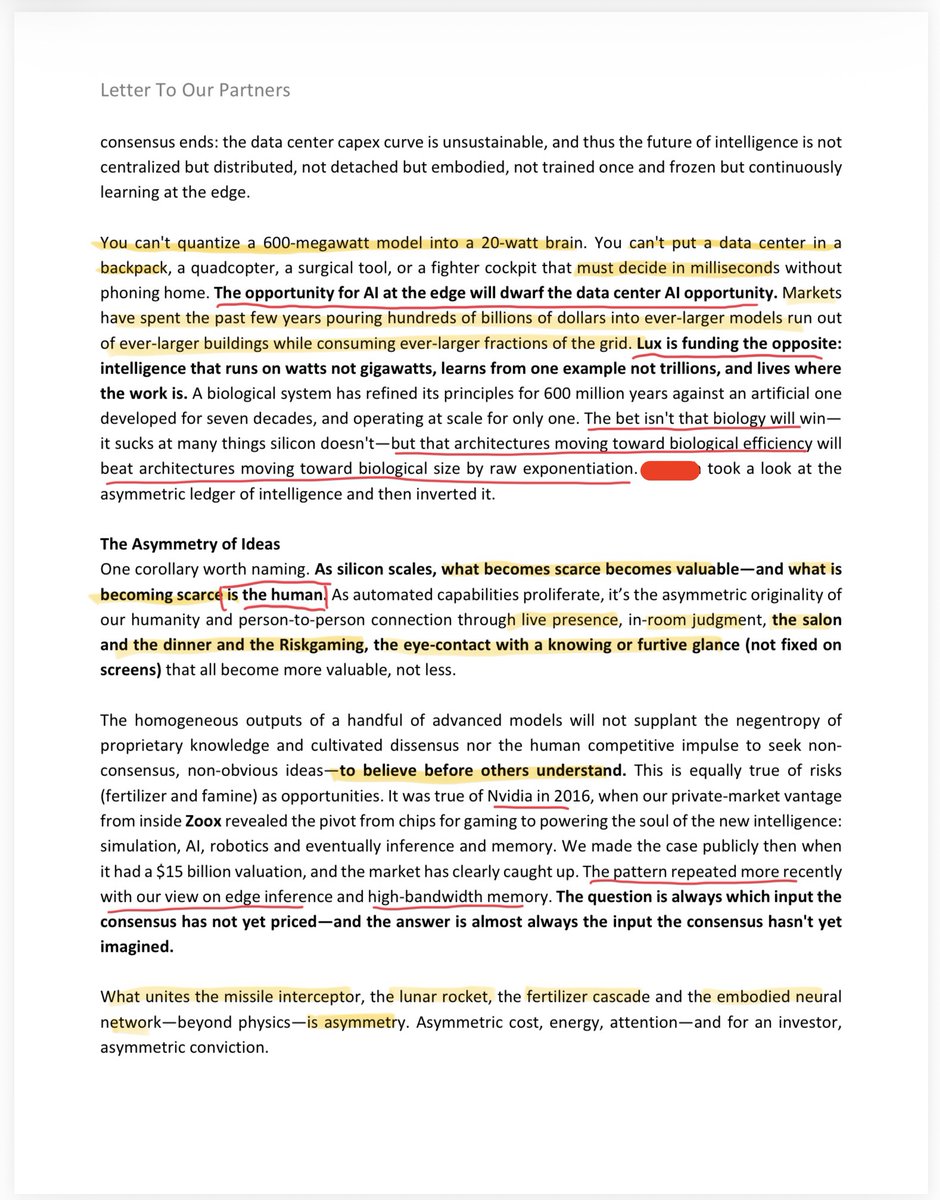
7/We can train models that beat last year’s benchmarks on all axis––but still cant build a FLY🪰
cant quantize 600MW model into 20W brain🧠
cant put data center in backpack 🎒or a fighter cockpit that must decide in millisec
opportunity for AI @ EDGE will DWARF data center AI
1/n Most deep-tech companies don't fail because the science was wrong.
They fail because the science was never made legible.
"Ahead of its time" is a generous epitaph.
It is also, frequently, an inaccurate one.
🧵
2/ Deep tech does not only need product design. It needs translation design.
Because the hardest part of deep tech is rarely the first proof that something works.
It is the journey from: lab truth to investor conviction, prototype to buyer confidence, scientific novelty to procurement logic and most importantly, technical possibility to human trust that leads to an institutionally adoptable product.
3/ That journey does not happen by itself. It has to be designed.
Deep tech already has TRL - Technology Readiness Level.
TRL tells us whether a technology has moved from scientific principle to proof, prototype, demonstration, and deployment. It is necessary.
But it is not sufficient because TRL measures whether the technology is ready.
It does not measure whether the world is ready to receive it.
4/ A company can have a working prototype and still be commercially illegible, the buyer may not know where to place it in their world.
The investor may admire the breakthrough, but not know how risk reduces over time.
The regulator may understand the category, but not the operating model.
The user may see the device, material, molecule, robot, sensor, or system and still not know whether to trust it.
That is the deep-tech translation gap.
5/ And this is why we need a second lens - call it WRL - World Readiness Level.
TRL asks: does the technology work?
WRL asks: can the world understand it, evaluate it, use it, procure it, maintain it, regulate it, insure it, finance it, and believe in it?
6/ Between TRL and WRL sits translation design.
Translation design is not branding.
* It is not storytelling after the fact.
* It is not making weak science sound attractive.
It is the design discipline that helps scientific truth travel into the world without losing its integrity.
It asks:
What must be simplified without being made false?
What must be shown physically, not explained verbally?
What does the first pilot need to prove - technical performance, economic value, operational fit, or institutional confidence?
Who is the real first user: the operator, the buyer, the regulator, the technician, the CFO, the clinician, the plant head, the defence evaluator?
What language does each of them need before the same technology becomes real to them?
7/ A prototype is not a product.
This is where design has to become much more than form, interface, branding, or communication.
In deep tech, design must convert invisible complexity into usable confidence.
8/ It must shape the first artifact, the first explanation, the first use case, the first pilot, the first evidence loop, the first buyer narrative, and the first category in the customer’s mind.
Not by exaggerating the science.But by making the science legible.
Because the world does not adopt what it cannot place and it certainly does not fund what it cannot evaluate.
9/ This matters especially for Indian deep tech.
We have many teams building serious science and engineering.But too often, the translation layer is weak.
The company communicates competence, not authority.
It explains the mechanism, not the meaning.
And then foreign validation becomes the shortcut to domestic conviction.
10/ The next generation of deep-tech companies will need to build translation design into the company from the beginning.
Not after the prototype.
Not just before the next investor pitch.
From the first decision about what is being built, for whom, why now, and what evidence will make the world believe.
TRL earns trust in the lab. WRL will earn trust from the world.
Read more at: https://t.co/BBQkr8tk6h
Curiosity 2026, played harder...than even we had imagined!
We've said it before. The creativity, resilience and ambition of Indian builders, is on another level!
The proof was in the room.
2 days. 30 hard/deep tech teams.
Whole lot of caffeine. (not much sleep)
And the best memories.
Some glimpses, before we do some more in-depth recaps soon!
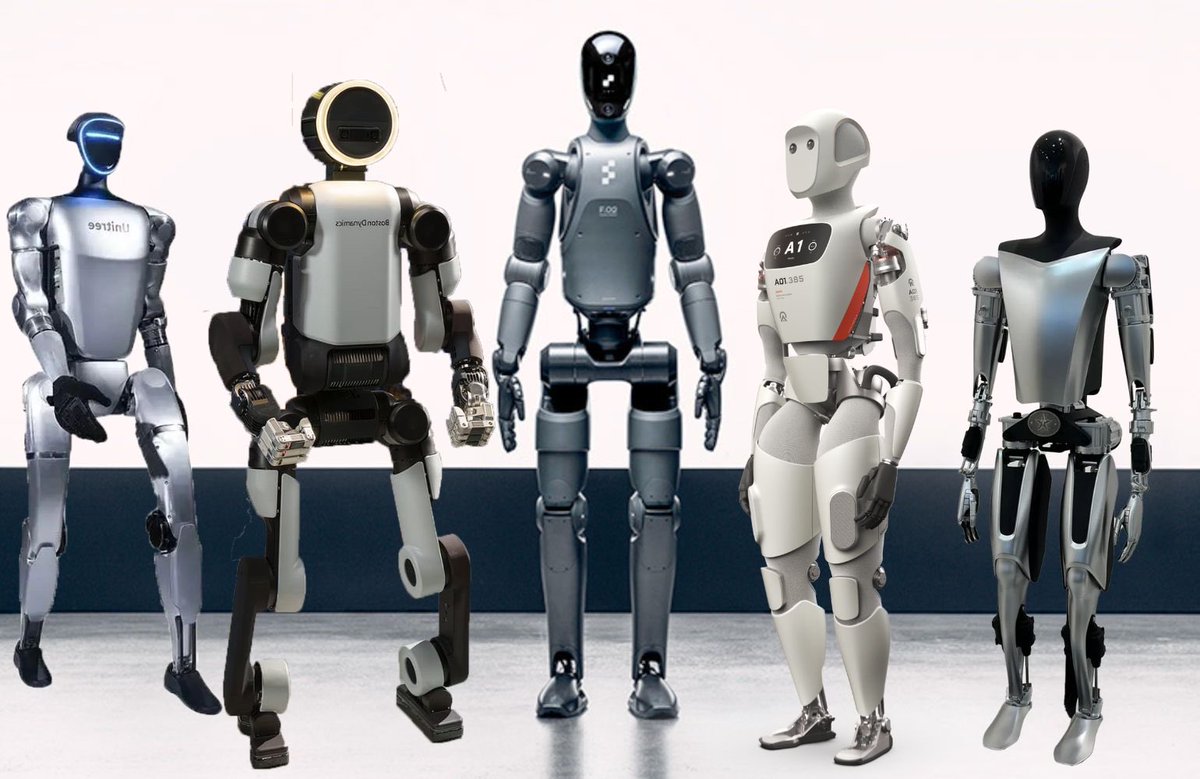
My favorite humanoid stocks ranked:
1. $AMBA (Ambarella) — Best pure-play edge AI vision for robotics. 37% revenue growth, 60% gross margins,$100M+ robotic pipeline, still under $5B market cap. The risk is concentration and scale. The upside is being the de facto vision processor as robots proliferate.
2. $6324.T (Harmonic Drive) — Irreplaceable. There is no substitute for strain wave reducers in high-precision robot joints. 75% market share with Nabtesco. Hard to replicate. If humanoid robots ship in any volume, this company prints money.
3. $ALGM (Allegro MicroSystems) — Near-monopoly in motor current sensing, priced like an auto cyclical. 30-50 sensors per humanoid at automotive-tier P/E multiples. The market hasn’t re-rated this for robotics yet.
4. $VPG (Vishay Precision Group) — The purest humanoid hardware play. Precision load cells and force sensors with a 1.21 book-to-bill. Risk: trading at 255x current earnings on ~$320M revenue. If humanoid volumes slip, this gets crushed. But if they don’t, VPG is the most direct bet on robot touch.
5. $MOG.A (Moog) — Aerospace-grade precision actuators with a credible humanoid crossover. Already up 83% on the thesis but the volume ramp hasn’t started. Defense + robotics optionality.
🔎 Humanoid Robots: A $200B Market by 2035?
The humanoid robotics market is about to enter the exponential phase that AI just went through. According to Barclays Research, the global humanoid market is projected to grow from essentially zero in 2025 to between $28B and $204B by 2035 depending on the scenario. Even the base case at $38B represents a multi decade growth story. But the high case at $204B is what investors should pay attention to, because every transformative technology in history has tracked closer to the bullish projection than the conservative one. Smartphones, EVs, cloud computing, all consistently blew past the "realistic" forecasts.
Key Takeaways
🔸 High case projects 200x+ growth over 10 years. Even the conservative case at $28B is a 100x expansion from today's near zero baseline.
🔸The bull/bear spread (28 vs 204) is massive, showing analysts have no clue how big this gets. That uncertainty is exactly where the biggest asymmetric returns live.
🔸Major catalysts are already in motion: Tesla Optimus, Figure AI, Boston Dynamics, and Chinese manufacturers like Unitree are all entering mass production phases.
🔸The labor market backdrop matters. Aging populations in developed economies + persistent worker shortages = humanoid robots become economic necessity, not luxury.
📍 Bottom Line: We're at the inflection point of humanoid robotics. The companies winning this race over the next decade will define the next industrial revolution. Pay attention now while it still looks early.
The humanoid robot market is going from $1.8 billion today to $38 billion by 2035 and Goldman Sachs had to revise that number sixfold because the growth is happening faster than anyone on Wall Street predicted.
This is the most underfollowed mega trend in the market right now.
Everyone is focused on which humanoid company wins. Figure. Boston Dynamics. Tesla Optimus. That is the wrong question. In every technology revolution the platform companies get the headlines and the component suppliers get rich quietly.
In the gold rush the shovel makers retired wealthier than the miners. Every single time.
Here are the three stocks I want to own for the next decade of humanoid growth.
$AMBA — Every humanoid needs a brain. A chip that processes everything it sees in real time on the device itself. Not in the cloud. On the robot. In milliseconds. $AMBA has been building this exact chip for 15 years. 42 million units shipped. 370 customer products in production. The software moat around CVflow makes switching costs enormous. One of the only Western pure play edge AI chips at scale and every humanoid developer needs what they built.
$VPG — Every humanoid needs to feel. Precision force sensors that tell the robot how hard it is gripping, how much weight it is carrying, whether it is about to drop something. Without $VPG a humanoid hand is just a claw. Already booking orders with four different humanoid developers. $400 to $500 of sensor content per robot. At millions of robots that math becomes staggering.
$OUST — Every humanoid needs eyes. The world’s first native color lidar. Depth and color captured simultaneously at the physics level. Qualified on the $NVDA DRIVE Hyperion platform. The most advanced sensor on the market for any robot that needs to navigate the real world safely alongside humans.
The brain. The senses. The eyes. The full stack.
$38 billion market growing at 60% annually. The robots are coming. Own the parts inside them.
McKinsey just mapped the supply chain bottlenecks for humanoid robotics and everyone is focused on the wrong thing.
The real story is not that actuators and sensors are the bottleneck, that is obvious. The real story is what happens next.
🧵 Some thoughts and keys:
1. NdFeB magnets (neodymium iron boron) are in every single rotary actuator inside these robots. China controls ~90% of global rare earth processing. This means Beijing has a kill switch on the entire Western humanoid robotics industry before it even starts. The next chip war is not chips. It is magnets.
2. Harmonic drives and cycloidal gearboxes are precision components with maybe 3 serious manufacturers globally. Harmonic Drive Systems (Japan) has near monopoly status. One earthquake, one export restriction, and the entire sector stalls. Nobody is pricing this risk.
3. The EV industry already burned through this playbook. Battery bottlenecks, magnet shortages, supply chain concentration in China. Robotics is about to replay the exact same movie 5 years later and most investors are acting like it is a new plot.
4. Here is my contrarian take: the winners will not be the robot companies. The Teslas and Figures of the world will compress margins fighting each other on the finished product. The real margin will sit with component monopolists nobody has heard of yet. Just like $TSM prints while phone brands race to the bottom.
5. Sensing and perception is labeled "high risk" but I think this is where AI flips the script. Software defined sensing (using cheaper cameras + AI models instead of expensive LiDAR arrays) could collapse this bottleneck faster than anyone expects. Whoever cracks that eats the entire sensor supply chain.
6. One more: if humanoid robots scale to millions of units, NdFeB magnet demand will compete directly with EV motors and wind turbines for the same limited supply. Three industries fighting over one material. That is not a bottleneck, that is a price explosion waiting to happen.
7. The picks and shovels play for robotics is not even public yet. Most of these companies are Japanese, German, or Chinese industrials trading at 12x earnings while "AI" stocks trade at 50x.
The asymmetry is insane.
Physical AI lives or dies on hardware.
Tomorrow at @spc_india, A fireside with Dr. Boyd Fowler (Stanford PhD, pioneer of the CMOS image sensor that sits inside every smartphone) and Vrinda Kapoor @VrindaKa (CEO of BharatSemi)
RSVP here: https://t.co/NbsOsVMyZO
1/ Preview of a speculative hypothesis
hormuz > fertilizer shortage > vulnerable food supply chain > food insecurity > existing migratory pressures exacerbated > peripheral country crisis in EU
=mkts 📉
unassimilated immigrants + rise of Right > violent clashes in EU
=mkts 📉
It's interactive: click any investor and see their whole physical-AI portfolio.
v0.1, opinionated, every number has a caveat. We would love your feedback 👇
https://t.co/eqaibELD7S
1/ Our Q1 ‘26 Lux LP letter is about two forces hiding in plain sight: ASYMMETRY + ENTROPY
they govern markets, militaries, machines + more
the central Q: What did you choose to build and protect—and did you understand what it cost? 🧵
Thrilled to welcome @OpenAI as the Tech Partner for Curiosity 2026, in Bengaluru.
They are enabling standout winners in select categories, with up to $85,000 in credits!
This is our exclusive showcase for India's most ambitious deep-tech builders — where finalists will demo, science-faire style, before investors, judges & institutional leaders.
Apply now to compete! Link below:
India says it wants to become a deep-tech and manufacturing power. It has IITs, startups, research grants, and now even a ₹1 lakh crore innovation fund.
So why do so few Indian technologies become real products? 🧵
Apply to Curiosity 2026 — our exclusive showcase for India's most ambitious deep-tech builders. Compete for a ₹1.25 Cr+ prize pool (powered by @artparkindia) + lots more in credits!
Finalists will demo, science-faire style, before investors, judges & institutional leaders.
Themes: Aerospace , Defence & Robotics, Photonics/Semis, Climate & Energy, Biotech & Medical, Physical AI + more. To apply, you need: a working build/product, prototype, or scaled-down model.
We're selecting teams on a rolling basis.
Deadline: 20th May.
At this U.S. visit to China dinner banquet, the most eye-catching figure in the prime center seat between Musk and Cook was Lansi Technology founder Zhou Qunfei—from a rural factory girl to China's richest woman, with absolutely no background to rely on, building everything from scratch through her own grit. She was born in a small village in Hunan Province. At age 5, her mother passed away, and her father became disabled and blind from a work injury, leaving the family in dire poverty with nothing to their name. At 16, unable to afford school fees, she was forced to drop out and head to Guangdong to work in a factory, grinding glass on the assembly line—working days away during the day and furiously self-studying at night, earning certifications in accounting, computer operations, and other skills. That's how she spent a few years, until she scraped together 20,000 yuan from her wages, rallied eight relatives including her brother, sister, sister-in-law, and brother-in-law, and started a small workshop in Shenzhen doing watch glass processing. She handled machine repairs and sales runs single-handedly, grinding away like that for another four years.
By the 2000s, the mobile phone industry began booming on a massive scale. By a stroke of luck, her watch glass factory landed an order for TCL phone screens. She spotted the huge potential in the phone glass market and quickly founded Lansi Technology, specializing in the production, R&D, and sales of phone glass. At first, they only handled domestic phones and knockoffs, but everything changed when she went after a Motorola order—foreign companies had insanely strict quality standards. She bet nearly all her resources to meet Motorola's demands and snagged the V3 order, which sold over 100 million units worldwide, catapulting Lansi Technology straight to industry leadership. From there, she smoothly secured deals with Nokia, Samsung, and other foreign giants.
The pivotal turning point hit again in 2007, when Jobs unveiled the first iPhone, revolutionizing phones toward full-glass touchscreens. Jobs' obsessive craftsmanship demands left the whole world scrambling for a supplier that could meet them. Zhou Qunfei keenly sensed this was another massive opportunity, so she led her team in a three-month joint push with Apple engineers, breaking through key processes to mass-produce the first-generation iPhone glass panels. That locked in a long-term Apple contract, and soon after, nearly all Apple gear—from iPads to MacBooks—went to Lansi Technology for production. It also propelled Lansi to become the world's top player in touch glass panels.
That's why she got to sit next to Cook. But why was Musk right there beside her too?
After dominating global glass panels, Lansi Technology branched into more diverse smart devices, including car cockpits and robots. In autos, they've already locked in deals with 30 carmakers like Tesla, BMW, Mercedes, and Li Auto for windows, center consoles, and more. In robotics, they handle joints, sensors, and other components—areas with deep overlap in Musk's businesses.
A girl who dropped out at 15 with just a junior high diploma, emerging from rural Hunan to build an empire from nothing and become China's richest woman—forty years later, stepping into U.S.-China talks, seated between Musk and Cook. That's Zhou Qunfei's story.
- @hihongjie