Interested in your exploring your creative gifts?
Over the next 30 days, I'm writing 30 Atomic Essays as a part of @dickiebush's and @nicolascole77's Ship 30 for 30.
I'll share insights on creativity gleaned from the Ad biz.
Follow along in this thread below 👇🏼
Most SMBs aren't losing revenue at conversion.
They're losing before a human ever gets involved.
Buyers now asks AI "who's the best fractional CMO for healthcare in the Southwest?" If you're not in that answer, you're out.
How is your brand being cited by the AI engines?
Most SMBs aren't losing deals at the close.They're losing them before a human ever gets involved.Your buyer now asks AI "who's the best fractional CMO for healthcare in the Southwest?" If you're not in that answer, you're not on the shortlist.Where does your brand show up?
High-performing teams decompose every ad into four testable components:
1. Hook — what stops the scroll
2. Angle — the problem/benefit framing
3. Format — UGC, demo, talking head, voiceover
4. CTA — the conversion trigger
These are modular building blocks, not fixed assets.
Most paid media teams build ads like lottery tickets.
One concept. One video. One chance.
Hit? Nobody knows why. Miss? Start over from scratch.
There's a better way to structure ad creative — and it produces 10–20x more testable variations from the same effort.
Here's how 🧵
The problem with "one-shot" ad creative:
Every new ad starts from zero. No carryover learning. No data accumulation. No compounding.
You're not building a marketing engine. You're pulling a slot machine lever with your media budget.
How do you scale beyond founder-led sales? Not with more content. Not with more tools. With a marketing architecture that generates revenue whether the founder is in the room or not.
“We have a marketing person. She handles it.” She’s working hard. She’s working without a strategy. Both can be true — and the second one is the expensive one.
150 stores. Top-to-bottom transformation. No new budget. eCommerce revenue +30%. Transaction volume +15%. What changed wasn’t the spend. It was the clarity about what the spend was supposed to do.
What’s our true market position — and how do we own it? Most $10M–$75M companies can describe their position. They haven’t built it. Description without architecture is just a slide deck.
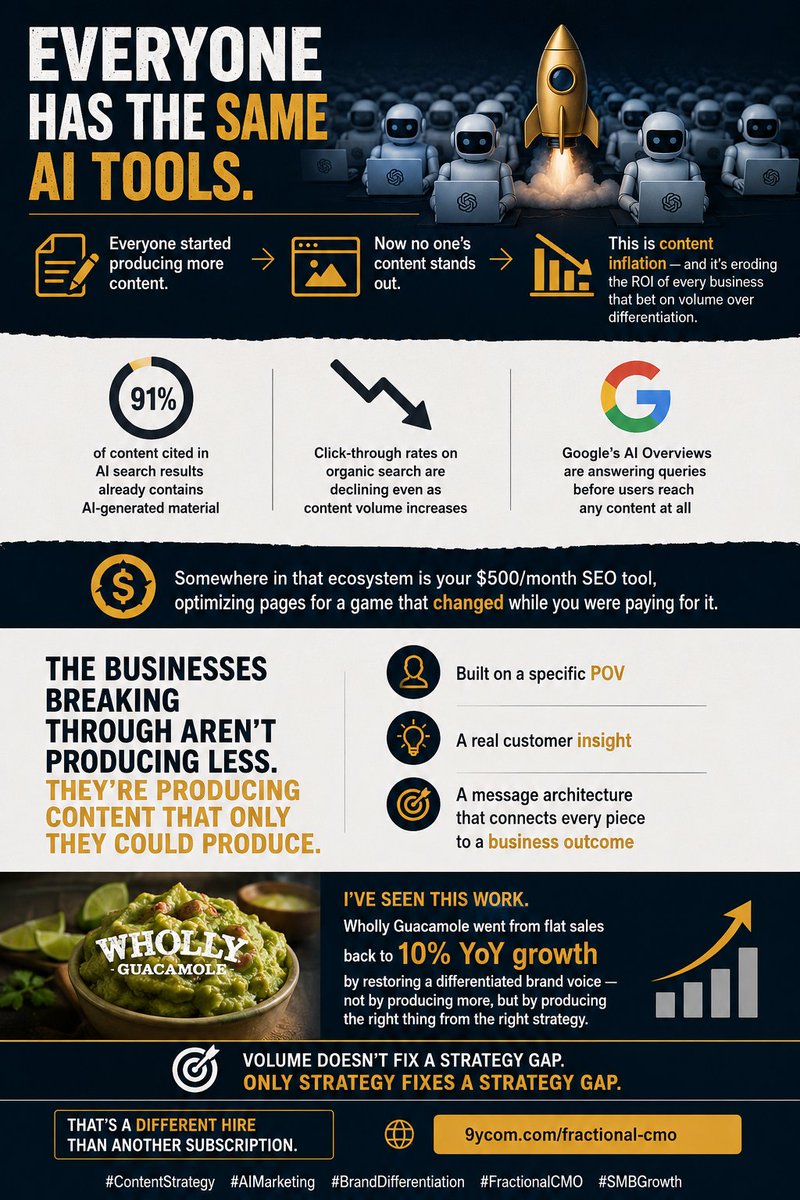
Wholly Guacamole went from flat sales to 10% YoY growth by restoring a differentiated brand voice. Not by producing more. By producing the right thing from the right strategy. Volume doesn’t fix a strategy gap.
The real cost of your $500/month AI marketing tool isn’t $500/month. It’s the 40+ hours your team spends managing a tool that was supposed to save time. Run that math before the next renewal.
Healthcare marketing isn’t a content volume problem. It’s a trust architecture problem. And trust doesn’t scale with a tool subscription. #HealthcareMarketing
18% of small business owners feel confident their marketing is working. Down from 27% last year. In a year when tool adoption, AI usage, and spend all went up. More action. Less certainty. That’s the Confidence Gap.
Are we getting ROI from our martech stack — or just complexity? I put that question in my bio because the data says most companies are getting the second thing. 5-week series starts today. #TheToolTrap
For most of America's history, freedom of navigation has been treated not as a privilege to be sold, but as a right to be defended.
To abandon that now in the Strait of Hormuz, as President Trump has suggested, is to trade a durable advantage for a fleeting gain.
My take: