Polaris: The Star That Guides Humanity
Credit: ESO / DSS2 / Giuseppe Donatiello
(J2000) RA 02h 31m 48.7s | Dec +89° 15′ 51″
For thousands of years, one star has been humanity’s faithful compass: Polaris, the North Star.
Sitting almost directly above Earth’s North Pole, α Ursae Minoris is the brightest star in the constellation Ursa Minor and the anchor of the northern sky. While other stars wheel around the heavens each night, Polaris stands nearly motionless — a celestial lighthouse that has guided sailors, explorers, and travelers across the ages.
A Complex Stellar Family
Polaris isn’t a lone beacon. It’s a multiple-star system with at least five confirmed members:
Polaris Aa**: A luminous yellow-white supergiant and the heart of the system.
Polaris Ab**: A smaller companion orbiting very close to Aa.
Polaris B**: A more distant companion easily visible in small telescopes.
Polaris C and D**: Two even more remote members of the extended family.
What makes Polaris Aa truly special is its identity as a classical Cepheid variable. It rhythmically pulses, changing brightness by a small but measurable amount over a few days. These Cepheids are cosmic standard candles — stars whose predictable variability lets astronomers measure distances across the universe.
A Dusty Cosmic Backdrop
The entire region around Polaris is veiled in delicate cirrus clouds of interstellar dust — faint, wispy tendrils glowing faintly in long-exposure images. These clouds add an ethereal beauty to the view, reminding us that even the North Star floats within a sea of cosmic material.
Whether you’re navigating by sea, aligning a telescope, or simply staring up on a clear night, Polaris remains one of the most important and beloved stars in the sky — a steady, ancient companion that has watched over humanity since the dawn of civilization.
Next time you find the Little Dipper, look to the end of its handle. That single unwavering point of light has guided empires, inspired poets, and still quietly holds the North for all of us on Earth. ✨
🚨: You are looking at NOBLE PRIZE WINNING work.
This is timelapse of stars orbiting the supermassive black hole that lies at the heart of the Milky Way over a period of nearly 20 years.
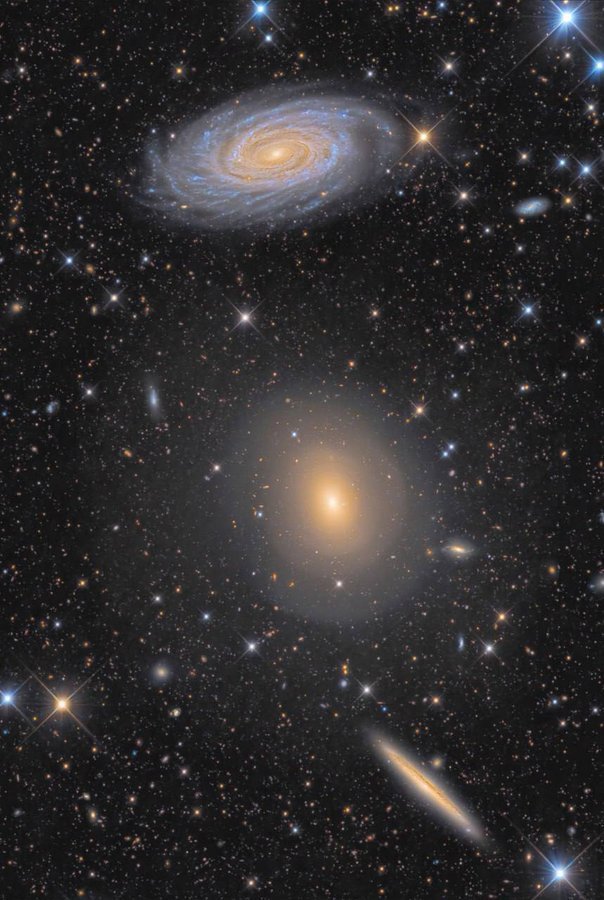
A trio of galaxies in the constellation Draco.
At the top is the spiral galaxy NGC 5985, in the center is the elliptical galaxy NGC 5982, and at the bottom is the edge-on spiral galaxy NGC 5981. All three galaxies are between 100 and 140 million light-years away.
Hubble