Serial Criminologist (coming this fall). Dr. Wade Deisman. Canadian criminologist, professor & associate dean. Crime, policing, and public safety issues.
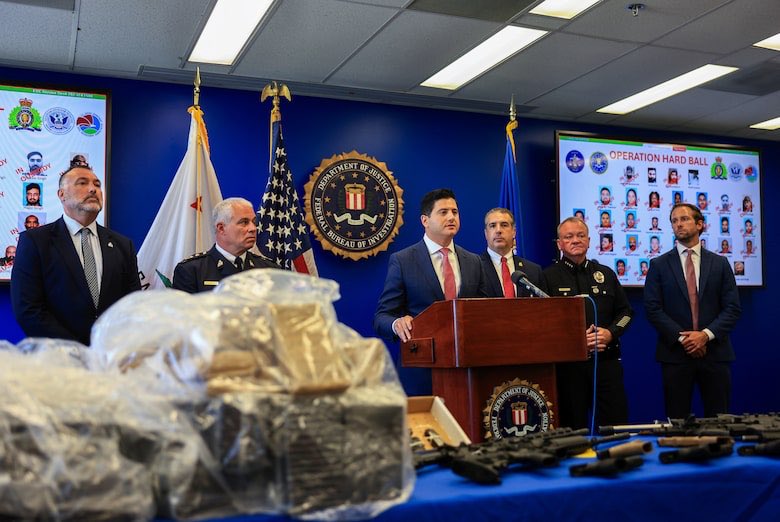
Grateful to speak with Ian Hanomansing yesterday (https://t.co/yFOtPQ51A7) about a critical breakthrough in the public safety crisis gripping Indo-Canadian communities. The indictments announced in Los Angeles settle the debate: this is not, and never was, simply a story about extortion. It is, instead, a story of a transnational terror campaign that uses targeted violence - including assassination, arson, and extortion - to undermine and eviscerate the shared sense of security that once existed within these communities, all for the purposes of control, punishment, and exploitation.
That makes it a rule-of-law problem, a sovereignty violation, and not simply a crime problem.
The indictments vindicate what many within the Indo-Canadian community have long known. Yet that will come as cold comfort to the many people in those same communities who are still merely coping - still under the gun, and still feeling vulnerable, uncertain, and afraid.
The Nijjar indictment may prove to be the most consequential aspect of yesterday's announcement. It addresses the question many had about whether there would ever be any consequence for the perpetrators. Some worried that the lack of action signalled that hostile parties were free to come to Canada to assassinate foes with impunity. For many Sikh organizations, yesterday's announcement is more than a criminal indictment. It is recognition that the fears expressed by community members deserved to be taken seriously. The courage of victims, families, community leaders, journalists and investigators helped bring us to this point. Naming the alleged architects of the assassination may restore (some) public faith, and moves the investigation beyond the alleged gunmen and toward those accused of directing the operation. That is a major development, and one whose legal, diplomatic, and geopolitical consequences are only beginning. @GurpreetSSahota@1DanStanton
#NationalSecurity #TransnationalCrime
#Extortion #BCPoli #HardeepNijjar
This marks a real breakthrough - but it also strikes me as a case of 'too little, too late' - with emphasis on the 'late'. Forgive me if saying so makes me a wet blanket. The fact remains: in less than eight months, Indo-Canadian communities have been beset by a targeted criminal offensive so severe in scale and scope that many are now simply coping, living in a state of crisis, vulnerability, uncertainty, mistrust and fear. I shudder to think how they will be able to find their way back. So, yes, a significant win to be sure, but we are a long way from being out of the woods. #RuleOfLaw #TransnationalCrime #ForeignInterference #PublicSafety #CDNPoli
The second is the extraordinary scale, sophistication and complexity of the threat apparatus. Three separate criminal organizations operating across multiple countries and continents, linked by violence, extortion, drug trafficking and cross-border logistics, point to a sophisticated transnational infrastructure - not a home grown law and order issue, not a collection of isolated crimes. Indo-Canadian communities were right to insist they were confronting something far more dangerous: a sustained challenge to Canadian sovereignty and the rule of law, an attempt to make them submit to a parallel power. Regardless of where you stand on from whence that parallel power originates (recognizing that some pundits and commentators, quite understandably, see a throughline that reaches all the way to the Indian state, while others are more circumspect).
I Was There. I Raised Concerns. Nothing Changed.
This isn’t conservatism. It’s power without consequence.
I sat at that cabinet table.
I raised concerns.
I pushed for stronger oversight because the governance problems were becoming impossible to ignore.
Nothing changed.
Today, we have ongoing RCMP investigations, court proceedings, allegations of corruption, search warrants, and serious questions about the use of public money -all while the same people who ignored those concerns continue to tell Albertans everything is fine.
It isn’t.
This isn’t about left versus right.
It’s about accountability.
It’s about whether government serves the public or serves itself.
Watch the video and decide for yourself whether this is the standard of government Alberta deserves.
#abtory #abpoli #accountability #Alberta #ucp #transparency
Canadian think tanks have documented a systematic russian influence operation aimed at stoking separatism in Canadian province of Alberta
Website “albertaseparatist,” which masqueraded as “grassroots” Alberta initiative, has been identified as part of russian Storm-1516 network
Canada is deeply concerned about the ongoing humanitarian crisis in Gaza and reaffirm our opposition to Israeli settlement expansion and settler violence in the West Bank.
Earlier today, I spoke with President Mahmoud Abbas to discuss the measures taken by the Palestinian Authority to strengthen accountability, governance, and democratic institutions, in which Hamas can play no part.
We will continue to promote peace and stability in the region, and work closely with partners toward this goal.
Watching Carney and Poilievre go at it in Parliament is starting to feel uncomfortable. Not in a dramatic way, just in the way it feels when someone is clearly out of their depth and keeps pressing anyway.
Carney knows the file. When he answers, he answers the actual question. He doesn’t need to perform outrage or repeat a catchphrase three times and call it a rebuttal. He just explains things, clearly, because he understands them.
Poilievre comes in loud and confident, same as always, and that works great on a campaign trail or a Facebook video. But in a room where the other guy actually knows what he’s talking about? The gap shows. Every time.
The frustrating part isn’t even the politics. It’s watching someone confuse intensity for competence and expect nobody to notice the difference. People notice.
This stopped being a left vs right thing a while ago. Now it just looks like one guy who did the reading and one guy who thinks he doesn’t have to.
An MIT professor taught the same math course for 62 years, and the day he retired, students from every country on earth showed up online to watch him give his final lecture.
I opened the playlist at 2am and ended up watching three of them back to back.
His name is Gilbert Strang. The course is MIT 18.06 Linear Algebra.
Every machine learning engineer, every data scientist, every quant, every self-taught programmer who actually understands how AI works learned the math from this one man. Most of them never set foot on MIT's campus. They just opened a free playlist on YouTube and let him teach.
Here's the story almost nobody tells you.
Strang joined the MIT math faculty in 1962. He retired in 2023. That is 61 years of standing at the same chalkboard teaching the same subject to 18-year-olds.
The interesting part is what he did when MIT launched OpenCourseWare in 2002. Most professors were skeptical. They worried that putting their lectures online would make their classrooms irrelevant. Strang did not hesitate. He said his life's mission was to open mathematics to students everywhere. He filmed every lecture and gave it away.
The decision quietly changed how the world learns math.
For decades linear algebra was taught the wrong way. Professors started with abstract vector spaces and proofs about field axioms. Students drowned in the abstraction. Most never recovered. They walked out believing they were bad at math when they had simply been taught in an order that nobody's brain is built to absorb.
Strang inverted the entire curriculum.
He started with matrix multiplication. Something you can write down on paper. Something you can compute by hand. Something you can see. Then he showed his students that everything else in linear algebra eigenvectors, singular value decomposition, orthogonality, the four fundamental subspaces was just a different lens for understanding what the matrix was actually doing under the hood.
His rule was strict. If a student could not explain a concept using a concrete 3 by 3 example, that student did not actually understand the concept yet. The abstraction was supposed to come last, not first. The intuition was the foundation. The proofs were just confirmation that the intuition was correct.
The second thing Strang changed was the classroom itself. He said please and thank you to his students. Every single lecture. He paused mid-derivation to ask "am I OK?" to check if anyone was lost. He never used the word "obviously" or "trivially" because he knew exactly what those words do to a student who is one step behind. He treated 19-year-olds learning math for the first time the way he treated his own colleagues. With patience. With respect. With the assumption that they belonged in the room.
For 62 years.
The result is something that has never happened in the history of education. A single math professor became the default teacher of his subject for the entire planet.
Universities in India, China, Brazil, Nigeria, every country with a computer science department, started telling their own students to just watch Strang's lectures. The University of Illinois revised its linear algebra course to do almost no in-person lecturing. The reason was honest. The professor said they could not compete with the videos.
His final lecture was in May 2023.
The auditorium was packed with students who had never met him before. He walked to the chalkboard, taught for an hour, and at the end the entire room stood and applauded. He looked confused for a moment, like he genuinely did not understand why they were cheering. Then he smiled and waved them off and walked out.
His written comment under the YouTube video of that final lecture was four sentences long. He said teaching had been a wonderful life. He said he was grateful to everyone who saw the importance of linear algebra. He said the movement of teaching it well would continue because it was right.
That was it. No book promotion. No farewell speech. No legacy management.
The man whose teaching is the foundation of modern AI just thanked the audience and went home.
20 million views. Zero ego. The entire engine of the AI revolution sits on top of math that millions of people learned for free from one quiet professor in Cambridge.
The course is still on MIT OpenCourseWare. Every lecture, every problem set, every exam, every solution. Free.
The most important math course of the 21st century is sitting one click away from you. Most people will never open it.
By grounding public discourse in evidence, context, and thoughtful analysis, Serial Criminologist seeks to contribute to safer, more informed, and more resilient communities.
The ultimate aim is not simply to inform, but to cultivate a more criminologically literate public—one capable of interpreting crime narratives critically, resisting misinformation, and engaging constructively with questions of safety, justice, and social responsibility.
In doing so, it builds a bridge between the university and the public sphere, positioning criminology as an essential tool for democratic understanding and collective problem-solving.
It mobilizes scholars, students, and practitioners to co-produce content—podcasts, interviews, analyses—that are both rigorous and publicly meaningful.
At its core, the project integrates three elements that are rarely brought together in a coordinated way: academic expertise, media production, and community engagement.
Drawing on real cases, current events, and emerging patterns, the platform connects empirical research with lived experience—helping audiences see crime not as isolated incidents, but as part of broader social, political, and economic dynamics.
It moves beyond “hit-and-run” media commentary by creating a sustained, structured space where criminological insight is translated into accessible, compelling narratives.