For years, Europe’s economy was about the size of America’s. Not today.
Today, the U.S. is 50% RICHER--despite the EU having 100 million MORE people.
What changed?
That water clarity is an engineering decision, and the math behind it is wilder than the video.
Roman aqueducts ran on gravity alone. No pumps, no pressure systems. Engineers carved channels with a gradient so shallow it borders on absurd. The Pont du Gard in southern France drops 2.5 centimeters over 275 meters. That's roughly the thickness of a coin over the length of three football fields. They surveyed that accuracy with plumb lines and wooden leveling instruments.
The clarity you're seeing is a direct product of flow velocity. Too steep and the water erodes the channel walls, picks up sediment, turns brown. Too flat and it stagnates. Roman engineers targeted a slope of about 20 centimeters per kilometer, which kept the water moving fast enough to stay fresh but slow enough to stay clear. Before the water reached the city, it passed through multi-chamber settling tanks where velocity dropped near zero. Suspended particles sank. Clean water flowed out the top into the next chamber. Repeat three or four times.
Pliny specified the minimum slope in writing. Vitruvius published the exact mortar ratio for hydraulic cement: one part lime to two parts volcanic ash for underwater work. The pozzolana from Pozzuoli reacted with water to form a calcium-aluminum-silicate compound that actually gets stronger the longer it sits submerged. Modern concrete degrades in water. Roman concrete bonds with it.
Scale the whole system and it gets harder to process. Eleven aqueducts fed Rome at its peak. Combined output: roughly 1 million cubic meters of water per day. That works out to about 250 gallons per person for a city of one million. Modern New York delivers about 125 gallons per person per day. Ancient Rome had access to double the per capita water supply of the largest city in the United States, running entirely on slope and stone.
The Trevi Fountain in Rome is still fed by one of them. Two thousand years, same source, same gravity, same water.
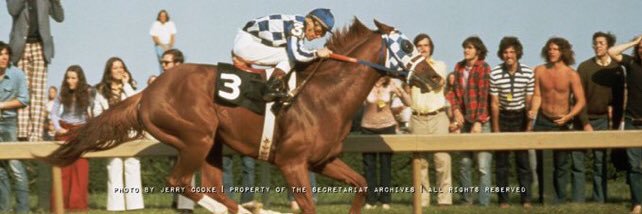
PERRY WAYNE OUZTS, the oldest jockey to ever win a race in North America, picks up win #7,534 in today's 2nd race at @BelterraPark!!
At the age of 71, Ouzts earned his 3rd win of the year today aboard Lipstick N Lashes for trainer Barbara Riley.
Ouzts turns 72 on July 7 and holds the record for the most career mounts of any jockey in North American history, now with 53,729 #Ironman
He has scheduled mounts at Belterra on Thursday, Friday and Saturday.
Let's go, Perry!!!
Every Honeycrisp apple is a clone of a single tree planted at the University of Minnesota in 1962. Every one. Apple seeds are random. Plant a Honeycrisp seed and the new tree produces a small, sour apple that’s usually inedible.
So apple growers do something old and clever. They cut a small branch off the original Honeycrisp tree, slot it into a slit in a young apple sapling, wrap the joint, and wait. The branch fuses to its new host and starts producing Honeycrisps. About 20 million Honeycrisp trees exist worldwide, every one a piece of that 1962 tree on different roots.
Same goes for Gala, Fuji, Pink Lady, Granny Smith. Every Granny Smith on Earth traces back to a seedling found in 1868 by a woman named Maria Ann Smith in Australia. She’d thrown French crab apple cores onto her compost heap, one of them sprouted, and the apples it bore were unusually tart and good for cooking. That one tree is the ancestor of every Granny Smith in every grocery store on the planet.
Wine has the bigger story. In the 1860s, a tiny aphid called phylloxera caught a boat from America to France, hidden in some grapevine cuttings. It eats grape roots. French vines had no defense and started dying everywhere. Within 15 years, French wine production crashed from about 11 billion bottles a year to 3 billion. The blight then tore through Italy, Spain, and Germany, and European wine was on the edge of collapse.
The rescue came from Missouri and Texas. American grapevines had grown up with phylloxera and were immune to it. So growers chopped French grape varieties off at the trunk and joined them to American roots. Above the soil: still French grapes. Below the soil: aphid-proof American root. It worked. Today, almost every bottle of French, Italian, Spanish, Australian, and Californian wine you’ve ever drunk sits on top of an American root.
The technique is ancient. Chinese farmers were grafting trees by 1000 BCE. A Greek medical text from 424 BCE describes it casually, like it was already old news. It works because plants don’t have a rejection system the way animals do. Cut two branches. Match the green layers just under the bark. Wrap them tight. In a few weeks the plumbing has fused into a single plant.
A Syracuse University art professor named Sam Van Aken has spent 18 years building a single tree that grows 40 different fruits: peaches, plums, apricots, cherries, nectarines, almonds. In spring it blossoms in pink, white, and crimson all at once. He’s made more than a dozen. They sell for up to $30,000 each.
Without grafting, there would be no commercial apple industry, no global wine industry, and most of the heirloom fruits humans have bred over the centuries would have gone extinct. One clean cut, and you’ve kept entire species alive.
Elon Musk just defended America better than every politician in Washington combined.
Musk: “After World War 2, the US could have basically taken over the world and any country. Like we got nukes, nobody else got nukes. We don’t even have to lose soldiers. Which country do you want?”
One nation on earth held a weapon nobody else had.
Total dominance. Zero competition. No risk of retaliation.
Every empire in history that held that kind of advantage used it.
Rome. The Mongols. The British. The Ottomans.
They conquered until they collapsed.
America had a bigger advantage than all of them combined.
And it rebuilt the countries it just defeated.
Musk: “The United States actually helped rebuild countries. So it helped rebuild Europe, it helped rebuild Japan. This is very unusual behavior, almost unprecedented.”
Almost unprecedented?
It had never happened before. Not once in 5,000 years of recorded history.
The Marshall Plan wasn’t foreign aid.
It was the most radical act of restraint any superpower ever committed.
America turned its enemies into allies. Turned rubble into economies. Turned surrender into partnership.
Germany went from ashes to the economic engine of Europe in a generation.
Japan went from unconditional surrender to the third largest economy on earth.
Three years after the war, America was flying food into Berlin.
A city in the heart of the nation that just tried to destroy it.
That’s not policy.
That’s a civilization deciding what it is at the exact moment it has the power to be anything.
You’re being told a story right now.
That America is the villain of history.
You hear it everywhere. Media. Universities. Social platforms.
Musk: “There’s always like, well America’s done bad things. Well of course America’s done bad things, but one needs to look at the whole track record.”
Every nation on earth has dark chapters. Every single one.
The difference is what a country does when nobody can stop it.
And when nobody could stop America, it fed its enemies and rebuilt their cities.
Musk: “The history of China suggests that China is not acquisitive. Meaning they’re not going to go out and invade a whole bunch of countries.”
Probably right.
China has historically built walls, not fleets.
But the real question isn’t about borders anymore.
We’re approaching a moment that mirrors 1945 in ways nobody has fully processed yet.
AI is going to give a handful of people a power advantage that makes nuclear monopoly look quaint.
If someone is going to hold that kind of power, who do you want it to be?
The country that conquered when it could? Or the one that rebuilt when it didn’t have to?
Every alliance. Every trade route. Every economy.
Billions lifted out of poverty.
All of it traces back to one act of restraint that had never been done before.
And carries no guarantee of being repeated.
The most powerful thing America ever did wasn’t building the bomb.
It was what it didn’t do after.
Was not ready for Eric Church to deliver the best commencement speech I’ve ever heard.
Six guitar strings. Six pillars of a life.
Faith. Family. Spouse. Ambition. Community. You.
Tune them when you’re whole, not just when you’re broken.
Watch the whole thing.
The biggest wealth transfer in American history isn’t happening on Wall Street. It’s happening on U-Hauls.
Over $2 trillion in income fled high-tax blue states for low-tax red states in just 11 years.
And blue states’ solution? Raise taxes again.
Vegas banned him. So he wrote an algorithm, moved to Hong Kong, and extracted $1 Billion from the betting crowd.
As this Bloomberg documentary shows, Bill Benter didn’t guess. He mathematically exploited the public's emotional mispricing.
Today, millions of dollars are being extracted from Polymarket using this exact same framework. While the crowd trades on "vibes," algorithms are siphoning the pool.
Bookmark this, then read the 77-year-old math framework below to build your edge
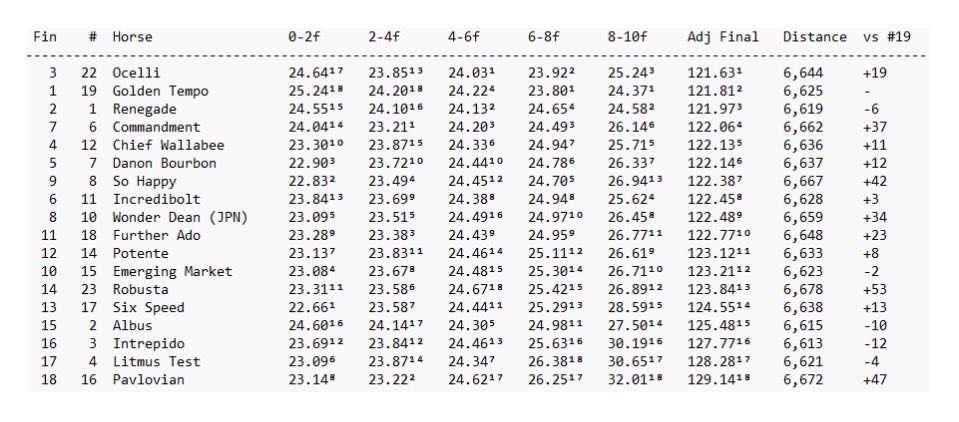
Derby order of finish adjusted for ground loss (data from Equibase GPS chart). Golden Tempo traveled 6625’ in 122.27s for an avg of 54.18 ft/sec. His adjusted 1 1/4 (6600’) time was 121.81s. Ocelli went 19’ further than the winner so has a lower adjusted time.
Cathie Wood just named the contradiction nobody wants to touch.
She compared Elon Musk to Thomas Edison.
Not as praise. As a pattern.
Wood: “I think he’s the Thomas Edison of our age… he wants to do the right thing to transform the lot of most of humanity.”
The media sees a reckless billionaire setting fires.
Wood sees the only person in the room building anything at all.
The gap between those two readings tells you everything about who controls the narrative.
Start with Tesla.
Wood: “Tesla was an environmental move, which I think a lot of people attacking his cars… they’ve forgotten.”
He built the exact machine environmentalists spent thirty years begging for.
Didn’t lobby for it. Didn’t write a whitepaper. Built it.
Forced every major automaker on Earth to abandon the combustion engine.
Then the second he won, the same movement made him the enemy.
Because the establishment never wanted the problem solved. They wanted the problem funded. And those are two very different things.
A solved problem kills the committee. Kills the nonprofit. Kills the careers built on managing the crisis instead of ending it.
Musk ended it. And they have never forgiven him.
SpaceX looks like an escape hatch if you never read past the headline.
Which is exactly what the press counts on.
Wood: “What we learn about material science and technologies… is going to help us here on Earth as well.”
Mars was never the exit.
It is the lab.
Build under conditions so brutal that every breakthrough changes what is possible back home.
You learn to keep a human alive in a frozen irradiated vacuum.
Fixing an energy grid on a temperate planet becomes arithmetic.
He is not running from the cradle.
He is stress-testing the technology that preserves it.
But that story doesn’t sell ads. Doesn’t move polling numbers. So they bury it under hit pieces and congressional theater and call it journalism.
Most people who reach his level stop building and start protecting what they have.
They buy senators. They buy newspapers. They buy silence.
Musk keeps picking the hardest unsolved problems on the planet and running straight at them.
That is what terrifies the establishment.
Not that he might fail.
That he might succeed without them. Without their funding. Without their approval. Without anything they can hold over his head.
A man they cannot buy is a man they cannot control.
So they do the only thing they have left.
They send the media after him.
Every legacy outlet runs the same playbook. Strip the context. Clip the quote. Frame the motive. Let the algorithm do the rest.
It has worked on every builder before him.
It will not work on this one.
They will spend their careers trying to tear him down.
He will spend his building the thing that saves them anyway.
The stones always come from inside the walls.