@Christ_Conserv@HwsEleutheroi@BasedMikeLee The Father is Elohim. Because they are one *in purpose* Yahweh speaks with the authority of Elohim throughout most all of the Old Testament.
@Christ_Conserv@HwsEleutheroi@BasedMikeLee Oh, we believe Jesus is the Jehovah of the Old Testament. He does the will of God the Father. Jesus is God, He is God the Son. In other words, yes, Yahweh comes to live with man as the Christ Child. But he still has a Father, whose will He does. Not Christ’s own but his Father’s.
@Christ_Conserv@HwsEleutheroi@BasedMikeLee There is only one God the Father. His only begotten in the flesh is Jesus Christ.
If you presuppose the Trinity, then yes, you can do some mental gymnastics to make it fit the text. But if you read the text without any presuppositions, you find quickly they are two beings.
@Christ_Conserv@HwsEleutheroi@BasedMikeLee The New Testament is filled with such verses plainly stating that Christ was sent or heard by or begotten of God the Father. Etc etc etc.
@Christ_Conserv@HwsEleutheroi@BasedMikeLee The Old Testament teaches that there is a God the Father and He is the most high. It doesn’t teach that He and the Son are the same being.
The New Testament affirms the grand sacrifice as not only Christ sacrificing his life but also His Father sacrificing His Son.
@Christ_Conserv@HwsEleutheroi@BasedMikeLee But neither the New Testament nor the Old Testament teach the creedal theory of the Trinity. It just isn’t in the text. Early Christians don’t seem to have widely believed or taught it either. These theories have to have come from somewhere.
@Christ_Conserv@HwsEleutheroi@BasedMikeLee The Hebrew noun (Elohim) is plural and there are sometimes singular verbs assigned to it. Other times, like this, it’s a plural verb (na’aseh).
It’s a tough text that has been wrestled with for millennia, but it doesn’t seem to point a 3-in-1 mysterious substance/being.
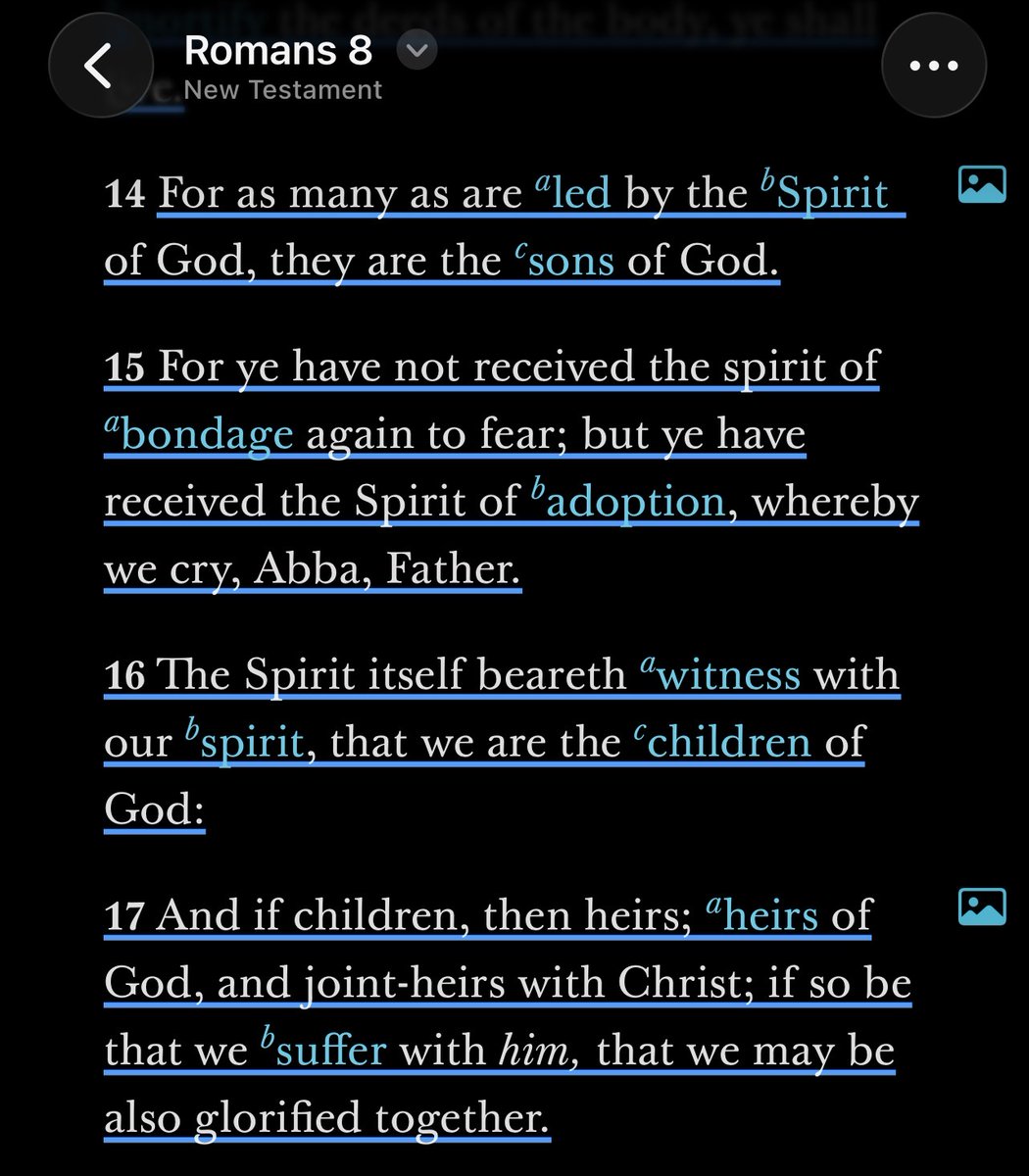
@Christ_Conserv@HwsEleutheroi@BasedMikeLee Ontologically, no. Neither are He nor we ontologically different from the Father. We are children of God. Sons and daughters.
How can we be joint heirs to a mysterious substance? Hint: we cannot because God is not a mysterious substance.
@Christ_Conserv@HwsEleutheroi@BasedMikeLee Because we are like God—his literal spirit children. You are a son of God.
And God the Father and His Son are two separate beings. They both have the same image (as do we, though we are fallen and they are perfected).
When you say I have to accept “the Nicene Creed” to be Christian, could you be more specific?
Do you mean the creed produced in A.D. 325 at a council convened by the Roman emperor Constantine, who was trying to settle the Arian controversy and preserve unity in his empire?
Or do you mean the version most Christians actually recite today, which comes from A.D. 381, when another Roman emperor, Theodosius I, convened the First Council of Constantinople to settle further disputes and more fully define the doctrine of the Holy Spirit?
Because that seems like a pretty important distinction.
One was created under Constantine, a Roman emperor with no priesthood authority, whose interest in Christianity was inseparable from his interest in imperial stability.
The other was expanded under Theodosius, another Roman emperor who used state power to enforce religious uniformity.
And somehow I’m supposed to believe that my faith in Jesus Christ is invalid unless I accept the theological conclusions of emperor-sponsored councils held centuries after Christ and His apostles?
You are free to trust those councils, led by rulers of the same empire that crucified Christ.
But please stop pretending that your post-biblical, politically entangled, imperial committee language is simply “biblical truth.”
And stop acting like you have the authority to decide who is and is not Christian based on a person’s willingness to pledge allegiance to Rome’s preferred definition of the Divine.
@Christ_Conserv@HwsEleutheroi@BasedMikeLee How could man be made in God’s image if God is a mysterious substance (according to the creedal theories)?
The Trinity is not mentioned here. How does one come to your conclusion above?