It's extremely important to understand your YouTube retention graphs. Here are 12 of the most common retention graphs and what they suggest you could improve.
1. Fluctuating Decline: This graph shows that there are multiple moments where the viewer aggressively loses interest. When you see a graph like this, you should investigate the specific moments where the retention goes down and where it stays flat to figure out what you're doing well and what you're doing wrong. This graph may indicate that the audience is extremely responsive to specific moments.
2. Grace Period: This graph shows that the viewer is willing to give the video a shot, but you didn't manage to convince them to watch for longer. When you see a graph like this, try to look into what reasons you provided that the audience may care about to encourage them to watch for longer. This graph may indicate that your current reasons may not be strong enough.
3. Rewatch Spike: This graph shows that there were specific moments the viewer really enjoyed or needed to rewatch to understand what happened. When you see a graph like this, you should look at the moments where the spikes are happening to see if this was valuable information that you were giving (which helps you understand what more information to give) or whether the moment itself was unclear. This graph may indicate both.
4. Sharp Dip(s): This graph shows that there were moments that the viewer thought were worthy of skipping. When you see a graph like this, you should ask yourself, "Is there any way to remove these sections?" If not, then you should figure out how to optimize those sections to reduce the amount of loss from before the drop until after the drop. This graph is common for brand deals.
5. Smooth Decline: This graph shows that the viewer is slowly losing interest over time, without a distinct moment being responsible for their loss of interest. When you see a graph like this, try to think about whether you had enough distinct moments. Did any moment stand out that made it impossible for the viewer to tune out? Was there conflict being used or anything like that? This graph is the most common graph and is still very healthy because it just highlights gradual boredom, which is normal. This is typically the type of graph you would want to see.
6. Segmented Decline: This graph shows that the viewer was willing to give segments a shot, but then each segment is resulting in early satisfaction or loss of interest for portions of your audience. When you see a graph like this, you need to ask yourself if there are ways to lengthen earlier segments and shorten the time between segments. That's the best way to optimize these kinds of graphs. This type of graph is common for segmented experiences.
7. Early Drop: This graph shows that you are including something early in the video that the viewer didn't want to see early. When you see a graph like this, you need to ask yourself if you really needed that early part in your videos. If you cannot cut it out or move it later, you should aim to shorten it to reduce the loss of viewers that may otherwise be interested in your video. This type of graph is typical when you have logo screens, early ad reads or early disclosures in educational content.
8. Low Retention: This graph shows that you either reach a wide audience or your typical audience is extremely disinterested in this video. When you see a graph like this, you should not panic. It can mean a lot of things. Often, as you reach a wider audience, your overall retention will be lower. The idea is not to look at the percentage, but rather the behavior, so look for other patterns within the lower retention. However, it is also common when you upload content to an extremely cold audience. This happens often to smaller creators. This kind of graph isn't always a bad thing, as it may just be that YouTube serves you to an audience that otherwise would never see your videos.
9. Outcome Spike: This graph shows that the viewer really cared about seeing what came at the end. When you see a graph like this, it indicates that the promise to the end was worth it, and people really wanted to see the outcome. This kind of graph really highlights how much viewers care about the outcome. The question is whether the journey was interesting enough. This is where you should look at whether the graph towards the ending was more flat or whether there was an aggressive decline before the spike.
10. Early Ending: This graph shows that the viewer already found the video to be ending early in their mind. When you see a graph like this, just ask yourself whether you really needed the extra content or whether you could leave the viewer at the height of the story. This type of graph is extremely common in educational content and storytelling content that lingers on too much after the reveal.
11. High Retention: This graph shows that the video was shown to an audience that was very engaged, typical for videos that have wide appeal. When you see a graph like this, you shouldn't instantly assume that you did everything well. It typically means that the audience who saw your content was highly engaged. However, it could also mean that a wider, less engaged audience never saw the video, which affects the height. When I see a graph like this, I typically look into whether there were possible wide appeal issues.
12. Ad-driven Retention: This graph shows that the video was shown through YouTube's promotion feature. When you see a graph like this, you should not really do anything. This is extremely common when you drive ads to your video or link your video to an extremely cold audience. My biggest advice is to not panic or think that this is going to prevent the video from being shown to your typical audience. YouTube estimates per viewer, individually, whether they will like the video or not, and a graph like this won't necessarily affect that negatively.
These are just simplified explanations for each graph, and there are plenty more explanations possible for each graph, but I mainly wanted to show that there are distinct patterns with clear directions for your analysis.
Let’s be honest! China 🇨🇳 is truly the only dominant superpower on the planet. This American living there is there to prove that. I’ve been following his channel and everything he shows is like Sci-fi and yet it’s the naked truth.
Happy to welcome PRC Vice Premier Ding Xuexiang back to Singapore. I still remember his warm hospitality when we co-chaired the Joint Council for Bilateral Cooperation (JCBC) in China in 2023. Good to catch up ahead of tomorrow’s JCBC, which he’ll co-chair with DPM @GANKIMYONG.
Our artists tell our stories, in our own voices, in our own ways.
At the He Xiangning Art Museum in Shenzhen, I had the chance to see Canadian artist Le Lin’s Asian Night Market prints. Originally shown in Montréal’s Chinatown, Lin’s work is a reminder that our stories resonate far beyond our borders.
🚨 THREE GREAT POWERS. ONE TABLE.
Trump just posted this painting of himself walking side by side with Xi and Putin.
For years the experts said a US, China and Russia sit-down was impossible.
Trump made it happen, and he walked in as an EQUAL, not a guy asking permission.
That's what strength looks like.
🚨 ONE TABLE. THREE MEN. THE WHOLE WORLD WATCHING.
America. China. Russia.
For the first time EVER, the leaders of all three sat down together at the same table.
Biden couldn't get a meeting like this. Obama never tried. The Washington crowd said it couldn't be done.
Trump walked in and took his seat.
You don't have to like who's sitting across from you. You just have to be strong enough that they show up.
That's leadership.
The most beautiful place on the planet?
Li River in Guilin, Guangxi, where mist-covered karst mountains rise above tranquil waters. 🇨🇳⛰️
There are so many wonderful spots on Planet Earth 🌍. But this is for sure a strong contender.
"It's clean. It's immaculate. It's been built in a short period of time."
- US President Donald Trump
Trump, after visiting Shenzhen, agrees with what I have been saying for years.
Good to meet Premier Li Qiang again in Beijing. Our flagship Government-to-Government projects underpin cooperation in Jing-Jin-Ji and closer western China–Southeast Asia links via the Chongqing Connectivity Initiative, International Land-Sea Trade Corridor and Pinglu Canal.
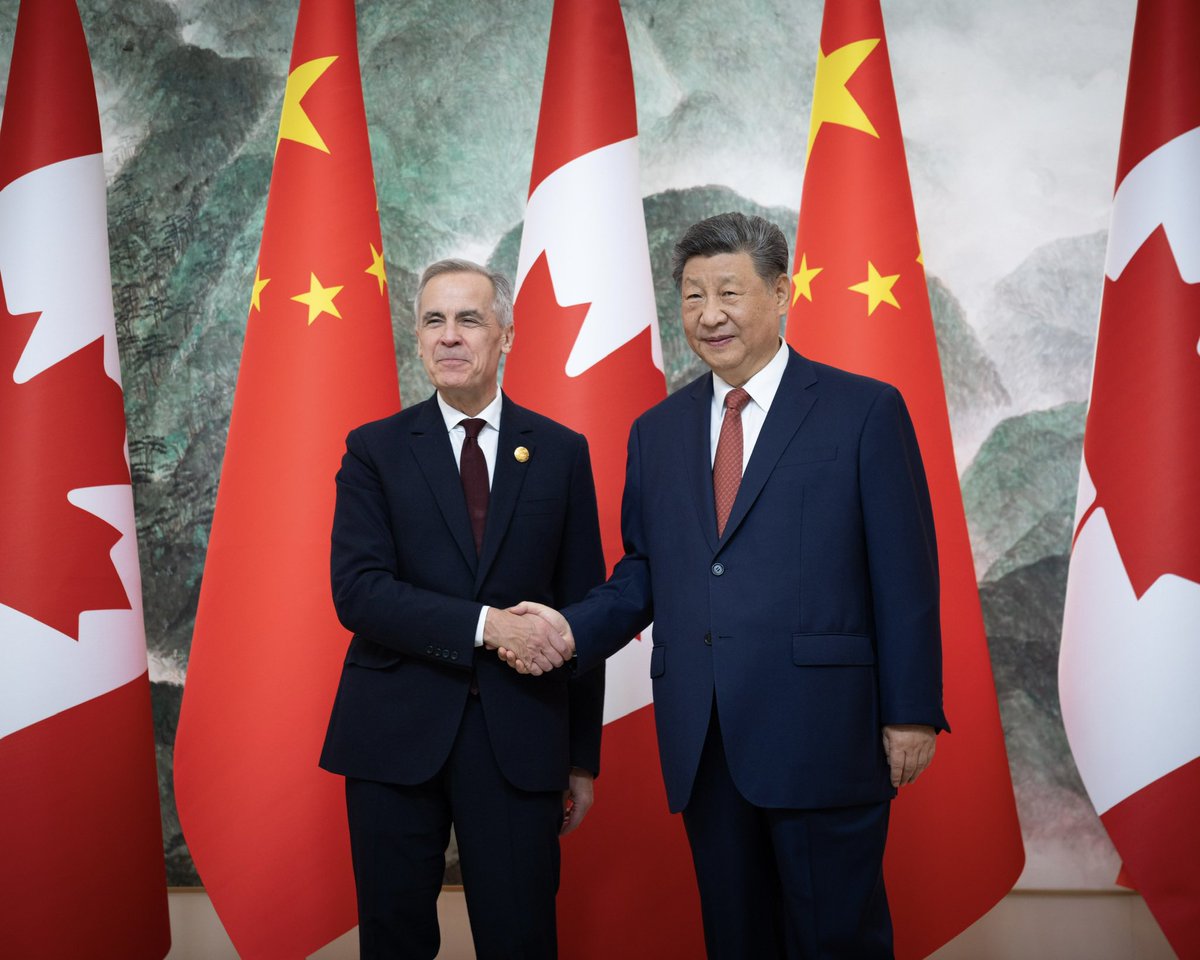
La souveraineté est fondée sur notre force au pays et sur nos partenariats diversifiés à l’étranger.
Cette semaine, à l’APEC, le Canada a renforcé nos partenariats dans la région Asie-Pacifique. Des partenariats qui donneront lieu à plus d’échanges commerciaux, à plus d’investissements et à plus d’occasions pour nos travailleurs et nos entreprises.
Pour en savoir plus : https://t.co/RFMcouSPQl
When I first met Mexico President @Claudiashein two years ago, I shared our plans to open a Singapore Embassy in Mexico City. It was good to meet her again at APEC in Shenzhen, this time with our Embassy up and running!
Trump just stood at the White House podium and trashed his own country.
American cities: 'rusty and disgusting.' China's cities: 'flawless' and 'immaculate.'
He went to China and came back as Xi's spokesman.
Wow! This is this single best post I've ever read from a Chinese national living abroad as he finally breaks his silence and reveals the truth about China 👇
Some background...Mr Xia is a Chinese national who moved abroad. Like many Chinese he still follows the news in China and started a YouTube channel speaking out on China and grew it to over 200k+ followers. But recently he stopped posting videos and today revealed why:
1. We’re a bunch of people who left China years ago and haven’t been back. Do we still understand China? I seriously doubt it, myself included.
2. Basically every day, all these bloggers repeat the same act: “squeezing out bullshit when there’s nothing to say.” They can’t go to China, yet they make a living every day by droning on about it. Isn’t that some kind of mental distortion, or even a psychological perversion?
3. My life in China was so rich and varied, yet after moving abroad, I spend 24 hours a day glued to what’s happening in China so I have something to talk about. Can you call that living? Isn’t it more like drawing a circle on the ground and locking yourself inside it? I don’t want to spend the rest of my life like this.
I honestly couldn't agree more with Mr. Xia's observations because I also know many foreigner YouTubers who make a living of talking negatively about China, despite the fact they left China many years ago!
But the truth is China is NOTHING like these people want you to believe and most importantly YOU NEED TO GO TO CHINA AND EXPERIENCE IT YOURSELF.
I just returned from Shenzhen yesterday. The city was buzzing with the APEC 2026 meeting and it's impossible not to feel bullish about the country when you walk around that city and see what China has accomplished in just 4 decades.
25% of Australia’s trade is with China.
It brings jobs and boosts our economy.
We’re working with leading Australian companies and universities to make the most of the opportunities ahead.
Great to expand on that work at the Australia-China CEO Roundtable in Beijing.
Sovereignty is built on strength at home and diverse partnerships abroad.
This week at APEC, Canada strengthened our partnerships across the Asia-Pacific. For more trade, more investment, and more opportunities for our workers and businesses.
Read more: https://t.co/jMqCvHiWsl