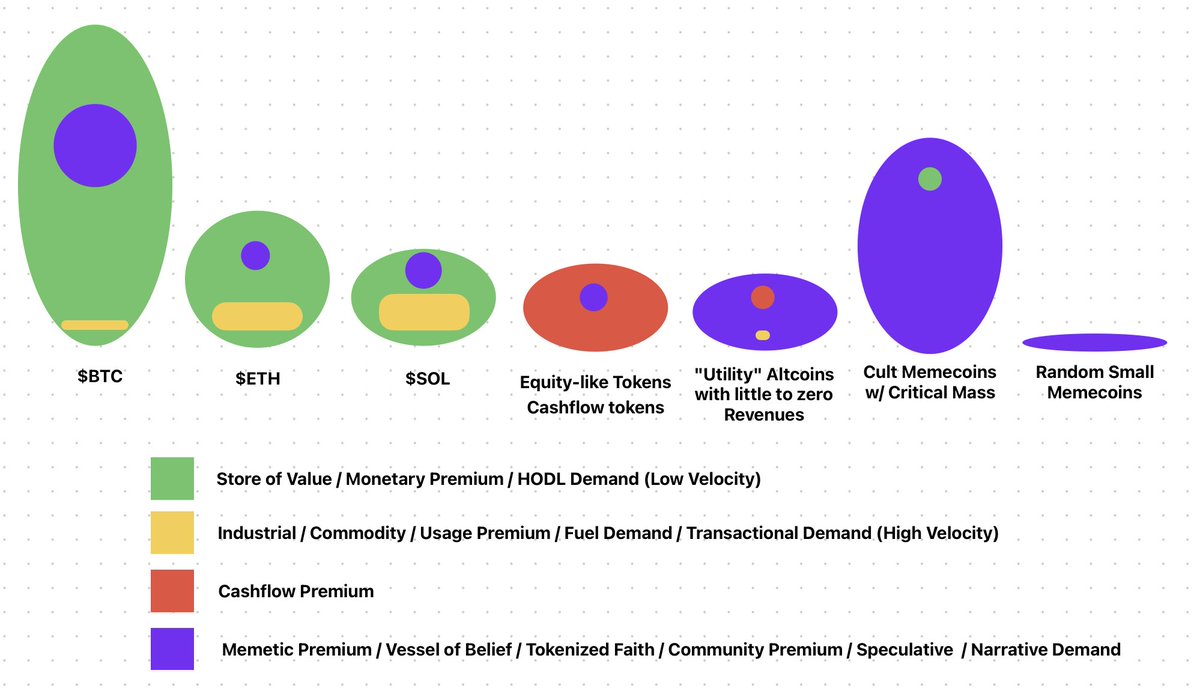
If you're building Utility, Cash Flow is King ♔
According to this analysis, it's also the color of $DRV 🔥🔺️🔥
A rising tide lifts all boats.
Perpetual Revenue is accelerating on the Perpetually #1 Options Dex — well over $1 million generated in Free Cash Flow YTD.
Perfect storm brewing with the added memetic potential energy of @chayensan & the recently organized @Derivexyz OGs!
❤️🔥🐦🔥❤️🔥
Many of us have been building and upskilling in private.
Grants 2.0 will be LIT ❤️🔥🔦
Memecoins are *STEALING* Memetic, Speculative, Community and Belief *ENERGIES* from ALTCOINS.
This is how Crypto Assets work in 2024-2025.
Few understand. Many will.
Summarising the above in words:
For 16700 strike to come within 1 stdev of ATM Strike during this expiry, we need a realised volatility of ~51%.
Say for m = 3, if new Strike 17643 (4.63% down) is reached in 3 days; equals a realised volatility of 4.63*√(365/3) = 51.07%
So,
X (strike in m days) – 1 standard deviation over (7-m) days = 16700
X - (18500-X)/18500*√(7-m/7) = 16700
We see that if we vary m from [2,5] days, we get realised volatility of 51%
Let’s say Nifty drops down from 18500 to a strike X in 'm' days (m < 7) such that 16700 comes within 1 standard deviation of this strike X.
We solve for X as follows:
Realised volatility in first m days = (18500-X)*√(365/m)/18500
1 stdev post realisation = (7-m) day volatility
Let's call this the "Actual Distance". This metric will be referenced later in this thread.
The ATM IV of 16700 strike, if Nifty reaches there by 1 Jun 2023, would be referenced to 70.26%. Currently it’s trading at a measly 33.3%. Talk about cheap tails!
Interpreting Option Skew:🧵
Let's first understand how volatility is measured using standard deviation (stdev).A stdev is a measure of how dispersed the data is in relation to the mean.Low stdev means data is clustered around the mean, and high stdev means data is more spread out
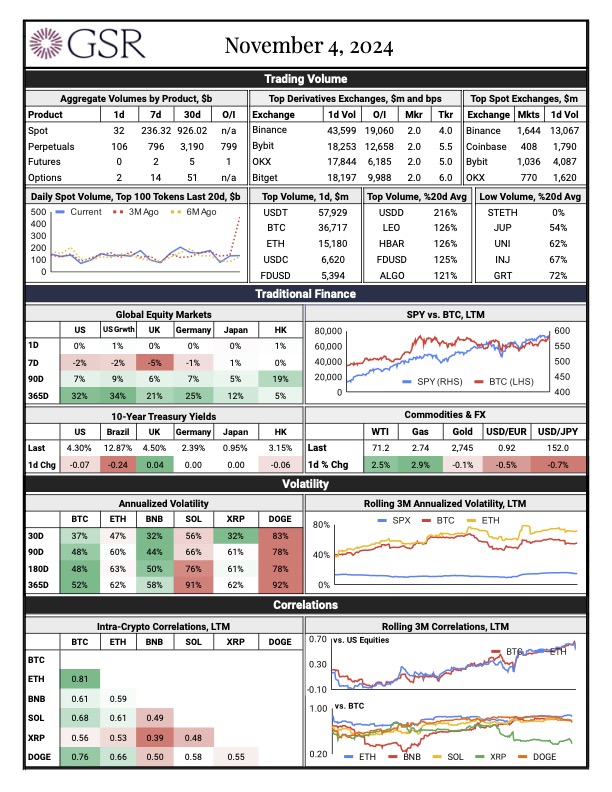
Daily Market Update 11/4: #BTC is currently trading around $67.7k and #ETH around $2.4k. Notable gainers in the last 24 hours are #DOGE, #ENA, and #XMR. The global crypto market cap is $2.36T, down 2.2% over the last day. DeFi TVL is ~$87b and BTC dominance is around 57%
3/ Possible Futures of the Ethereum Protocol
Amidst the significant debate around #Ethereum’s rollup-centric strategy, Vitalik published a series of blog posts titled ‘Possible Futures of the Ethereum Protocol’ covering key areas of the roadmap in depth. As a quick refresher, the Ethereum roadmap, consists of six categories of upgrades being pursued in parallel. The first of these is The Merge, which focuses on upgrading Ethereum’s consensus mechanism to make it simpler, more robust, and decentralized. A key part of this upgrade track was the eponymous ‘The Merge’ event in 2022, during which Ethereum’s consensus switched from Proof-of-Work to Proof-of-Stake. The second track is The Surge which is all about scaling Ethereum to 100,000 TPS and beyond, primarily through rollups. The third is The Scourge which looks to mitigate centralization risks to the Ethereum protocol, primarily those emanating from liquid staking/pooling and MEV. The fourth is The Verge which aims to make Ethereum blocks easy to verify through cryptographic upgrades that enable statelessness. The fifth is The Purge which has the goal of simplifying the protocol and eliminating technical debt. Finally, The Splurge represents a catch-all category that captures various remaining improvements that don’t neatly fit into a single category.
Vitalik’s blog series provides the clearest and most comprehensive single articulation of the current thinking for each of the upgrade tracks. It further serves as a much needed resource to help frame discussions around Ethereum’s development with a clear view of the available options and their tradeoffs. While each post is worth reading in full, they discuss:
The Merge: This post primarily focuses on framing the discussion around how to achieve two goals for consensus which are in tension with one another: achieving single-slot finality and reducing the validator staking requirement such that more validators can participate. Vitalik sketches out a few possible paths with different tradeoffs which range from introducing technological complexity to relaxing requirements around economic finality and possible centralization.
The Surge: This post discusses how Ethereum will scale by fundamentally relying on two technologies: ZK-SNARKs (ZK) and Data Availability Sampling (DAS). Given potential bottlenecks in data availability, Vitalik outlines potential paths forward, including bringing back improved Plasma based designs which do not need onchain data availability. The post also explores other complementary paths to scaling L2 throughput and improving interoperability.
The Scourge: This post discusses two different approaches to mitigating MEV centralization in 1) a variant of Proposer-Builder Separation combined with inclusion lists and 2) multiple concurrent proposers. Both approaches address censorship resistance concerns arising from highly centralized block building, but they differ in terms of how they split the value generated from MEV across different parties. The post also addresses staking centralization through liquid staking and discusses a couple of solutions including modifying the ETH issuance curve to disincentivize staking past a certain level and creating a maximally decentralized, trustless, and neutral liquid staking token.
The Verge: This post explores two possible approaches to enabling stateless validation in Verkle Trees and STARKed binary hash trees. While the former has been the leading option for a long time, improvements in STARK proving have made the latter option practical faster than expected, making it a potentially viable candidate for implementation in the near future. The post also discusses plans to implement ZK-SNARKs at the L1 level to prove both consensus and execution, thus greatly easing the burden of verification for clients.
The Purge: This post goes over approaches to implementing history expiry and state expiry, which would help ease the storage burden that current Ethereum clients face. Vitalik also covers other ways of simplifying the protocol like removing unused features.
The Splurge: This post discusses a variety of miscellaneous upgrades including improvements to the EVM, approaches for enshrining account abstraction into the protocol, changes to the protocol fee mechanism, implementation of Verifiable Delay Functions (VDFs), and experimentation with powerful emerging cryptographic primitives including Fully Homomorphic Encryption (FHE), Indistinguishability Obfuscation, and quantum one-shot signatures.
Ethereum’s Roadmap as of 2023:
1/ Monthly Crypto Commentary for October 👀👇
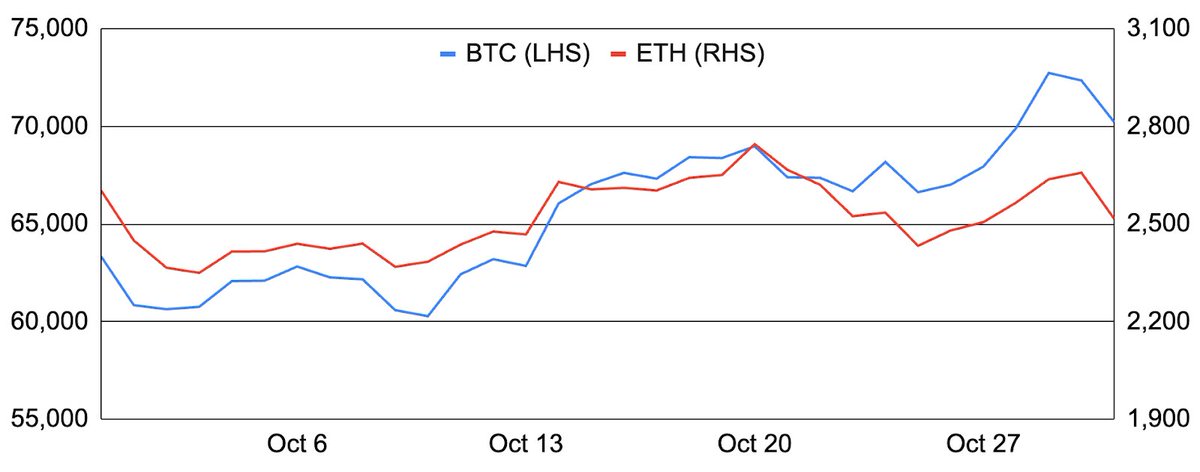
#Bitcoin entered October around $63,300 and rose 11% during the month to $70,200. Crypto’s apex asset traded sideways for the first two weeks of the month due to various factors including rising tensions in the Middle East and poor spot ETFs flows. However, Bitcoin spent the remainder of October generally moving higher on US election enthusiasm as the pro-Bitcoin Trump gathered momentum and on what ultimately turned out to be phenomenal spot ETF flows that totaled $5.4b.
#Ethereum materially trailed Bitcoin during the month, falling 3% after entering October around $2,600 and finishing at ~$2,500. While subject to the same macro factors, sentiment around Ethereum remained particularly low, the spot Ethereum ETFs gathered just $55m of net flows, and the ETH/BTC ratio hit its lowest mark since 2021.
When Bitcoin Began its post-Election 2020 Rally, its Annualized Volatility was Below 30.
Today it is 36.
So I am not sure about the argument that the rally should be so much smaller. Maybe.
But to indulge you, an 88% rally (1/4 of previous cycle) would be $130k.
Clear Street Initiates on "Disruptive Technology" Equities Bullish on BTC Miners & High Performance Computing.
Top picks BTBT, BITF, CLSK
"This is an exciting time to start our coverage as many BTC miners explore growth in the HPC field and BTC moves into the mainstream."
Day 22: $18. And now back to our regular scheduled programming.
Each day @derivexyz is #1 in options on @DefiLlama, $1 goes to the Great Koala National Park (https://t.co/jUc8S7Dzvb).
Day 21: $17. Sleepy weekend strikes again.
Each day @derivexyz is #1 in options on @DefiLlama, $1 goes to the Great Koala National Park (https://t.co/jUc8S7Dzvb).




![G3ni3sWish's tweet photo. So,
X (strike in m days) – 1 standard deviation over (7-m) days = 16700
X - (18500-X)/18500*√(7-m/7) = 16700
We see that if we vary m from [2,5] days, we get realised volatility of 51% https://t.co/lwGVepUm6L](https://pbs.twimg.com/media/FxIGeLCaUAAevaG.jpg)