Presenting the new WATERONE
The project formerly known as FLUX is now WaterOne.
A new name. A new identity. The same vision.
Our core mission remains unchanged.
Thank you for being part of our journey.
Welcome to WaterOne. A new chapter begins.
#WaterOne
Buying a share can give you an economic interest in a company, but voting power depends on the class of stock and its terms. Some companies issue multiple share classes with different voting rights. One class may carry more votes per share than another.
That means two investors can own part of the same business while having very different influence over shareholder decisions.
Before investing, check the prospectus or company filings for the rights attached to the share class—not just the ticker or price. Ownership, voting power and dividend terms are not always identical.
#FLUX #ShareholderRights #CorporateGovernance #Stocks
Dollar-cost averaging means investing a set amount at regular intervals, regardless of market moves. It can make the process more disciplined: the same contribution buys more shares when prices are lower and fewer when they are higher.
But it doesn't make a weak investment stronger or prevent losses in a falling market. If prices rise while part of your money remains in cash, gradual investing can also mean missing some gains. More frequent purchases may add fees, depending on your broker.
It changes how you enter—not what you own or the risks you take.
#FLUX #DollarCostAveraging #LongTermInvesting
The price-to-earnings (P/E) ratio compares a company's share price with its earnings per share. It can help you compare a business with its own history or with peers—but it cannot explain the whole story behind the valuation.
A low multiple may reflect slower growth, pressure on margins, debt, or uncertainty about future earnings. A higher multiple may reflect stronger expectations, but those expectations still have to be delivered.
Use P/E as a starting point, not a verdict. Look at earnings quality, growth prospects, balance-sheet strength and industry context before deciding what the number means.
#FLUX #EquityValuation #PERatio #InvestingBasics
The dividend a company announces is usually quoted before any withholding tax that may apply. For investors holding foreign shares, part of the payment may be deducted at source before it reaches their account.
The amount withheld can depend on the country paying the dividend, your tax residence, treaty eligibility and the documents on file.
So the yield shown on a quote page may not match the cash you actually receive. Check whether the figure is gross or net before comparing income investments.
#FLUX #WealthInMotion
When a company issues new shares, its total share count grows. If you don't participate proportionally, your percentage of ownership can fall even though the number of shares in your account stays the same.
Dilution isn't automatically bad. New capital may fund expansion, product development or debt repayment. The important question is what the company does with that money, and whether the growth it creates benefits existing shareholders over time.
Watch the share count, not just the headline results.
#FLUX #WealthInMotion
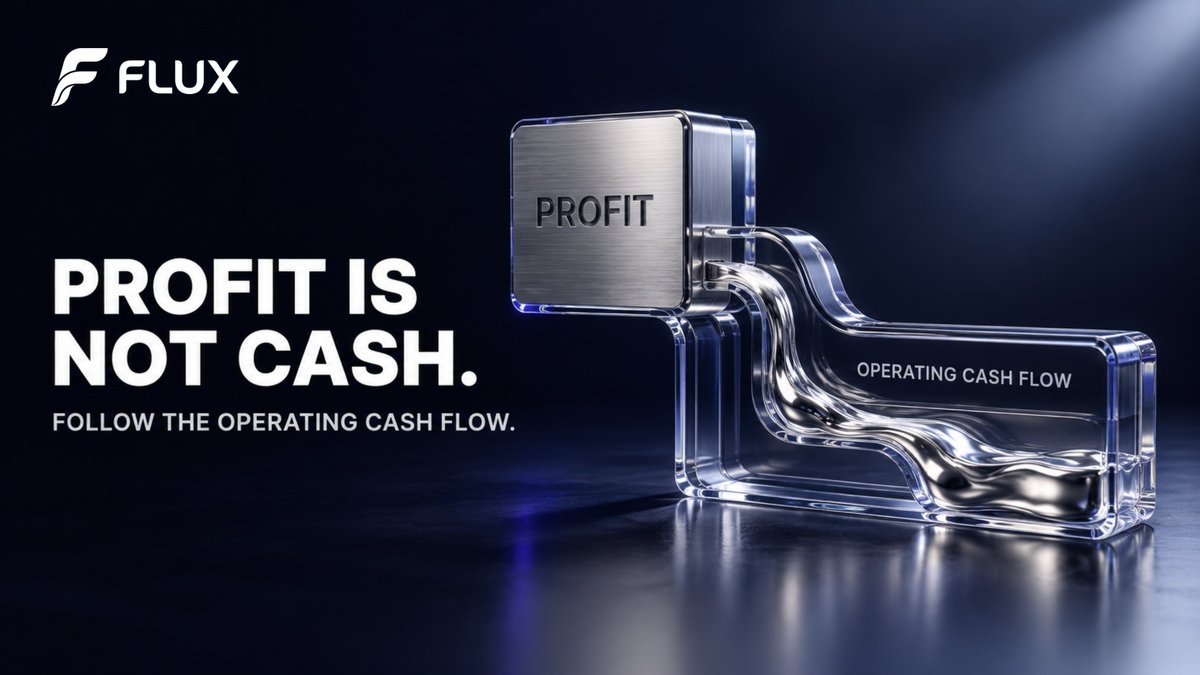
A company can report a profit before all its customers have paid. It can also record non-cash expenses that affect earnings without an immediate cash outflow. That's why the income statement and cash flow statement answer different questions.
Operating cash flow helps show whether the core business is actually generating cash. Read it alongside reported profit and watch how the relationship changes over time. A strong earnings headline is useful, but it is not the whole picture.
#FLUX #WealthInMotion
Feeling calm about market swings doesn't automatically mean your finances can absorb a loss.
Risk willingness is how much uncertainty you feel ready to accept. Risk capacity is what your situation can handle—when you'll need the money, how steady your income is, and which expenses depend on it.
Those can point in different directions.
Money set aside for a distant goal may have room for more volatility than funds needed soon for tuition, a home, or everyday bills.
The right risk level isn't just about how brave you feel. It's about matching an investment to the job that money needs to do.
#FLUX #WealthInMotion
Before putting every spare dollar into the market, look at the interest you're already paying.
Paying down high-interest debt can reduce a known cost. Investing, by contrast, offers potential returns—but also uncertainty and the possibility of loss.
That doesn't mean every debt should be cleared before you invest. Emergency savings, repayment terms, and your broader goals still matter.
But comparing the cost of borrowing with the uncertain outcome of an investment can change your priorities.
A financial plan isn't only about where money might grow. It's also about the costs quietly working against you.
#FLUX #WealthInMotion
A strong credit rating can help you understand how an agency views a borrower’s ability to repay. But it isn't a promise, a buy signal, or a complete picture of an investment.
A rating focuses on credit risk. It doesn't tell you whether a bond's price is attractive, how easily you could sell it, or whether it fits your goals.
Ratings can also change as a borrower's finances and outlook change.
Treat the label as one useful input—not a substitute for understanding the issuer, reading the terms, and deciding which risks you can accept.
#FLUX #WealthInMotion
An interest-rate decision can reach far beyond the bond market.
It may influence what savers earn, what borrowers pay, and how investors value future company profits.
But the effects aren't uniform—or immediate.
A business that depends heavily on borrowing may respond differently from one with strong cash reserves. A household with variable-rate debt faces different pressures from someone building savings.
Markets also react to what central banks signal about the future, not just the decision announced today.
So when you see an interest-rate headline, avoid turning it into a simple "stocks up" or "stocks down" story.
Ask which borrowing costs, cash flows, and expectations might actually change.
One policy decision can affect many parts of the economy in very different ways.
#FLUX #WealthInMotion
You hear that a market index is rising. You own an ETF that follows it. Should your return match the index exactly?
Not necessarily.
An index is a measuring tool. An ETF is an investment product that tries to track a benchmark through actual holdings and fund management.
That difference matters.
Funds can use different tracking methods, charge different ongoing fees, and experience small performance gaps. An ETF's trading price can also differ from the value of its underlying holdings.
Before choosing an index-tracking ETF, look beyond the benchmark's name. Check the fund's strategy, costs, and how closely it has followed its index.
An index tells you what the market is measuring.
A fund determines how you gain exposure to it.
#FLUX #WealthInMotion
The price you paid for a stock can stay in your mind long after the business has changed.
When shares fall, it's tempting to treat your purchase price as the level they should return to. But the market doesn't use your cost basis to decide what a company is worth.
Its prospects, competition, financial health, and risks may look different now.
Instead of asking only, "When will I get back to even?" try asking, "Would this investment still make sense based on what I know today?"
That question doesn't dictate a buy or sell decision. It helps separate an old reference point from a current assessment.
Your entry price is part of your history, not a prediction of the future.
#FLUX #WealthInMotion
For global investors, a U.S. stock has two moving parts: its share price in dollars and the dollar's exchange rate against their home currency.
Consider a simple example:
A stock gains 8% in USD. Over the same period, the dollar weakens 10% against your home currency.
Your investment is now worth roughly 2.8% less in home-currency terms, before fees and taxes.
The stock went up. Your local-currency value went down.
That's why cross-border investors should look beyond the USD return.
And if your funds start in USDT, remember: using a dollar-referenced stablecoin doesn't eliminate currency risk or the stablecoin's own risks.
Measure performance in the currency that matters to your life.
#FLUX #WealthInMotion
Owning several ETFs can feel like diversification. But different fund names don't always mean different exposures.
Imagine holding a broad-market ETF, a technology ETF, and a growth ETF. The same large companies could appear in all three.
When those companies move together, your portfolio may be more concentrated than it looks.
Before adding another fund, check:
Top holdings: Which companies appear in each ETF?
Portfolio weights: How much exposure do the largest names represent?
Sector overlap: Are you repeatedly increasing exposure to the same industry?
Diversification isn't just about how many funds you own. It's about what you actually own through them.
Look beneath the label.
#FLUX #WealthInMotion
A company reports higher revenue and profits. Its shares still fall. That isn't necessarily a contradiction.
A stock price reflects what investors expected before the report. If growth was already priced in—or management signals weaker demand ahead—good results may not be good enough.
Before reacting to the headline, look at three things:
Results vs. estimates: Did the company outperform what the market expected?
Margins and cash flow: Is growth translating into stronger financial health?
Forward guidance: What does management expect next?
The question isn't only "Did the business grow?"
It's "What changed relative to expectations?"
#FLUX #WealthInMotion
An account balance is not always one fully usable number.
Some capital may be available now.
Some may already be reserved for an open order or withdrawal.
And some may be waiting for settlement after a transaction.
For users, those differences matter.
Because the number that appears under “total assets” is not always the same as the amount that can immediately be traded, moved, or withdrawn.
A better financial experience should make every state visible:
available
reserved
pending
Clarity is not only knowing how much you have.
It is knowing what each part of your capital can do right now.
#FLUX #FinancialClarity
A stock is more than the number moving on the screen.
Price appreciation is one part of ownership.
But some companies also return cash to shareholders through dividends, while corporate actions can change the economics or structure of a position over time.
That means understanding a holding requires more than watching whether the chart is green or red.
A useful portfolio should help answer:
What changed in price?
What cash was distributed?
What changed in the position itself?
Not every stock pays a dividend, and no distribution is guaranteed.
But when economic events happen, investors should be able to see them clearly.
A position is not only a price.
It is a continuing economic relationship.
#FLUX #Investing
Funding is the beginning of an investment journey — not the investment itself.
USDT can make it easier to move capital into an account.
But holding USDT is not the same as holding a stock.
A stock position begins after an order is executed and the holding is recorded. That is when the user gains exposure to the underlying company and the economic rights associated with that position.
Those states should never feel ambiguous:
funding → order → execution → position
Good financial infrastructure does more than move money efficiently.
It makes it clear what your money has become.
Funding moves capital.
Execution creates exposure.
#FLUX #WealthInMotion
Markets reward patience as much as activity.
A financial platform should support the moments between decisions:
monitoring,
reviewing,
learning,
and adjusting.
Not every valuable action is a transaction.
Sometimes the most important decision is understanding what you already have.
Better finance is not only about moving faster.
It is about making every move more intentional.
#FLUX #WealthInMotion