We’re building the future before the rules catch up.
This week, the FCC proposed opening the 902–928 MHz, 2.4 GHz, and 5.7 GHz bands to satellite communications (ET Docket 26-169). Its proposed framework is based on Europe’s ECC Decision (25)02, the same regulatory model under which Plan-S already operates.
Our benchmarking demonstrates that Satellite IoT can safely share these spectrum bands and supports adopting the same approach for the 902–928 MHz band worldwide.
For us, this is already reality. Our Connecta network is recognised in Annex 2 of ECC Decision (25)02 and holds authorisations in Türkiye, Australia, Sweden, and Denmark. We have 16 satellites built in-house and currently in orbit, with more than 1,000 terminals deployed in the field.
At Plan-S, building satellites also means helping shape the regulatory frameworks that enable them to operate.
#WeArePlanS #PlanS #SatelliteIoT #LoRaWAN #Spectrum #Connecta #NewSpace
Precision Earth-referenced attitude determination, designed for small satellite missions. Earth Horizon Sensor is developed to support reliable Earth-pointing performance for CubeSat and MicroSat platforms, delivering compact, low-power and robust horizon sensing for ADCS applications.
By processing the Earth’s horizon image, the sensor calculates the vector toward the center of the Earth and provides a dependable Earth-referenced input for attitude determination. Its infrared-based sensing approach enables operation in both sunlight and eclipse, supporting ADCS availability across different orbital phases.
Fully qualified with its environmental qualification campaign completed, the sensor reflects Plan-S’ growing in-house capability in developing mission-critical satellite subsystems from design and engineering to qualification and flight readiness.
At Plan-S, building satellites also means building the technologies that enable them. Explore Plan-S Earth Horizon Sensor: https://t.co/XyB1ToPPuD
#WeArePlanS #PlanS #SpaceTechnology #SatelliteTechnology #NewSpace #ADCS #SmallSat #CubeSat #MicroSat #SatelliteSubsystems #SpaceEngineering #InHouseDevelopment
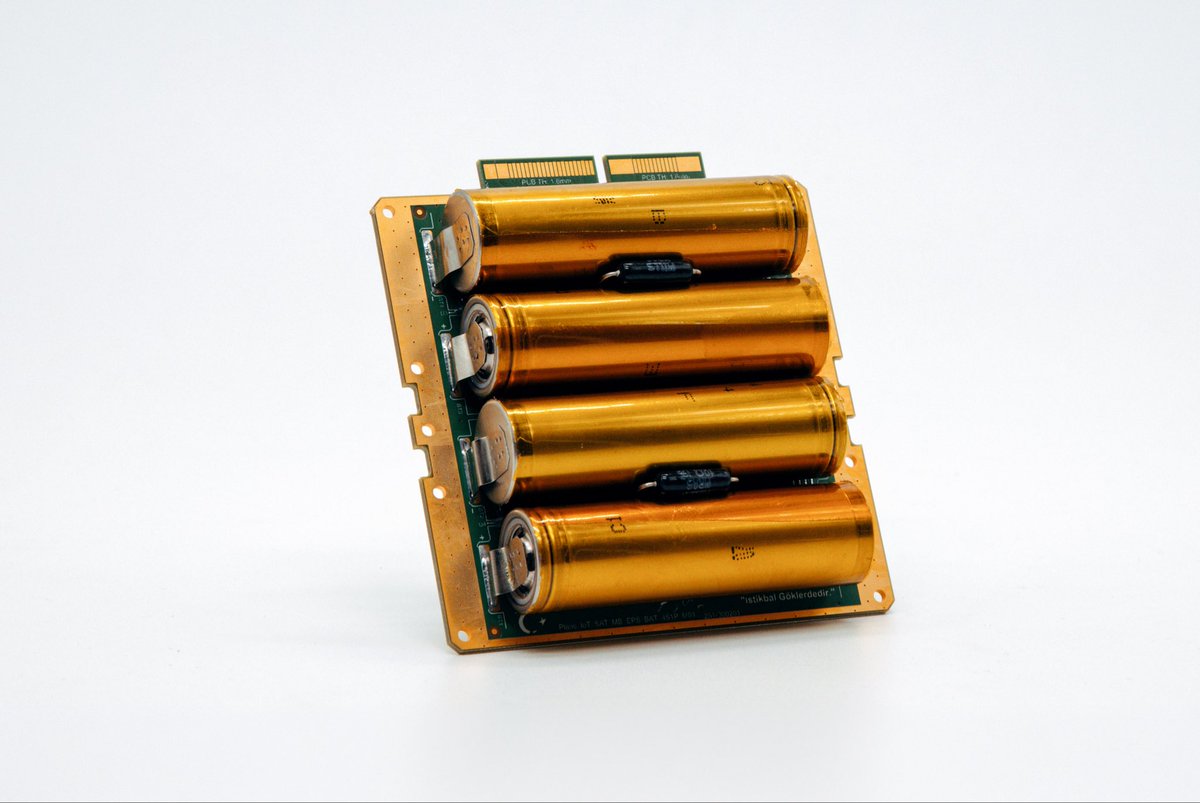
Engineered power architecture for mission-specific satellite platforms. At Plan-S, satellite battery packs are designed and configured in-house according to each platform’s power budget, mission profile, subsystem load requirements and operational constraints.
By defining the battery pack architecture internally, our engineering teams can adapt cell configuration, capacity, voltage levels and redundancy approach based on the specific needs of the spacecraft. This enables a more optimized power storage and distribution strategy across different satellite classes and mission scenarios.
Plan-S also implements an in-house battery integration technique that supports fault-tolerant operation at pack level. In the event that one or more cells become inactive or stop contributing to power delivery, the battery pack architecture allows the affected cells to be electrically bypassed, while the remaining cells continue to support the satellite’s power system. This approach helps improve power system resilience, reduce single-point failure risks and maintain operational continuity during the mission.
From satellite platform architecture to subsystem-level power design, Plan-S develops critical engineering capabilities under one roof, enabling modular, reliable and mission-adaptable satellite solutions. To learn more about Plan-S Space Services, contact us at [email protected]
#WeArePlanS #PlanS #SpaceTechnology #SatelliteTechnology #NewSpace #SatelliteEngineering #PowerSystems #BatteryPack #SatellitePower #SpaceSystems #InHouseEngineering #SatelliteManufacturing
From satellite manufacturing to mission operations, Plan-S builds control into every layer of the mission.
Our in-house satellite production capability is only one part of our end-to-end space systems approach. On the ground segment side, the command, control and mission management software that supports satellite operations is also developed by our teams.
This means Plan-S does not only design, manufacture and integrate satellites in-house. It also manages the critical processes required to operate them, from pass planning and telemetry monitoring to telecommand execution, mission workflows and coordination across satellites and ground stations.
By bringing space segment development and ground segment operations together under one roof, Plan-S strengthens operational agility, system-level visibility and long-term mission reliability.
Explore our Ground Segment Software: https://t.co/a1qZgSuEcP
#WeArePlanS #PlanS #SpaceTechnology #SatelliteTechnology #GroundSegment #MissionControl #CommandAndControl #SatelliteOperations #NewSpace
From design to flight-ready satellites, under one roof.
At Plan-S, satellite development is not only about engineering ideas. It is about transforming those ideas into reliable, space ready systems through controlled, qualified and scalable production processes.
With our in-house production capability, we bring together satellite design, subsystem development, assembly, integration and testing within a single operational framework. This integrated approach enables greater agility, tighter quality control and faster execution across different mission requirements.
Our cleanroom infrastructure plays a critical role in this process, providing the controlled environment required for sensitive satellite assembly and integration activities. Across smallsat class platforms, every stage is supported by the precision, discipline and operational standards needed for space missions.
By combining engineering know-how with in-house manufacturing and cleanroom-based integration capabilities, Plan-S strengthens its ability to deliver modular, flexible and scalable satellite solutions for the New Space era. Explore Plan-S’ end-to-end satellite development and space services capabilities: https://t.co/cvo6D4oZXS
#WeArePlanS #PlanS #SpaceTechnology #SatelliteTechnology #NewSpace #SatelliteManufacturing #SpaceSystems
Compact platforms. Flexible missions. Faster access to orbit.
Plan-S CubeCore satellite platforms are designed to support CubeSat-class missions with a modular, scalable and mission-oriented architecture.
Built for flexibility, the CubeCore family enables different payload, power, communication and mission configuration needs within a compact satellite platform structure. From technology demonstration and IoT missions to Earth observation and in-orbit validation, CubeCore platforms provide an agile foundation for small satellite missions.
With in-house capabilities covering spacecraft design, manufacturing, integration, testing, launch coordination and satellite operations, Plan-S delivers CubeCore platforms as part of an end-to-end space services approach.
Engineered to adapt to mission requirements, CubeCore platforms help reduce development complexity while enabling a faster and more efficient path to orbit.
To learn more about CubeCore, contact us at [email protected]
#WeArePlanS #PlanS #SpaceTechnology #SatelliteTechnology #CubeSat #SmallSat #SatellitePlatforms #SpacecraftPlatforms #NewSpace #SpaceEngineering #SpaceServices #MissionDesign
Built for missions that require more capacity, more flexibility and more control.
Plan-S MicroCore satellite platforms are designed to support a wide range of small satellite missions with scalable architecture, modular configuration options and in-house engineering capability.
From payload accommodation and power management to avionics, ADCS, communications and mission operations, MicroCore platforms bring together the core building blocks required for reliable and efficient satellite missions.
Developed to adapt to different mission lifetimes, redundancy needs and operational requirements, the MicroCore family enables faster development cycles, flexible payload integration and a more agile path to orbit.
With end-to-end capabilities covering spacecraft design, manufacturing, integration, launch coordination and satellite operations, Plan-S delivers MicroCore platforms as part of a complete space services approach.
Because every mission needs a platform built around its own goals. To learn more about MicroCore, contact us at [email protected]
#WeArePlanS #PlanS #SpaceTechnology #SatelliteTechnology #SmallSat #SatellitePlatforms #SpacecraftPlatforms #NewSpace #SpaceEngineering #MissionDesign #SpaceServices
Quick detumbling. Quick wheel unloading. Compact integration.
Meet Plan-S Magnetic Torque Rod-0.8, PS-MTQ-0.8, a compact magnetic torque rod designed to support efficient attitude control for CubeSat missions and power-constrained spacecraft platforms.
With its integrated driver and digital interface, it eliminates the need for a separate driver card or digital-to-analog converter, helping reduce external electronics, harness complexity, board-level integration effort, and system-level design risk.
Proven in orbit with heritage on 9 satellites and a collective operation time of more than 8,000 days, PS-MTQ-0.8 reflects Plan-S’ in-house capability in reliable, compact, and mission-ready ADCS subsystem technologies.
Because efficient attitude control starts with smart, space-proven integration. Discover how PS-MTQ-0.8 supports reliable magnetic actuation for CubeSat missions: https://t.co/g3nYvKCuBS
#WeArePlanS #PlanS #SpaceTechnology #SatelliteTechnology #MagneticTorqueRod #Magnetorquer #ADCS #CubeSat #SmallSat #SatelliteSubsystems #NewSpace #SpaceEngineering
Quick detumbling. Reliable wheel unloading. Simplified integration.
Meet Plan-S Magnetic Torque Rod-4.0, PS-MTQ-4.0, a high-performance magnetic torque rod designed for microsatellite missions requiring efficient attitude stabilization after deployment and reliable reaction wheel unloading throughout mission operations.
Delivering 4 A·m² magnetic moment from a compact, driver-integrated architecture, PS-MTQ-4.0 helps reduce the need for additional driver electronics while supporting simpler and more efficient ADCS integration.
Engineered for microsatellite-class platforms, PS-MTQ-4.0 enables fast detumbling with low power consumption and provides the magnetic performance needed to support stable, mission-ready satellite operations. Fully qualified and developed in line with environmental verification requirements, PS-MTQ-4.0 reflects Plan-S’ growing in-house capability in satellite subsystems and ADCS technologies.
Because stable missions start with controlled motion. Explore how PS-MTQ-4.0 simplifies ADCS integration for microsatellite missions: https://t.co/g3nYvKCuBS
#WeArePlanS #PlanS #SpaceTechnology #SatelliteTechnology #MagneticTorqueRod #Magnetorquer #ADCS #SatelliteSubsystems #Microsatellite #NewSpace #SpaceEngineering
Scalable avionics. Modular production. Faster access to orbit.
At Plan-S, satellite manufacturing is built around an in-house scalable avionics architecture designed to support modular, flexible and scalable satellite platforms.
This approach enables our engineering teams to adapt satellite configurations to different mission requirements while maintaining a high level of design consistency, production efficiency and system reliability.
By standardizing core avionics building blocks and integrating them into a modular satellite production framework, Plan-S strengthens its ability to move with agility, reduce development complexity and support faster launch timelines.
This architecture also plays a key role in enabling low-cost, repeatable and scalable satellite manufacturing, supporting the transition from individual satellite production to mass production capabilities.
For Plan-S, scalable avionics is more than a technical architecture. It is a foundation for building satellites faster, smarter and at scale.
#WeArePlanS #PlanS #SpaceTechnology #SatelliteTechnology #SatelliteManufacturing #Avionics #NewSpace #SpaceEngineering #SpaceServices
Powering satellites starts with in-house capability. At Plan-S, solar panel integration is carried out in-house as part of our end-to-end satellite production capabilities.
Designed and integrated to support both CubeSat and microsatellite platforms, our solar panels are developed with the flexibility to meet different mission requirements, platform sizes and power needs.
With flight heritage gained through Plan-S missions, this production capability reflects our growing expertise in satellite subsystems and our commitment to building reliable, mission-ready technologies under one roof.
From design and manufacturing to integration and testing, Plan-S continues to strengthen its vertically integrated approach to space technology. Mission success depends on power systems designed, integrated and proven for space.
#WeArePlanS #PlanS #SpaceTechnology #SatelliteTechnology #SolarPanels #SatelliteSubsystems #CubeSat #Microsatellite #NewSpace #SpaceEngineering #InHouseProduction
Every mission comes with its own lifetime, performance and resilience requirements.
That is why satellite systems need more than proven technology. They need the right design heritage, component strategy and qualification pathway for the mission they are built to serve.
At Plan-S, flight-proven design heritage is adapted to each mission’s specific needs, from mission lifetime and redundancy expectations to performance targets and operational constraints.
Our engineering approach combines flexible component strategies, including New Space III, Rad-Tol and Rad-Hard options, with tailored qualification pathways such as thermal, vibration, EMI/EMC, proton and TID testing.
The result is a mission-fit solution aligned with cost, availability, resilience and operational performance requirements. Discover Plan-S spacecraft platforms and explore how mission-specific solutions are built for different operational needs: https://t.co/2JUd4Oltas
#WeArePlanS #PlanS #SpaceTechnology #SatelliteTechnology #SpaceEngineering #NewSpace #MissionDesign #SatelliteSystems
Every satellite mission depends on a reliable communication backbone. Plan-S Communications portfolio brings together a range of RF and communication products designed to support different mission needs, from high-speed data transmission to TT&C, antenna systems and flexible radio architectures.
Designed for integration flexibility and mission reliability, these products support satellite platforms with the communication performance needed across uplink, downlink, and in-orbit operations.
By combining in-house engineering expertise with flight-proven space technologies, Plan-S continues to deliver communication systems that help turn satellite missions into operational capabilities. Explore our Communications portfolio: https://t.co/VdJnf4xQ3C
#WeArePlanS #PlanS #SpaceTechnology #SatelliteTechnology #SpaceServices #SatelliteCommunications #NewSpace #SatelliteSubsystems
With its end-to-end Space Services capabilities, Plan-S supports organizations across every critical stage of a satellite mission, including spacecraft design, satellite manufacturing, launch and commissioning services, satellite operations, and capacity building.
This integrated approach enables customers to move from idea to orbit with greater efficiency, technical confidence, and operational continuity. By combining engineering expertise, in-house manufacturing capabilities, flight-proven experience, and hands-on operational know-how, Plan-S delivers comprehensive solutions tailored to diverse mission needs.
From designing reliable spacecraft platforms to managing launch processes, commissioning satellites in orbit, operating missions, and transferring know-how through capacity building programs, Plan-S helps transform space ambitions into sustainable operational capabilities.
Because building a satellite mission requires more than technology. It requires an integrated partner that can support every step of the journey. To learn more about Plan-S Space Services, contact us at [email protected]
#WeArePlanS #PlanS #SpaceServices #SpaceTechnology #SatelliteTechnology #SatelliteManufacturing #SpacecraftDesign #SatelliteOperations #NewSpace #SpaceEngineering
A smarter delivery model for a faster path to orbit. At Plan-S, we combine flight-proven spacecraft platforms with fully integrated in-house execution to help satellite missions move from payload integration to launch readiness faster and with less complexity.
Our delivery model brings design, manufacturing, testing, payload integration, launch coordination, and mission operations under one coordinated structure, supporting greater schedule predictability and smoother execution.
For eligible missions, electrical payload integration can begin within 2–3 months, flight model assembly can be completed in 6–8 months, and the full mission flow through Flight Readiness Review can be achieved in as little as 10–12 months.
Because reaching orbit faster starts with an integrated approach. Discover more about Plan-S spacecraft platforms and space services. https://t.co/2JUd4Oltas
#WeArePlanS #PlanS #SpaceServices #SpacecraftPlatforms #SatelliteTechnology #NewSpace #SpaceTechnology
When missions demand more capacity, more power, and more performance, spacecraft platforms need to go beyond standard configurations.
MicroCore & MiniCore are designed to support advanced satellite missions by providing the payload capacity and available power required for more demanding applications, from Earth observation and RF signal intelligence.
With a spacecraft class of up to 300 kg, up to 150 kg payload capacity, and up to 3 kW available power, the MicroCore & MiniCore platform range enables organizations to integrate more capable payloads, support higher data needs, and address complex mission requirements with greater flexibility.
While MicroCore offers a dependable path for advanced microsatellite missions, MiniCore is being developed for higher-performance applications, including SAR, ultra high resolution imaging and high capacity communications.
By combining platform engineering, payload integration, launch coordination, and operations under a single structure, Plan-S helps turn ambitious mission concepts into operational space capabilities.
Explore how MicroCore & MiniCore platforms can support your next generation satellite mission:
https://t.co/2JUd4Oltas
#PlanS #SpaceServices #MicroCore #MiniCore #SatelliteTechnology #SpacecraftPlatforms #SmallSat #NewSpace #SpaceTechnology
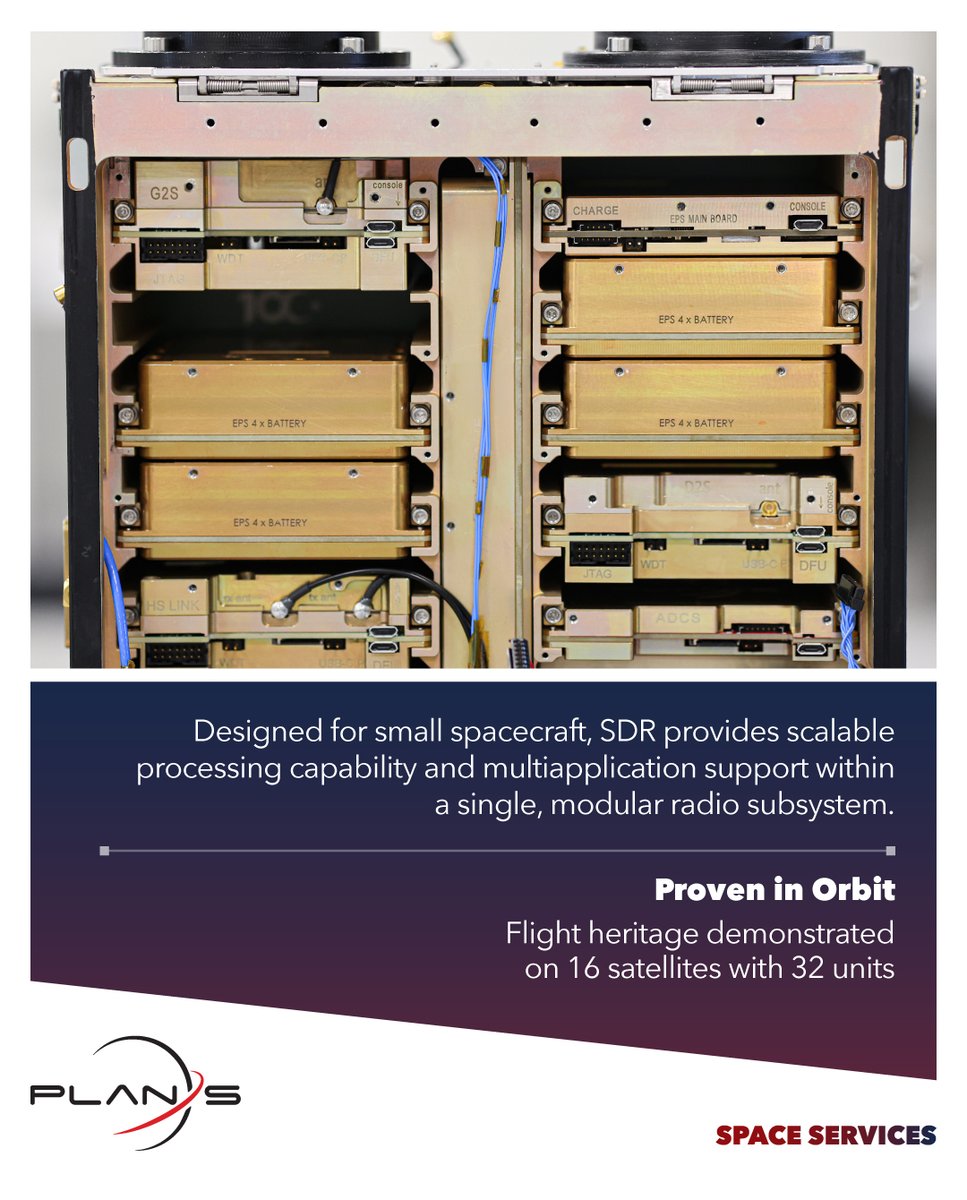
Flexible satellite communication starts with a radio system that can adapt to mission needs in orbit.
Meet Software Defined Radio, a compact, high-performance radio platform designed for small spacecraft, single-satellite missions, and constellation deployments.
Built on space heritage gained through multiple flight-qualified missions, SDR combines a proven hardware design, low-power digital signal processing and robust waveform support to help ensure stable operation during rapid orbital passes.
From flexible RF frontend options to fail-safe in-orbit software update capability, SDR is engineered to support reliable, adaptable, and future-ready satellite communication.
Because in space, flexibility is not just an advantage. It is a mission enabler. Learn how SDR supports reliable and adaptable satellite communication for today’s small spacecraft missions: https://t.co/fXsgKoYgNb
#WeArePlanS #PlanS #SpaceTechnology #SatelliteTechnology #SoftwareDefinedRadio #SDR #SatelliteCommunication #SmallSat #NewSpace #SpaceEngineering #SatelliteSubsystems