MAIN RULES EVERY TRADER SHOULD FOLLOW
PART 2
A trader's ability to succeed in the constantly changing world of financial markets depends not only on their ability to analyze markets, but also on their ability to follow a core set of principles.
A Thread 🧵
Most blockchains are decentralized and secure, but once you push them into real-time use, the cracks start to show: high fees, slow confirmations, and networks that struggle under load. That’s where @magicblock clicked for me.
Instead of adding more complexity, it focuses on
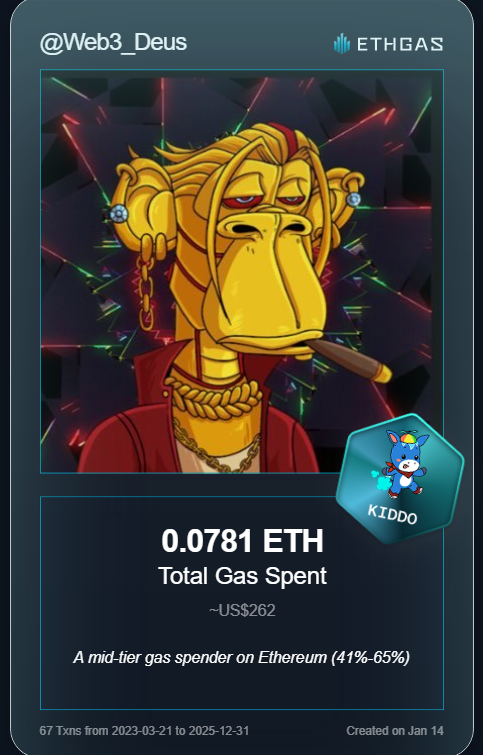
Leveled up in the Great Gas Reckoning with ETHGas! 💪
Kiddo Jack status: 0.0781 ETH gas spent, 25 Beans earned—supporting the Gasless Future!
Claim your Gas ID at https://t.co/sNUCxylgGC
After going through @codexfx's doc and seeing the convenience & simplicity they bring to ramping btw crypto and fiat, I thought many people needed to know about it.
So I used this cartoon interaction to explain it like I was chatting with a 5 year old.
Enjoy 👌
#CodexCartoon
Big news: Cambrian just secured $5.9M in seed funding led by @a16zcrypto's CSX accelerator, with participation from @theBBFund.
Today’s AI agents operate at just a fraction of what’s possible. One of their biggest hurdles? Actionable intelligence.
Cambrian's mission is to provide agents with hyperaware financial intelligence for radically smarter decision-making. In essence: We want to enable financial agents that win. Agents that leverage predictive market forecasting, powered by real-time knowledge of both the onchain and offchain world.
Agents with capabilities that exceed human limitations.
Accelerate 🪴
🌟 Meet the Comfy Circle! @inconetwork
A community bound by comfort and creativity. Dive into our world and join the journey.
🔗 Discord: https://t.co/nTHkZxrJ3v
pivot to @vooi_io
Vooi is building a future where you don't have to hop chains, bridge assets, or manually compare rates. truly a seamless, gas-efficient, cross-chain experience
the one-stop shop to swap stablecoins and aggregate liquidity across networks with minimal slippage
With the way this space is moving, in the next 3-5 years some of the hottest usecases of the prevailing times will be very much redundant.
Something like bridges must have been fully forgotten by then.
Why say so?
Projects like @anoma and @SOCKETProtocol are building things that totally exterminate the purpose in bridges.
There's so much fun time ahead, man.
In my last thread about @inconetwork, we explored Why On-Chain Confidentiality Matters. Today, let’s go deeper into 👇
Who’s being left out because of the lack of confidentiality?
What industries can’t fully move on-chain without it?
Let’s break it down 🧵
Who Gets Left Out?
Because public chains expose all data, who remains excluded?
- Ordinary users: People who care about privacy (think salary or medical payments) won’t want their entire history on-chain. It’s a fundamental right to keep finances and personal data confidential.
- Enterprises and banks: Companies handle sensitive customer info, intellectual property, and compliance rules. They cannot build practical solutions on public blockchains under these conditions. As one summary put it, the lack of privacy leads to “Limited Enterprise Adoption”. Businesses won’t put secret financial operations or corporate strategies on a fully transparent ledger.
- DeFi traders and funds: In today’s DeFi, large orders broadcast to all can be front-run or copied. Without privacy, traders face MEV (miner extractable value) attacks and everyone can infer strategies from on-chain data.
- Gamers: Any game needing hidden info (cards, secret moves, random roll) breaks on a transparent chain. For example, on-chain poker is currently impossible because everyone would know all the cards.
- Governments and organizations: Voting or identity systems require confidential ballots or private credentials. Exposing every vote or social security-like record on-chain simply won’t work.
In summary, retail users, institutions, and entire industries are underserved or shut out by today’s fully public blockchain model. This “missing layer” of privacy has become a bottleneck for Web3’s growth.
In next thread, I will discuss on how confidential computing works and Inco’s solution. Stay tuned
One thing I like about the @PlasmaFDN DeFi ecosystem is that it's not trying to reinvent the wheel like every other blockchain that wants their own native lending protocols, liquid staking protocols, Dexes, etc.
Rather, it takes already existing protocols and strategies, and optimizes them to suit its broader purpose.
By collaborating with top projects that have grown their user base, and reputation overtime, they get to tap into these protocols user base and gain some authenticity in people's eyes; instead of starting from the beginning to build everything from scratch.
Smart move from the ecosystem, product, and DeFi team 🫡
The Internet wasn’t ready for e-commerce until SSL made it private. Blockchains won’t hit mainstream until they get their own SSL — on-chain confidentiality. That’s what @inconetwork is building.
Today, let’s dive into: Motivation and Need for On-Chain Confidentiality 🧵👇
Why On-Chain Confidentiality Matters?
Public blockchains like Bitcoin and Ethereum are lauded for their transparency – every transaction and smart contract is visible to all. This openness builds trust and security, but it also limits real-world use cases. Very few people want their entire financial history, voting record, or even a poker hand broadcast to the world. As Inco’s team notes, making an account balance fully public compromises an individual’s right to privacy and security. In other words, if every dollar you spent or game you played was on a public ledger, many everyday activities (like voting, paying salary or playing hidden-information games) wouldn’t be practical.
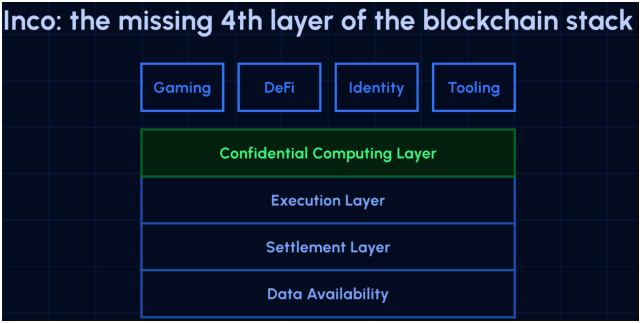
@inconetwork is often described as adding a Confidential Computing layer atop the blockchain stack. The diagram below illustrates this idea: confidentiality (green) sits above execution, settlement and data-availability layers. Inco’s goal is to let smart contracts run with encrypted data, unlocking new dApps in gaming, finance, identity and beyond. Without privacy, sensitive data is exposed. Individuals lose financial privacy, businesses can’t protect trade secrets, and entire sectors (like finance and gaming) can’t move on-chain. Crypto-media point out that “mainstream institutions are deterred from joining DeFi” because everything is transparent.
Inco founder Remi Gai quips that blockchain needs an SSL-equivalent not for anonymity, but to encrypt valuable information as it’s processed. In short, without confidentiality, big parts of Web2 simply don’t translate to Web3.
So far, we’ve seen why transparency alone isn’t enough for Web3. But here’s the real question
👉 Who’s being left out because of this?
👉 What industries can’t move on-chain without privacy?
That’s what we’ll explore in the next part of this thread. Stay tuned 🚀