$1M+ trading volume in just 7 days.
And that’s from just 40 active traders executing 16K+ trades while @ekidenfi is still in closed Mainnet.
Early demand is already showing.
The real question: what happens when the gates open?
Get in early with my referral: https://t.co/NxcwwlY8rO
7 days of @ekidenfi Mainnet.
And the first week is already telling a story.
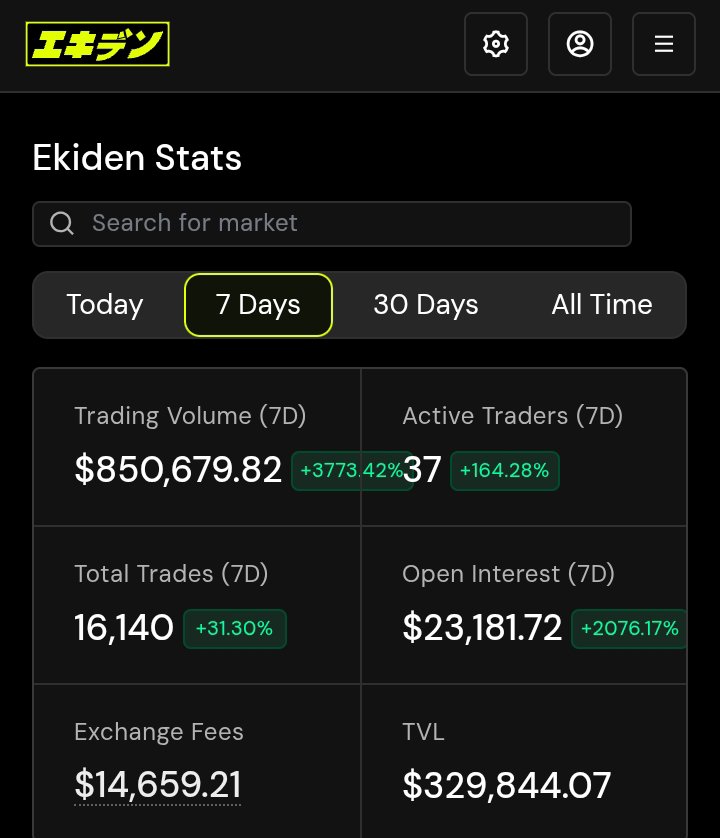
📊 $850,679.82 7D volume
⚡ 16,140 trades executed
👥 37 active traders
💰 $329,844.07 TVL
💸 $14,659.21 fees generated
All of this while Mainnet is still in controlled access.
No wide-open onboarding. No farming incentives driving activity. Just traders putting the product through its paces.
Ekiden is bringing a CLOB-based perpetuals exchange to @CantonNetwork, combining orderbook trading with Canton’s privacy-focused infrastructure.
Week 1: $850K+ volume. 16K+ trades.
The market is only getting started.
Imagine these numbers when the gates fully open.
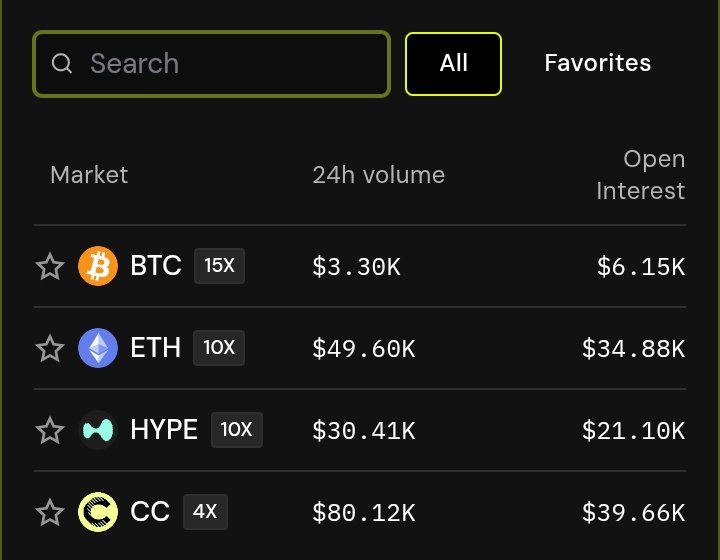
$CC is setting the pace on @ekidenfi , leading the 24H volume leaderboard as activity picks up.
Here’s how the top perpetual markets are performing:
🥇 $CC — $80.12K volume | 4x max
🥈 $ETH — $49.60K volume | 10x max
🥉 $HYPE — $30.41K volume | 10x max
4️⃣ $BTC — $3.30K volume | 15x max
$CC is currently leading the board by a clear margin, while $ETH and $HYPE are also seeing strong activity.
Still early days for Ekiden Mainnet, but the trading activity is already starting to build.
Which perp are you watching?
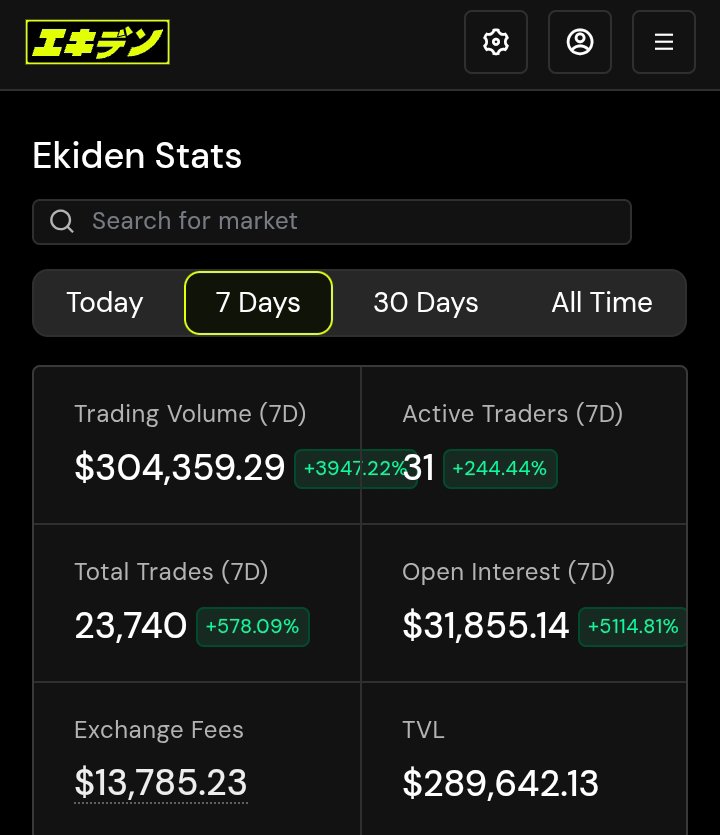
5 days into @ekidenfi Mainnet and the numbers are already starting to speak.
📊 $304K Volume
👥 31 active traders
🔁 23,740 total trades
📈 $31,855 open interest
💰 $13,785 in exchange fees generated
🔒 $289,642 TVL
No marketing push.
No farming incentives.
Still closed access.
Just traders testing the product and liquidity forming organically.
And remember: this is CLOB-based derivatives infrastructure on Canton.
When access opens wider, these numbers should get interesting.
Early days. Ekiden is just getting started.
Really appreciate this mention by @CantonArmy. 🙏
Being recognized alongside people who are actively building, contributing, and pushing the @CantonNetwork ecosystem forward means a lot.
I’m grateful for the opportunity to contribute, learn, and grow with this community.
Still early. Still building. 🟡
Thank you for the recognition. 🤝
Just received my Ekiden Mainnet access code.
After months of testing and trading on Testnet, it feels good to finally step into Mainnet.
Now the real test begins.
I'm glad for being among the first 100 traders to use the product on mainnet after making the top 100 testnet traders.
Time to put the CLOB engine through its paces, explore the derivatives experience on @CantonNetwork , and see what @ekidenfi has been building all this time.
Mainnet unlocked.
Let’s trade.
GM ☀️
A new day, a new opportunity to move forward in Web3.
You don't need to know everything.
You just need to keep learning.
Read that thread.
Study that protocol.
Join that community.
Ask questions.
Share what you learn.
Small progress every day compounds.
Keep building. Keep learning. Keep showing up.
Have a productive day! ☕️
One of the more interesting parts of Retium is its approach to validators.
@RetiumChain doesn't treat every validator as an interchangeable node responsible for the entire transaction lifecycle.
Instead, it uses a role-based validator framework that separates responsibilities across the network.
A transaction can move through distinct stages:
→ Validation
→ Staging
→ Execution
→ Finalization
Each stage can be handled by specialized roles rather than concentrating every responsibility in the same validator set.
Why does this matter?
Because separating duties can reduce power concentration, distribute workload, improve redundancy, and make each decision easier to verify.
The bigger idea is simple:
Don't make every validator do everything. Give each role a defined responsibility, then connect those roles through deterministic logic.
That's the foundation of Retium's validator mesh.
#Retium #RTM #Blockchain #Web3
What I find interesting about the Worker role is that it's not a watered down version of validation. It's the most accessible part of the validator architecture.
Workers independently check transactions before they reach finality, while the heavier roles handle block coordination and finality.
That separation is important. @RetiumChain isn't making participation easier by making the work meaningless. It is making a real part of network validation lighter and more accessible.
To me, that's a much more interesting approach to decentralization than simply counting how many nodes exist.
#Retium #RTM
🎓 Canton Academy | Lesson 9
How Does Canton Achieve Consensus Without Sharing Everything?
One of the biggest differences between @CantonNetwork and traditional blockchains is how consensus is achieved.
On most public blockchains, everyone can see the same transaction data.
Because everyone sees the same information, everyone can independently verify it.
Canton takes a different approach.
Transactions remain private and are only visible to authorized parties.
So the question becomes:
«If everyone can't see the same data, how can everyone agree on the outcome?»
The answer is consensus through coordination, not exposure.
What is Consensus?
Consensus simply means:
«Reaching agreement on the outcome of a transaction.»
The challenge is doing this while preserving privacy.
---
In Canton, the network doesn't need access to every contract detail, business agreement, or transaction record.
Instead, the network only needs enough information to ensure:
✅ The transaction is valid.
✅ The rules were followed.
✅ The ordering is correct.
✅ The asset cannot be spent twice.
This is where Synchronizers and the Global Synchronizer play a critical role.
They help coordinate and order transactions so that all relevant parties reach the same outcome, without exposing sensitive information to the entire network.
---
Public Blockchain vs Canton
🌍 Public Blockchain
Everyone sees everything.
➡️ Consensus through shared visibility.
🔒 Canton
Only authorized parties see transaction details.
➡️ Consensus through coordinated agreement.
«Canton achieves consensus without requiring every participant to see every piece of data.»
This is one of the innovations that makes Canton suitable for financial institutions, where privacy is just as important as trust.
For more? Follow @am_BinHamzat, The guy who makes Canton Network easy to understand.
GN CT.
The markets never sleep, but you should.
Charts can wait.
Notifications can wait.
The next opportunity will still be there tomorrow.
Get some rest, clear your mind, and come back ready to build, learn, and grow.
See you on-chain tomorrow.
🎓 Canton Academy | Lesson 8
Visibility: Who Can See What on Canton?
One of the biggest misconceptions about blockchain is that everyone can see everything.
That's true for many public blockchains. It's not true for @CantonNetwork.
What is Visibility?
On Canton network, Visibility means determines which parties are allowed to see specific contracts, transactions, and data on the network.
In Canton, access to information is granted on a need-to-know basis. This means that being connected to the network does not automatically give you access to every piece of data. Only authorized parties can view the information relevant to them.
Why Does Visibility Matter?
Assume:
🏦 Zenith Bank enters into an agreement with 🏦 Access Bank.
The transaction may contain:
>Contract terms
>Asset details
>Settlement instructions
>Commercial information
Should every institution on the network have access to those details? No.
Only the parties involved in the transaction, and any explicitly authorized participants, should be able to view that information.
Visibility vs Privacy. These two concepts are closely related but not the same.
🔒 Privacy protects information from unauthorized parties.
👀 Visibility determines who is authorized to access that information.
In simple terms: Privacy is the objective. Visibility defines the access rules.
Why This Is Important for Financial Institutions?
Banks, asset managers, and financial institutions handle sensitive information every day. They need to collaborate and transact with other organizations.
At the same time, they must protect customer data, business agreements, and market-sensitive information.
Canton allows organizations to coordinate and transact while maintaining controlled visibility over their data.
Being on the Canton Network does not automatically give you access to transaction data.
Information is shared only with the parties that are authorized to see it. That's how Canton enables collaboration without sacrificing confidentiality.
The guy who makes Canton Network easy to understand.