Jev has been exploding in popularity recently.
If you already have access to the Jev API but aren’t sure how to start experimenting with it, just copy this checklist:
1. agent-desktop
Desktop automation. Read the system's accessibility tree, judge which button, menu, or input field to click next. https://t.co/ZtSEjUSPBF
2. typesafe-mario
Have Jev play Super Mario. No screenshots—just read the structured state in the emulator's RAM, then decide to run, jump, or dodge. https://t.co/GHttIjWQ3p
3. jev-drone
Use Jev to control a drone. The underlying flight control still handles stability and safety; Jev just does higher-level judgments like climbing, braking, and navigating obstacles. https://t.co/z0lYh9ykJq
4. OneVOneJev
1v1 FPS in the browser. Every decision tick, judge movement, view angle, aiming, firing, and jumping. https://t.co/aJiU0aaNcI
5. jev-trader
High-frequency market making on Monad testnet. Jev judges the next buy or sell based on spreads and trade direction, with model latency around 81ms. https://t.co/DaDRIrkJpO
6. Prism
Doesn't directly have Jev place orders. It judges states like toxic flow, market pressure, mean reversion, etc., then hands off to the original strategy. https://t.co/aim9lGRAP8
7. neo4jev
Stuff Jev into a knowledge graph. At each node, judge the most worthwhile edge to take next, then follow it all the way. https://t.co/9h0KXKdWj9
8. jev-curate
Use Jev to screen training data. For JSONL / Parquet, first judge quality, relevance, and risk, then decide which ones go into the next training round. https://t.co/yYV6aEdUtG
9. Canny
Prevents Coding Agents from stubbornly claiming they're done. Look at tool outputs, code diffs, and test results, then judge if the completion claim is reliable. https://t.co/H4jFT8hV0E
10. killmyidea
Input a startup idea, and Jev scores it from multiple angles, finally giving you KILL, FIX, or SHIP. https://t.co/XWo7JPOb6y
Copy these complete Jev blueprints - then read full Jev setup below ↓ ↓
THIS IS WHAT IT LOOKS LIKE WHEN A DEAD FLY'S NERVOUS SYSTEM GETS A NEW BODY.
Not a brain-inspired AI. Not living neurons in a jar. A digital reconstruction of the actual wiring diagram biology built.
Scientists mapped the complete brain and central nervous system of an adult male fruit fly: 166,700 neurons, 124.2 million synapses and 11,710 cell types, including the circuits connecting vision to movement.
That map can be turned into a control loop.
Camera pixels become sensory input. Activity is approximated across the reconstructed network. Motor neurons are read as output, and software translates that output into a turn, a step or a button press.
The machine supplies the camera, motors and metal limbs. The fly supplies the architecture that decides how signals can move between them.
This video is a concept visual of that loop. It does not claim this specific robot is already controlled by the fly connectome.
The fly never came back to life. It has no memory, awareness or body left to return to.
But the wiring that once controlled six tiny legs is now detailed enough for developers to connect it to Doom, Mario, Beat Saber - and eventually bodies biology never designed it to inhabit.
I broke down how a dead nervous system became software below ↓
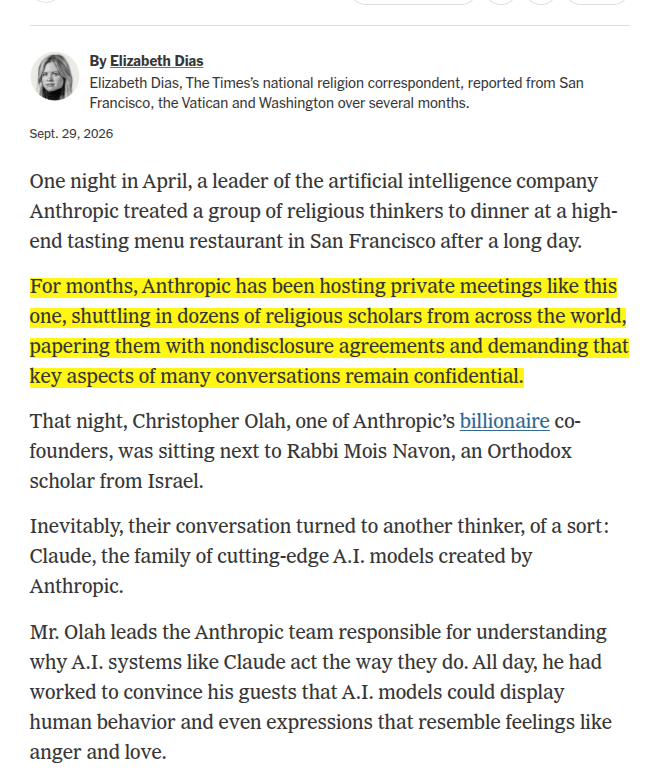
The New York Times published a piece saying that Anthropic has been quietly bringing in Catholic, Jewish, Sikh, evangelical, and other religious thinkers from around the world to help give its AI a moral compass.
Tavus gave me early access to Griffin, and I spent 5 minutes making up a story with it about two kindergarten friends and a plate of eggs.
It set the scene on its own: a hole-in-the-wall diner, a corner booth, two friends too busy gossiping to touch their food. Every idea I threw in, it folded into the story.
Then I started a real one, about my best friend and me running from a guy who followed us all evening. Halfway through my sentence it cut in: "Wait, wait, wait. You're escaping from a boy?"
Griffin watches and listens while it talks, so it can interrupt you the way a friend would. Tavus says it's the first model to pass the Turing test: 45% of 120 people in their study thought it was real.
@tavus@hassaanraza
https://t.co/8ruaJzhAGx
Announcing 𝙾𝚙𝚎𝚗𝙳𝚘𝚝𝚜
An open source OpenAI Dots that's self-hostable and works with any agent harness.
Available on Mobile and Web!
Clone it.
Build on top of it.
Repo → https://t.co/G5uHGZ4o3O
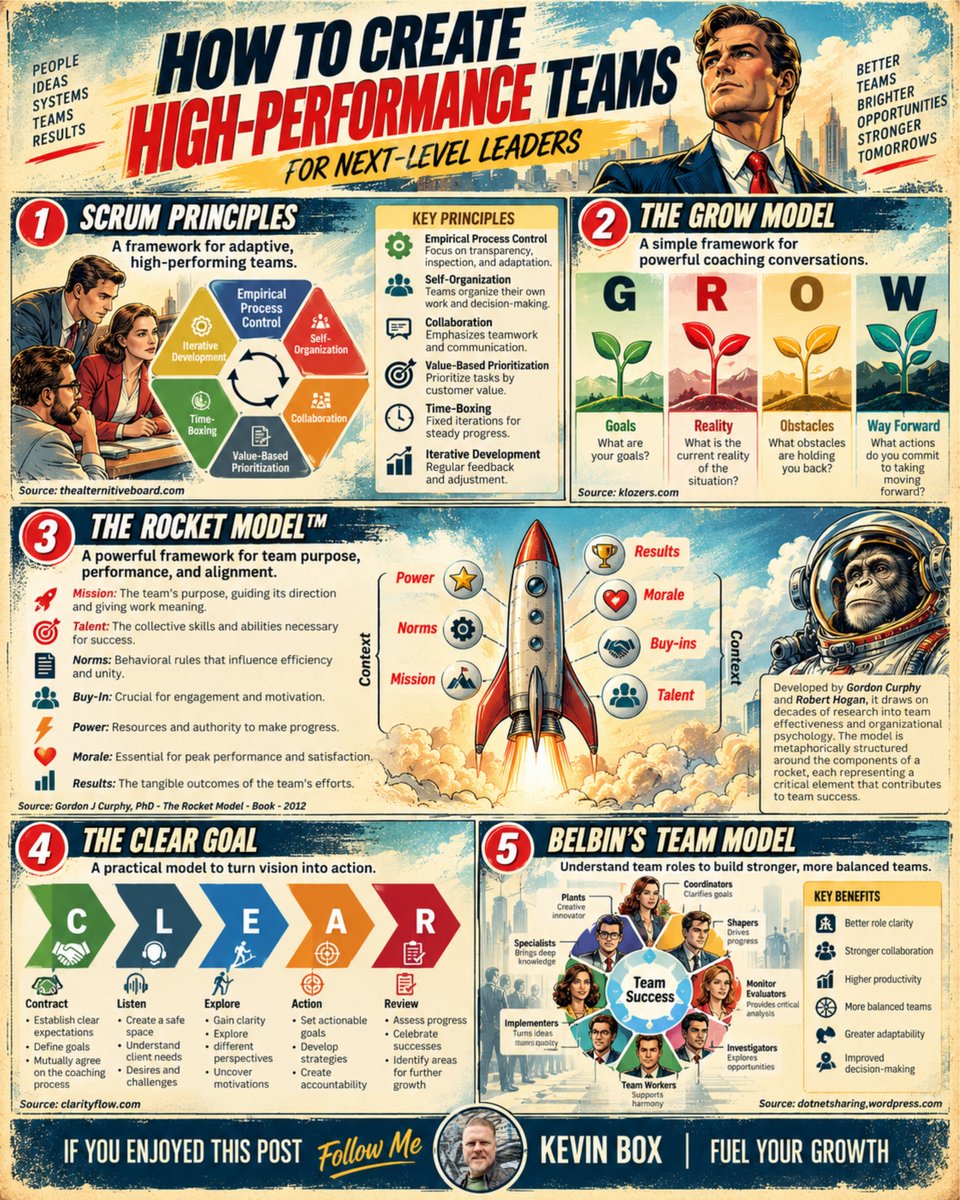
High-performance teams aren't built by accident.
They are built with clear systems.
5 frameworks every leader should understand:
1/ Scrum Principles
Adapt fast. Prioritize value. Improve constantly.
2/ The GROW Model
Coach people through goals, reality, obstacles, and next steps.
3/ The Rocket Model
Align mission, talent, norms, buy-in, power, morale, and results.
4/ The CLEAR Goal
Turn vision into action with clarity and accountability.
5/ Belbin’s Team Model
Know the roles your team needs, not just the titles people hold.
Better teams come from better leadership.
Which model have you seen work best?
When you can't out-brand or out-pay the big guys, stop competing on their terms: hire for potential over proof, for roles that have no precedent, and start with one talent magnet who drags the rest of the team in behind them.
Anthropic wants to decide who gets to defend the internet.
Yesterday Anthropic's red team published a report on GLM-5.3, the open-weight model from Chinese lab https://t.co/ID5vSkKcjr. The findings are serious.
In Anthropic's exploit test, GLM-5.3 succeeded 12% of the time, close to the 14% scored by Claude Mythos, the model Anthropic keeps restricted. Given a simple cover story, GLM-5.3 helped with harmful requests 64% of the time. Anthropic expects attackers to use it to build exploits.
Today https://t.co/ID5vSkKcjr shared what it's doing with the same model. Its free service, OpenVuln, has scanned 389 open-source projects and flagged 4,249 potential security holes. Each finding goes privately to the people who maintain the code.
A model that can find a hole can also exploit one. The question that matters is who gets to use it.
Anthropic gave Mythos to a hand-picked group of defenders, and they found over 10,000 vulnerabilities. The volunteer keeping a library alive that half the internet depends on had no way into that group.
An open model reaches attackers, and it also reaches every maintainer, researcher and small security team that was never on the list.
Locking the best tools away buys a few months at most. By Anthropic's own estimate, GLM-5.3 arrived about four months behind the frontier. Restriction only decides which defenders get a head start, and right now a company picks them.
I'd rather every maintainer on the internet had the shield.
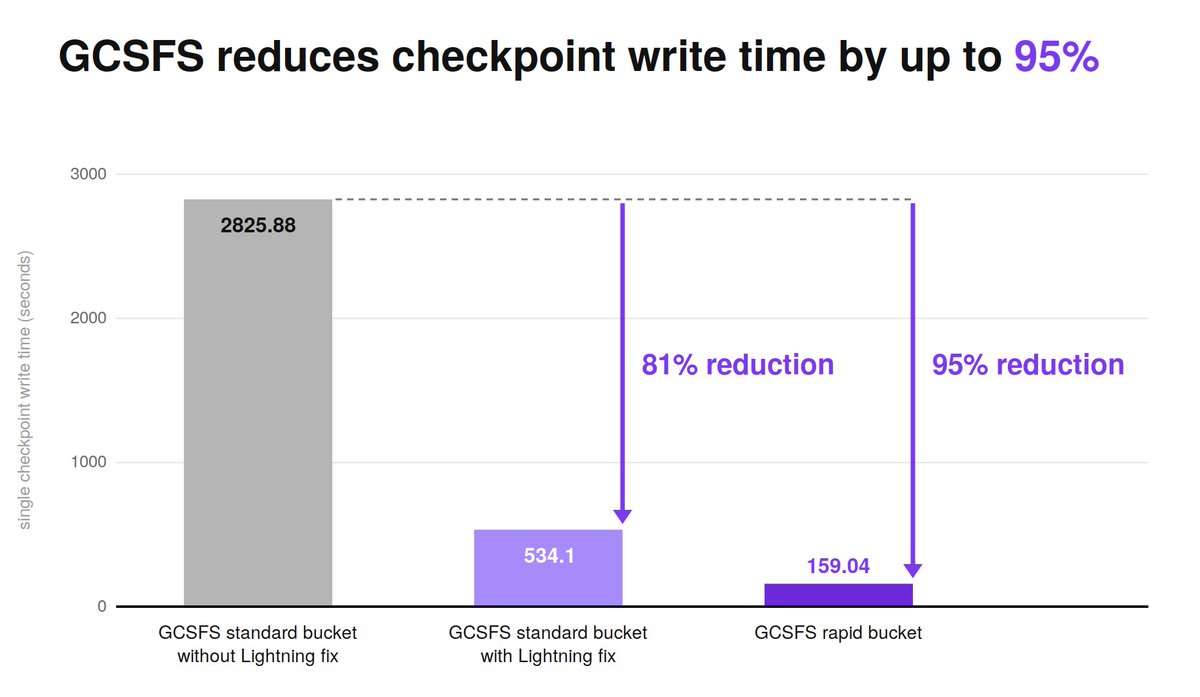
Faster checkpoints, less GPU idle time.
Our collaboration with Google Cloud brings GCSFS and Rapid buckets to PyTorch Lightning, cutting checkpoint write times by up to 95%.
Full breakdown and how to try it → https://t.co/8cLXo5iZOQ
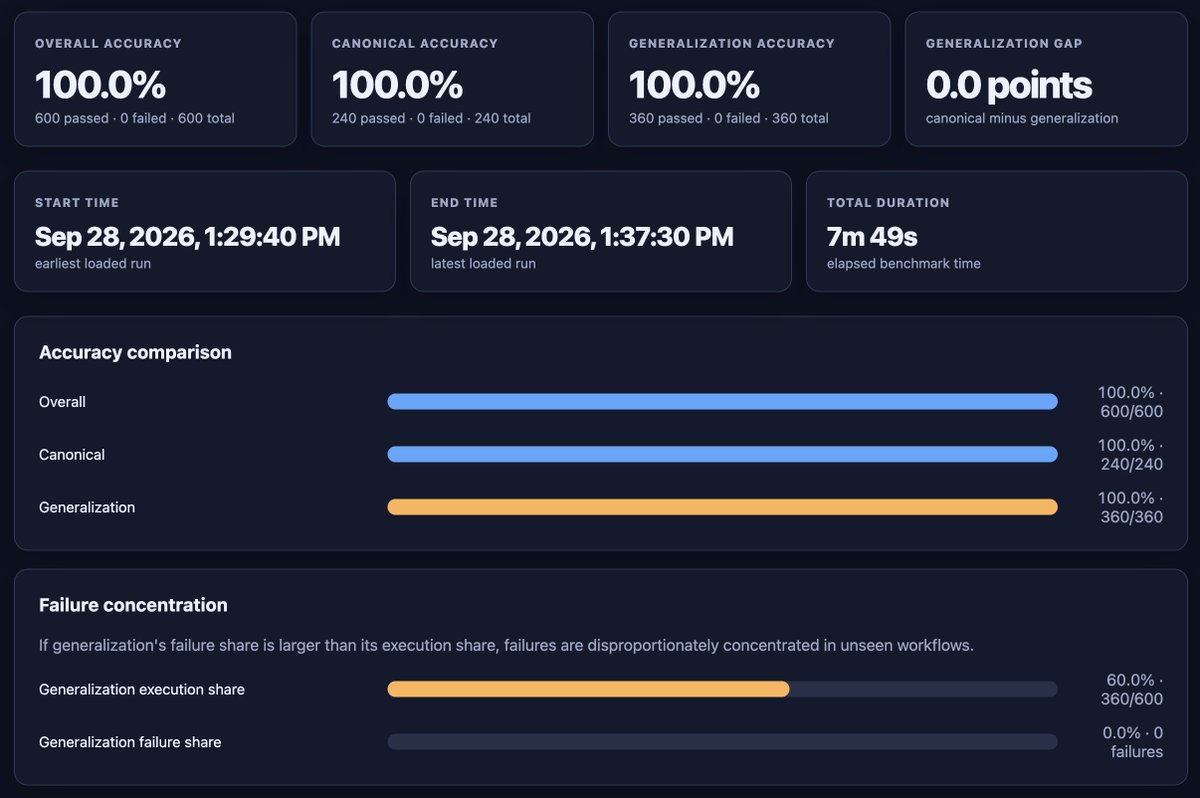
If failure modes cluster, they can be hacked. After building automation to identify failure modes and using an LLM to refine prompts, Jev gets 600/600 passing, including 240/240 canonical cases and 360/360 generalization cases, with a reported generalization gap of zero.
Specialization plays a huge role here. Because each X Reason agent owns its decision boundary, we can specialize that boundary. We can improve the state representation, change the question, refine criteria, narrow the eligible choice, add relevant state, encode domain policy in the agent, or move an invariant entirely into deterministic code. This is a hell of an advantage.
Next up, repeat across all our agents. Build the automation to do this at scale. Intelligent software will have to be adaptive to failure modes and hackable, but in a good way: Observe, Orient, Decide, and Hack.
Large Language Models in Finance — Hands-on guide to LLM architectures, agents, RAG, governance, and evaluation in finance: https://t.co/8WlLasVusC via @PacktPublishing
𝓦𝓱𝓪𝓽 𝓨𝓸𝓾 𝓦𝓲𝓵𝓵 𝓛𝓮𝓪𝓻𝓷:
🟢Understand LLM foundations for financial applications
🟢Build financial LLM systems from ingestion to deployment
🟢Fine-tune models with LoRA, QLoRA, RLHF, and DPO
🟢Create RAG pipelines for financial documents and knowledge
🟢Design autonomous agents and multi-agent finance workflows
🟢Integrate LLMs securely with MCP and enterprise systems
🟢Apply LLMs to trading, banking, risk, fraud, KYC, and AML
🟢Evaluate and govern auditable financial AI with rigorous metrics
Freedom is the greatest act of love.
Then, why are 🇺🇸 Big Tech bosses in London preventing people from being free to start new companies in the UK 🇬🇧 by enforcing long noncompetes, sending threatening letters that bring young families to tears, and coercive 6-12 month garden leaves? We need our freedom back. Our sovereignty depends on this.
https://t.co/jP0TcOtGUD
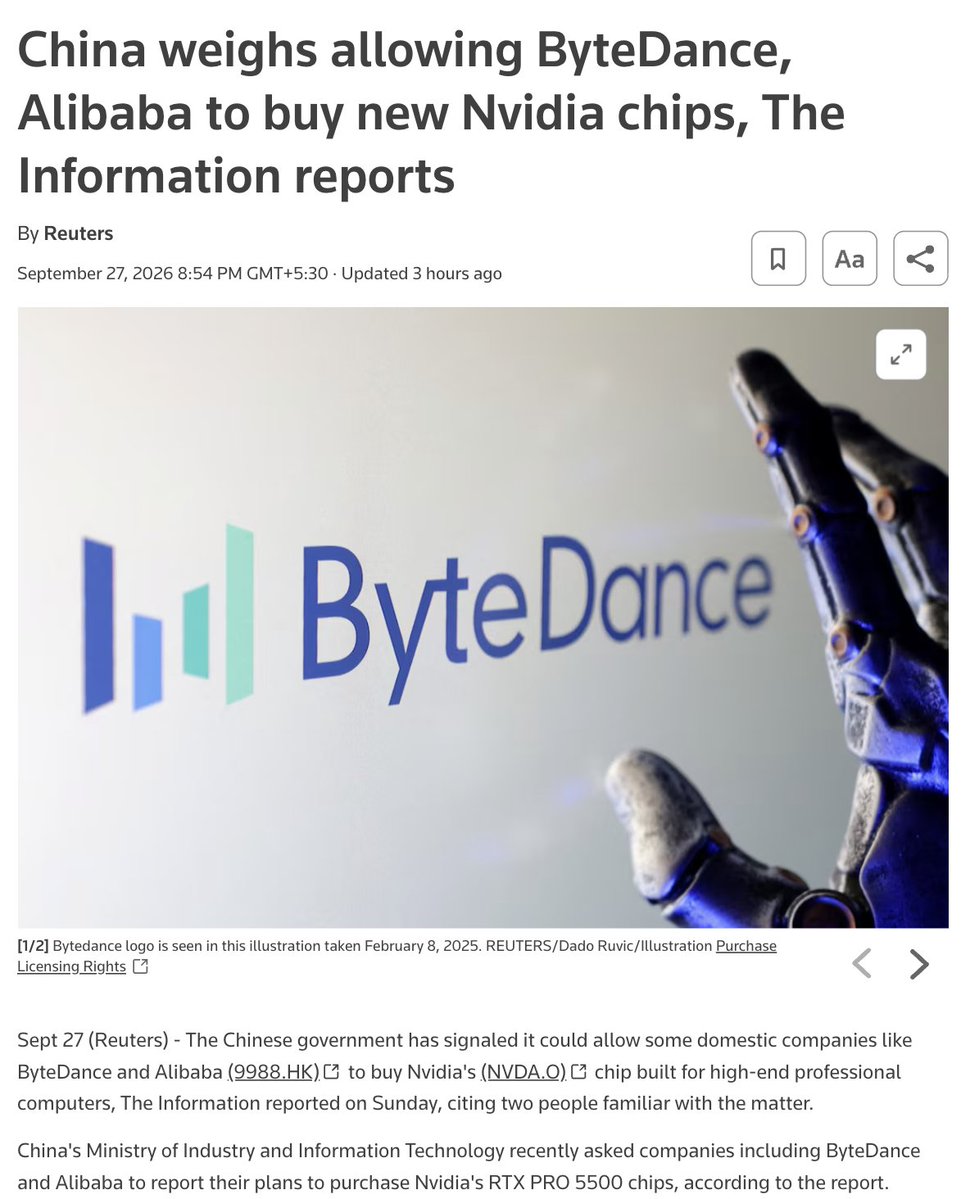
China's government is asking Alibaba, ByteDance and others to report their plans to buy Nvidia's RTX Pro 5500.
It says it intends to approve the purchases.
Read that carefully. Compute is now allocated by capitals, not just budgets.
Any AI vendor tied to a specific chip supply carries a geopolitical dependency, and so does every customer of that vendor.
Open models run on whatever hardware you can get.
That isn't a slogan. It's supply-chain resilience.
Your AI strategy has a chip policy inside it, whether you wrote one or not.
Microsoft moved the GitHub Copilot runtime from TypeScript to Rust with AI agents. One engineer, ~3 weeks of dev time, $120K in credits, 800K lines.
Result: up to 21x faster in-process.
Nobody read every line. Here's how they reviewed it: https://t.co/uhf4UUjJkM