What if poverty reduction is less about building capacity and more about closing exit routes for surplus?
Empirically, Kerala suggests constraint precedes redistribution.
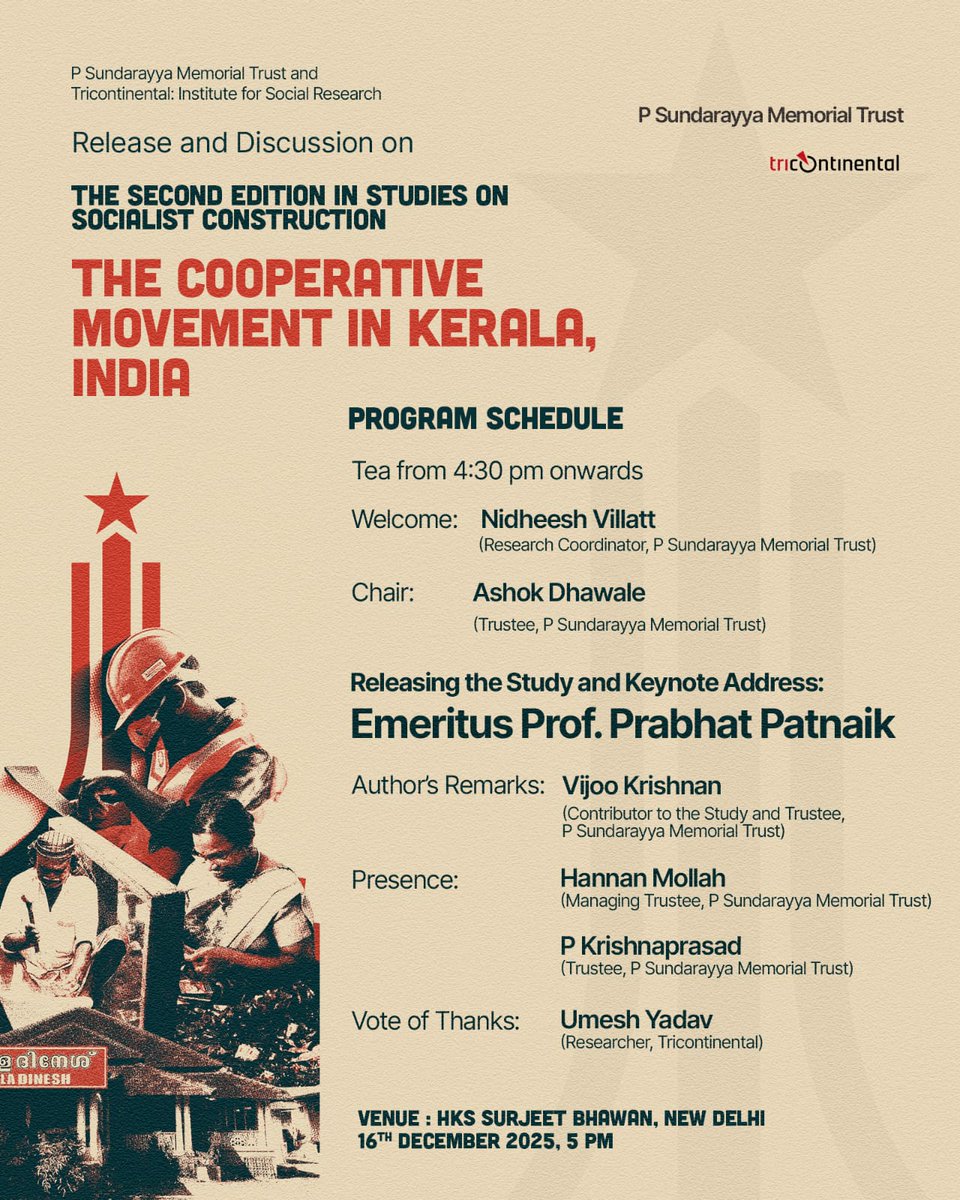
The Cooperative Movement in Kerala, India, is part of a series from us on Socialist Construction. It is about possible communism, the possibilities in our time of a future society.
Read here: https://t.co/2JdLZQq2vi
@EvanWritesOnX Resource luck is the easy part, discipline is the rarity. States diverge not on extraction but on who gets to set the limits—whether constraints serve the public or the networks that grow around the surplus.
Some bind the surplus early. Others let the surplus bind them.
The correction says agriculture, not data centers. Both are right. They’re drawing from the same substrate and the contest over primacy only obscures that. Water keeps its own ledger—cumulative extraction, distributed blame.
How Oregon’s Data Center Boom Is Supercharging a Water Crisis
Amazon has come to the state’s eastern farmland, worsening a water pollution problem that’s been linked to cancer and miscarriages.
Rolling Stone reports in collaboration with @fernnews: https://t.co/wYcbMfDaBM
Evan — welcome back. Some of us were half-convinced you’d been drafted into the MIC as an involuntary consultant. Good to see you survived the ritual.
Now, onto the circles. They remind me of those medieval cosmology diagrams where everything looks orderly until you realise the real turbulence sits in the margins. So here are a few dimensions from my side—just structural additions.
First, the diagram captures the circularity, yet it arguably understates the direction of the flows. What we’re really seeing is an AI-era version of 20th-century industrial coordination: a closed loop where capital, compute and credibility reinforce each other faster than oversight can keep pace.
That’s the essence of these valuation flywheels — they don’t need demand, only belief and energy inputs. And both have limits.
Second, your point on government “subsidy” is essentially correct, but historically these subsidy regimes weren’t just buffers; they were disciplining mechanisms. Subsidy doesn’t only float the system — it anchors it to the state’s tolerance for risk, emissions, and balance-sheet exposure.
Which means the TIC’s ambitions aren’t just capped by physics or capital markets — they’re capped by political patience. That ceiling rarely appears in Bloomberg diagrams, yet it always appears in real time when grids strain or deficits bite.
Third, the sustainability question isn’t merely financial. It’s infrastructural. Every one of these loops runs on energy, water, land, minerals and cloud capacity — all finite, all geopolitically fraught.
The deflation you mention might not only be engineered by financiers; it may be forced by physical constraints. Models scale infinitely. Transformers don’t.
Finally, the real wild card isn’t hype-cycle fatigue or investor rotation. It’s the geopolitical overhang: BRICS industrial policies diverging, supply chains regionalising, and states rediscovering the idea of technological sovereignty.
So yes — this ecosystem can be managed, slowed, even gracefully deflated. But it’s also sitting on top of resource bottlenecks and competing national strategies that don’t care about Silicon Valley’s preferred glide path.
Happy to be corrected where I’ve missed something — or where your vantage point sees the stabilising forces more clearly than mine.
As always, good to have your signal back in the noise.
"Rana Pratap and his home-grown start-up was the first time a scammer had approached me rather than the other way around. Things had come full circle. Someone had tried to scam me; I was now part of the story." —@snigdhapoonam for @thedialmag https://t.co/NeFiQpoGt9
What would William Morris think if he saw his designs printed on cheap smartphone cases? His reaction might not be as straightforward as you’d expect.
https://t.co/61cNcIdufm #WilliamMorris
Of Slaves and Stooges, and Yellow Ribbons
Both my parents died 30 years ago in 1995, my Father on January 21, my Mother on October 19 (yesterday). In my book, I'll Burn That Bridge When I Get to It, I included a brief remembrance of them. Here's what I wrote:
“Traitors!”
Except for my Mother and Father, every member of both my parents’ families was exterminated during the war. From as far back as I can remember, our home was saturated with politics. On Sunday mornings, seated around the breakfast table, we divided up among the five of us the sections of the New York Times while, later in the day, we sat around the television set watching Meet the Press, hosted by the redoubt able Lawrence Spivak. But politics wasn’t just intellectualizing words. When the nightly news flashed war images from Vietnam, my Mother would abruptly avert her gaze, hold her hand up to shield her eyes, and say: “Tell me when it’s over.” My parents stayed faithful to their decidedly unpopular political beliefs until their last breaths. They reserved their harshest epithet for those who betrayed their principles for earthly reward. “Traitors!” they would mutter, with a mixture of disdain and disgust.
Announced in Washington at the end of September, it is becoming clear to everyone what this ‘peace’ deal really amounts to. The continued bombardment of Palestinians, corporations encircling Gaza for cheap real-estate, all potentially led by Tony Blair! https://t.co/Kigxakwb0Y
@EvanWritesOnX If both Koreas are folded into the same investment architecture, does ideology even survive as a variable or just become branding for whoever owns the corridor?
Virginia Roberts Giuffre’s posthumously published memoir lays bare the life-wrecking impact of Jeffrey Epstein and Ghislaine Maxwell’s crimes, highlighting the shameful conduct of other perpetrators and the morally bankrupt efforts to protect them. https://t.co/DH54thvrt5
CHINA CALLED PALESTINE THE GATE OF ASIA
In 1965, Mao Zedong told a Palestinian delegation: ‘You are the gate of the great continent. We are the rear.’
That moment wasn’t symbolic. It was strategic.
For decades, China supported the Palestinian liberation struggle - not just in words, but in weapons, training and revolutionary theory. Palestinian fighters studied Mao’s writings on guerrilla warfare. China provided AK-47s, radio systems and tactical doctrine. Arafat visited Beijing 14 times. PLO fighters trained in Chinese camps. And Nakba Day was marked in Tiananmen Square.
This video traces that forgotten history. From the high tide of national liberation to the modern battlefield of Gaza. Today, as Gaza faces a genocidal assault and the Axis of Resistance confronts Israeli and US power on multiple fronts, China’s role has returned to the conversation. Not as a militant sponsor, but as a geopolitical force shaping the balance of power. It’s refusing US demands to join the Red Sea blockade, speaking out at the International Court of Justice in defence of armed resistance and slowly distancing itself from Israel, politically and economically.
But this story goes deeper than policy. It’s about memory - about the bond between people who shared the long road of resistance from China’s war against Japan, to Palestine’s war against Zionism. It’s also about the global information war, where platforms censor the oppressed and Chinese apps such as TikTok, Weibo and Bilibili have become unlikely spaces for pro-resistance content to survive.
From the tunnels of Gaza to the factories of Shenzhen, from Hezbollah’s rockets to the ghost ships of the Red Sea, this is the new map of global struggle A map where Palestine is still the gate. And the world is shifting behind it.
To learn more, please check out our March 2024 piece on China and the Palestinian resistance: https://t.co/TDFHUgwP1m
And our November 2024 translation, "Shattering the Iron Wall": https://t.co/YV5937NRo1
@VoxUmmah@venanalysis@qiaocollective@ProgIntl@KawsachunNews@OrinocoTribune@blkagendareport