$WEFT is live.
ca: 86Eq7y8tnbW53PhTtkVEj7DbQ71mgLDJeL94bsg3pump
Decentralized VPN on Solana. Home devices route encrypted traffic and earn per gigabyte. No company in the middle, no logs by design.
Run a node or use the VPN - everything is in the cabinet.
https://t.co/HQuRM0gVvA
https://t.co/YBIN5VWVWd
Staking on Weft is not lockup for APY.
It changes how much traffic network sends your node.
Lock 10,000 $WEFT and network treats your node as higher priority when building paths. More gigabytes routed, more earned per epoch. Unstake and you drop to base priority immediately.
Stake buys queue position in live bandwidth market, not yield.
Every gigabyte routed burns $WEFT.
20% of every user payment goes to burn, permanently. More traffic handled means faster supply shrinks. Growth in usage and growth in scarcity happen at the same time, not at different roadmap stages.
Burn fires on every settlement.
Guy in a country where most VPNs are blocked told me he had stopped trying. Every app he installed stopped working within a week.
He set up Weft. VLESS with Reality makes the connection look like a visit to a legitimate website. His ISP sees nothing unusual, and it is still running.
He also left his laptop on overnight and earned enough to cover the cost of the traffic he used.
Most censorship systems block VPNs by fingerprinting the traffic pattern.
WireGuard has recognizable handshake. OpenVPN has one too. Governments keep lists of both and block them at the ISP level.
Reality changes that. It borrows the TLS fingerprint of a real website, major CDN, bank, search engine, and presents that fingerprint to any inspection system.
Traffic is indistinguishable from a normal HTTPS visit, there is nothing to add to a blocklist.
Node operator sees one thing in their cabinet: traffic volume and earnings.
No user identities, no destination addresses, no browsing history. Node processes encrypted envelopes and forwards them. The operator is a relay, not a witness. Running a node carries no legal exposure to what passes through it.
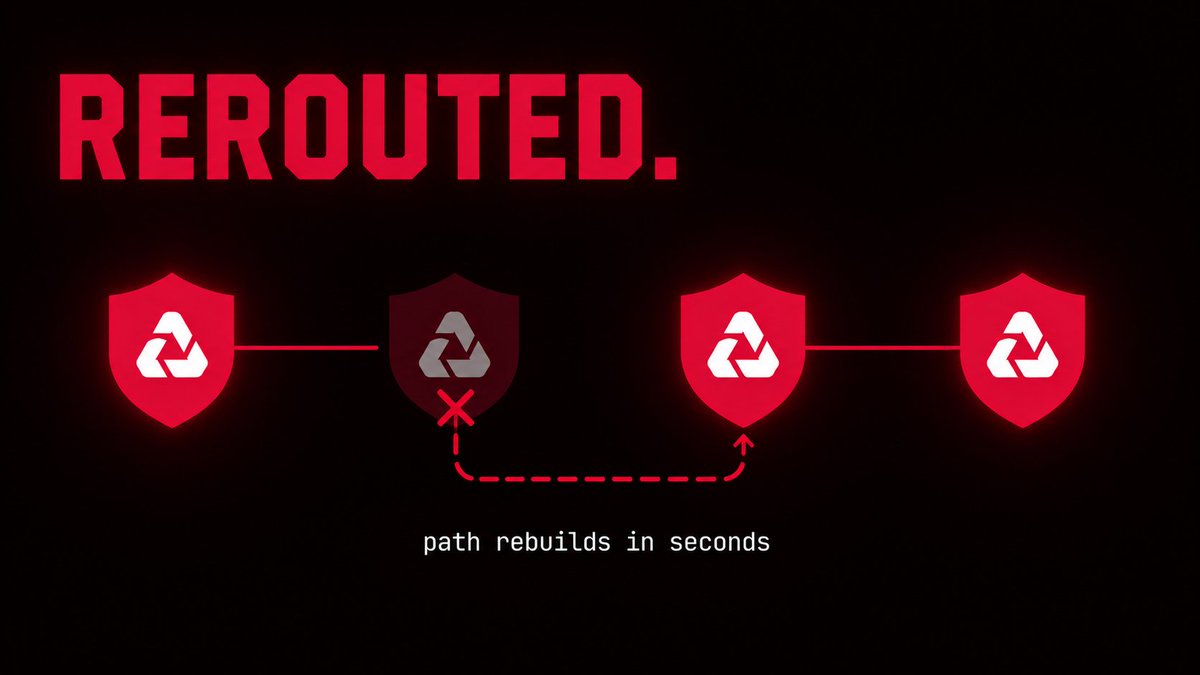
Node drops mid-session. What happens to whoever is routing through it?
Network detects the outage in seconds and rebuilds the path through available nodes. Connection pauses briefly and resumes. No session data lost, no logs exposed, reputation score takes a small hit and recovers with uptime.
Built to route around failure. That is why many nodes beat one.
The global VPN market is worth around $50 billion and growing. Every dollar of it flows to companies that own centralized infrastructure, log your traffic, and pocket the margin.
Weft routes that money differently. Users pay per gigabyte, nodes take 70% of every fee, and 20% gets burned. The people running the infrastructure keep the revenue instead of a VC-backed company in a data center somewhere.
A friend of mine has been running a Weft node on an old laptop he kept meaning to sell.
He set it up on a Sunday, ran the script, forgot about it. Ten minutes later his wallet got its first settlement. By the end of the week it had processed a few hundred gigabytes of traffic and paid him more than the laptop would have sold for on eBay.
He asked me why he hadn't heard of this sooner, I didn't have a good answer.
Weft pays you to carry real encrypted traffic for users.
Your device does actual work, the network measures it onchain, and you get paid per gigabyte every 10 minutes.
The yield comes from people using the product, not from inflation.
Every Weft node is minted as a cNFT on Solana when you deploy through the cabinet.
That cNFT is your node's id. It stores your reputation score, geo location, and uptime history.
When the network picks a path for a user, it reads those cNFTs to find the best matches. Your node key stays local, but your node's track record lives onchain and anyone can verify it.
A lot of home devices sit behind NAT. They can't accept incoming connections directly, which is the first problem any p2p network has to solve.
Weft runs a public relay that handles NAT traversal for you. Your node registers with relay, relay brokers initial handshake, and traffic flows directly after that. Your node key never leaves your device and relay never sees content of what passes through.
146.93 $WEFT sitting in the reward pool right now, waiting for nodes to claim it.
3 active nodes are splitting it. Every new node that comes online takes a share of what's already there before more operators arrive and divide it further.
https://t.co/aiRhh9BexV
Every VPN you have ever paid for knew exactly what you were doing online.
The company kept logs, shared them with advertisers, handed them to courts, and charged you monthly for the privilege.
Weft flips the model: your traffic hops through strangers' devices, nobody holds the full picture, and the strangers get paid instead of a corporation.
https://t.co/HQuRM0gVvA
Weft Network is running.
4 nodes registered, 3 active right now. 0.17 GB routed, 88.13 $WEFT earned by operators, 4.41 already paid out.
Day one numbers, the map is still mostly empty.
https://t.co/aiRhh9AGIn
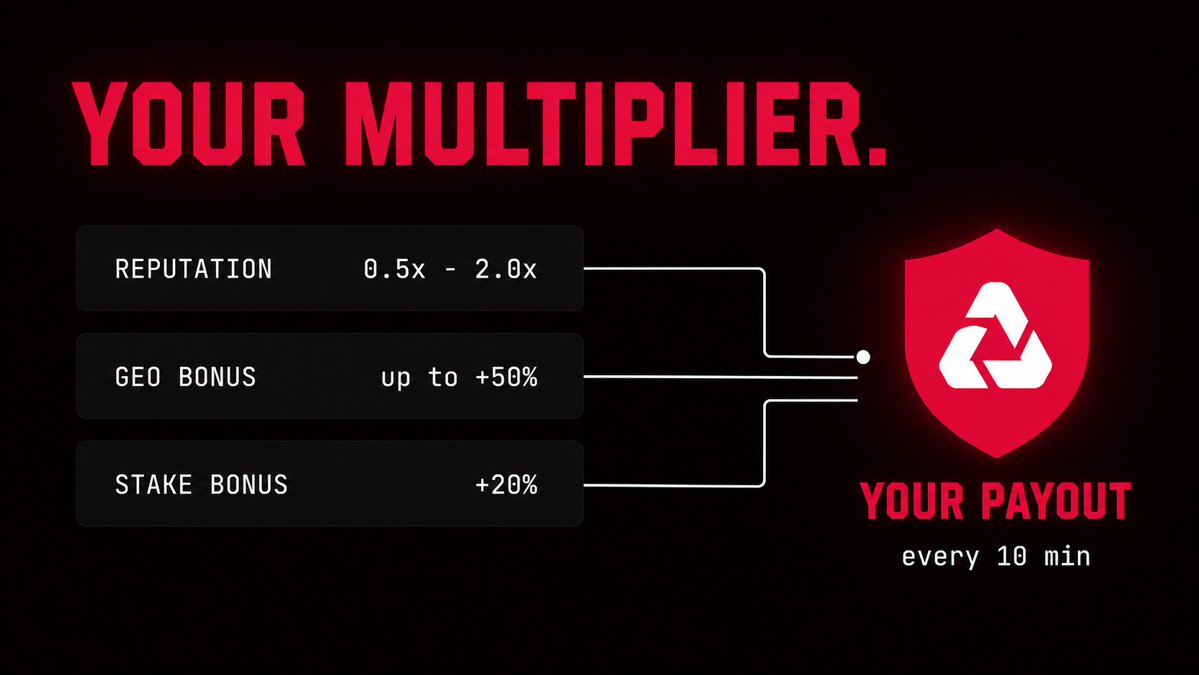
Your payout has multipliers and they all stack.
Reputation tracks your uptime and speed onchain, ranging from 0.5x if you lag to 2x if you stay reliable. Nodes in underserved regions earn up to 50% more. Stake 10,000 $WEFT and add another 20% on top.
Base rate is 700 $WEFT per gigabyte. Settlement every 10 minutes.
Three options, three problems.
Paid VPN logs everything and hands it over when asked. Tor is private but too slow for anything real. Other DePIN VPNs put a hardware wall in front of you before you can even start.
Weft is DPI-resistant, runs on any device with internet, and has no company in the middle.
Your device routes traffic for strangers. You earn $WEFT per gigabyte. Settlement every 10 minutes.
1. Choose a device - home PC, router, or VPS
2. Deploy in the cabinet - mints your node as a cNFT on Solana
3. Run https://t.co/L7bApZeCVi - installs Xray-core and opens the relay
4. Collect - base rate 700 $WEFT per GB, multiplied by reputation, geo, and stake
https://t.co/w8EZJMztDM
Weft runs on Xray-core, VLESS wrapped in Reality.
On the wire your connection looks like a normal HTTPS visit to a trusted website. Deep packet inspection sees a standard TLS handshake and finds nothing to block. Russia's TSPU included.
Your traffic routes through the Tor network or through community nodes. Both options are in the cabinet.