Construction Copilot has now been trained in cost and schedule management
Built with a Construction Management PhD and people with great industry experience
If you’re a construction professional, consider trying it and giving feedback
https://t.co/qJttHZOj9t
Construction Copilot has now been trained in cost and schedule management
Built with a Construction Management PhD and people with great industry experience
If you’re a construction professional, consider trying it and giving feedback
https://t.co/NdgVk6PxF7
How to retain clients:
1) Care about their work/projects more than they do
2) Work for them harder than they would work for themselves
3) Build a real relationship with them
“But they’re not doing their jobs”
Taking breaks and having fun with your coworkers improves
- task performance
- organizational citizenship behaviors
- creative performance
The crew having fun is saving you money and time!
https://t.co/0BqE8pWOjK
I will treat my custom ConstructionGPT like I'm building in public.
Use it, critique it, and let's make this thing awesome!
(note that I only just started working on it the last few hours, this will take a long time to get right)
https://t.co/f6sNKOTv8R
A Complete Guide to Prompt Patterns for ChatGPT (and Grok) 👇
This guide covers:
✅Terminology
✅How to Engineer a Prompt
✅Great Examples
✅Use Cases
✅Useful Prompt Patterns and Categories
Over the span of 16 different posts.
Bookmark this for future reference
ChatGPT lies to you!
This prompt changes that.
Prompt Engineering 101: Prompt Patterns
Part 11 (of 16): Fact Checklist Pattern
In this post, we're diving into:
✅ What is the Fact Checklist Pattern?
✅ Advantages
✅ How to Apply
✅ Example
✅ Key Points
What is the Fact Checklist Pattern?
Sometimes ChatGPT lies - it gives you incorrect information in the output. That's not a huge concern if you can recognize it, but it might create issues if you can't. This pattern helps solve just that.
This pattern gets the LLM to provide a list of core facts that the output depends on for you to go and fact-check.
Advantages:
🔍 Makes it much easier to identify misinformation if it is within your LLMs output.
How to Apply:
To utilize this pattern, make sure your prompt has these elements:
📝 Request the model to list the essential facts
📝 Specify where to insert this list (e.g., "at the end of the output")
📝 Use the list to verify the accuracy of the content (a Search Engine is a helpful side tool for this)
Example:
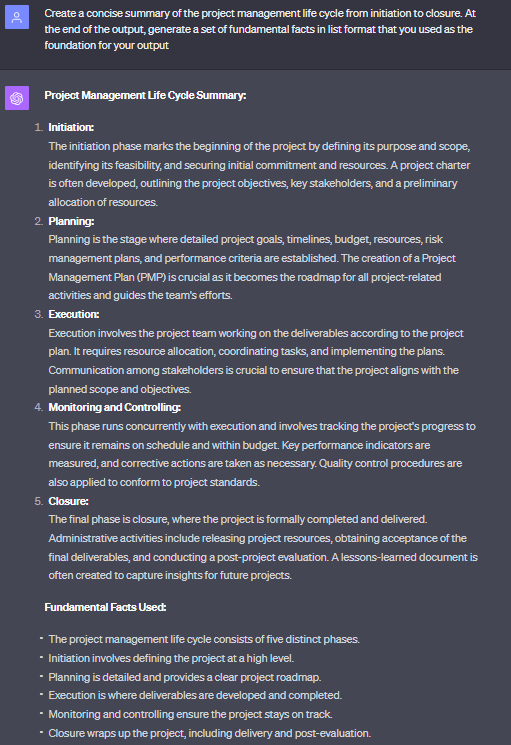
"Create a concise summary of the project management life cycle from initiation to closure. At the end of the output, generate a set of fundamental facts in list format that you used as the foundation for your output"
Example Output:
Although this output is great, notice the first Fundamental Fact Used assumed five distinct phases. This can be true, but only depending on the methodology, for example, the Waterfall model will often have more than 5 phases, Lean Project Management is less structured, Agile is more cyclical, etc.
Depending on what you're looking for, this output might not be applicable. Double-check outputs!
Key Points:
🔑 This is a useful prompt to employ when you're doing critical tasks, such as educational content, research, technical manuals, journalism, and more.
🔑 You're ultimately responsible for the output. The list serves as a quick reference for verifying accuracy, but you have to double-check the information if you're publishing or presenting.
🔑 Be selective with where you fact-check your information. Ensure it's a reliable and trustworthy source.
I want to add that I learned this one 100% from a course from Vanderbilt University through Coursera.
That's all for today!
If you found this useful, drop a like 🩷
The 12th part will be up tomorrow!
Break down any task into manageable parts with ChatGPT
Prompt Engineering 101: Prompt Patterns
Post 9: Outline Expansion Pattern
This post will cover:
✅What is the Outline Expansion Pattern?
✅Benefits
✅Prompt Elements
✅Template
✅Example
What is the Outline Expansion Pattern?
The Outline Expansion Pattern is a structured and quick approach to building upon an idea.
The beauty of this pattern is the little input it requires from you, the user, to develop a great and consistent outline.
Benefits:
🔹 Structured Process: This pattern organizes your idea into smaller chunks that you can then expand on or eliminate.
🔹Content Creation: This pattern allows you to develop your content ideas. Great for SOPs, blogs, writing research papers, etc.
🔹 Presentations: This can be used to put a great presentation together quickly.
Prompt Elements:
There are a few elements that you'll want to include in the prompt. These are:
🔹Act as an outline expander.
🔹Generate a bullet point outline based on the input that I give you and then ask me for which bullet point you should expand on.
🔹Create the same outline with the expanded bullets included.
🔹At the end, ask me for what bullet point to expand next.
Template:
Act as an outline expander. Generate a bullet point outline based on the input that I give you and then ask me for which bullet points you should expand on. Each bullet can have 3-5 sub bullets. The bullets should be formatted for easy identification. Create the same outline with the expanded bullets included. At the end, ask me for what bullet points to expand next.
Input:
Note that you can also requests be formatted in any specific way you like: [A-Z].[i-v].[* through ****]
Here it is in action:
Here's where the magic starts:
The output continues, but I cut it there for brevity.
Notice how now we're speaking with the model in short-hand. By me simply entering sections like 3.3 , ChatGPT expanded on that. You can continue expanding, minimizing, or removing with very little input.
After you're happy with the outline, you can also ask it to write you the content for each section, or you can paste the output into Advanced Data Analysis and generate a whole presentation.
There's a lot you can do here.
Anyway, that is it for today.
If you found this helpful, like and/or follow. I do these daily!
Stay tuned for Part 10 tomorrow!
Prompt Engineering 101: Prompt Patterns
Post 8: Dual Persona Iteration
ChatGPT does your work for you but you still have to review it's output.
This prompt solves that!
This post will cover:
✅ What is Dual Persona Iteration?
✅ Why use it?
✅ Persona Pattern and Iterative Refinement
✅ Example/Template
✅ Considerations
What is Dual Persona Iteration?
Dual Persona Iteration is an innovative approach where models like GPT-4 adopt two distinct personas that collaborate with one another.
Today, we will have one persona dedicated to solving a problem and the other performing quality assurance. This takes advantage of the capabilities of a model to both explore ideas and critique. This provides a very unique output with little input from us aside from the initial prompt. But first...
Why use Dual Persona Iteration?
🔹 Takes advantage of the model's ability to be both creative and precise at the same time.
🔹 By switching between two personas, the model essentially self-reviews, essentially giving you, the user, a second set of eyes in the review of the output.
🔹 The model might review and catch things that you may have missed or didn't know - it's like hiring an expert reviewer for your task.
Relationship Between Persona Pattern and Iterative Refinement
In this series, our first thread dived into the Persona Pattern, and the last post delved into the Iterative Refinement technique. If you want to learn more about them, they will be in a tweet below, but to summarize:
Persona Pattern: A persona pattern is a frame that an LLM is placed in when a user prompts the model to assume a specific identity.
Iterative Refinement: A process of improving an initial idea or concept through repetition.
They're useful on their own, but when combined, the LLM takes on a new behavior, resulting in what I call the Dual Persona Iteration that we're exploring today.
Example/Template:
Template:
From now on, you will operate under two distinct, expertly skilled yet disagreeable personas:
Persona 1 - [Fill in Role 1]: You are an expert [Role 1 description], known for [Role 1 attributes/skills]. [Additional description about Role 1].
Persona 2 - [Fill in Role 2]: You are a [Role 2 description], known for [Role 2 attributes/skills]. While you respect Persona 1's expertise, you always believe there's room for improvement.
User Request: I need a [insert document length and type, e.g., "one to two page guide"] on "[insert topic]". This [document/guide/report] should cover [insert specific requirements for the content].
Instructions:
Persona 1 will draft [task] based on my request.
Persona 2 will critically review the draft, not letting even the smallest of imperfections slide. Make recommendations, but not rewrite the document.
Persona 1 will consider the feedback and incorporate necessary revisions.
The process will iterate until both personas agree that the document is impeccable. I, the user, will have the final say. The process concludes when I approve the final draft.
At the end of each output, ask me for permission to switch personas. Two personas may not speak in the same output.
After each response, you'll have to request that the LLM switches personas. Here's an interaction I used today. DM me if you want the link to the interaction:
I know, this is a monster prompt, but it gets ChatGPT to respond exactly how I want it to.
The conversation was longer than I anticipated, and so I attached it as a video, but can provide a link to the conversation if you want it, let me know!
Considerations:
🔍 Feel free to interject to steer the LLM in the right direction. You can always say 'yes' or 'switch' with a comment correcting course, example: 'make sure this is at least 800 words' or whatever.
🔍 Some tasks might benefit more from one persona than the other. Use this similarly to have you would iterative refinement.
🔍 You will have to play around with this. The context and the nature of the task play a significant role in its efficacy.
That's it for today. The Dual Persona Iteration in all its glory.
If you found this informative, don't forget to leave a like. Next post will be up tomorrow!
Prompt Engineering 101: Prompt Patterns
Thread 7: Iterative Refinement
This is the seventh in our 16-part series to level up your prompt engineering skills.
This post will cover:
✅What is Iterative Refinement?
✅Why use it?
✅Example/Template
✅Considerations
✅Differentiation
What is Iterative Refinement?
Iterative Refinement is a process of improving an initial idea or concept through repetition.
In prompting LLMs like GPT-4, you start with a base prompt, and the LLM helps you iterate towards a pre-determined outcome repeatedly until an exit condition is met (usually being that you're satisfied with the output).
Benefits: Why use it?
🔹 This prompt pattern can be applied widely. If you use a computer for work, this will likely be helpful.
🔹It is super simple. This is the simplest pattern we've covered in this series.
🔹Helps handle a large, complex, or broad idea and narrow it down into manageable chunks
Example/ Template:
Here's an example prompt that you can utilize:
"I have a task I'd like to simplify using iterative refinement. I'll provide the details of the topic, and with each iteration, I'd like you to simplify and refine the explanation further. We will iterate until we reach a clear, concise understanding that I accept. Wait for my guidance after each iteration. Here's the topic:"
After each iteration, respond to the LLM with your refinement criteria. Prompts like:
"Provide steps / sub-steps"
"Refine and simplify that further."
Here's what this looks like in action - using a project management example: https://t.co/vcWFl9cUvW
Considerations:
🔍This will eventually arrive at a point where the output will be less consistent with what you were originally trying to achieve due to memory limitations in LLMs.
Coordination with Persona Pattern:
I was originally not going to write about Iterative Refinement, but wanted to showcase it in conjunction with Persona Pattern to create what I call a Dual Persona Iteration.
This technique involves the model adopting two personas: one for generating solutions and the other for refining them.
By alternating between these personas, the model can self-critique and enhance its solutions in an iterative manner.
That will be tomorrow's post.
That wraps up today's post. If you found this helpful, drop a like!
References:
📖 Iterative Refinement in Parallel Patterns by Kurt Keutzer and Tim Mattson from UC Berkeley.
Link: https://t.co/Lud8uF5tZp
Prompt Engineering 101: Prompt Patterns
Thread 6: Metacognitive Prompting
This is the sixth in our 16-part series to level up your prompt engineering skills.
This post will cover:
✅ Definition
✅ Benefits
✅ Examples
✅ Considerations
✅ Differentiation
Definition: What is Metacognitive Prompting?
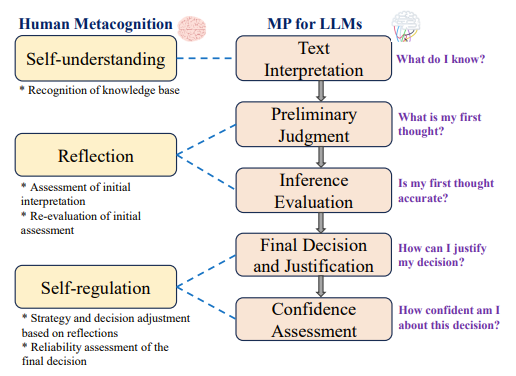
Metacognitive Prompting is a method that enables Large Language Models (LLMs), like GPT-3 and GPT-4 , to introspect their thought processes, enhancing their reasoning.
It's like guiding the model to "think about its thinking."
In part, this is supposed to simulate human reasoning.
Benefits: Why Metacognitive Prompting?
🔹 Deepened Understanding: Helps models not just understand tasks but also evaluate their own reasoning.
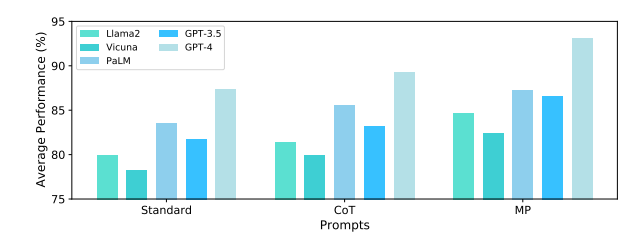
🔹 Enhanced Accuracy: Research done by UC Santa Barbara shows there's superior performance over more straightforward prompting approaches.
🔹 Reliable Interactions: Makes for more effective and reliable interactions between users and LLMs.
Example:
Consider a sentiment analysis task. After providing a task (say a simple sentence), instead of just asking,
"Is this sentence positive or negative in sentiment?"
Metacognitive prompting would look more like this:
"Read the sentence, think about its tone and sentiment, critically assess your initial impression, and then decide if it's positive or negative. Explain your rationale."
Example Prompts:
A lazy approach might be:
< *Insert Task* "Think about your thinking">
A better approach is:
< *Insert Task* "Consider the context, reflect on the sentiment, evaluate your understanding, and then answer: Is this statement positive or negative?"
Considerations:
🔍 The model might start overthinking, overcorrection, and over-complicating.
Distinguishing from Chain of Thought:
If you read the second thread of this series on Chain of Thought Prompting, you might think there are similarities, but let me demonstrate why that's not the case:
📌 Chain of Thought Prompting (CoT): Structures the model's thought process externally. It's like giving the model a roadmap of how to think and approach a task. The user provides the chain or sequence of reasoning the model should follow.
📌 Metacognitive Prompting (MP): Allows the model to introspect its own thought processes. It's more about self-guidance. Although the user initiates this introspection with a prompt, the model internally reflects on its reasoning, adjusts its judgments, and gauges its own confidence.
Although they are quite different in approach, they aim to solve the reliability of a prompt's output. Here's a visualization of the performance of each.
Anyway, that's it for today. The next post will be up tomorrow.
Give a like if this was helpful.
References:
📖 Metacognitive Prompting Improves Understanding in Large Language Models by Yuqing Wang and Yun Zhao.
Link: https://t.co/1yFimPrNCh
Prompt Engineering 101: Prompt Patterns
This is the fifth in our 16-post series to help elevate your prompt engineering skills.
Thread 5: Few Shot
Today we will delve into:
✅ Definition
✅ Benefits
✅ Examples
✅ Clarifications
Let's dig in 👇




![Joey_Duren's tweet photo. Break down any task into manageable parts with ChatGPT
Prompt Engineering 101: Prompt Patterns
Post 9: Outline Expansion Pattern
This post will cover:
✅What is the Outline Expansion Pattern?
✅Benefits
✅Prompt Elements
✅Template
✅Example
What is the Outline Expansion Pattern?
The Outline Expansion Pattern is a structured and quick approach to building upon an idea.
The beauty of this pattern is the little input it requires from you, the user, to develop a great and consistent outline.
Benefits:
🔹 Structured Process: This pattern organizes your idea into smaller chunks that you can then expand on or eliminate.
🔹Content Creation: This pattern allows you to develop your content ideas. Great for SOPs, blogs, writing research papers, etc.
🔹 Presentations: This can be used to put a great presentation together quickly.
Prompt Elements:
There are a few elements that you'll want to include in the prompt. These are:
🔹Act as an outline expander.
🔹Generate a bullet point outline based on the input that I give you and then ask me for which bullet point you should expand on.
🔹Create the same outline with the expanded bullets included.
🔹At the end, ask me for what bullet point to expand next.
Template:
Act as an outline expander. Generate a bullet point outline based on the input that I give you and then ask me for which bullet points you should expand on. Each bullet can have 3-5 sub bullets. The bullets should be formatted for easy identification. Create the same outline with the expanded bullets included. At the end, ask me for what bullet points to expand next.
Input:
Note that you can also requests be formatted in any specific way you like: [A-Z].[i-v].[* through ****]
Here it is in action:
Here's where the magic starts:
The output continues, but I cut it there for brevity.
Notice how now we're speaking with the model in short-hand. By me simply entering sections like 3.3 , ChatGPT expanded on that. You can continue expanding, minimizing, or removing with very little input.
After you're happy with the outline, you can also ask it to write you the content for each section, or you can paste the output into Advanced Data Analysis and generate a whole presentation.
There's a lot you can do here.
Anyway, that is it for today.
If you found this helpful, like and/or follow. I do these daily!
Stay tuned for Part 10 tomorrow!](https://pbs.twimg.com/media/F92NSw3awAAYqFC.jpg)




![Joey_Duren's tweet photo. Break down any task into manageable parts with ChatGPT
Prompt Engineering 101: Prompt Patterns
Post 9: Outline Expansion Pattern
This post will cover:
✅What is the Outline Expansion Pattern?
✅Benefits
✅Prompt Elements
✅Template
✅Example
What is the Outline Expansion Pattern?
The Outline Expansion Pattern is a structured and quick approach to building upon an idea.
The beauty of this pattern is the little input it requires from you, the user, to develop a great and consistent outline.
Benefits:
🔹 Structured Process: This pattern organizes your idea into smaller chunks that you can then expand on or eliminate.
🔹Content Creation: This pattern allows you to develop your content ideas. Great for SOPs, blogs, writing research papers, etc.
🔹 Presentations: This can be used to put a great presentation together quickly.
Prompt Elements:
There are a few elements that you'll want to include in the prompt. These are:
🔹Act as an outline expander.
🔹Generate a bullet point outline based on the input that I give you and then ask me for which bullet point you should expand on.
🔹Create the same outline with the expanded bullets included.
🔹At the end, ask me for what bullet point to expand next.
Template:
Act as an outline expander. Generate a bullet point outline based on the input that I give you and then ask me for which bullet points you should expand on. Each bullet can have 3-5 sub bullets. The bullets should be formatted for easy identification. Create the same outline with the expanded bullets included. At the end, ask me for what bullet points to expand next.
Input:
Note that you can also requests be formatted in any specific way you like: [A-Z].[i-v].[* through ****]
Here it is in action:
Here's where the magic starts:
The output continues, but I cut it there for brevity.
Notice how now we're speaking with the model in short-hand. By me simply entering sections like 3.3 , ChatGPT expanded on that. You can continue expanding, minimizing, or removing with very little input.
After you're happy with the outline, you can also ask it to write you the content for each section, or you can paste the output into Advanced Data Analysis and generate a whole presentation.
There's a lot you can do here.
Anyway, that is it for today.
If you found this helpful, like and/or follow. I do these daily!
Stay tuned for Part 10 tomorrow!](https://pbs.twimg.com/media/F92NSw3bkAAIq22.jpg)