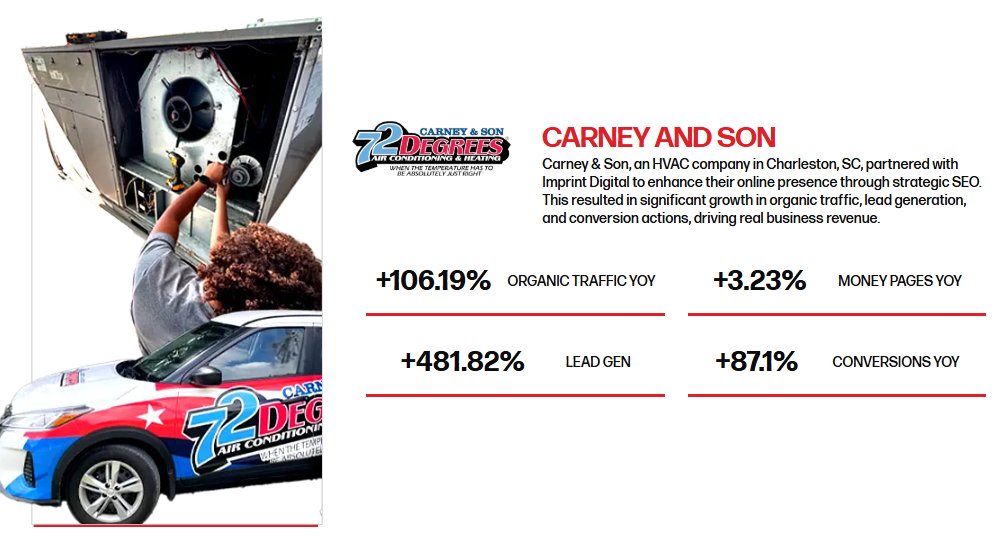
Carney & Son had been in the HVAC game for decades. Family-owned. Trusted. But in the digital space? They were getting smoked.
They’d been burned by another agencies promises, jargon, invoices. No ROI.
And then we stepped in. Here's what happened.
+106% in organic traffic
+87% in conversions
+481% in leads
We tore it down and rebuilt from scratch.
- SEO structure tailored to local HVAC intent
- Service pages that convert
- Copy that actually speaks to Charleston homeowners
Load speeds, schema, mobile UX all buttoned up
Then we lit the fire:
- Content with teeth
- Backlinks that matter
- A playbook built for domination, not decoration
Today, Carney & Son is no longer the best-kept secret in Charleston HVAC. They’re the go-to.
Phones ringing. Trucks rolling. Calendar full.
That’s not luck. That’s strategy.
That’s @imprintdigi.
You’ve never had a friend like us.
Changed how I run 1:1s and got an hour back per person, per month.
Old way: 30-minute live meeting, half of it status updates I could have read.
New way: they fill a 4-line doc the day before.
- What went well
- What's stuck
- What you need from me
- One thing you'd change about how we work
Live time is now 15 minutes on the stuck and the need. No status theater.
The written prep does the real work. The meeting just resolves what the writing surfaced. Most 1:1s are slow because nobody thought before walking in.
@jspujji Agreed, the harness outlasts the model. Running client content, we hit the next wall: it makes reach cheap, and reach is now the commodity. The scarce input is knowing which few angles out of twenty drive booked calls. That judgment isn't swappable yet.
Most home service owners think their Google Business Profile is "done" once they've claimed it. Then they leave half the fields blank.
The ones that actually move ranking and clicks:
- Full services list, not just the category
- Q&A seeded with your real FAQs
- A weekly post (offers, jobs, before-and-afters)
- Products with prices where it fits
This is free real estate Google rewards for being filled in. Competitors leave it empty.
Spend one hour completing yours. I've seen profile views jump 20-30% in a month with zero ad spend.
Private equity is quietly buying up home services. HVAC, plumbing, electrical. Roll-ups are consolidating your local market while you're heads-down running jobs.
What it means if you're independent: your competitor just got a balance sheet, a recruiting budget, and pricing patience you can't match on volume.
But the roll-ups have a weakness. They standardize, which means they get slow and impersonal. Owner-operators win on speed, relationships, and actually answering the phone.
Don't try to out-scale them. Out-care them. That's the moat they can't buy.
The single highest-leverage move a home service business can make: convert one-time jobs into recurring service plans.
A furnace tune-up is a $150 transaction. A maintenance agreement is $180 a year that renews on autopilot, books the off-season, and makes that customer 3x less likely to call a competitor.
The math that matters: a book of 500 plan members is $90K of predictable annual revenue before a single new lead.
You already do the work. You're just not packaging it as a subscription. The recurring wrapper is the whole edge.
Every time someone on my team asks a question I've answered before, I don't answer it. I record a 3-minute Loom and drop it in the library.
We're at roughly 200 SOPs and recordings now.
The first time costs you 5 minutes. Every time after, it costs zero. The new hire onboards from the library instead of from my calendar.
A question answered live is gone the moment the call ends. A question answered once on video pays you back for years.
The library is the cheapest employee I've ever hired.
There are only three ways to grow revenue. Every tactic rolls up to one of them:
1. More customers
2. Higher average ticket
3. More purchases per customer
Owners pour 90% of their energy into number one. It's the hardest and most expensive of the three.
Two and three are sitting right there. Raise your prices. Add a second service. Build a maintenance plan that bills monthly.
A 10% lift in each multiplies to 33% more revenue, not 30. Compounding, not adding. Most operators only ever pull one lever.
The fastest margin win in home service has nothing to do with pricing or ads. It's your service radius.
Most owners chase jobs 45 minutes out because the ticket looks good. Then windshield time eats the day. Two long-haul jobs or four local ones in the same 8 hours.
Tighten your radius. Raise job density per route. I've watched operators add 15-20% to net margin without a single price increase, just by refusing the far jobs.
Map your last 100 jobs. The far ones are quietly subsidized by the close ones.
Five numbers I look at before 8am, every day, in this order:
1. Cash in bank vs 90-day burn
2. Pipeline: dollars in proposal stage
3. Delivery health: any client past SLA
4. Team utilization: who's over or under
5. Churn risk: any account gone quiet
Takes 4 minutes. I built a one-screen dashboard so I never hunt for them.
The point isn't the numbers. It's that I decided what deserves daily attention and refused to let anything else into the morning. Most founders check 30 things and steer by none.
@sweatystartup The business version of the marshmallow test is the year-end distribution. Take the bigger check home now, or leave it in and let the business compound. I've watched operators with 20-point margins stay small for a decade because they grabbed the check every single year.
@WilsonCompanies@thehvacjack The trap is it looks fine on the P&L. Depreciation spreads that truck over five years, so the income statement stays clean while the loan payment quietly drains your bank account. Owners who only read the P&L never see it coming.
Two types of work in any business:
Linear work: you do it, you get paid, work stops, revenue stops.
Compounding work: you do it once, it pays you for years.
Linear: client deliverables, sales calls, replying to email.
Compounding: writing SOPs, training the team, building systems, content that ranks.
Most owners spend 90% of their week in linear work and wonder why they can't take a vacation.
Audit your last week. Count compounding hours vs linear hours. Most operators are shocked at the ratio.
Service techs are the highest-leverage sales channel in home service. Most owners under-train them.
Pre-walk script we coach:
1. Walk the property before starting the called job
2. Note 1-2 additional issues (no pressure, just observation)
3. End the called job, then say: "While I'm here, want me to take a look at X?"
Average upsell when this script runs clean: $180-240 per visit.
40 visits/week × $200 avg upsell × 25% take rate = $80K/year of revenue your techs are leaving in driveways.
Hard line I keep about my personal brand:
I never publish anything operationally sensitive about Imprint clients.
Fair game: my own decisions, my own mistakes, frameworks I use, numbers from my agency in aggregate.
Off-limits: specific client names, specific client metrics, anything competitive intel could be reverse-engineered from.
The brand has to stand on its own ideas, not on borrowed credibility from work the team did.
The line keeps the brand honest and keeps client trust intact.