Repetition breeds mastery, that's how I became a Professional Computer Presser 📍I build scalable web and mobile apps engineered for performance and impact.
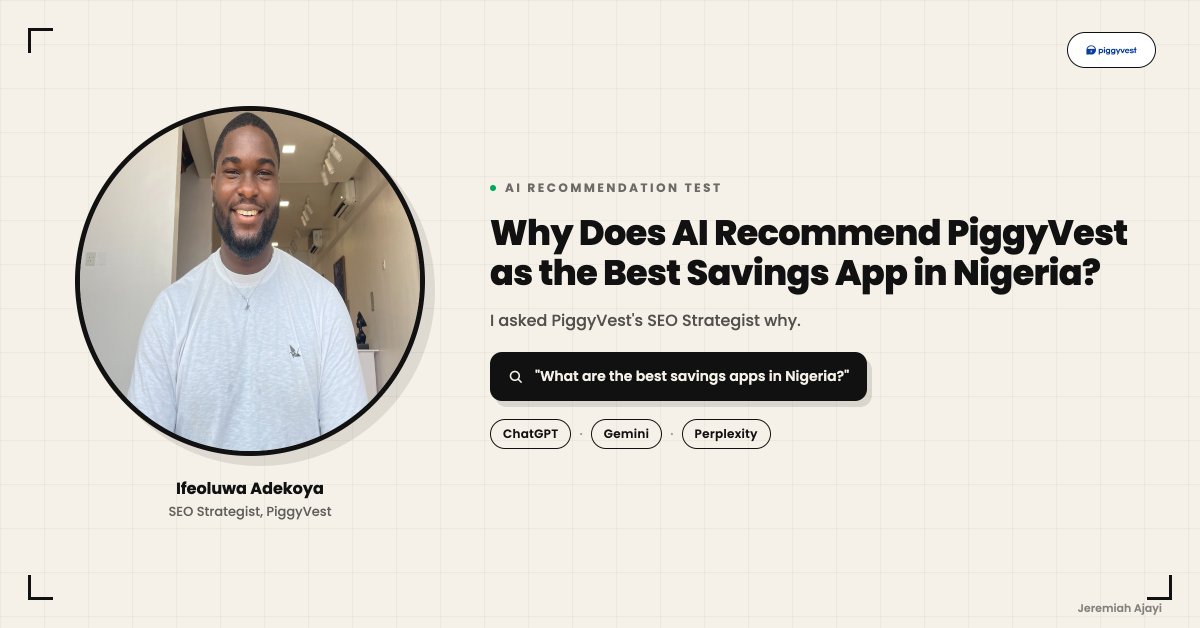
PiggyVest kept showing up when I asked AI where Nigerians should save.
So I asked @trueerudite , PiggyVest’s SEO strategist, why.
His answer went from https://t.co/m7aFNLO4UB in 2016 to years of SEO, Meta AI, competitor content and public proof.
I broke it down here: https://t.co/m3wh8iwedt
There is a japanese legend that says,
"If you get on the wrong train, get off at the nearest station; the longer it takes you to get off, the more expensive the return trip will be."
And it's not only about trains.
When we started @sofreshng_co the only thing I had in mind was to sell fruits worth ₦1,000 to 50 people every day. That was a cool ₦50k daily, even though that took almost a year to achieve, but that’s not the point of this.
What I didn’t bargain for was that a pivot would be needed from a simple fruit business to a restaurant. I had no idea I would eventually be thinking about 100 things at the same time running a restaurant-style business.
Never thought about the IT infrastructure and systems needed to support 15 branches. I never thought about how 150+ people would communicate and synchronise operations effectively across 4 states. In my original calculation, I never factored in things like Microsoft or email subscriptions, ERP user payments, or incentive-based pay to keep people motivated beyond the initial founding energy.
I didn’t even see the taxes and levies that grow with your size, or how government expectations and compliance requirements change as you grow.
And these are just a few of the things you don't see when you are looking at the economics of one small unit and multiplying it by 100.
This is not to say don’t do it or that it’s impossible, rather, understand what it takes and don’t over romanticize it.
Prove the economics at the unit level first. Understand exactly why the first unit works before trying to replicate it. Then, as you scale, don't just add more units. Build the capabilities required to sustain the economics for the next level of scale.
Buy a business instead.
Also If you already own a business, structure it to be sold, even if you have no plans to sell. No matter how small the business is.
@asemota is working on something around this, and I recently went through the process of potentially buying a business. I didn’t end up buying it, but the process was incredibly eye opening.
Build your business so it can run without you. Keep proper books. Document your processes. Know your numbers. Build systems.
Even if you never sell, you will end up with a much stronger business.
One thing I have learnt over the years of APC rule is that it only takes one term of bad government for all the success you've built in this country to be wiped out.
The damage Buhari's policies did to my mum's business still leaves a taint till date.
Even civil servants were saving to buy UK properties in the 80s while our Nigerian ogas were building Nigerian mansions because of their faith in our local economy. They would rather spend a fortune in hotels abroad. My dad’s late uncle, “Paulosa,” was how I learned about the Waldorf Astoria hotel in New York in the 80s. Very few saw Nigeria’s rapid decline coming.
I was talking with my wife yesterday morning about family and legacy and how things can go completely wrong when you don't think big enough. I was looking at that massive house the Nigerian rich guy built in the 70s and wondering what would have happened if he lived simpler and invested that money in other assets. The thing is, we will never know. He lived his best life and was happy.
In the 80s, a relative spent $900m to build a wood-processing factory in Benin City, largely funded by cash generated from their wood-export business—with very little financing. I don't think that factory is functional today. I only learned yesterday for the first time that he had passed away. His first son left the family business early and broke out on his own. He never really made as much money as his father did. His father was the biggest Edo timber baron.
I still remember visiting them every Christmas with my Dad, and I recall the hold the man had on local politics and the lumber and rubber industry. All of that is gone now; he and my dad have both passed away. Just like wealth, influence is ephemeral.
They made the right move to start processing locally for export after exporting raw lumber and rubber for a while, but things didn't eventually pan out. One particular mistake I think they made was not investing enough in the talent pipeline and depending solely on outsiders. The factory had a lot of technical issues, and their boiler for the wood dryer blew up once.
When it came to capital, they also didn't invest enough in other industries like banking, which was ramping up in Nigeria in the 90s to hedge their bets. Many rich people invested in the young bankers, and it paid off.
Also, unlike Chief Ibru and others, they didn't invest in other countries and in other currencies to hedge against currency risks. In their Benin home in the 90s, my cousins used to boast that they had a “safe of last resort” that held the cash equivalent in Naira of $20 million at the time. If all else failed, the family had that cash to build up from.
Banks were failing in Nigeria at the time, so I understood that ultimately flawed logic. The man was not literate, so he made those kinds of blunders. His son, however, had a PhD, but he left to run his own business.
In contrast to my relatives, when Oceanic Bank was being set up. Chief Ibru wired only a million pounds in to pay for the license. He had diversified wisely. His wife and kids eventually ran the bank, but it is now defunct. So, maybe they both still suffered the same fate.
All of this happened to very wealthy Nigerian families that I know very well within my lifetime. Did I learn lessons from them? I don't know yet. I have been reviewing all I have done in the last two decades, and I don't have $20m cash in a safe and can't yet wire £1m to start a bank.
Chief Ibru told me point blank what to do over 20 years ago. If I had invested in fisheries, as he advised and as the late Emmanuel Ijewere corroborated, would my life have been different? Maybe. Instead, I didn't listen, and I invested in tech startups.
Those startups have created wealth on paper but largely unrealized. One thing is for sure: even when they are realized, I won't be overinvesting in the same asset class again. I don't want to make the mistake of having $20m cash in a safe. This is exactly what digital assets were for me with FTX. I was wiped out. Startup investments aren't that different from crypto or stocks, and they are riskier.
If I survive it all this time around, I will listen to Chief Ibru and sell fish, but maybe in a different “asset-light " way. It is important to read the signs. Learn from the good and avoid the bad. Always be learning.
We just launched Entire 101, a practical video series for developers building with coding agents.
As agents produce more of our code, keeping track of what changed, why it changed, and the work behind those changes matters more than ever.
Watch episode 1: How to Enable Entire in Your Repo
Largely agree but it’s also why every man needs to learn how to also fight. You only need 1-2 years of Krav Maga training to beat the shit out of this person.