Not yet peer-reviewed. The note (6 pages, papers/ruler-compass) and the Lean proof are public on GitHub: decalion89/chromatic-number-of-the-plane
#Mathematics#Lean4#HadwigerNelson
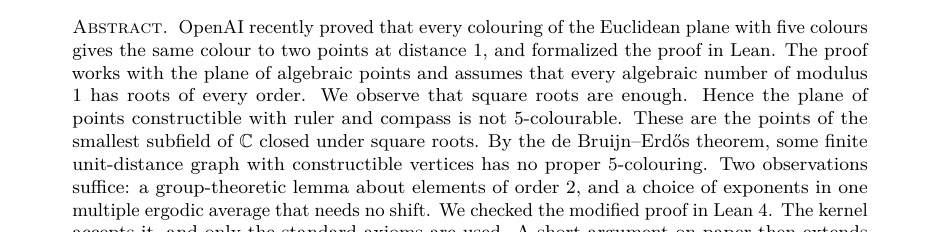
Take all the points you can construct with ruler and compass, starting from two points at distance 1. Can you colour them with 5 colours so that points at distance 1 always get different colours?
No. A short thread 🧵
Consequences: some finite set of constructible points with unit distances cannot be 5-coloured (de Bruijn–Erdős), and the same holds for the plane over every Euclidean field. We know of no explicit such finite set.
5/5 Not yet peer-reviewed. The paper (4 pages, papers/unit-distance-density-3d), the certificate, both checkers and the tests are public on GitHub: decalion89/chromatic-number-of-the-plane
#Combinatorics#DiscreteGeometry#Mathematics#HadwigerNelson
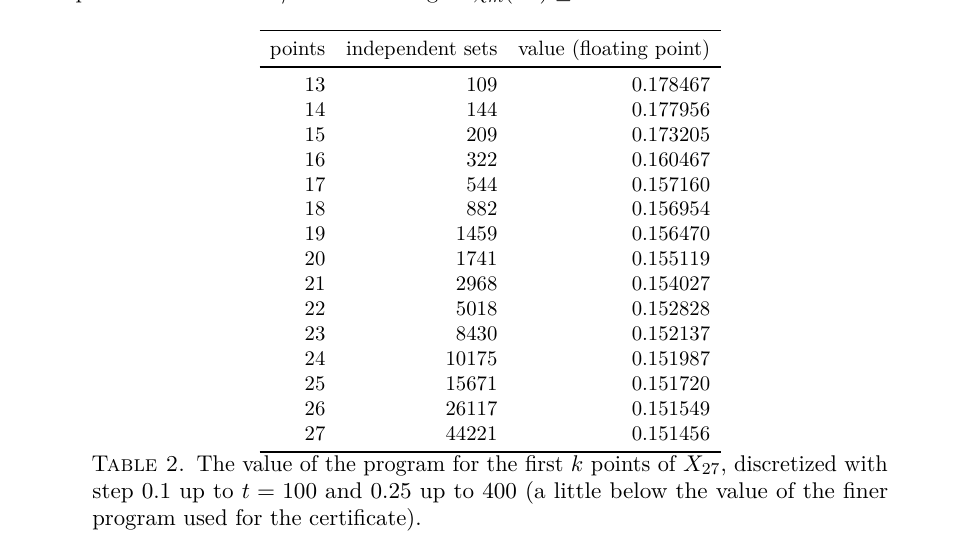
1/5 New upper bound in three dimensions: every measurable set in ℝ³ with no two points at distance 1 has upper density at most 0.15159.
The previous bound with a published proof was 0.1532996 (DeCorte, Oliveira Filho, Vallentin, Math. Program. 2022). 🧵
4/5 The proof is a rational certificate (44 221 independent sets, 1 078 congruence relations), accepted by two separately written programs.
So the measurable fractional chromatic number of ℝ³ is at least 6.5969 (was 6.5232). The measurable chromatic number bound 7 is unchanged.
In space the answer is smaller. We have just proved at most 0.15159 in ℝ³ (the bound before was 0.1533, from 2022).
Papers, certificates and checkers, all public on GitHub: decalion89/chromatic-number-of-the-plane
#Mathematics#HadwigerNelson#Geometry
Colour every point of the plane so that any two points at distance exactly 1 get different colours. How many colours do you need?
Edward Nelson asked this in 1950. Today we know the answer is 6 or 7. Where it stands, in 6 posts 🧵
A cousin problem: how much of the plane can a set cover if no two of its points are at distance 1? Erdős conjectured less than 1/4; proved in 2022 (0.2470). This month we lowered it to 0.24353 (0.2415 was announced in 2023, no proof published).
1/7 New bounds for the Hadwiger–Nelson problem with two forbidden distances.
For every real algebraic d ≥ 8·10⁸, colouring the plane so that no two points at distance 1 or d share a colour needs at least 17 colours.
Also 15 for d ≥ 5·10⁵ and 16 for d ≥ 7·10⁷. 🧵
6/7 Every bound is an exact rational certificate, checked by two separately written programs:
• exact arithmetic in ℚ(√3, √11) + Arb balls;
• integer interval arithmetic with its own Bessel series.
One check runs over all 2²³ subsets of the 23 points. Not yet peer-reviewed.