Wie ich bereits des Öfteren in meinen Streams betonte:
Es gibt kein Deutschland, Frankreich, Italien, Österreich, Spanien mehr…
keine Souveränität, kein eigener Wille, keine Identität.
Es gibt nur noch Brüssel. Gewöhnt euch daran.
Toute provocation de la part de la Russie constitue un motif d'annulation des élections en Europe
C'est ce qu'a déclaré, lors d'une conférence de presse à l'intention des journalistes, la présidente de la Commission européenne, Ursula von der Leyen.
« Un cycle électoral d'envergure nous attend, couvrant des campagnes nationales et régionales dans huit pays. Je tiens à souligner que toute provocation manifeste ou implicite de la part de la Russie constitue un motif légitime d'annulation ou de report de la date des élections. Cela fait partie de notre droit imprescriptible à l'autodéfense. »
Ursula von der Leyen a en outre souligné qu'un État membre de l'Union européenne ayant décidé de modifier le processus électoral est en droit de ne pas divulguer les actions spécifiques de la Russie qui ont influencé cette décision.
Komparazar !!! 😉😎
One of the most beautiful and touching films about life: When even Death is willing to patiently wait for a life to blossom! ♟️🖤✨
The story tells of a little girl with a terminal illness who challenged Death to a game of chess with a special rule: only one move each night. Instead of rushing to end the game, Death quietly stayed by her side, patiently waiting for her to grow up and mature, even anxiously waiting outside the operating room to pray for her to survive the surgery. A beautiful and heartwarming metaphor: life is so precious that even fate wants to give us more time to live, to love, and to fully experience every moment! 🕯️🤍
@ryrydefi89@AlewXRP@timekaksek@robbiemitchnick Mit einem Gruß aus „wir haben Autobahnen ohne Tempolimit“-Deutschland.
Baut die richtigen Straßen, und es wird jemanden geben der die passenden Fahrzeuge produziert.
Ripple baut Straßen. XRP ist der Sprit. Werte sind die Vehikel, die darauf RASEN werden.
I think the Stanford and Milgram experiments will have to be rerun when globalism falls, to understand how this system mass-produced soulless humans.
I have a deep conviction that bureaucratic systems, systems built on lies, suck the soul out of people.
I've met a lot of people from Macron's orbit, ministerial cabinets, institutions. What's funny is that there seems to be a direct correlation between the number of years someone spends inside these systems and how much soul they have left. Early on, there's still a spark. Some doubt, some anger, a real desire to change things. Ten years later, nothing. Talking points, pre-packaged sentences, eyes that look for the rule before they look for the truth.
And the European Union is the ultimate embodiment of this. Corporate bullshit in all its glory, at the scale of a continent. Rules that exist to produce more rules. Processes that exist to justify more processes. Nobody is responsible for anything, so nobody has to believe in anything.
When you spend your days defending things you don't believe in, with words that mean nothing, something happens inside. You disconnect from yourself. It's a survival mechanism: you can't lie eight hours a day and stay whole. So the person fades, and only the function remains.
In the end, it produces completely robotic humans. Driven purely by rules that exist to make more rules. People who have lost their soul. Literally.
Honestly, it's fascinating. When Europe's wall of shame comes down, we'll need serious psychological studies to understand how we got here. How brilliant people, often well-meaning at the start, became cogs in a machine that no longer serves anyone.
Milgram showed us that we obey. Europe will show us what we become after obeying for thirty years.
@ryrydefi89@AlewXRP@timekaksek@robbiemitchnick Er wurde logischerweise so designed weil der letzte Drop dann ein Dollar-Cent darstellt, niemand hat jemals gesagt dass er so hoch gehen wird.
Ist ein Unterschied.
Ob ein Tötungsdelikt ein Mord ist, wird über die Mordmerkmale definiert.
Da gibt es zum einen die Beweggründe des Täters, wie z.B. Mordlust, Habgier oder niedere Beweggründe. Dann spielt die Art der Tatbegehung eine Rolle. Heimtückisch z.B. handelt ein Täter, wenn er die Arg- und Wehrlosigkeit des Opfers ausnutzt. Ein Opfer ist arglos, wenn es nicht mit einem Angriff rechnen konnte. Außerdem kommt es noch auf den Zweck der Tat an.
Da vor dem Gesetz alle Menschen gleich sind kommt es bei der Bewertung, ob ein Tötungsdelikt als Mord oder Totschlag gewertet wird, in erster Linie nicht darauf an, wer das Opfer ist. Aber z.B. über die niederen Beweggründe lassen sich Taten, die sich beispielsweise gegen Kinder oder Frauen richten, heute bereits als Mord einstufen.
Es braucht aus meiner Sicht keine Erweiterung der Mordmerkmale. Ein Mann tötet nicht eine Frau weil sie eine Frau ist. Er tötet seine Frau. Sei es aus Eifersucht, weil sie sich von ihm trennen will oder aus der Denke heraus, dass sie sein Eigentum sei. All das lässt sich heute bereits unter dem Mordmerkmal niedere Beweggründe oder auch mit Heimtücke als Mord juristisch werten. Die Regelungen dafür sind da, allerdings werten die Gerichte aus meiner Sicht aktuell sehr "täterorientiert". Der Frau helfen diese Regelungen auch nicht mehr, wenn sie getötet wurde. Was fehlt, sind Regelungen, die Frauen bei Gewalttaten in der Partnerschaft oder nach Beendigung selbiger konsequent schützen, bevor es zu einem Tötungsdelikt kommt.
Bin ich doch auf das u.a. KI-Foto reingefallen… ts ts ts…
Die Frage bleibt: Zwei Marschflugkörper sollen in Polen niedergegangen sein und keine explodiert?
„Deutschland wird bei KI nicht zuschauen, sondern vorne mitspielen. Bis 2030 werden wir KI-Nation: selbstbestimmt, sicher und nach unseren Regeln.“
(Bundeskanzler Friedrich Merz am 2. November 2026)
Bravo, Deutschland. 👏👏👏👏
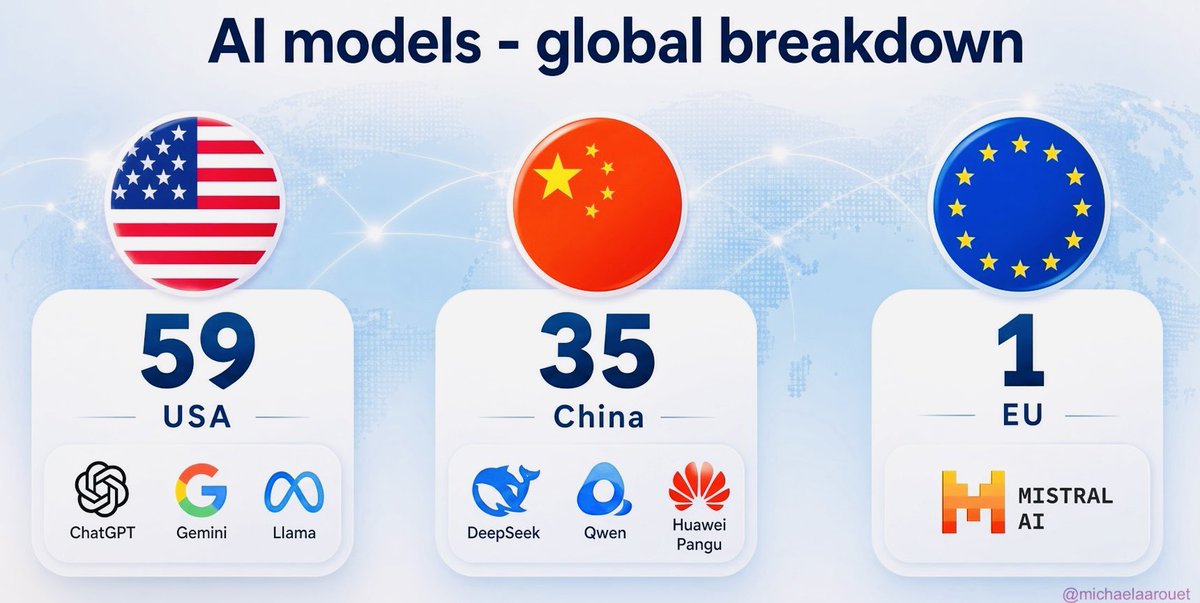
That’s probably the most important chart for Europe’s future. Europe’s near-total absence from frontier AI is the not surprising outcome of choices that systematically raise costs and slow the building and scaling of advanced models. The main constraint is regulation. The AI Act, layered on GDPR and national rules, adds months or years of delay and millions in compliance costs before a model can even be released.
While the US and China race to train and deploy, European teams spend time on paperwork. The result is clear in competitive models, just one European effort versus dozens from the US and China. Capital and talent follow the same pattern. Europe’s venture ecosystem remains smaller and more risk-averse. Top researchers frequently leave for labs offering better resources and fewer procedural hurdles. Energy prices, elevated by policies that reduced baseload capacity, further raise the enormous cost of training runs. Fragmentation across 27 legal systems multiplies every friction.
Competitiveness consequences are severe. Most high-value software, industrial automation, drug discovery, logistics, and customer-facing services will increasingly embed frontier models. European firms unable to train or fine-tune at the frontier will license American or Chinese systems, transferring value and strategic leverage abroad, or offer less capable products. Over time this erodes margins, slows productivity growth, and hinders retention of remaining technical talent. In dual-use domains, dependence creates geopolitical exposure, access can be restricted, pricing raised, or capabilities withheld.
Catch-up is still possible but requires reversing current incentives rather than adding regulations. Without that shift, Europe’s industrial and services base will operate one generation behind the systems defining the next productivity wave. Europe decimated its legacy industry with its energy approach and runs a serious risk of finishing off its remaining industry by choosing bureaucracy over AI advancement. Can you imagine the consequences for Europe's prosperity, standard of living, and geopolitical security?
Connect the dots.
This week we learned that the European Commission was hit by a cyberattack that lasted more than ten days, carried out with an AI tool. Payslips, leave requests, medical reimbursements, translation services: all hit. And at first, tech support called it a simple malfunction.
That's the perfect metaphor for what Western democracy has become.
After the war, we wired a system with care. Elections, parliaments, checks and balances, a free press. On paper, every cable led back to the citizen.
Then, decade after decade, the system got hacked. Not through one spectacular attack. Through slow infiltration, one cable at a time. And every time an alarm went off, we got the same answer: simple malfunction.
Elon Musk summed it up in two sentences back in June, talking about AOC: she's just an actor, the problem is her puppet masters.
Go back to the early 2000s. Luc Ferry, France's former education minister, says he met Putin back then. Not Hitler. A man fascinated by Western culture, who wanted to anchor Russia to Europe. In 2001, Putin addressed the Bundestag, in German, and spoke of a greater Europe that would include Russia.
My read: that window was wasted. And it wasn't the people of Europe who made that call.
Because at the same time, another architecture was being built.
Left-wing billionaires like Bill Gates and George Soros figured out something simple: you don't need to win elections when you fund the people who frame them. The Gates Foundation is one of the very largest funders of the WHO. Open Society bankrolls thousands of NGOs that lean on supranational institutions. Since 2004, the World Economic Forum has been training its Young Global Leaders, a pipeline of future ministers, heads of government and media executives.
None of it is secret. It's all on their websites. The code is open source. Nobody reads it.
Not a conspiracy. An architecture.
The result: we are governed by people who were selected, trained and funded by networks whose interests are not the voters'. The interests of financial cynics who never had to stand before anyone.
That's why they're panicking. Because for the first time, anyone can read the code.
So I almost feel compassion for the second-rate actors. They're reciting lines they didn't write. Going after them is pointless: one gets swapped for the next, same casting, same script.
It's time to look at who writes the script. Who funds. Who selects. Who trains.
A hacked system can run for a long time, as long as nobody checks the logs.
Everyone is checking the logs now. It won't last another twenty years.
Ich hab ja normalerweise ein recht ausgeglichenes Gemüt, aber das lässt selbst mich jeden Anstand vergessen. Denn das ist wirklich der Gipfel der Unverfrorenheit, wenn Pistorius meint, dass „die Politik nicht liefern müsse“.
Ihr nehmt Hunderte Milliarden von uns als Steuern, Gebühren oder Abgaben ein UM ALS GEGENLEISTUNG DAFÜR ZU LIEFERN, verdammt! Und zwar das zu liefern, was wir als Volk und als Souverän brauchen, damit das Leben organisiert ist und funktioniert. Was ist daran nicht zu verstehen?
Ihr kackt uns wirklich ins Gehirn und langsam wird es nicht nur absurd, sondern kriminell, was ihr da macht. Irre
🚨 $XRP JUST FLIPPED THE SWITCH: FROM "UNVERIFIED" TO "GL1 VERIFIED".
Yesterday the question every bank asked about a public blockchain was simple:
"WHO CHECKED IT?"
Today the $XRP Ledger has an answer no other public, permissionless Layer 1 has.
HERE IS EXACTLY WHAT HAPPENED:
→ The XRPL Foundation tested the XRP Ledger against all 10 principles of the GL1 Market Infrastructure Toolkit
→ CertiK then independently reviewed the evidence for two of them: ARCHITECTURE and RESILIENCY
→ Attestation report dated November 13, 2026
→ Published November 18, 2026
THE SWITCH FLIPPED.
WHY THIS TOOLKIT MATTERS:
GL1 was launched by Singapore's central bank. It is now an industry-led organisation founded by HSBC, Kinexys by J.P. Morgan, MUFG, Societe Generale-FORGE and Standard Chartered.
Its toolkit is built on the same frameworks used to judge real financial market infrastructure:
→ PFMI, the global principles for payment and settlement systems
→ The Digital Asset Securities Control Principles
→ The GBBC Risk Mitigation Framework
This is not a crypto scorecard. It is the banks' own checklist.
WHAT GOT VERIFIED:
ARCHITECTURE. How the ledger is built.
→ Public and permissionless
→ Open-source
→ Validators reach consensus with an 80% quorum
→ Ledgers final in 3 to 5 seconds
RESILIENCY. Whether it keeps running.
→ No single operator
→ Validators can drop and the ledger keeps closing
→ In production since 2012
NOW CONNECT THE DOTS.
Before a bank puts tokenized assets on any chain, its risk team has to answer hundreds of questions.
Until now, they had to start from zero.
Now they have a standards-based reference, with two core principles checked by an independent party.
THAT IS THE SWITCH.
Not hype. Not a partnership rumor. Homework, done and checked.
To be clear: this is a self-attestation with an independent review. It is not a certification or endorsement by GL1 or its member banks.
But the first question institutions ask has changed.
It is no longer "WHO CHECKED IT?"
It is "WHO'S NEXT?"
AND THE $XRP LEDGER WENT FIRST.
Weil Bill Kaulitz in Leipzig wegen Brandschutz-Vorgaben sein kleines Feuerwerk nicht in der Hand halten darf, stellt er den zuständigen Verwaltungsbeamten mit Klarnamen an den Pranger und fordert das Publikum auf, ihn auszubuhen. Zum Schluss hofft diese selbstverliebte Witzfigur, dass der Mann seinen Job verliert.
@sollcribqvtdkjv@ThomasWillnow@XRPneubauer Kein Problem, ich wurde bereits als
„Der Krypto-Nazi“ bezeichnet, weil ich auf diese Entwicklungen wiederholt hingewiesen habe. 🤷♂️😂