ON THIS DAY — 9 SEPTEMBER
🔴 Arsenal’s European journey began!
On 9 September 1969, Arsenal beat Glentoran 3–0 at Highbury in the Fairs Cup — the beginning of their journey to their first European trophy.
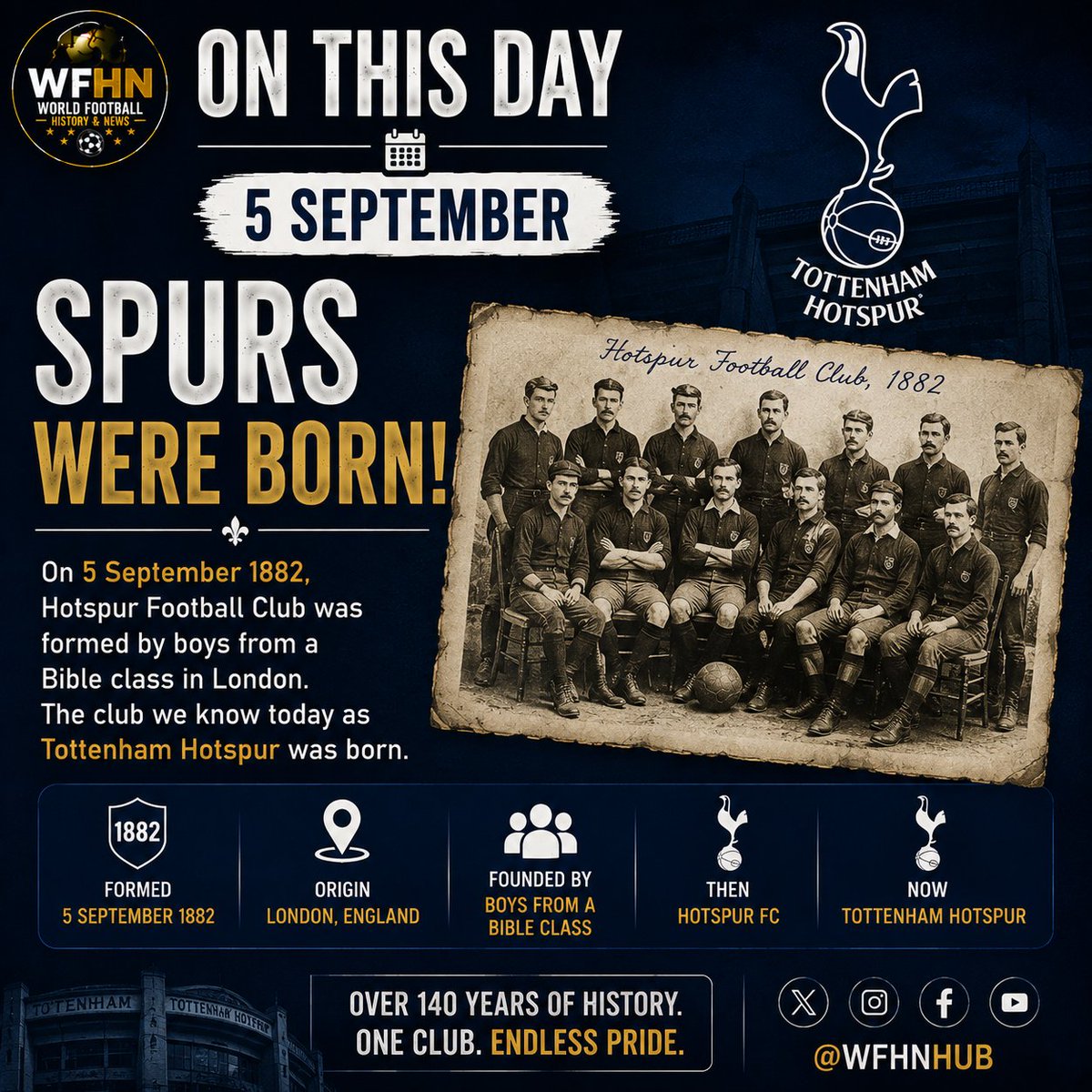
⚽ ON THIS DAY — 5 SEPTEMBER
🇬🇧 SPURS WERE BORN!
On 5 September 1882, Hotspur FC was formed by boys from a Bible class in London. The club later became Tottenham Hotspur.
ON THIS DAY — 4 SEPTEMBER
🏆 Sheffield Wednesday was born!
On 4 September 1867, members of the Wednesday Cricket Club decided to form a football club to stay fit during winter. That club became Sheffield Wednesday FC. �
https://t.co/kfC0tF01Ag +1
🔴 Arsenal History
On 2 September 1893, Woolwich Arsenal played their first-ever Football League match, drawing 2–2 with Newcastle United.
🏟️ A historic beginning to Arsenal's journey in English league football.
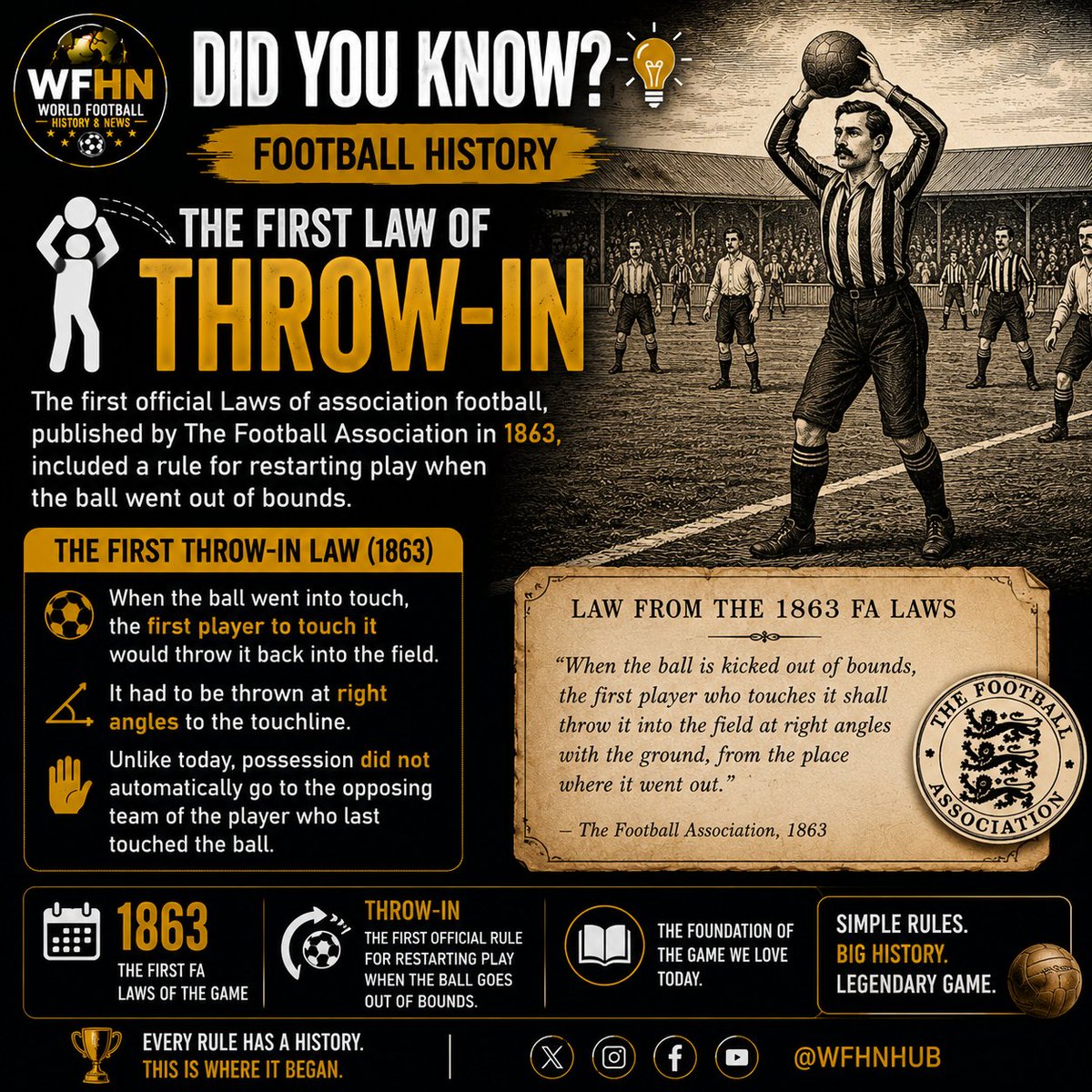
⚽ DID YOU KNOW? — FOOTBALL HISTORY
🤲 THE FIRST THROW-IN LAW
The first official Laws of association football, published by The Football Association in 1863, included a rule for restarting play when the ball went out of bounds.
The law stated that when the ball went into touch, the first player to touch it would throw it back into the field from where it crossed the boundary line, at right angles to the touchline.
🤯 This was very different from modern football, where the throw-in is awarded to the opposing team of the player who last touched the ball.
📅 1863 — The first FA Laws
DID YOU KNOW? — FOOTBALL HISTORY
🤯 THE FIRST RECORDED HEADED GOAL IN FOOTBALL HISTORY
The earliest known account of a goal scored with the head dates back to 28 December 1861.
In a match between Sheffield FC and Hallam FC, a player named Warburton was reported to have headed the ball under the crossbar to score. ⚽
📅 28 December 1861
🏟️ Sheffield, England
⚽ Warburton — earliest identified headed goal
Because football records from that era are incomplete, it is safest to call this the earliest known or earliest identified recorded headed goal, rather than claiming with absolute certainty that it was the first ever. �
https://t.co/p4829wb9ii +1
⚽ DID YOU KNOW? — FOOTBALL HISTORY
✋ THE FIRST OFFICIAL HANDBALL RULE
When the Football Association published the first official Laws of the Game in 1863, football was still very different from today's game.
The original laws already restricted the use of hands. Players were not allowed to throw or pass the ball with their hands, and they could not pick the ball up from the ground while it was in play.
📅 1863 — First FA Laws of the Game
✋ Hand use was restricted
⚽ A major step towards the foot-based game we know today
The modern handball law developed over time, but its roots go back to the birth of association football in 1863. �
⚽ DID YOU KNOW? — WORLD CUP HISTORY
🎯 THE FIRST PENALTY GOAL IN WORLD CUP HISTORY
🇲🇽 Manuel Rosas made history at the very first FIFA World Cup in 1930.
In Mexico's match against Argentina, Rosas converted the first-ever penalty kick scored in World Cup history.
🇦🇷 Argentina 6–3 Mexico 🇲🇽
⚽ Manuel Rosas — penalty goal
📅 19 July 1930
⏳ Rosas was just 18 years old
🤯 A historic moment from the tournament that started it all! �
⚽ ON THIS DAY — FOOTBALL HISTORY
📅 23 August 1978
🇦🇷 Argentine World Cup winners Ossie Ardiles and Ricky Villa made their highly anticipated home league debut for Tottenham Hotspur.
🤯 Nearly 48,000 fans packed White Hart Lane to welcome them — but Aston Villa spoiled the occasion with a 4–1 victory over Spurs
@FabrizioRomano Olise has to be right up there for me. A goal and an assist in a final, plus his ability to create danger whenever he gets on the ball — decisive performance. ✨🏆
The Story Behind the Crest: Manchester United’s Iconic Emblem 🔴😈
Football History Fact ⚽
Manchester United's crest is one of the most recognizable symbols in world sports, but its design is rooted in 19th-century history, local rugby traditions, and global rebranding:
The Ship (Industrial Roots): The three-masted sailing ship at the top of the shield represents the Manchester Ship Canal and the city’s trade heritage, originally taken from the official Manchester City Council coat of arms.
The Red Devil (Sir Matt Busby's Vision): In 1970, the club added the trident-wielding Red Devil to the center of the crest. Legendary manager Sir Matt Busby adopted the nickname from the nearby Salford Red Devils rugby league club in the 1960s to give his team a fierce, intimidating identity.
The Color Palette: The bold Red symbolizes the passion, strength, and iconic home shirts, while Gold represents prestige and the club's decorated trophy history.
The Modern Redesign (1998): To prepare the brand for global expansion, the crest was streamlined in 1998 by removing the words "Football Club", leaving just "Manchester" across the top banner and "United" across the bottom.
From trade ships on the canal to an international symbol of dominance, the crest tells the story of Manchester's transition from an industrial engine to a global football power. 🔴 Manchester United's emblem remains a masterclass in sports identit
Forged in Woolwich: The Origin of Arsenal’s Cannon 🔴🔫
Football History Fact ⚽
Arsenal’s iconic cannon crest is a direct tribute to the club's industrial roots and founding workers:
1886 Foundation: Dial Square FC (later renamed Woolwich Arsenal) was formed by workers at the Royal Arsenal armaments factory in Woolwich, South East London.
The Original Emblem: In 1888, the club adopted its first crest, which featured three prominent military cannons modeled after the official borough coat of arms of Woolwich.
The Single Cannon: When the club relocated north to Highbury in 1913, the crest evolved into a single east-facing cannon.
Victoria Concordia Crescit: In 1949, Arsenal unveiled a classic crest featuring the Latin motto "Victory Through Harmony."
The Modern Redesign: In 2002, the club streamlined its identity into the contemporary badge used today, keeping a single, bold gold cannon pointing east at its heart.
More than just a stylized symbol, the cannon serves as a permanent emblem of the factory workers who laid the foundation for one of football’s most historic clubs. 🔴⚪
⚽ DID YOU KNOW? — REAL MADRID LOGO HISTORY
👑 THE CROWN ON REAL MADRID'S CREST HAS A ROYAL STORY
Real Madrid's original crest featured the intertwined initials MCF for Madrid Club de Fútbol.
Then, on 29 June 1920, King Alfonso XIII granted the club the title “Real” — meaning Royal. 👑
That decision allowed the club to add the royal crown to its crest, creating one of football's most iconic symbols. The crown later disappeared during Spain's Second Republic before eventually returning. �
Real Madrid +2
🇩🇰 DENMARK WON THE EURO AFTER JOINING THE TOURNAMENT AT THE LAST MINUTE
In 1992, Denmark were called into the European Championship just before it began after Yugoslavia were unable to participate.
Against the odds, Denmark went all the way to the final and defeated reigning world champions Germany 2–0. 🏆
📅 EURO 1992
🇩🇰 Denmark 2–0 Germany 🇩🇪
👑 One of football's greatest underdog stories
UEFA describes Denmark's triumph as a fairy-tale ending to one of the biggest surprises in international football. �
https://t.co/fpzWZiqQxW
This is bigger than football. The most important thing is that Jamal has the right medical support and a stable treatment plan. Bayern standing firmly behind him and respecting his decision to speak when he was ready shows what a real football family should look like. ❤️🙏
The recent reports also confirm that the club says it has known about the condition since last season and that a treatment change contributed to the recent episodes.