Research news on @Wikipedia @Wikidata @Wikimedia, hot off the press. Volunteer-curated by @tilmanbayer & @mad_astronaut. Read our newsletter for full coverage
In the July issue of our newsletter:
* LLMs and Wikipedia's "Neutral Point of View"
* 20 years of user blocks
* A look at the Esperanto and Volapük Wikipedias
and more: https://t.co/I6QxDAllfA
New paper with Dylan Walker, now open access in Management Science: "The AI Democratization Paradox."
We ask: when AI lowers barriers to knowledge production, does it democratize participation, or amplify existing inequality?
A thread on Wikipedia + AI translation.
In the latest issue of our monthly newsletter:
* Proposed tagging system for AI-involved edits on Wikipedia and Commons
* Successful and unsuccessful AI tools for contributors
https://t.co/HmAcIAvs9Y
"Labeling the Spectrum of AI Involvement: New Tag Proposals for Wikipedia and Commons" https://t.co/DpVADdmcL4 (suggests extending the [[Special:Tags]] edit labeling system)
Randomized experiment:
Using a LLM (ChatGPT 5 Instant) in a Wikipedia editing assignment improved undergraduates' "linguistic polish", but had no significant effect on content quality and verifiability (i.e. citation coverage and reliability of sources) https://t.co/BKQBVemJKC
"Multilingual and Cross-Lingual Citation Needed Detection on Wikipedia for Lower-Resource Languages" https://t.co/z0p1oyT6AU (Data and code: https://t.co/jjSgdde5LP )
"SLMs [small language models] outperform LLMs on monolingual CND"
"Institutionalization and automation of [newcomer adaption] processes in Wikimedia projects" https://t.co/alVEkW9Gcm
"A clear correlation was observed between the number of users registering and the number of people actively editing on Wikipedia."
"Orthographic Practices in the Alemannic Wikipedia" https://t.co/9eMVxW2cDS
(thesis, finds that the project "promotes broad and inclusive norms and guidelines that allow for multiple, diverse orthographic practices" for the German dialects it covers)
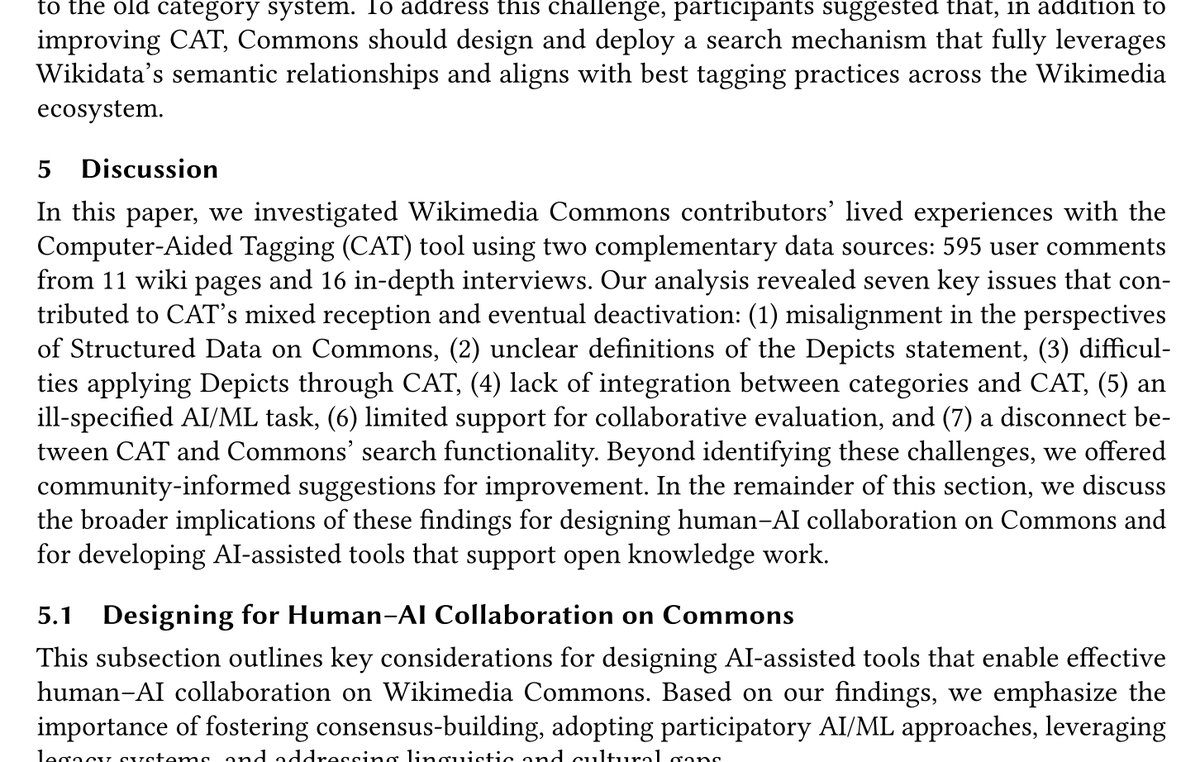
"Designing for Human–AI Collaboration in Open Knowledge Work":
Lessons from the failure of the Wikimedia Foundation's "Computer Aided Tagging" tool on Wikimedia Commons https://t.co/yfSCidpsLc
"Monitoring the gender gap in the coverage of biology professors on Wikipedia" https://t.co/bqjo1WaiVS
Women "were significantly less likely [to be on WP] until 2018. However,the trend reversed in 2022,and women were 25% more likely than men to have a Wikipedia biography in 2024"
In the latest issue of our newsletter:
* "Wikilambda the ultimate: the Wikimedia foundation’s search for the perfect language" (with Wikifunctions/Abstract Wikipedia)
And other recent research publications involving Wikidata and Wikipedia
https://t.co/qPKXQR4hgo
@Wikipedia@JemielniakD "@Wikipedia at 25: The Encyclopedia That Might Not Last" @JemielniakD follows up on how the extraction of its value by artificial intelligence and other factors might break Wikipedia.
https://t.co/Lhm6twrW9p
"@Wikipedia at 25: The Encyclopedia That Shouldn't Exist" @JemielniakD on how its governance structure, quality control mechanisms, and integration into educational practice make Wikipedia work.
https://t.co/REbUUZYnuI
See also the review of an earlier version of this paper (and other research comparing Grokipedia and Wikipedia) in the December issue of our newsletter: https://t.co/3pv5ltvMSs
Paper out in @PNASNews.
We compared ~18k matched articles Wikipedia vs Grokipedia (@grok-made)
Many Grokip pages closely mirror Wikip, but a substantial subset diverges strongly in structure, sourcing & political orientation, particularly in religion and history @WikiResearch
Paper out in @PNASNews.
We compared ~18k matched articles Wikipedia vs Grokipedia (@grok-made)
Many Grokip pages closely mirror Wikip, but a substantial subset diverges strongly in structure, sourcing & political orientation, particularly in religion and history @WikiResearch








![WikiResearch's tweet photo. "Labeling the Spectrum of AI Involvement: New Tag Proposals for Wikipedia and Commons" https://t.co/DpVADdmcL4 (suggests extending the [[Special:Tags]] edit labeling system) https://t.co/tFGkjn5jGd](https://pbs.twimg.com/media/HLB_GrSbQAAVrZC.jpg)
![WikiResearch's tweet photo. "Multilingual and Cross-Lingual Citation Needed Detection on Wikipedia for Lower-Resource Languages" https://t.co/z0p1oyT6AU (Data and code: https://t.co/jjSgdde5LP )
"SLMs [small language models] outperform LLMs on monolingual CND" https://t.co/TncDx3l8p4](https://pbs.twimg.com/media/HKbofRlaMAAWMp7.png)
![WikiResearch's tweet photo. "Institutionalization and automation of [newcomer adaption] processes in Wikimedia projects" https://t.co/alVEkW9Gcm
"A clear correlation was observed between the number of users registering and the number of people actively editing on Wikipedia." https://t.co/oQCJg1lJue](https://pbs.twimg.com/media/HKZPAjgbkAAJ8wN.png)

![WikiResearch's tweet photo. "Monitoring the gender gap in the coverage of biology professors on Wikipedia" https://t.co/bqjo1WaiVS
Women "were significantly less likely [to be on WP] until 2018. However,the trend reversed in 2022,and women were 25% more likely than men to have a Wikipedia biography in 2024" https://t.co/Ciao3KoUJt](https://pbs.twimg.com/media/HJ3rO73a4AAIWDI.jpg)